

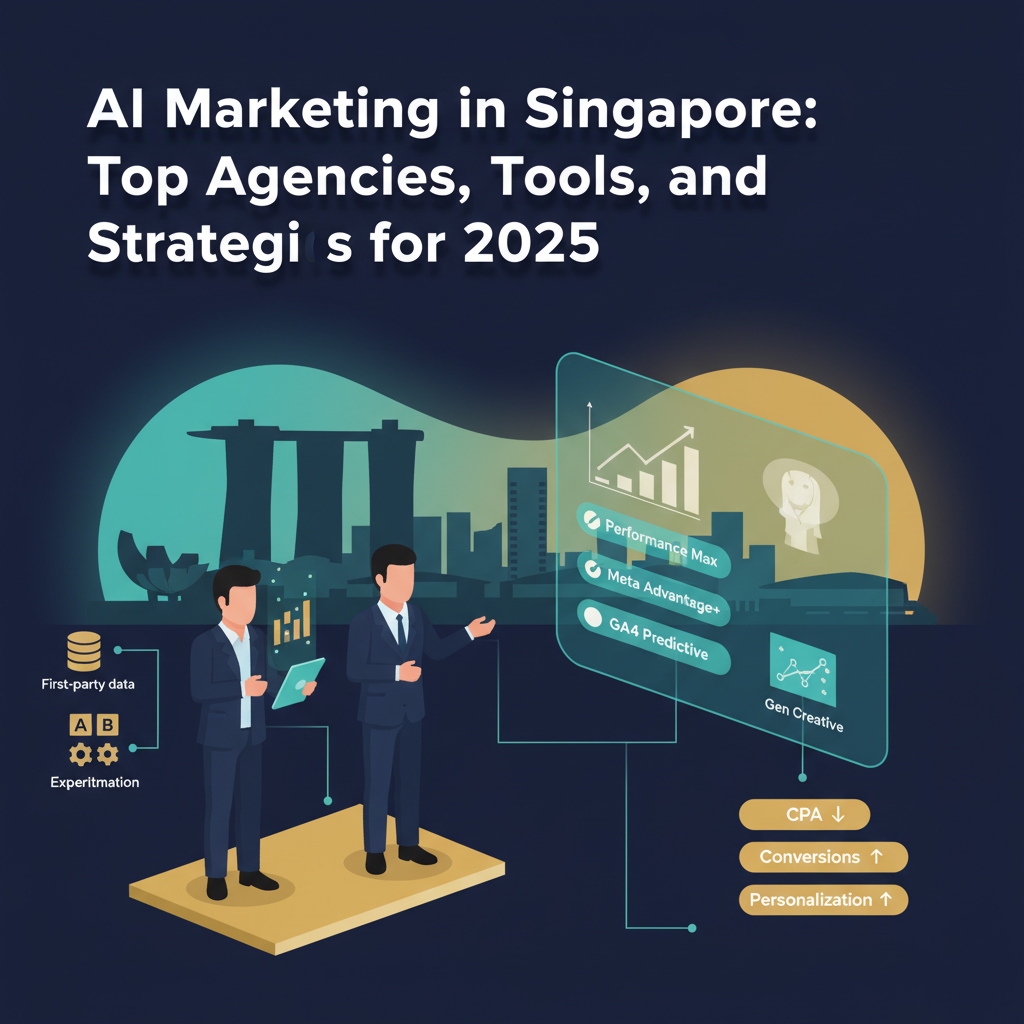
The Complete Guide to AI Marketing Singapore: Strategies, Tools & Best Practices for 2025
The Rise of AI Marketing Singapore
Artificial intelligence is reshaping how businesses market to customers—and Singapore is at the forefront of this transformation. The city-state’s digital economy reached S$128.1 billion in 2024, contributing 18.6% of GDP and growing at a 12% compound annual growth rate since 2019, according to IMDA. Within this thriving ecosystem, AI adoption among firms has accelerated sharply: SME AI adoption rose from approximately 4% to 14.5% in 2024, while non-SMEs jumped from 44% to 62.5%, per IMDA data.
For marketing teams, this shift is profound. AI is no longer a future capability—it’s operational today. From predictive audience targeting to generative content creation, from real-time personalization to automated campaign optimization, AI marketing tools are enabling Singapore businesses to compete at scale and deliver experiences that resonate with increasingly sophisticated consumers.
This guide explores what AI marketing Singapore means in practice, why the market is unique, which tools and strategies deliver measurable results, and how to build an AI-powered marketing function that drives growth while maintaining customer trust and regulatory compliance.
What you’ll learn in this guide
- The fundamentals of AI in marketing and Singapore-specific advantages
- Essential tools and platforms reshaping the industry
- Trends to watch in 2025 and a practical roadmap for integration
Understanding AI Marketing Singapore: What Sets It Apart
Definition and scope of AI in marketing
- Predictive analytics: lead scoring, churn forecasting, LTV prediction
- Personalization engines: recommendations, dynamic web/email content
- Generative AI: copy, images, video and localization
- Automated campaign management: bidding, budget allocation, creative testing
- Customer service automation: chatbots and agent augmentation
- Measurement and attribution: incrementality tests and ROI modeling
Unique factors in the Singaporean market
Government support & programmes (e.g., IMDA SPARK) foster vendor access and confidence. Consumers are digitally mature yet privacy-conscious; only 40% trust organizations to use AI responsibly, per Qualtrics data. Singapore’s regional hub status enables pilots that scale across ASEAN.
Key industries adopting AI locally
- E-commerce & retail
- Financial services
- Telecommunications
- Healthcare & wellness
- Hospitality & travel
- FMCG
Key Benefits of AI Marketing for Singapore Businesses
Enhanced customer targeting and personalization
Hyper-personalization drives meaningful sales lifts; one telecom brand reported ~11% sales lift from AI-driven personalization, per Adobe Digital Trends. Success depends on unified data, explicit consent and transparent communication.
Local example: M1 with BeLive livestream commerce: 95% completion rates and high in-stream engagement (source: IMDA case highlights).
Improved campaign efficiency and ROI
Automated bidding (e.g., Google Ads Performance Max; Meta Advantage+) and genAI content workflows compress production time and reduce CPA when fueled by quality first-party signals.
Additional examples
- In-store analytics (Whale) synchronizing physical-digital tactics
- Marketplace personalization (Shopee/Lazada) via recommendation systems
- Fintech lifecycle marketing leveraging predictive audiences
Selecting an AI Marketing Agency Singapore (Criteria & Questions)
Evaluation criteria
- Strategy & roadmap clarity
- Domain experience & case studies
- Data & integration capability
- Model & tooling transparency
- Measurement rigor (holdouts, significance)
- Security & compliance credentials
- Governance & explainability
- Implementation speed & team
Questions to ask vendors
- What KPI will be impacted and how will lift be measured?
- What data is required and where is it stored?
- What models are used and how is drift handled?
- How will experiments be run and reported?
- What certifications and DPAs are in place?
- Who owns IP and what are SLAs?
Engagement models & typical pilot outcomes
Pilot→Scale, Retainer+Deliverables, Fixed-scope, Outcome-based, and Managed Service, with 8–12 week pilots leading to dashboards, statistical analysis and scale plans.
Essential AI Marketing Tools and Platforms in Singapore
Popular tools
- Google Ads Performance Max
- Meta Advantage+
- HubSpot AI
- Adobe Firefly / Adobe GenStudio
- GA4 predictive metrics and Amplitude
Features to prioritize
- First-party data integration & consent handling
- Explainability & human-in-the-loop
- Real-time performance & experimentation
- Ease of integration, support & pricing transparency
Integration pattern
- CRM/CDP as source of truth
- Analytics capture behavioral signals
- Feed predictive audiences into ad platforms
- Use genAI for content variants
- Measure incrementality and feed results back
Emerging AI Marketing Trends Singapore to Watch in 2025
Automation & predictive analytics
- Predictive lead scoring, churn prediction, demand forecasting
- Next-best-action systems operationalized in journeys
AI-powered content and chatbots
- Production-scale genAI content and localization
- Agentic chatbots augmenting human agents
- Singapore consumers still prefer human support channels, per Qualtrics (source)
Data ethics-by-design
- Transparency, user controls, privacy-by-design
- Bias audits, model risk registers, vendor security reviews
How to Build an Effective AI Marketing Strategy in Singapore
6-step integration plan
- Define the business problem and KPIs
- Audit data and infrastructure
- Prioritize high-impact use cases
- Run a 4–8 week pilot with holdouts
- Measure incrementality (not correlation)
- Scale winners with governance
Common challenges & fixes
- Data quality: invest in CDP/unified data layers
- ROI measurement: randomized holdouts
- Trust: transparency, user controls, augmentation-first
- Change management: training, celebrate wins, stakeholder involvement
- Model drift: continuous monitoring and retraining
Measurement framework
- Primary KPIs: incremental revenue, conversion lift, CPA reduction, LTV, retention
- Secondary KPIs: time saved, chatbot containment, latency, per-prediction costs
- Governance KPIs: deletion SLAs, bias audits, drift stability
Conclusion: The Future of AI-Powered Marketing in Singapore
- Singapore is uniquely positioned for AI marketing leadership
- Focus on execution: start small, measure rigorously, scale responsibly
- Hybrid human+AI workflows will dominate; explainability and governance matter
Ready to transform your marketing with AI?
At Hamilton & Sherwind, we help Singapore businesses build effective AI marketing strategies, select the right vendors and measure true ROI. From data strategy and vendor evaluation to pilot design and performance optimization, we turn AI potential into business results. Contact us today.
Recommended internal reading
- AI-driven marketing in Singapore: automation, personalization, and ROI
- AI marketing services in Singapore: the complete guide for businesses
- How AI-powered social media content production is transforming brands in Singapore
- Brand storytelling in Singapore: A practical guide
- Brand storytelling: A practical framework for authentic narratives
- Singapore Marketing Playbook 2025: A practical guide for Singapore SMEs
- AI-driven content operations for SEO (Singapore)
- How Singapore brands can build an AI-driven MarTech stack in 2025
- AI marketing in Singapore: a practical SME guide
- Contact Hamilton & Sherwind
Sources
- IMDA: Press releases, factsheets and speeches
- IMDA SPARK Programme
- AI Verify (IMDA)
- Google Ads Performance Max
- Meta Advantage+
- Google Analytics 4: Predictive metrics
- Adobe Firefly
- HubSpot AI
- McKinsey: Economic potential of generative AI
- Salesforce: State of Marketing
- Marketing-Interactive: Singapore leads in AI adoption