

AI-driven Marketing in Singapore: Automation, Personalization, and ROI for SMEs and Enterprises
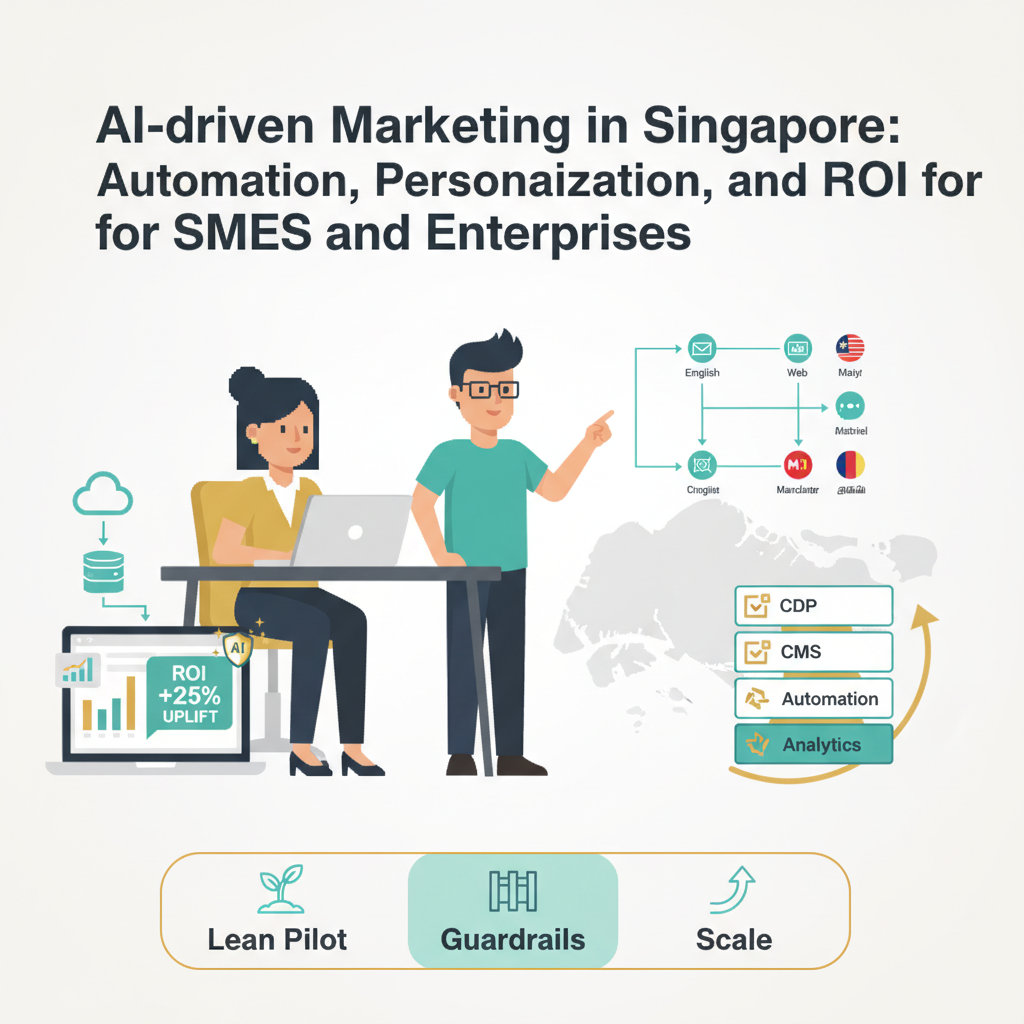
Why AI Marketing Now? The Singapore Context
Market signals and business pressure in Singapore/SEA
Singapore sits at the center of a rapidly maturing SEA marketing technology landscape. Marketers in Singapore are seeing a steady shift from traditional, rules-based automation to AI-first approaches that can learn from data, adapt in real time, and scale across Southeast Asia’s diverse markets. The region’s growing digital economy, especially in eCommerce, fintech, hospitality, and education, creates both the incentive and the pressure to move faster: faster content creation, more precise targeting, and tighter optimization loops that translate into measurable revenue gains.
Across SEA, several market signals point to a strong ROI case for AI-powered marketing. Businesses report that AI can shorten the cycle from idea to deployment, enable more agile experimentation, and unlock incremental revenue when combined with a solid data foundation. In Singapore, firms increasingly view AI as a competitive differentiator—an efficiency lever for marketing operations and a driver of personalized experiences for customers who expect relevance and speed across channels. The broader SEA picture is even more compelling: multilingual content generation, local language localization, and near real-time decisioning are become practical capabilities rather than experimental luxuries.
- Example: A Singapore-based fashion retailer accelerates holiday campaigns by generating localized, language-specific email and social content in hours rather than days. The retailer trims production timelines, improves regional relevance, and realizes a measurable lift in local conversion during festive promotions.
- Example: A SEA hospitality group uses AI to tailor offers by language and country, delivering dynamic hotel packages via email, push, and retargeted ads. With a unified data layer, they coordinate messaging across channels and see faster time-to-publish and higher cross-border bookings.
What’s changed in the MarTech stack (from rules-based to AI-first)
The MarTech landscape across Singapore and SEA is shifting from discrete rules-based automations to an integrated AI-first operating model. The core change is not just adding AI capabilities; it’s reimagining how data, decisioning, content, and activation work together. AI-first stacks embed predictive insights and autonomous decisioning into the heart of marketing workflows—across CDP, MAP, CRM, analytics, content, and experiences—reducing handoffs, improving speed, and enabling more precise personalization at scale.
- Unified, real-time data fabrics replace data silos and ad-hoc integrations. The data layer becomes the backbone that feeds AI-driven audiences, NBA (next-best-action) decisions, and contextual content across channels.
- AI-driven decisioning accelerates content creation and activation. Marketers can run real-time experiments, adapt messages on the fly, and coordinate across email, push, and ads without waiting for manual handoffs.
- Governance and safety become built-in disciplines. With AI everywhere, brand voice, factual accuracy, and compliance require explicit guardrails, visible audit trails, and clear human oversight points.
- ROI measurement becomes end-to-end and ongoing. Rather than isolated campaign metrics, teams track how AI-enabled processes lift efficiency, effectiveness, and the customer experience across the funnel.
Singapore-specific implications include a focus on data governance suited for a dense, privacy-conscious market, localization at scale, and cross-border readiness for SEA campaigns. Enterprises increasingly demand integrated platforms with strong localization, while SMEs look for lean, cloud-first configurations that deliver quick wins with transparent ROI.
Building the ROI Case for AI Marketing
Where value is created (efficiency, effectiveness, experience)
- Efficiency: AI accelerates content creation, campaign setup, and optimization cycles. Expect faster go-to-market times, fewer manual steps, and a reduction in repetitive tasks for marketing teams.
- Effectiveness: AI-driven segmentation, predictive audiences, and next-best-action decisions improve relevance and conversion propensity. Personalization across emails, pushes, and ads becomes more accurate, leading to higher engagement and higher incremental conversion.
- Experience: Customers experience more coherent journeys across channels, languages, and markets. Language-aware content and timely interactions create a smoother, more satisfying brand experience that supports loyalty and retention.
- Concrete Singapore-relevant example: A Singapore-based FMCG brand uses predictive audiences to tailor launch messages by language and channel. The result is faster content cycles, higher engagement, and more efficient allocation of paid media spend.
ROI model for SMEs vs enterprises (costs, returns, payback)
- SMEs
- Costs: initial onboarding and integration (roughly a mid four-figure SGD range) plus ongoing licenses and data/infrastructure costs (tens of thousands per year, depending on scope).
- Returns: incremental revenue uplift from smarter targeting and faster content cycles; labor savings from automation.
- Payback: often within 6–18 months, with upside as data quality improves and localization scales.
- Enterprises
- Costs: higher upfront investments in data fabrics, identity resolution, governance tooling, and cross-market activation capabilities; annual costs scale with data volume and regional expansion.
- Returns: larger absolute uplift potential via cross-border campaigns, multi-market personalization, and more sophisticated lifecycle optimization.
- Payback: typically 1–3 years, with long-run ROI supported by governance maturity, data quality, and cross-market efficiency.
- Quick math (illustrative, SGD)
- SME scenario: One-time setup SGD 20k; annual costs SGD 25k; annual incremental revenue SGD 100k; payback within Year 1 with a 300%+ ROI on the first year’s incremental revenue.
- Enterprise scenario: One-time setup SGD 600k; annual costs SGD 1.2M; annual incremental revenue SGD 3–5M; payback in 12–24 months, with ROI improving over a multi-year horizon as cross-market efficiencies accumulate.
Note: these numbers illustrate patterns, not forecasts. Your ROI depends on data readiness, the scope of channels, market mix, and the degree to which AI outputs are trusted and acted upon.
Common pitfalls that erode ROI and how to avoid them
- Poor data quality and siloed data sources undermine AI effectiveness. Tackle with a disciplined data readiness plan and a lightweight governance structure.
- Over-dependence on AI outputs without human review can erode brand safety and trust. Build human-in-the-loop checks for high-impact content and disclosures.
- Underestimating localization and language needs in SEA. Invest in translation/transcreation, glossary management, and QA to avoid misinterpretation or cultural missteps.
- Underinvesting in measurement. Without a robust attribution and ROI framework, it’s hard to prove AI’s impact. Start with a simple, transparent ROI model and scale measurement as you expand.
- Vendor sprawl. Consolidate around a core, integrated stack where possible to avoid data fragmentation and fragmented governance.
Automation and Personalization at Scale
Journey orchestration and triggered campaigns
- Journey orchestration connects customer signals across channels to create cohesive, data-driven experiences. AI decisions determine who to reach, which channel to use, and what content to deliver, all in near real time.
- Triggered campaigns rely on events (site visits, purchases, app activity, loyalty status) and AI scores to trigger the right action at the right moment. The SEA context—with multilingual audiences and mobile-first behavior—benefits from near real-time triggers and language-aware content.
- Example: A Singapore-based retailer triggers a welcome journey in a customer’s preferred language, followed by time-of-day optimized emails and push messages post-signup. If a user browses a product but does not purchase, NBA selects an optimal channel and content variant (email with a localized offer, push reminder, or a retargeting ad) based on propensity to convert.
Predictive audiences, next-best-action, and content automation
- Predictive audiences use historical data to score propensity to convert, churn risk, or loyalty potential. These scores guide segmentation and NBA decisions, enabling more precise targeting across SEA markets and languages.
- Next-best-action (NBA) decisioning determines the optimal channel, message, and offer for each user at the moment of interaction, coordinating across email, push, and ads to create a seamless experience.
- Content automation scales personalized creative: dynamic emails, localized subject lines, multi-language landing pages, and localized ad copy based on segmentation and NBA decisions. Guardrails ensure brand consistency and safety, with automated QA and human review for high-risk assets.
- SEA example: A travel platform uses predictive audiences to tailor itineraries by language and region, deploys NBA-driven email and push campaigns for timely promotions, and generates localized ad creative that aligns with the user’s language and travel interests.
- Guardrails in practice: every AI-generated asset passes through brand voice checks, factual accuracy checks for product and pricing details, localization QA, and compliance checks before publishing.
Creative production with AI: guardrails for brand and safety
- Guardrails are essential as AI-generated content scales. They include brand voice constraints, factual accuracy checks, localization QA, regulatory disclosures for the Singapore/SEA context, and clear disclosure when content is AI-generated.
- A practical approach combines prompts with guardrails, automated checks, and human review gates. This minimizes risk while preserving speed and scalability.
- Localization nuance matters in SEA: avoid literal translations that miss cultural context; instead, apply transcreation where appropriate and validate with bilingual reviewers.
- Channel-specific guardrails ensure the right balance of speed and compliance across email, push, and ads, and maintain a consistent brand experience across all SEA markets.
Choosing the Right MarTech: A Singapore-Ready Stack
Core components: CDP, MAP, CRM, analytics, experimentation
- CDP (customer data platform) for identity unification, a centralized data model, and first-party data governance.
- MAP (marketing automation/activation platform) for journey orchestration, triggered campaigns, and cross-channel activation.
- CRM and analytics for sales/marketing alignment, performance measurement, and decision support.
- Analytics and experimentation components to test hypotheses, measure uplift, and optimize campaigns.
Experimentation and measurement framework
- A/B testing and multivariate testing capabilities across channels; figure out the contribution of AI-driven content versus baseline content.
- Experimentation should be embedded in weekly or monthly cycles with clear success criteria and governance.
When to add genAI, LLMs, and copilots to the stack
- Early use: AI-generated content for localization and rapid iteration; AI-assisted personalization that informs segmentation and message tailoring; model-assisted decisioning for next-best-action in real time.
- Mid-stage: Integrating larger language models (LLMs) or copilots into content production, idea generation, and campaign planning; expanding cross-market capabilities with localization and policy guardrails.
- Advanced: Full AI copilots that assist with creative development, content QA, and governance, while maintaining human oversight on high-risk or regulated communications.
- Singapore/SEA considerations: prioritize languages, localization quality, regulatory compliance, and data residency when adding GenAI capabilities. Look for vendors with robust localization support and auditability for multi-market campaigns.
Integration and data readiness: practical steps and quick wins
Practical steps
- Establish a unified identity layer (or CDP-first approach) to enable consistent segmentation across channels.
- Create standard data pipelines with real-time event streams and robust data governance.
- Start with a lean measurement framework and progressively enrich with more advanced attribution as data quality improves.
- Implement modular templates and localization QA to support SEA markets without sacrificing speed.
Quick wins
- Start with 1–2 core AI-enabled journeys (welcome onboarding and cart recovery) in Singapore, then expand to additional markets.
- Build language-aware templates and an initial glossary to accelerate localization.
- Use a lightweight governance framework to manage AI content, with a small cross-functional council to guide policy and guardrails.
Governance and Risk: Practical Guardrails (avoid legal deep-dives)
Data quality, model oversight, and brand governance
- Data quality: define data quality rules for key marketing fields (completeness, accuracy, timeliness, consistency) and monitor them in dashboards. Poor data quality undermines AI outputs and ROI.
- Model oversight: implement drift detection, periodic model retraining, version control for prompts, and an AI governance log to track which prompts and models produced which outputs.
- Brand governance: embed brand voice and policy checks into prompts; maintain a brand glossary; enforce tone consistency across languages and markets.
- Auditability: keep traceable logs of AI-generated content, decisions, and changes to prompts or templates to satisfy governance requirements.
Human-in-the-loop and prompt standards
- Human-in-the-loop (HITL) for high-risk outputs: finance, health, and regulatory messages require human verification before publishing.
- Prompt standards: create a centralized prompt library with versioning, guardrails, and usage guidelines. Include language variants and localization considerations.
- Training and enablement: provide ongoing training for teams on prompt design, content QA, and governance policies.
Change management for marketing teams
- Change management is essential for AI adoption. Align leadership, marketing ops, and creative teams around new workflows, governance practices, and measurement plans.
- Role clarity: define AI-focused roles (AI orchestrator, content QA, data steward) and ensure clear escalation paths for issues.
- Communication and skills: prepare teams for new collaboration patterns with AI tools. Provide quick-start training and ongoing enablement to accelerate adoption.
Playbooks and Use-Cases for Singapore Businesses
SME playbook (90-day roadmap)
- Focus: 2–3 high-impact AI-enabled journeys; quick wins with localization; lean data readiness.
- 90-day plan in brief
- Weeks 1–4: assess data readiness, define 2–3 use cases, set governance, and align with business goals.
- Weeks 5–9: implement core data fabric, identity resolution, and NBA rules; create localization-ready content templates; run a pilot in Singapore.
- Weeks 10–12: measure pilot outcomes, refine governance, and prepare for scale; document a repeatable playbook.
- Outcome expectations: faster content production, improved engagement, and validated ROI signals to justify expansion.
Enterprise playbook (180-day roadmap)
- Focus: robust data governance, cross-market orchestration, scalable content automation, and enterprise-grade compliance.
- 180-day plan in brief
- Phase 1 (weeks 1–6): architecture design for cross-market activation; governance charter; data contracts with vendors; foundation for identity resolution.
- Phase 2 (weeks 7–12): pilot across multiple SEA markets with localization; expand NBA rules and content automation; begin cross-market attribution refinement.
- Phase 3 (weeks 13–26): scale to additional markets; implement advanced model monitoring; formalize change management and capability-building programs; measure ROI across markets.
- Outcome expectations: mature data governance, scalable cross-market activation, higher ROI, and a repeatable operating model.
Sector snapshots: eCommerce, F&B, education, financial services
- eCommerce: AI-powered personalization and cross-border localization across SEA; ROI tied to incremental revenue and improved time-to-market for campaigns.
- F&B: loyalty-driven growth, time-limited promotions, and localized menus; content automation accelerates seasonal campaigns and reduces regional effort.
- Education: lead-to-enrollment optimization, localized program messaging, and onboarding journeys; ROI tied to enrollments and student engagement.
- Financial services: onboarding efficiencies, risk-aware marketing messages, and cross-border digital experiences; governance and compliance are central to ROI.
Measurement That Matters
North-star and leading indicators (CAC, LTV, conversion lift, AOV, time-to-publish)
- North-star metric: Net incremental revenue attributable to AI marketing (NIR_AI) per period, tied to ROI across SEA markets. This focuses teams on revenue impact and avoids vanity metrics.
- Leading indicators:
- CAC: AI-driven campaigns’ cost per acquired customer; monitor by market/language.
- LTV: incremental lifetime value uplift for customers engaged via AI-powered journeys.
- Conversion lift: uplift in conversions attributable to AI-enabled content and NBA decisions.
- AOV: average order value uplift from personalized offers and localized promotions.
- Time-to-publish: speed at which assets are produced and published across channels.
- Observability: track these indicators by market/language, channel, and campaign type; ensure currency normalization where needed for cross-market comparisons.
Experimentation cadence and AI model performance tracking
- Cadence
- Daily: pipeline health and data latency; critical alerts for data or content issues.
- Weekly: top-line indicators per market; asset performance; QA pass rates; basic drift checks.
- Monthly: ROI trending, uplift attribution, and model performance reviews; adjust prompts and templates as needed.
- Quarterly: cross-market benchmarking; governance reviews; ROI validation for scale-up.
- AI model performance tracking
- Propensity models: track AUC/PR AUC, calibration, and lift among top deciles; retrain when drift is detected.
- Content generation: monitor engagement metrics (open rate, CTR, time spent); QA pass rate and human review outcomes.
- Personalization quality: measure consistency of experiences across channels and markets; track any drift in segmentation or recommendations.
- Drift and safety: monitor for distribution drift, bias signals, or safety incidents; update guardrails and prompts as needed.
Getting Started with Hamilton & Sherwind
What engagement looks like (assessment, pilot, scale-up)
- Assessment: A fast, fact-based review of current MarTech stack, data readiness, governance posture, and business goals. The aim is to identify 2–3 high-impact AI use cases aligned to Singapore/SEA realities and a realistic ROI plan.
- Pilot: A structured, time-bound pilot implementing a minimal AI-enabled journey or two (e.g., welcome onboarding and cart recovery) in Singapore and one SEA market. Establish a lean data foundation, guardrails, and measurement dashboards; demonstrate measurable uplift and improved time-to-publish.
- Scale-up: A staged expansion across SEA markets and channels with governance, templates, and playbooks. Build capability through training and governance, and establish a formal ROI-driven plan to sustain and extend the AI marketing operating model.
Expected outcomes and timelines
- Short-term (0–3 months): data readiness baseline; governance structure; 1–2 AI-enabled journeys; initial uplift in engagement metrics and faster content production.
- Medium-term (3–9 months): expanded journeys and markets; improved ROI signals; stronger cross-channel coordination; more robust data quality and governance.
- Long-term (9–24 months): enterprise-grade AI marketing operating model; scalable cross-market activation; measurable ROI uplift across SEA markets; a sustainable, governance-driven approach to AI marketing.
Call-to-action
Ready to start your AI-powered marketing transformation in Singapore and across SEA? Hamilton & Sherwind can help you define the ROI-focused plan, architect a Singapore-ready stack, and guide you from assessment through scale-up. Take the first step toward automation, personalization, and measurable ROI today.
References
- Blueprint for AI-powered marketing (BCG) — supports ROI uplift and business case for integrating AI into marketing workflows.
- How generative AI can boost consumer marketing (McKinsey) — supports global ROI potential and productivity gains from generative AI in marketing.
- Gen AI’s ROI (McKinsey Week in Charts) — supports aggregated ROI signals and timelines for AI-driven marketing initiatives.
- Think with Google: Expertise AI marketing — supports APAC/SEA ROI improvements and best practices from AI-enabled marketing efforts.
- Marketers double AI usage in 2024 (HubSpot) — supports growing adoption of AI in marketing.
- SG ramps up AI push to turn digital ambition into real-world impact (IMDA) — supports Singapore’s emphasis on AI adoption relevant to SEA.