

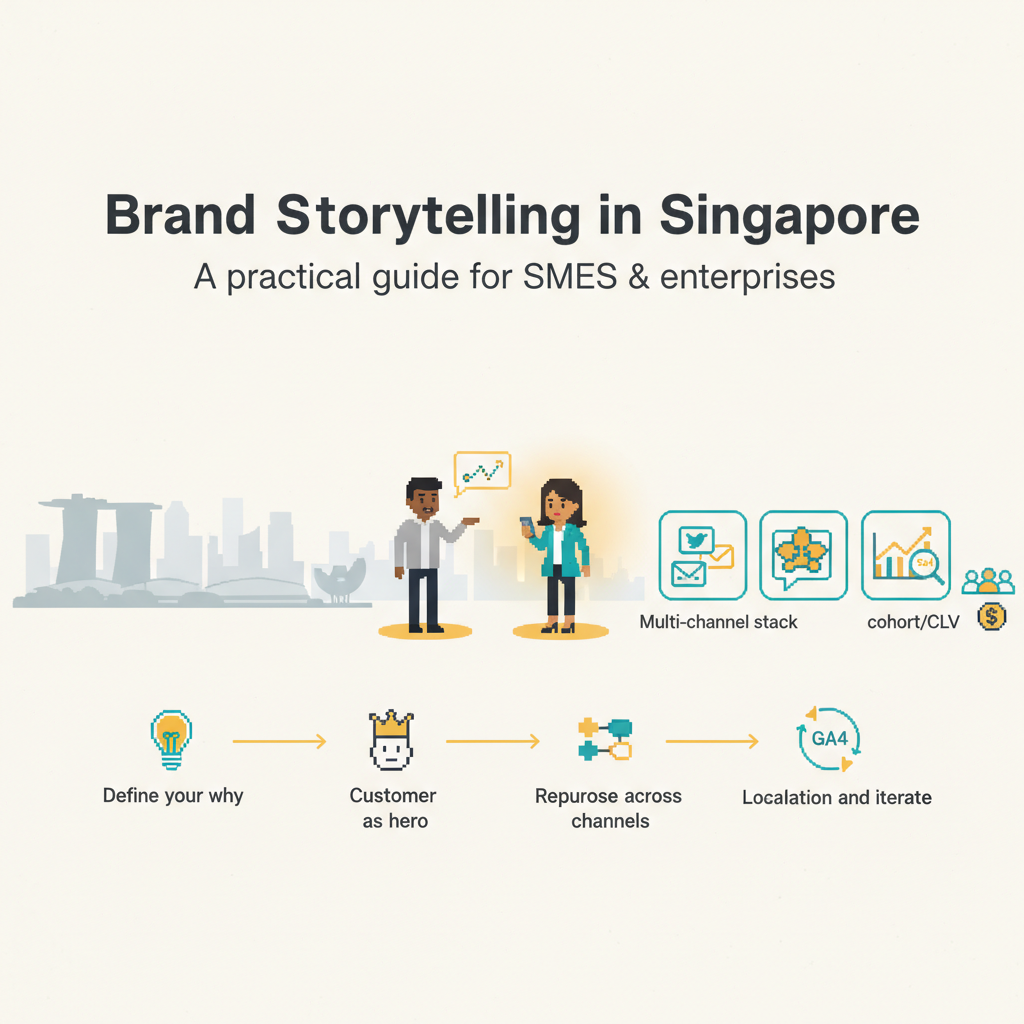
Brand Storytelling in Singapore: A Practical Guide for SMEs and Enterprises
In a market saturated with thousands of marketing messages daily—consumers are exposed to between 4,000 and 10,000 advertising impressions each day—the brands that cut through the noise are those that tell compelling stories. For Singapore’s SMEs and enterprises, brand storytelling has become less of a nice-to-have and more of a competitive necessity.
Singapore’s business landscape is uniquely positioned for storytelling success. The city-state’s multicultural fabric, fast-paced digital adoption, and highly engaged social media audience create fertile ground for narratives that resonate emotionally. Yet many businesses still rely on traditional product-focused marketing, missing the opportunity to build deeper connections with their customers.
The stakes are clear: according to research from Headstream cited by Outbrain, 55% of consumers are more likely to buy from a brand they love if they relate to its story, and 44% would share that story with others. For SMEs operating with constrained marketing budgets, this means storytelling offers a high-leverage way to compete against larger rivals. For enterprises, it’s a way to strengthen brand equity and reduce vulnerability to price competition.
Understanding brand storytelling: Concepts and core elements
What is brand storytelling?
Brand storytelling is a strategic marketing approach that uses narrative techniques to communicate a brand’s values, mission, personality and purpose—rather than simply listing product features. Unlike a one-off advertisement, a brand story is an intentionally constructed narrative delivered through videos, blog posts, social media, packaging, and customer experiences. It situates your brand in a human context and encourages an emotional connection with your target audience.
At its core, brand storytelling answers the question: “Why does your brand exist, and why should customers care?” It’s the difference between saying “We sell coffee” and saying “We source ethically from small farmers and roast small batches to preserve the unique character of each origin—because we believe great coffee should tell a story.”
Key components of a compelling brand narrative
- Authenticity: The story must be true to your brand’s history, values and behavior.
- Customer-centricity: Make your audience the protagonist or show how your brand solves real human problems.
- Emotional resonance: Stories deliberately evoke feelings—joy, empathy, inspiration, even frustration.
- Specificity and memorable details: Concrete details and specific characters create vividness and increase memorability.
- A clear protagonist: Either the brand (founder story) or—more commonly—the customer is framed as the hero.
- Simplicity and consistency: A tight, simple narrative consistent across channels is more likely to be remembered.
- Format and distribution fit: Pick formats and channels that match your audience and buyer stage.
How brand storytelling differs from traditional marketing
Traditional marketing is product- or offer-centric and direct. Storytelling is narrative- and human-centric, using characters, conflict and resolution to make the brand meaningful. A traditional ad might say “Buy now, 30% off.” A brand story might show a customer’s morning ritual transformed by your product, leaving the audience to conclude that your brand is part of their better life.
The business case: Benefits of brand storytelling for SMEs and enterprises
Building emotional connections with customers
Research aggregated by Outbrain suggests emotionally engaged consumers are 2.4x more likely to remain customers and make repeat purchases. Emotional connection also drives word-of-mouth—Forbes reports customers tell an average of nine people about a positive experience.
Enhancing brand recall and loyalty
Digital Marketing Institute notes storytelling improves memorability versus dry facts. Loyalty follows: per Emarsys, existing customers spend ~67% more on average than new customers, and Bain & Company’s analysis (via Emarsys) indicates a 5% retention lift can increase profits by 25–95%.
Driving engagement in the Singapore market
Singapore’s high social penetration favors story-driven creative. Outbrain reports brand studio formats can achieve notably higher engagement. Localized, platform-native storytelling also benefits from organic sharing.
Crafting your brand narrative: Step-by-step framework
Identifying your brand’s core values and mission
Start by defining your purpose, customer problem, values, desired feelings, and differentiators. Capture this in a one-page brand brief and ensure every story reinforces it.
Structuring your brand storytelling framework
Use proven structures (Three-act, Hero’s Journey, Pixar formula, StoryBrand, Golden Circle) depending on objective and format. For brand films and case studies, consider professional narrative-driven video production to achieve quality and consistency.
Aligning stories with your brand strategy
Map stories to your funnel: awareness (purpose films), consideration (case studies), conversion (product narratives), retention (community stories). Ensure each asset contributes to an integrated digital marketing strategy.
Proven brand storytelling techniques for Singapore brands
Story arcs and messaging approaches
Apply PAS, CAR, and Before-After-Bridge structures. Make the customer the hero while your brand plays the guide.
Visual and digital storytelling tools
Choose tools that match your skills and budget—from Canva and CapCut to Adobe and advanced analytics. Pair content with rigorous measurement via GA4 and platform analytics.
Integrating storytelling marketing into campaigns
Start with a core asset, repurpose into short-form social clips and blog/email assets, then distribute across owned and paid channels. For social-first execution, see our social media services and social media portfolio.
Local inspiration: Brand storytelling examples Singapore
Case study 1: Successful SME brand story
Founder-led coffee roaster narrative: community, craft, sustainability; repurposed into Reels, TikTok, email, and “About Us” page.
Case study 2: Enterprise-level storytelling
Hyper-local formats, culturally specific humor, and platform-native video demonstrate how enterprises can scale engagement.
Lessons learned from local brands
- Specificity wins (MRT, hawker centers, HDB moments).
- Authenticity is non-negotiable.
- Local voices matter (creators and community leaders).
- Platform fit is critical.
- Repurposing is essential.
Explore relevant project outcomes in our branding portfolio, digital marketing portfolio, and video portfolio.
Measuring success: Evaluating the impact of brand storytelling
Key metrics and KPIs
Track layered metrics across awareness, engagement, brand lift, conversion, retention, and CLV.
Tools for tracking storytelling performance
Leverage GTM, GA4, platform analytics, brand-lift studies, CRM/CDP, and BI dashboards for a complete measurement stack.
Iterating and improving your approach
Define hypotheses, run campaigns, analyze short/mid/long-term outcomes, document learnings, and iterate. For ongoing insights, visit our blog.
Overcoming challenges in brand storytelling for Singapore businesses
Common pitfalls and how to avoid them
Guard against inauthentic claims, inconsistent execution, weak localization, trend-chasing without purpose, and poor audience research.
Adapting to cultural and market nuances
Use local voices, choose right platforms, and maintain a single brand “north star” with local flexibility.
Tips for sustaining authenticity
Institutionalize storytelling governance, build a living asset library, activate employees, listen continuously, and invest in longitudinal measurement.
Conclusion: The future of brand storytelling in Singapore’s business landscape
Storytelling is essential in Singapore’s crowded market. SMEs can compete with authentic founder/customer narratives, and enterprises can fortify equity and CLV via integrated programs and rigorous measurement.
Ready to build a story-led growth engine? Learn more about Hamilton & Sherwind or contact us to design a storytelling strategy, content system, and measurement plan for your brand.