

Singapore Marketing Playbook 2025: A Practical Guide for Singapore SMEs
Intro: Why Singapore SMEs need a marketing playbook in 2025
Overview of the local marketing climate and SME needs
Singapore’s small-to-midsize businesses operate in a uniquely fast-moving, digitally driven, and cost-conscious environment in 2025. Digital adoption continues to accelerate, with government support and ecosystem enablers lowering barriers to technology, tools, and marketing experimentation (IMDA research and statistics). Yet pricing pressures, cash-flow concerns, and the need to demonstrate concrete ROI keep budgets tight. AI-assisted workflows, automation, and data-driven decision-making are no longer luxuries; they’re baseline capabilities for any SME that wants to scale efficiently.
Consumers in Singapore are increasingly “digital-first” in their information search and shopping journeys, moving across channels before purchase (Google e-Conomy SEA). They expect fast and helpful experiences, and value personalization, experiences, and sustainability. Local relevance matters: messaging that resonates with Singapore’s diverse cultures, neighborhoods, and seasonal shopping cues performs better than generic global campaigns. At the same time, omnichannel experiences—where online and offline touchpoints reinforce each other—remain essential for converting awareness into actual sales.
For SMEs, three ideas dominate 2025: get faster with smarter tools, invest in channels that prove their value, and partner carefully to extend reach without blowing budgets. Public programs and industry support help accelerate digital marketing, but they require discipline around governance, data handling, and measurement (SingStat Infocomm & Media). In short, a practical playbook is a prerequisite for turning limited resources into meaningful growth.
Section 1: Market context and SME marketing needs in Singapore
2025 trends in Singapore marketing
- Digital-first, ROI-driven marketing. SMEs are prioritizing measurable, scalable channels. Consider partnering with an experienced team for digital marketing services to accelerate time-to-value.
- AI and automation as productivity catalysts. Deploy AI where it improves speed and relevance, while maintaining human oversight for governance.
- Omnichannel remains essential. Integrate search, social, video, in-store experiences, and events; align measurement and attribution across touchpoints.
- Local relevance, sustainability, experiences. Anchor campaigns in local context; extend with branding that reflects Singapore’s diverse audiences.
- Grants as an accelerant. Subsidies can de-risk tests and speed up learning; plan campaigns to be measurement-ready and audit-friendly.
SME pain points and priorities
- Budget constraints and ROI scrutiny. Every campaign must justify spend with tangible results (Nielsen Ad Intel H1 2024).
- Talent and capacity gaps. Upskill your team and engage partners for analytics, attribution, and advertising strategy.
- Time is scarce. Use repeatable playbooks, templates, and light-weight processes to keep pace.
- Measurement challenges. Establish a simple cross-channel dashboard and pragmatic attribution that includes offline lift.
- Trust and data governance. Maintain privacy-by-design practices and secure data handling.
Section 2: Core channels and tactics for Singapore SMEs
Digital channels that deliver in 2025
- Search advertising for high-intent demand and rapid offer feedback.
- Social and video (Meta, YouTube) for reach, affinity, and retargeting. Explore social media and video production in Singapore to scale content efficiently.
- Short-form video for local storytelling and rapid iteration.
- Programmatic and retargeting to efficiently scale mid- and bottom-funnel performance.
Measurement guardrails: Set KPIs per channel (ROAS, CAC, incremental reach), maintain a unified dashboard, and add offline proxies (unique URLs, QR codes, promo codes) to capture in-store impact.
Local partnerships and community marketing
Partnerships extend trust and reach, especially when co-branded with complementary brands or community groups. Consider pop-ups, workshops, and ambassador programs, and formalize data sharing with light MOUs.
Balancing online and offline for budget efficiency
- Pair a core online plan (search + two social channels) with selective offline activations linked by tracking codes and landing pages.
- Budget 5–15% for opportunistic activations or accelerated trials.
- Plan around seasonal peaks (e.g., Chinese New Year, Hari Raya, Deepavali) and major sale periods to maximize relevance.
Alignment with the Singapore Marketing Playbook approach to channel mix
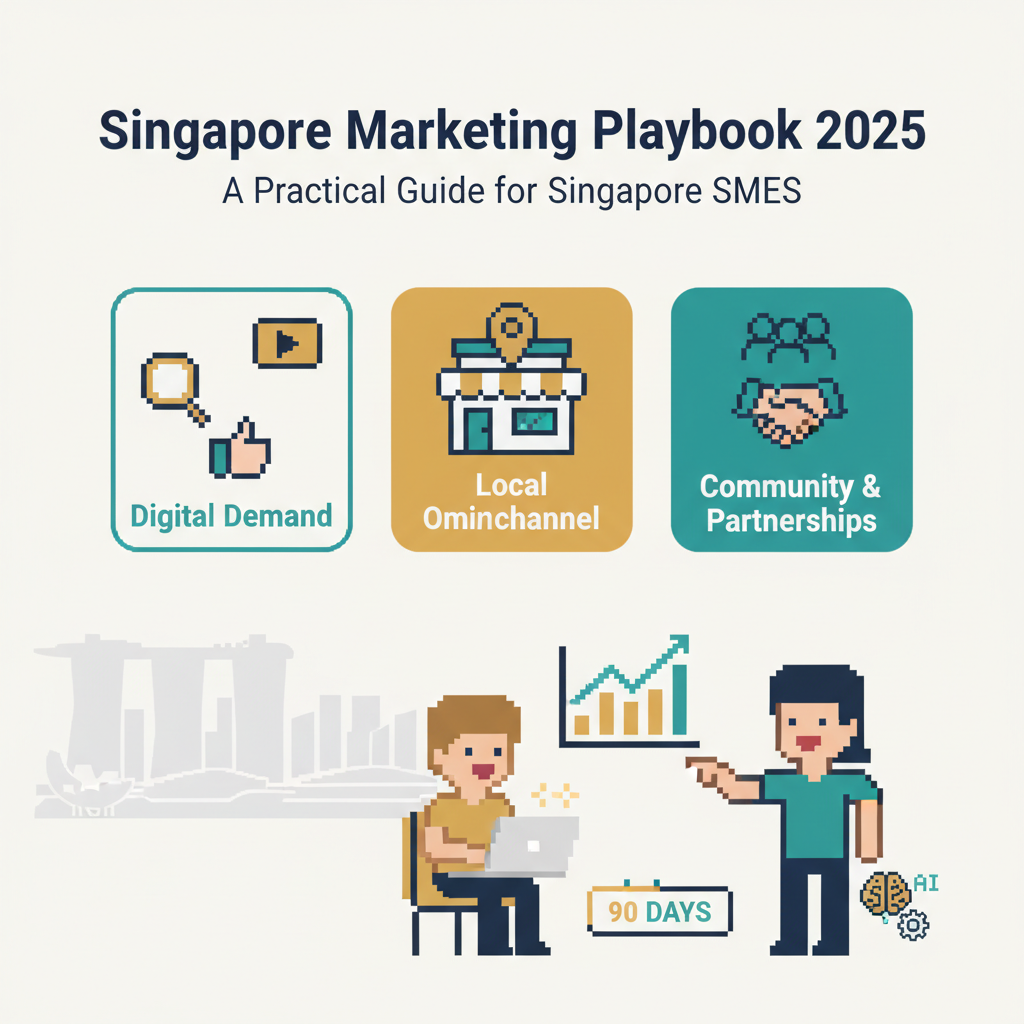
- Pillar 1: Digital Demand Engine (40–50%). Search, Meta, YouTube, TikTok, programmatic, with ROAS/CAC guardrails. See our advertising portfolio for campaign examples.
- Pillar 2: Local Omnichannel Presence (25–35%). Offline activations, in-store experiences, hyperlocal content tied to online conversion.
- Pillar 3: Community & Partnerships Ecosystem (15–25%). Co-branding, community groups, ambassadors, CSR and NGO/chamber partnerships.
Explore real work and outcomes in our portfolio and branding portfolio.
Section 3: Building the plan: goals, budgets, and timeline
Setting SMART goals for Singapore SMEs
- Define specific business outcomes (revenue, new customers, retention).
- Pick 1–3 metrics per goal (ROAS, CAC, CLV, retention).
- Ground targets in resources and market realities; leverage grants where eligible.
- Set quarterly targets and a 90-day execution cadence.
Budgeting guidelines and allocation
- Startup/Early-stage: 8–15% of annual revenue; grants can multiply net impact.
- Growth-stage: 6–12% of annual revenue; emphasize scaling proven channels and retention.
- Channel guardrails: Pillar 1 (40–50%), Pillar 2 (25–35%), Pillar 3 (15–25%).
- Contingency: 5–15% for pivots and opportunities.
90-day action plan and milestones
- Days 1–30: Baselines, tracking (GA4, UTMs, CRM), pilot plan; map to digital marketing capabilities.
- Days 31–60: Run 2–3 integrated pilots across online + one offline activation; refine audiences, creative, and landing experiences.
- Days 61–90: Scale top performers; finalize governance; plan next 90 days based on ROI.
Conclusion: The Singapore marketing playbook outlook for 2025
Adopt a three-pillar system: a Digital Demand Engine for measurable growth; a Local Omnichannel Presence to anchor trust and foot traffic; and a Community & Partnerships Ecosystem to expand reach cost-efficiently. Combine disciplined budgeting, a 90-day action plan, and pragmatic measurement linking online and offline outcomes. AI-powered workflows and local grants can accelerate adoption, while privacy-conscious data practices maintain customer trust. When you’re ready to operationalise, our team can help you implement this playbook end-to-end.
FAQ
What should be the first thing a Singapore SME does in 2025?
Establish a three-pillar plan (digital demand, local omnichannel, community partnerships), set a 90-day pilot with clear KPIs, and align with grant eligibility to maximize ROI.
How much of my budget should go to digital vs offline in 2025?
Start with 40–50% to digital, 25–35% to local omnichannel, and 15–25% to community/partnerships. Adjust based on results and seasonality.
How do I measure cross-channel impact when offline is involved?
Use tracking codes, unique landing pages/QRs, and connect to your CRM. Track ROAS, CAC, and incremental offline metrics like foot traffic and sign-ups.
What’s a good 90-day plan for a small team?
Phase 1: foundations and quick wins. Phase 2: run 2–3 integrated pilots. Phase 3: optimize and scale; plan the next 90 days.
How can I use content repurposing effectively?
Create one core asset, then break it into micro-content for social, email, and landing pages; repackage into multiple formats while preserving core value.
How should I think about grants in budgeting?
Treat grants as accelerants; plan grant-eligible tools, keep documentation audit-ready, and measure ROI rigorously.
Sources
- Google e-Conomy SEA — SEA digital economy and consumer behaviors.
- IMDA — Research & Statistics — Singapore’s digital and media landscape.
- SingStat — Infocomm & Media — Official statistics for local context.
- Nielsen Ad Intel H1 2024 — Advertising spend and media insights.
See our work: Portfolio · Branding portfolio · Advertising portfolio
Explore services: Digital Marketing · Branding · Advertising · Video Production · Social Media
Ready to build your 2025 playbook? Contact us to get a tailored plan for your SME.