

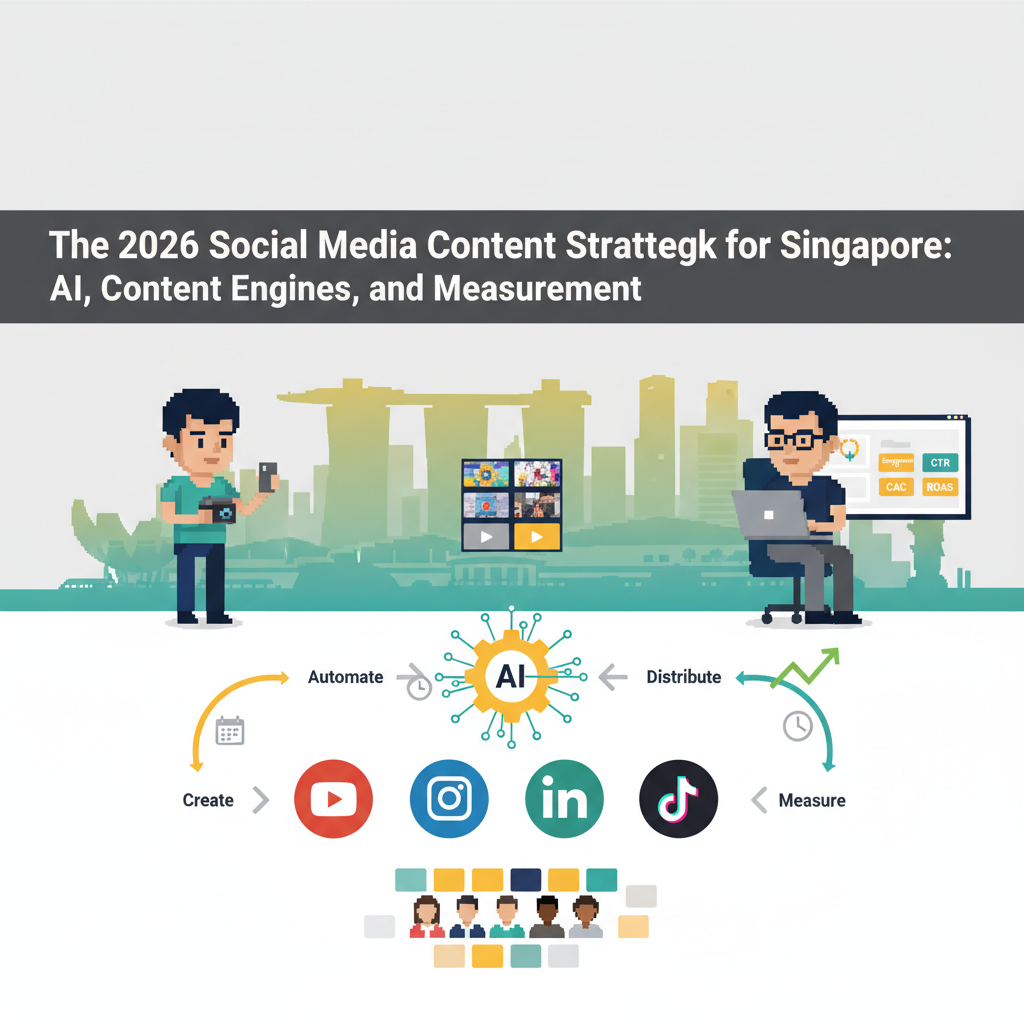
The 2026 Social Media Content Strategy Playbook for Singapore: AI, Content Engines, and Measurement
Now I’ll create the comprehensive article based on the research findings:
Introduction: Why a 2026 Social Media Content Strategy Matters in Singapore
Singapore’s digital landscape in 2026 represents one of the most sophisticated and competitive markets in Southeast Asia. With 5.16 million social media user identities representing 88.2% of the population, the city-state has achieved remarkable digital penetration that demands strategic excellence from brands seeking to capture attention and drive growth.
The platform ecosystem reflects Singapore’s unique multicultural and mobile-first characteristics. WhatsApp dominates with 80.1% monthly usage, followed by Facebook at 71.9%, Instagram at 62.6%, and TikTok at 56.6%. YouTube commands significant engagement with users spending an average of 29 hours and 45 minutes monthly on the platform. This diverse platform mix, combined with Singapore’s multilingual market spanning English, Mandarin, Malay, and Tamil, creates both opportunities and complexities for content strategists.
With 94.6% of internet users accessing the web via mobile devices and 10.5 million active cellular connections (179% of population), Singapore’s mobile-first behavior is more pronounced than most global markets. This reality shapes how content must be conceived, created, and distributed across platforms.
This playbook is designed for marketing leaders, content strategists, and digital teams at Singapore-based companies who need to build efficient content engines that deliver measurable growth while reducing customer acquisition costs. Whether you’re managing a local startup, regional headquarters, or multinational subsidiary, the frameworks and strategies outlined here will help you navigate the evolving social media landscape with confidence and precision.
The outcomes this playbook delivers include: a systematic approach to content creation that scales with your business, measurable improvements in engagement and conversion rates, reduced content production costs through AI integration, and a competitive advantage in Singapore’s crowded digital marketplace.
Understanding the 2026 Landscape: Trends Shaping Social Media Content Strategy in Singapore
Key Shifts in Audience Behavior and Platform Usage
The dominance of short-form video content has fundamentally altered how Singaporeans consume and interact with social media. TikTok users now spend an average of 34 hours and 29 minutes monthly on the platform, making it the most time-consuming social platform despite not having the highest user penetration. This shift reflects a global trend where attention spans are shortening, but engagement depth is increasing for content that successfully captures initial interest.
Search behavior on social platforms has emerged as a critical trend, with users increasingly turning to Instagram and TikTok not just for entertainment but for product discovery and information gathering. This transformation positions social platforms as search engines in their own right, requiring brands to optimize content for discoverability within platform ecosystems rather than relying solely on traditional SEO approaches.
The creator economy has matured significantly, with micro-influencers (1,000-100,000 followers) becoming particularly valuable for Singapore brands seeking targeted reach within specific communities. According to recent industry analysis, the creator economy could approach $480 billion globally by 2027, with Southeast Asia representing one of the fastest-growing segments.
The Rise of AI-Powered Social Media Content and Automation
Artificial intelligence has moved from experimental to essential in social media content creation. Platforms are integrating AI capabilities directly into their creator tools, with Meta’s Advantage+ campaigns showing 20-30% improvement in performance metrics compared to traditional campaign structures.
Content generation tools have evolved beyond simple text creation to encompass sophisticated video editing, image generation, and even voice synthesis. Adobe Firefly and Canva’s Magic Studio represent the mainstream adoption of generative AI, making professional-quality content creation accessible to teams without extensive design resources.
Personalization at scale has become achievable through AI-driven content optimization. Platforms can now analyze user behavior patterns and automatically adjust content delivery timing, format, and messaging to maximize engagement rates. This capability is particularly valuable in Singapore’s diverse market, where content must resonate across different cultural and linguistic segments.
Local Regulations and Cultural Considerations
Singapore’s regulatory environment emphasizes brand safety and responsible content practices. While avoiding specific legal guidance, brands must maintain awareness of cultural sensitivities across the multicultural landscape. Content that performs well with English-speaking audiences may require adaptation for Mandarin, Malay, or Tamil-speaking segments.
The government’s focus on combating misinformation has created an environment where authenticity and source credibility are paramount. Brands benefit from transparent communication practices and clear attribution of claims or statistics used in social content.
Cultural events and local celebrations provide significant content opportunities, but require nuanced understanding of their significance across different communities. Chinese New Year, Hari Raya, Deepavali, and National Day each offer unique engagement opportunities when approached with cultural sensitivity and authentic celebration rather than superficial marketing tactics.
Building a Robust Content Engine for Singaporean Brands
What is a Content Engine and Why It Matters in 2026
A content engine represents a systematic approach to content creation, distribution, and optimization that operates with the efficiency and consistency of a well-tuned machine. Unlike ad-hoc content creation, a content engine establishes repeatable processes, standardized workflows, and measurable outcomes that scale with business growth.
The core components of an effective content engine include:
- Strategic Foundation: Audience research, competitive analysis, and platform-specific content strategies that align with business objectives.
- Production Systems: Standardized workflows for ideation, creation, approval, and distribution that maintain quality while enabling speed.
- Distribution Networks: Multi-platform publishing strategies that optimize content for each platform’s unique characteristics and audience behaviors.
- Measurement Framework: KPI tracking, performance analysis, and optimization protocols that drive continuous improvement.
- Technology Stack: Tools and platforms that automate routine tasks while preserving creative control and brand consistency.
In Singapore’s competitive digital landscape, brands without systematic content engines struggle to maintain consistent presence across multiple platforms while managing costs and quality. A well-designed content engine reduces production time by 40-60% while improving content performance through standardized optimization practices.
Frameworks for Scalable Social Media Content Creation
The Pillar → Cluster → Atom model provides a hierarchical approach to content organization that maximizes both search visibility and audience engagement:
Pillar Content serves as the foundation, addressing broad themes and competitive keywords that establish topical authority. For a Singapore fintech company, pillar content might focus on “Digital Banking in Singapore” or “Investment Strategies for Young Professionals.”
Cluster Content explores specific aspects of pillar themes, creating detailed explorations that support the main topic while targeting long-tail keywords. Using the fintech example, cluster content could include “How to Choose a Digital Bank in Singapore” or “Investment Apps vs Traditional Brokers.”
Atom Content represents the smallest content units—individual posts, stories, or short videos that can be mixed, matched, and repurposed across platforms. These atoms might include quick tips, statistics, or behind-the-scenes content that supports cluster themes.
The 70/20/10 Content Mix Strategy ensures balanced content portfolios:
- 70% Core Content: Proven formats and topics that consistently generate engagement and align with audience expectations
- 20% Innovative Content: New formats, trending topics, or experimental approaches that have potential but require testing
- 10% Experimental Content: High-risk, high-reward content that explores emerging trends or completely new directions
Production Sprint Methodology organizes content creation into focused, time-bound periods:
Week 1: Planning and Research
- Audience insights review
- Competitive analysis
- Content calendar finalization
- Resource allocation
Week 2-3: Creation and Production
- Batch content creation
- Asset development
- Copy writing and editing
- Quality assurance review
Week 4: Distribution and Optimization
- Scheduled publishing
- Community management
- Performance monitoring
- Optimization adjustments
Content Creation Checklist for Singapore Brands
Pre-Production Phase:
- Audience persona validation for target segment
- Platform-specific format requirements confirmed
- Cultural sensitivity review completed
- Multilingual considerations addressed
- Brand voice guidelines referenced
- Legal and compliance requirements checked
Production Phase:
- Visual assets optimized for mobile viewing
- Captions written for accessibility
- Hashtag research completed for discoverability
- Call-to-action elements included
- Cross-platform adaptation planned
- Quality assurance review passed
Post-Production Phase:
- Publishing schedule confirmed
- Community management plan activated
- Performance tracking enabled
- Engagement response protocols ready
- Optimization opportunities identified
- Learnings documented for future sprints
Case Examples from Leading Singapore Brands
Singapore Airlines has mastered the art of content atomization, taking single brand campaigns and creating dozens of platform-specific variations. Their “A380 Experience” campaign generated over 200 individual content pieces from one core concept, each optimized for different platforms and audience segments.
DBS Bank’s digital transformation content strategy demonstrates effective pillar-cluster-atom implementation. Their “Digital Banking” pillar spawned clusters around mobile banking, security, and customer experience, with hundreds of atom-level posts providing practical tips and insights across LinkedIn, Instagram, and TikTok.
Grab’s localized content approach showcases cultural sensitivity in action. Their campaigns consistently adapt messaging, imagery, and timing to resonate with Singapore’s diverse communities while maintaining brand consistency across all touchpoints.
Integrating AI-Assisted Content Creation into Your Workflow
Overview of Top AI Tools for Social Media Marketing Singapore
The AI tool landscape for social media marketing has matured significantly, offering solutions for every stage of the content creation process. Content ideation tools like Jasper AI and Copy.ai help generate topic ideas and content angles based on trending keywords and audience interests. These platforms can analyze competitor content and suggest unique approaches that differentiate your brand.
Copywriting assistance has evolved beyond simple text generation. Jasper AI maintains brand voice consistency across multiple team members and content types, while tools like Lately can transform long-form content into dozens of social media posts optimized for different platforms.
Design automation through Canva’s Magic Studio and Adobe Firefly enables teams to create professional-quality visuals without extensive design expertise. These tools can generate images, adapt existing designs for different platforms, and maintain brand consistency across all visual assets.
Video creation tools like CapCut and Synthesia have democratized video production. CapCut offers AI-powered editing features including automatic captions and scene transitions, while Synthesia enables avatar-based videos in over 120 languages—particularly valuable for Singapore’s multilingual market.
Scheduling and optimization platforms integrate AI to determine optimal posting times, suggest content improvements, and automate routine publishing tasks. Meta’s Advantage+ campaigns use machine learning to optimize ad delivery and audience targeting in real-time.
How to Balance Automation with Authentic Brand Voice
Maintaining authentic brand voice while leveraging AI requires structured governance and clear guidelines. The key lies in using AI as a creative assistant rather than a replacement for human judgment and creativity.
Brand Voice Documentation should include specific examples of tone, style, and messaging preferences. Create a comprehensive style guide that covers:
- Preferred vocabulary and phrases
- Topics to avoid or approach carefully
- Cultural considerations for Singapore’s diverse audience
- Platform-specific voice adaptations
- Examples of on-brand and off-brand content
AI Prompt Libraries ensure consistent output quality. Develop standardized prompts that incorporate brand voice elements:
- “Write in [Brand Name]’s friendly but professional tone…”
- “Create content that resonates with Singapore professionals aged 25-40…”
- “Incorporate our brand values of innovation and customer-centricity…”
Human Review Workflows maintain quality control through structured review processes:
6-Step AI Content QA Process
- Initial AI Generation: Use AI tools to create first draft content based on standardized prompts
- Brand Voice Review: Compare output against brand voice guidelines and make necessary adjustments
- Cultural Sensitivity Check: Ensure content appropriately addresses Singapore’s multicultural context
- Platform Optimization: Adapt content for specific platform requirements and audience expectations
- Legal and Compliance Review: Verify content meets regulatory requirements and brand safety standards
- Performance Prediction: Use historical data to assess likely performance and make final optimizations
Workflow Tips for Maximizing Efficiency
Batch Production Strategies significantly reduce time investment per content piece. Dedicate specific time blocks to similar tasks:
- Monday mornings for content ideation and planning
- Tuesday-Wednesday for creation and production
- Thursday for review and optimization
- Friday for scheduling and community management setup
Template Development accelerates production while maintaining consistency. Create templates for:
- Platform-specific post formats
- Campaign announcement structures
- Product launch sequences
- Event promotion timelines
- Crisis communication protocols
Time and Cost Benchmarks for AI-assisted content creation in Singapore typically show:
- 50-70% reduction in content creation time
- 30-40% decrease in design and video production costs
- 25-35% improvement in content consistency scores
- 15-25% increase in publishing frequency without additional resources
UGC Integration Workflows leverage user-generated content efficiently:
- Automated monitoring for brand mentions and hashtags
- Streamlined permission request processes
- Template responses for UGC collaboration requests
- Integration systems for incorporating UGC into content calendars
Crafting a Social Media Content Calendar for 2026
Planning for Platform-Specific Content
Each social media platform requires distinct content approaches that align with user expectations and platform algorithms. Understanding these nuances is crucial for maximizing reach and engagement across Singapore’s diverse digital landscape.
TikTok Content Strategy centers on immediate engagement through compelling hooks. The first 3 seconds determine video success, requiring content that immediately signals value or entertainment. Effective TikTok hooks for Singapore brands include:
- Local cultural references that resonate with specific communities
- Trending audio clips adapted with brand-relevant visuals
- Behind-the-scenes content that humanizes corporate brands
- Educational content delivered in entertaining formats
Optimal TikTok posting frequency ranges from 3-5 times per week, with performance targets including 5-15% engagement rates for business accounts and 1,000-10,000 views per video depending on follower count.
Instagram Content Mix requires balancing feed posts, Reels, and Stories to maintain algorithmic favor. Successful Singapore brands typically follow a 40% Reels, 30% carousel posts, 20% single image posts, and 10% video posts distribution. Instagram carousels perform particularly well for educational content, product showcases, and step-by-step guides.
Posting cadence recommendations include 4-6 feed posts per week with daily Stories content. Engagement rate benchmarks for Singapore businesses range from 2-6% for accounts with 10K-100K followers.
YouTube Strategy differentiates between Shorts and long-form content based on audience intent and content depth. YouTube Shorts (under 60 seconds) work well for quick tips, product highlights, and trending topic commentary. Long-form content (5-20 minutes) suits educational content, detailed product demonstrations, and thought leadership pieces.
Singapore brands typically see success with 1-2 long-form videos per week supplemented by 3-4 Shorts. View-through rates of 40-60% indicate strong content performance.
LinkedIn Thought Leadership requires professional tone and industry-relevant insights. Effective formats include:
- Industry trend analysis with Singapore-specific implications
- Behind-the-scenes content showcasing company culture
- Employee spotlight posts highlighting expertise
- Educational content addressing professional development
LinkedIn posting frequency of 2-3 times per week typically yields optimal engagement, with successful posts generating 2-8% engagement rates.
Incorporating Social Media Content Trends and Local Events
Singapore’s event calendar provides numerous content opportunities that require strategic planning and cultural sensitivity. Major events include:
- Chinese New Year (January/February): Two-week celebration period requiring content that acknowledges traditions while avoiding cultural appropriation. Successful approaches include employee celebrations, traditional food features, and prosperity-themed business content.
- Hari Raya Puasa (April/May): Month-long Ramadan period followed by celebration. Content should respect fasting practices while celebrating community and family values.
- National Day (August 9): Singapore’s independence celebration offers opportunities for patriotic content, local pride themes, and community involvement showcases.
- Deepavali (October/November): Festival of lights celebration requiring understanding of Hindu traditions and appropriate visual elements.
- Great Singapore Sale (May-July): Major retail period requiring early planning and competitive differentiation strategies.
- Formula 1 Singapore Grand Prix (September): International event attracting global attention and providing content opportunities around luxury, technology, and international business themes.
Tools and Templates for Effective Scheduling
Content Calendar Template Structure should include:
| Date | Platform | Content Type | Topic/Theme | Visual Assets | Copy | Hashtags | CTA | Status |
|---|---|---|---|---|---|---|---|---|
| Mon 1/15 | Carousel | CNY Traditions | 5 images | Draft ready | #CNY2026 #Singapore | Learn more | Approved | |
| Tue 1/16 | TikTok | Video | Office celebration | Video file | Script done | #ChineseNewYear | Follow us | In review |
Approval Workflow Systems ensure content quality while maintaining publishing schedules:
- Level 1 Review: Content creator self-review using brand guidelines checklist
- Level 2 Review: Team lead review for strategy alignment and quality standards
- Level 3 Review: Legal/compliance review for sensitive content or regulatory requirements
- Final Approval: Publishing authorization with scheduled timing confirmation
Version Control Best Practices prevent confusion and maintain content integrity:
- Use cloud-based collaboration tools with edit tracking
- Implement naming conventions that include date, platform, and version number
- Maintain master content libraries with approved assets
- Document all changes with timestamps and reviewer identification
Measuring Success: Social Media Measurement and KPIs in 2026
Essential Social Media KPIs for Singaporean Businesses
Effective social media measurement requires tracking metrics that directly correlate with business outcomes rather than vanity metrics that provide limited actionable insights. The following KPIs provide comprehensive performance visibility:
Reach and Impressions measure content visibility across platforms. Reach represents unique users who see content, while impressions count total content views including multiple views by the same user. Singapore businesses typically target 10-25% month-over-month reach growth for established accounts.
Engagement Rate calculation varies by platform but generally follows the formula: (Total Engagements ÷ Total Followers) × 100. Industry benchmarks for Singapore businesses include:
- Instagram: 2-6% for accounts with 10K-100K followers
- TikTok: 5-15% for business accounts
- LinkedIn: 2-8% for company pages
- Facebook: 1-3% for business pages
View-Through Rate tracks users who view content but convert through other channels, providing crucial attribution insights for multi-touch customer journeys. This metric requires integration between social platforms and analytics tools like Google Analytics 4.
Saves and Shares indicate content value and organic amplification potential. High save rates suggest content provides lasting value, while shares demonstrate audience willingness to associate their personal brand with your content.
Click-Through Rate (CTR) measures content effectiveness in driving traffic: (Clicks ÷ Impressions) × 100. Singapore social media CTR benchmarks range from 0.5-2% depending on platform and content type.
Customer Acquisition Cost (CAC) from social media: Total Social Media Spend ÷ Number of New Customers Acquired. Effective social media strategies typically achieve CAC 20-40% lower than traditional advertising channels.
Return on Ad Spend (ROAS) for paid social campaigns: Revenue Generated ÷ Ad Spend. Successful Singapore campaigns typically achieve 3:1 to 6:1 ROAS depending on industry and campaign objectives.
Using Social Media Analytics Tools for Actionable Insights
Native Platform Analytics provide the most accurate data for platform-specific performance:
- Meta Business Suite offers comprehensive analytics for Facebook and Instagram, including audience demographics, content performance, and advertising metrics. Key features include cross-platform reporting and audience overlap analysis.
- TikTok Analytics provides video performance metrics, audience insights, and trending content identification. The platform’s analytics excel at identifying viral content patterns and optimal posting times.
- YouTube Analytics delivers detailed video performance data, audience retention graphs, and revenue tracking for monetized channels. Watch time and audience retention metrics provide crucial insights for content optimization.
- LinkedIn Analytics focuses on professional engagement metrics, including industry-specific performance data and lead generation tracking.
Google Analytics 4 Integration enables comprehensive social media traffic analysis through UTM parameter tracking. Proper implementation allows attribution of social media traffic to specific campaigns, content types, and conversion events.
Social Listening Tools like Brandwatch, Hootsuite Insights, and Sprout Social provide sentiment analysis, competitor benchmarking, and trend identification capabilities crucial for strategic planning.
Benchmarking and Continuous Improvement
North Star Metric Selection focuses team efforts on outcomes that directly impact business growth. For Singapore businesses, common north star metrics include:
- E-commerce: Social commerce conversion rate
- B2B Services: Social-generated qualified leads
- Brand Awareness: Share of voice in relevant conversations
- Customer Service: Social media response time and satisfaction scores
Experimentation Cadence ensures continuous optimization through structured testing:
- Weekly: A/B test posting times and content formats
- Monthly: Test new content themes and platform features
- Quarterly: Evaluate platform mix and resource allocation
- Annually: Comprehensive strategy review and goal setting
Marketing Mix Modeling (MMM) analyzes historical data to understand social media’s contribution to overall marketing performance. This approach helps optimize budget allocation across channels and identify synergies between social media and other marketing activities.
Multi-Touch Attribution (MTA) provides granular insights into customer journey touchpoints, enabling more accurate ROI calculation and optimization opportunities. Advanced attribution models account for social media’s role in awareness, consideration, and conversion phases.
Overcoming Challenges in Social Media Content Strategy Implementation
Navigating Resource Constraints and Team Buy-In
Resource limitations represent the most common barrier to effective social media content strategy implementation. Singapore businesses often struggle with competing priorities, limited budgets, and insufficient specialized talent. Successful organizations address these challenges through strategic resource allocation and stakeholder alignment.
In-House vs Agency Role Allocation requires careful consideration of core competencies and strategic priorities:
In-House Strengths: Deep brand knowledge, cultural understanding, immediate availability, and long-term commitment to brand success. In-house teams excel at community management, crisis response, and maintaining authentic brand voice.
Agency Strengths: Specialized expertise, scalable resources, cross-industry insights, and access to premium tools and technologies. Agencies provide value for content production, paid advertising management, and strategic planning.
Hybrid Model Optimization combines in-house and agency capabilities:
- In-house: Strategy development, community management, brand voice oversight
- Agency: Content production, paid advertising, analytics and reporting
- Shared: Campaign planning, performance review, optimization decisions
Sprint Planning for Content Teams maximizes productivity through structured workflows:
Sprint Planning Phase (Week 1):
- Review previous sprint performance and learnings
- Identify upcoming priorities and resource requirements
- Assign roles and responsibilities for sprint period
- Establish success metrics and review checkpoints
Execution Phase (Weeks 2-3):
- Daily standup meetings to track progress and address blockers
- Continuous quality assurance and brand alignment checks
- Regular stakeholder updates and feedback incorporation
- Agile adjustments based on performance data and market changes
Review and Optimization Phase (Week 4):
- Comprehensive performance analysis against established KPIs
- Team retrospective to identify process improvements
- Documentation of successful strategies and lessons learned
- Planning preparation for subsequent sprint cycle
Editorial Board Structure ensures content quality and strategic alignment:
- Board Composition: Representatives from marketing, legal, customer service, and relevant business units
- Meeting Cadence: Weekly tactical reviews and monthly strategic planning sessions
- Decision Authority: Clear escalation paths and approval thresholds
- Documentation Standards: Consistent record-keeping and decision rationale
Addressing Data Privacy and Compliance in Singapore
Singapore’s regulatory environment requires careful attention to data privacy and consumer protection without compromising marketing effectiveness. While avoiding specific legal advice, brands must implement practices that respect user privacy and maintain regulatory compliance.
Consentful Marketing Practices build trust while enabling effective targeting:
- Clear opt-in processes for email and messaging communications
- Transparent data usage explanations in accessible language
- Easy opt-out mechanisms prominently displayed
- Regular consent renewal for long-term customer relationships
Platform Privacy Tools provide built-in compliance capabilities:
- Facebook’s Custom Audiences with privacy-safe matching
- Google’s Privacy Sandbox initiatives for cookieless targeting
- TikTok’s privacy-focused advertising options
- LinkedIn’s consent management integration
Data Minimization Strategies reduce compliance risk while maintaining marketing effectiveness:
- Collect only data necessary for specific marketing objectives
- Implement automatic data deletion schedules
- Use aggregated and anonymized data for analysis when possible
- Regular audits of data collection and usage practices
Staying Agile Amid Rapid Digital Change
The pace of digital platform evolution requires organizational agility and continuous learning capabilities. Successful Singapore brands develop systems for monitoring change and adapting strategies quickly.
Trend Radar Implementation provides early warning of significant shifts:
- Weekly monitoring of platform updates and feature releases
- Monthly analysis of competitor strategy changes
- Quarterly assessment of emerging platforms and technologies
- Annual strategic review incorporating major industry developments
Quarterly Retrospective Process ensures continuous improvement:
- Performance Review: Comprehensive analysis of KPI achievement against targets
- Strategy Assessment: Evaluation of strategic assumptions and market changes
- Resource Optimization: Reallocation of budget and personnel based on performance data
- Goal Setting: Updated objectives and success metrics for upcoming quarter
Capability Training Plans maintain team competency amid rapid change:
- Monthly platform update training sessions
- Quarterly skills development workshops
- Annual strategic planning and industry trend education
- Ongoing certification programs for key team members
Change Management Protocols enable rapid strategy pivots:
- Pre-approved budget flexibility for emerging opportunities
- Streamlined decision-making processes for time-sensitive changes
- Cross-functional communication channels for rapid information sharing
- Documentation standards for strategy changes and rationale
Future-Proofing Your Social Media Content Strategy for Singapore
The social media landscape will continue evolving rapidly, driven by technological advancement, changing user behaviors, and regulatory developments. Singapore brands that build adaptable, data-driven content strategies will maintain competitive advantages regardless of specific platform changes or market shifts.
Success in 2026 and beyond requires balancing automation efficiency with authentic human connection, leveraging AI capabilities while preserving brand personality, and maintaining cultural sensitivity while scaling content production. The frameworks and strategies outlined in this playbook provide the foundation for sustainable social media success in Singapore’s dynamic digital marketplace.
90-Day Implementation Plan:
Days 1-30: Foundation Building
- Conduct comprehensive audience research and platform audit
- Establish content engine framework and production workflows
- Implement AI tools and train team on optimization techniques
- Create brand voice guidelines and quality assurance processes
Days 31-60: Content Production and Distribution
- Launch content calendar with platform-specific strategies
- Begin AI-assisted content creation and optimization
- Implement measurement framework and analytics integration
- Establish community management and engagement protocols
Days 61-90: Optimization and Scaling
- Analyze performance data and optimize strategies
- Scale successful content formats and distribution approaches
- Refine AI workflows and quality assurance processes
- Plan next quarter expansion and capability development
The investment in systematic social media content strategy pays dividends through improved efficiency, better performance, and sustainable competitive advantage. Singapore’s sophisticated digital market rewards brands that combine strategic thinking with execution excellence.
Frequently Asked Questions
What’s the most important metric to track for social media content strategy in Singapore?
The most important metric depends on your business objectives, but engagement rate typically provides the best indicator of content resonance with Singapore audiences. Focus on meaningful interactions (comments, shares, saves) rather than passive metrics like likes or views. For e-commerce businesses, social commerce conversion rate often serves as the north star metric.
How much should Singapore businesses budget for AI tools in their social media strategy?
AI tool budgets typically range from S$500-2,000 monthly for small businesses to S$5,000-15,000 monthly for larger enterprises. The investment usually pays for itself through reduced content production time and improved performance. Start with free or low-cost tools like Canva Magic and gradually invest in more sophisticated solutions as your team develops AI integration capabilities.
Which social media platforms should Singapore businesses prioritize in 2026?
Platform prioritization depends on your target audience, but most Singapore businesses benefit from focusing on 2-3 platforms initially. Instagram and TikTok work well for B2C brands targeting younger demographics, while LinkedIn remains essential for B2B companies. Facebook continues to be valuable for reaching older demographics and driving website traffic.
How can small teams manage content creation across multiple platforms effectively?
Small teams should focus on content atomization—creating one piece of core content and adapting it for multiple platforms. Use AI tools for initial content generation and formatting, establish clear approval workflows to prevent bottlenecks, and consider hybrid in-house/agency models for specialized tasks like video production or paid advertising management.
What are the biggest compliance considerations for social media marketing in Singapore?
While avoiding specific legal advice, key considerations include obtaining proper consent for data collection, being transparent about sponsored content and partnerships, respecting intellectual property rights, and maintaining cultural sensitivity across Singapore’s diverse communities. Implement clear approval processes for content that makes claims about products or services, and maintain documentation of your compliance efforts.
Ready to transform your social media content strategy with proven frameworks and cutting-edge AI integration? Hamilton & Sherwind’s digital marketing experts specialize in helping Singapore businesses build scalable content engines that drive measurable growth. Our team combines deep local market knowledge with global best practices to deliver strategies that work in Singapore’s unique digital landscape. Contact us today to discuss how we can help you implement these strategies and achieve your social media marketing objectives.
Internal Links Added
- Social Media Strategy and Management
- Our Social Media Portfolio
- Related Blog Playbooks and Case Studies