

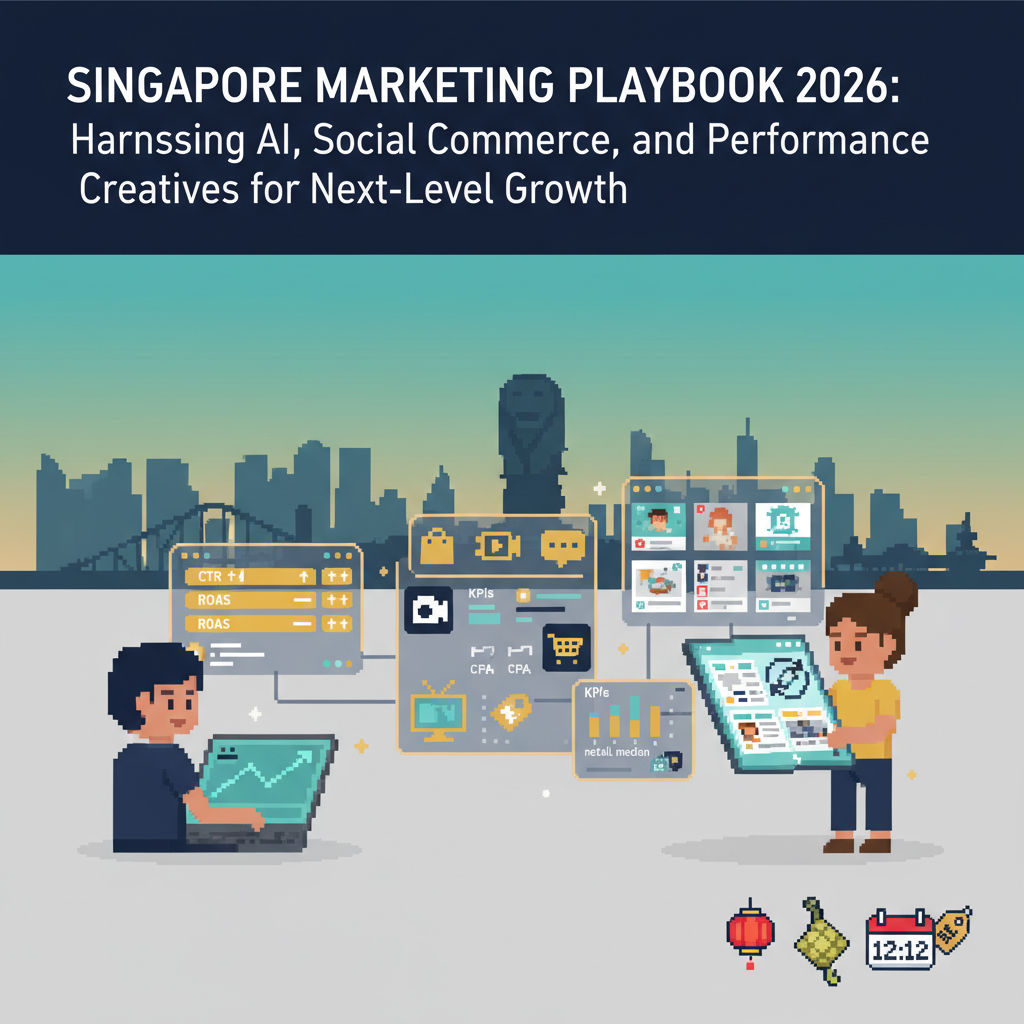
Singapore Marketing Playbook 2026: Harnessing AI, Social Commerce, and Performance Creatives for Next-Level Growth
Introduction: The Evolution of Marketing in Singapore for 2026
Singapore’s marketing landscape is undergoing a fundamental transformation as we approach 2026. The market has evolved into a privacy-light, performance-driven ecosystem where creative excellence meets data precision. Today’s omnichannel shoppers seamlessly navigate between TikTok Shop discoveries, Shopee Live sessions, and WhatsApp commerce conversations—All from their mobile devices.
The numbers tell a compelling story. According to We Are Social’s Digital 2026 Global Overview Report, more than 1 billion people now use generative AI tools monthly, while social media users have become a “supermajority” globally. In Singapore’s mobile-first environment, this translates to unprecedented opportunities for brands that can master the convergence of AI-powered creativity, social commerce, and performance marketing.
What’s changed dramatically since 2023-2025? Short-form video has achieved complete dominance across discovery channels. Social commerce has matured from experimental to essential, with platforms like TikTok Shop and Shopee Live driving billions in GMV. Retail media networks have emerged as the third pillar of digital advertising alongside search and social. Most significantly, AI has moved from boardroom buzzword to operational reality—powering everything from creative iteration to marketing mix modeling.
This playbook delivers a practical framework to plan, produce, and measure growth campaigns that capitalize on these shifts. Whether you’re a CMO at a scaling startup or a marketing director at an established brand, you’ll find actionable strategies, local examples, and measurement frameworks designed specifically for Singapore’s unique market dynamics.
The Rise of Singapore Marketing Playbook: Why 2026 Demands a New Approach
Consumer Behavior Evolution
Singapore consumers now discover brands primarily through social video, with younger cohorts spending hours daily across multiple platforms. The traditional funnel has fragmented into a complex web of touchpoints spanning TikTok discovery, Shopee Live consideration, WhatsApp consultation, and in-app purchase—often within the same shopping session.
Platform Economics Transformation
Digital channels now command roughly three-quarters of advertising spend, with social and retail media experiencing double-digit growth. We Are Social’s research emphasizes that Southeast Asia’s mobile-first nature demands platform-native creative approaches rather than repurposed desktop content.
AI Integration Reality
Artificial intelligence has moved beyond automation to strategic advantage. Leading Singapore brands are using AI for creative iteration, audience research, and predictive modeling—not as replacement for strategy, but as amplification of human insight.
The playbook structure you’ll follow addresses each layer systematically: AI implementation for efficiency and creativity, social commerce integration for revenue growth, performance creative mastery for attention capture, emerging channel navigation for competitive advantage, and measurement frameworks for sustainable scaling.
Embracing AI Marketing Singapore: Innovations and Practical Applications
Key AI trends shaping Singapore’s marketing landscape
Generative AI for Creative Iteration has become the productivity multiplier every performance team needs. Tools like Jasper, Claude, and Pictory enable teams to produce dozens of creative variants for feed placements, reducing early-stage creative grunt work while maintaining brand consistency. The key is implementing human oversight for brand safety and tone validation.
Marketing Mix Modeling (MMM) and Incrementality represents the next generation of measurement. Platforms like Sellforte combine Bayesian MMM with AI agents that provide week-level pacing recommendations and optimal bid guidance. This moves MMM from quarterly strategic planning to tactical execution support.
LLM-driven Audience Research synthesizes disparate signals—social listening, review text, customer service transcripts—into actionable persona insights faster than traditional analysis. Singapore brands are using this to capture local nuances like Singlish usage patterns and cultural celebration timing.
Predictive LTV and Churn Models enable sophisticated customer lifetime value bidding and retention interventions. Platforms like Mixpanel and Salesforce Einstein embed these predictions directly into marketing workflows, allowing real-time campaign optimization based on predicted customer value.
When selecting AI tools, prioritize model transparency, clear data handling policies, human-in-the-loop workflows, and demonstrable cost-to-value ratios. The most successful implementations combine AI efficiency with human strategic oversight.
How brands are using AI content generation Singapore for efficiency and creativity
Performance Creative Testing System
A leading beauty brand implemented an AI-powered creative factory using Jasper for copy variants, Canva AI for visual iterations, and Smartly.io for automated A/B testing. Their workflow: brief creation → AI generation of 20+ variants → human brand review → automated platform testing → performance analysis. Result: 300% increase in creative testing velocity with 40% improvement in click-through rates.
SEO + Content Automation for Long-tail Capture
An education provider automated their content pipeline using Surfer SEO for keyword research, Claude for article drafting, and Grammarly for editing. They added a compliance review step for regulated claims and maintained audit logs for PDPA requirements. The system produces 50+ optimized articles monthly, capturing long-tail search traffic that drives 25% of their demo bookings.
CRM Personalization with RFM + AI Copy
A F&B delivery service segments customers using RFM analysis (Recency, Frequency, Monetary), then generates personalized WhatsApp messages using OpenAI’s API. High-value customers receive premium menu recommendations, while price-sensitive segments get bundle offers. The AI maintains brand voice through carefully crafted prompts and template structures.
Workflow Template for AI Content Generation
- Brief Development: Define audience, objective, brand guidelines, compliance requirements
- AI Generation: Use approved tools with standardized prompts and brand voice rules
- Human Review: Check for accuracy, brand alignment, and regulatory compliance
- Quality Assurance: Run originality checks and fact verification
- Performance Tracking: Monitor engagement metrics and conversion outcomes
- Learning Integration: Feed performance data back into prompt optimization
Guardrails for Success
- Maintain human oversight for all customer-facing content
- Implement originality checking to avoid plagiarism issues
- Store prompt and response history for audit trails
- Regular brand voice calibration sessions
- Clear escalation procedures for edge cases
Mastering Performance Creatives Marketing: Data-Driven Storytelling
What makes a performance creative in 2026?
Thumb-stopping Hook (0-3 seconds): The opening must visually or verbally disrupt the feed pattern. Use bold contrast, unexpected movement, human faces, or provocative questions. For Singapore audiences, consider local context—hawker center scenes, MRT commutes, or HDB void deck settings create immediate relatability.
Single-minded Proposition: Focus on one clear benefit per creative. Test headlines like “50% off first lesson—limited seats” (Education) or “Free same-day delivery” (F&B) rather than multiple value propositions that dilute impact.
Native-first Format: Build for platform context, don’t just resize. Vertical video for TikTok needs native camera framing and captions. CTV requires cinematic quality with sound design. DOOH demands single-idea clarity with high-contrast typography.
Offer Clarity: Make the value proposition and next step obvious. Use specific numbers (“Save $50”) rather than vague promises (“Save money”). Include clear CTAs that match platform conventions.
Social Proof Integration: Incorporate reviews, testimonials, or usage statistics naturally within the creative. For Singapore, consider multilingual testimonials that reflect the market’s diversity.
Strong Call-to-Action: Match CTA language to platform norms and user intent. “Shop Now” for commerce, “Learn More” for consideration, “Book Demo” for B2B.
Creative Testing Matrix Approach
- Hooks: Problem vs. benefit vs. social proof
- Formats: UGC vs. produced vs. animation
- Offers: Pricing strategy and incentive structure
- Audiences: Demographic and behavioral segments
Interpreting Signal with Limited Attribution
Focus on leading indicators like landing page views, add-to-cart rates, and initiate checkout events. Use unique promo codes and dedicated landing pages to improve direct attribution. Run controlled experiments with holdout groups to validate creative performance beyond platform metrics.
Case studies from leading Singapore brands
Case Study 1: Beauty Brand Creative Testing System
Challenge: A local skincare brand struggled with rising CPMs and declining ROAS on Meta and TikTok.
Intervention: Implemented systematic creative testing using AI-generated variants. Created 15 hook variations around “glass skin in 7 days” theme, testing problem-focused vs. solution-focused openings across different audience segments.
Results:
- Baseline ROAS: 2.8x → Post-optimization ROAS: 4.2x
- 45% reduction in CPA
- 60% increase in creative testing velocity
Key Learning: Problem-focused hooks outperformed solution-focused hooks by 35% among 25-34, while solution-focused performed better for 35+.
Case Study 2: F&B Quick Commerce Optimization
Challenge: Improve conversion during peak ordering windows.
Intervention: Time-sensitive creatives with urgency messaging; dynamic creative optimization by time of day and user behavior.
Results:
- 28% increase in peak-window orders
- 15% AOV lift via bundles
- 22% reduction in cart abandonment
Case Study 3: Education Provider Lead Quality Enhancement
Challenge: High lead volume but low paid enrollment.
Intervention: Outcome-focused creatives + lead scoring based on creative engagement.
Results:
- 35% fewer leads but 85% higher lead-to-enrollment conversion
- 50% improvement in cost per enrolled student
- 25% higher course completion rates
Navigating Singapore Digital Marketing Trends 2026: What to Watch
Emerging channels and platforms
Retail Media Networks are the third pillar of digital advertising. Lazada, Shopee, Grab, and Carousell provide first-party purchase data and closed-loop attribution.
- Combine retail search ads with display placements
- Align campaigns to marketplace promo calendars (11.11, 12.12)
- Stack seller vouchers with platform coupons
- Test product-hero vs. lifestyle imagery by category
Connected TV (CTV) & Over-the-Top (OTT) bring TV storytelling with digital targeting.
- 15s for direct response; 30s for brand stories
- Put brand in first 3-5 seconds
- Design for sound-on but ensure visual comprehension
- Use sequential messaging: CTV for story, social for retargeting
Programmatic DOOH thrives in Singapore’s high-traffic, transit-centric environment.
- Dynamic creative by time-of-day/weather
- QR and proximity mobile activation
- Coordinate with mobile retargeting for attribution
B2B: LinkedIn + Events + ABM for integrated acquisition.
- Lead Gen Forms with pre-filled data
- Conversation Ads for scalable personalization
- Sync with webinars/field events and SDR outreach
The role of marketing automation Singapore in campaign success
Marketing automation now orchestrates real-time journeys informed by predictive signals.
E-commerce Flash Sale Funnel
- Click → LP with UTM
- ATC → cart email/SMS in 10–20 mins
- No purchase → dynamic retargeting in 24h
- Purchase → onboarding + cross-sell
- No purchase 48h → voucher + high-AOV push
SaaS PLG + Sales Assist
- Trial → PQL scoring
- High engagement → SDR ping with session replay
- Low engagement → activation content
- Expansion threshold → demo CTA
- Expiry → limited-time upgrade
F&B First Order → Loyalty
- Thank-you SMS + next-order discount
- 48h → personalized recommendations
- Frequent buyer → loyalty program
- Lapsed → win-back offer
Lead Scoring Model
- Fit (industry, role): +20–30
- Intent (pricing, competitor pages): +30–50
- Engagement (webinar, downloads): +10–20
- Product usage: +20–40
- Negative signals: −10 to −30
Automation Stack
- B2C: Klaviyo, Braze
- B2B: HubSpot, Marketo
- Data: Segment, Zapier
- Analytics: GA4, BigQuery, Looker
Building a Future-Ready Marketing Strategy: Actionable Steps for 2026
Setting marketing KPIs Singapore for measurable growth
E-commerce
North Star: Marketing-attributed Net Revenue. Inputs: ATC rate, checkout conversion, AOV, high-intent sessions, promo redemption. Guardrails: Margin%, return rate, CAC:LTV.
SaaS
North Star: Net New ARR (marketing-sourced). Inputs: Trials, demos, MQL→SQL, activation. Guardrails: LTV:CAC ≥3, churn, sales cycle.
F&B
North Star: Repeat order revenue. Inputs: Orders/user, app sessions, first-order rate. Guardrails: SLA, refunds, cost/order vs margin.
Education
North Star: Enrolled paid students. Inputs: Lead→demo, trial attendance, content engagement. Guardrails: Completion rate, refund rate, NPS.
Measurement Framework
- Tactical: GA4 + native reports + server-side conversions + promo codes
- Strategic: Experiments and holdouts
- Portfolio: Quarterly MMM
Dashboard Cadence
- Daily: inputs and pacing
- Weekly: channel performance
- Monthly: KPI trends
- Quarterly: MMM and budget reallocation
Choosing the right AI tools for marketing and creative partners
AI Vendor Checklist
- Model transparency; PDPA-ready data handling
- Integrations with your martech stack
- Human-in-the-loop; override controls
- Benchmark performance and accuracy
- Scalable pricing; training & support
In-house vs Partner
Build in-house when you have data science resources, proprietary data needs, and long-term cost rationale. Partner when you need speed-to-value, standard use cases, and specialized expertise.
Budget Split Guidelines
- Media 45–60%
- Creative 10–20%
- Martech & AI 6–12%
- Measurement 3–6%
- Pilots/R&D 3–5%
- Contingency 5–10%
Creative Partner Evaluation
- Portfolio relevance and local market knowledge
- Process efficiency and iteration speed
- ROAS/conversion track record
- AI and automation capability
- Scalability for seasonal spikes (CNY, 11.11, 12.12, Hari Raya)
Pro Tip: Start with a 90-day pilot, define success metrics, document learnings, scale winners.
Conclusion: Shaping the Future of Marketing in Singapore
Singapore’s marketing landscape in 2026 rewards brands that master AI efficiency, social commerce integration, performance creative excellence, and evidence-led measurement. The convergence of these capabilities represents a rare opportunity to build sustainable competitive advantage.
Next steps: Audit AI usage; map social commerce friction; implement creative testing; establish a hybrid attribution–experimentation–MMM measurement stack; ring-fence budget for emerging channels while optimizing proven ones.
Ready to transform your 2026 strategy? Contact Hamilton & Sherwind for a tailored strategy and execution plan.
Recommended internal resources
References
Talk to us
Looking to apply this 2026 playbook to your brand in Singapore? Contact Hamilton & Sherwind for a tailored strategy and execution plan.
The Surge of Social Commerce Singapore: Redefining Customer Journeys
Social commerce trends 2026 and their impact on local businesses
Social commerce in Singapore has evolved from experimental to essential, with DBS estimates suggesting the market could reach USD 1.0-1.3 billion by 2025. The ecosystem now spans multiple touchpoints that Singapore consumers navigate fluidly.
TikTok Shop dominates discovery and impulse purchases, particularly among Gen Z and Millennials. Its integrated affiliate program and live-sell mechanics create viral loops that can transform unknown products into trending must-haves within days. The platform excels for beauty, fashion, and gadgets where visual demonstration drives purchase decisions.
Shopee Live and LazLive serve as the conversion engines for price-conscious shoppers. These marketplace-integrated live streams leverage existing logistics infrastructure and payment systems, making them ideal for flash sales and promotional campaigns. During major shopping events like 11.11 and 12.12, these platforms process millions in GMV through coordinated live sessions.
WhatsApp Commerce has become the backbone of high-touch sales processes. Singapore businesses use WhatsApp Business API for product catalogs, order taking, and post-purchase support. This channel particularly excels for premium F&B, education consultations, and B2B services where relationship building drives conversion.
Mini-programs and In-platform Storefronts within super-apps provide lightweight commerce experiences without friction of external redirects. These work exceptionally well for loyalty programs, bundle configurators, and educational lead magnets.
Category-Specific Nuances
Integrating social media marketing Singapore with commerce strategies
Awareness Stage: Short-form Video Dominance
Create thumb-stopping content that introduces problems and solutions within the first 3 seconds. Use trending audio, native camera angles, and authentic demonstrations. For Chinese New Year campaigns, leverage red packet aesthetics and family gathering scenarios. During Ramadan, focus on breaking fast moments and community sharing.
Mid-funnel: Live Streaming + Affiliate Amplification
Live commerce sessions should follow a structured format: problem introduction (1-2 minutes) → product demonstration (5-8 minutes) → exclusive offer presentation (2-3 minutes) → Q&A and urgency creation (remaining time). Use live-only voucher codes and limited inventory to drive immediate action.
Conversion: In-app Checkout + Strategic Vouchers
Minimize friction with one-click purchasing and local payment methods (PayNow, GrabPay). Layer vouchers strategically: first-time buyer discounts for acquisition, bundle offers for AOV increase, and loyalty rewards for retention.
Loyalty: CRM Integration + Community Building
Post-purchase, migrate customers to owned channels like WhatsApp groups or email lists. Create exclusive communities for VIP customers with early access to new products and special pricing.
Creator Collaboration Framework
Approval Flow Process