

AI-Assisted SEO Content Strategy for Singapore Businesses (2025): Building a Scalable Content Engine
Introduction: Why AI-Driven SEO Content Strategies Matter for Singapore in 2025
Singapore’s digital landscape is experiencing a seismic shift as artificial intelligence transforms how businesses approach search engine optimization. AI-assisted SEO represents the strategic integration of machine learning tools and automation into content creation, keyword research, and optimization workflows—enabling businesses to scale their organic search presence while maintaining quality and relevance.
For Singapore businesses in 2025, this evolution isn’t just about keeping pace with technology; it’s about survival in an increasingly competitive digital marketplace. According to McKinsey’s State of AI 2024, 65% of organizations are now using generative AI in at least one business function, with marketing and sales leading adoption rates. The report highlights significant ROI improvements, particularly for companies that integrate AI across multiple functions.
The urgency becomes clear when examining Google’s evolving standards. Google Search Essentials now emphasize experience, expertise, authoritativeness, and trustworthiness (E-E-A-T) more than ever, while Google’s spam policies on AI-generated content make it clear that quality, not just quantity, determines success.
For Singapore SMEs, the cost-to-value equation is compelling. Traditional SEO hiring can cost S$8,000-15,000 monthly for experienced specialists, while AI-assisted approaches can automate up to 80% of manual tasks—from keyword research to technical audits—allowing smaller teams to achieve enterprise-level results.
The stakes are particularly high in Singapore’s hyper-competitive market, where businesses compete not just locally but across Southeast Asia. Companies that master AI-assisted SEO content strategies now will establish the foundation for sustainable organic growth throughout the region.
The Evolution of SEO in Singapore: 2025 and Beyond
Singapore’s SEO landscape in 2025 is defined by three transformative trends that are reshaping how businesses approach organic search visibility.
Algorithm Focus on Experience and Authority
Google’s algorithm updates throughout 2024 and into 2025 have doubled down on rewarding content that demonstrates genuine expertise and provides exceptional user experiences. The helpful content guidance emphasizes people-first content creation, regardless of whether AI tools are involved in the process.
This shift particularly impacts Singapore businesses operating in regulated industries like finance, healthcare, and legal services, where demonstrating expertise isn’t just about rankings—it’s about compliance and trust. Local businesses must now prove their authority not just through backlinks, but through consistent, accurate, and valuable content that serves real user needs.
Page Experience as a Competitive Differentiator
Google’s page experience guidance has evolved beyond Core Web Vitals to encompass mobile-first indexing, secure browsing, and intrusive interstitial penalties. For Singapore businesses targeting mobile-heavy audiences—where mobile commerce accounts for over 60% of e-commerce transactions—page experience optimization has become non-negotiable.
AI tools now automate much of this optimization, from image compression to schema markup generation, allowing businesses to maintain technical excellence while focusing on content strategy.
The SME Advantage Through AI Adoption
Perhaps most significantly, AI has democratized advanced SEO capabilities for Singapore SMEs. Where enterprise-level SEO once required teams of specialists, AI-assisted workflows now enable small businesses to compete effectively against larger competitors.
The numbers tell the story: less than 5% of Singapore SMEs have fully embraced AI for SEO, creating a significant first-mover advantage for early adopters. Those implementing AI-assisted strategies report 40-60% improvements in content production velocity while maintaining or improving quality metrics.
Core Components of an AI-Assisted SEO Content Strategy
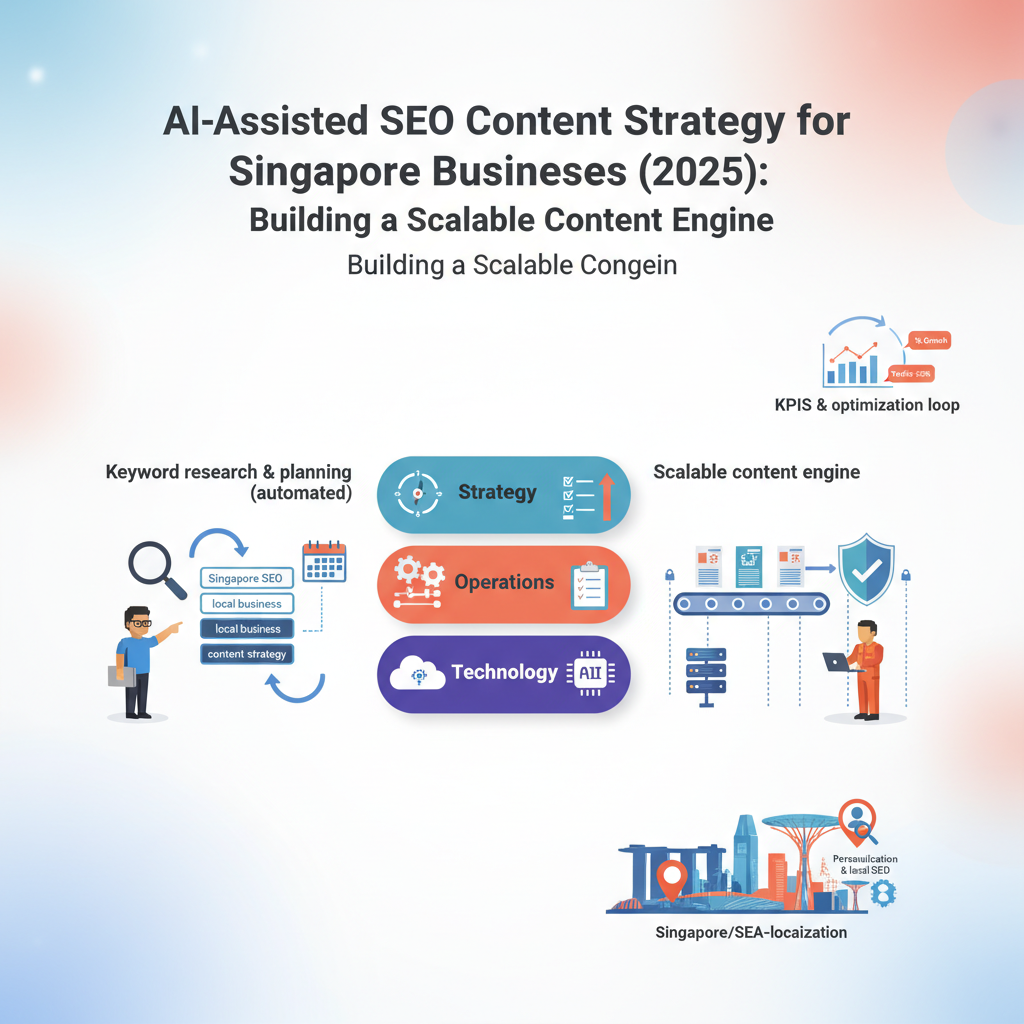
Building an effective AI-assisted SEO content strategy requires a structured approach across three interconnected layers: strategy, operations, and technology. This framework ensures scalability while maintaining the quality and compliance standards essential for Singapore businesses.
Strategy Layer: Foundation for Success
The strategy layer forms the intellectual foundation of your content engine. It begins with comprehensive audience research using AI-powered tools to analyze search behavior, competitor content gaps, and emerging topic opportunities. Jobs-to-be-Done (JTBD) framework integration helps identify the functional, emotional, and social jobs your content must accomplish for users.
Topic clustering becomes the organizational backbone, grouping related keywords and content themes into comprehensive coverage areas. For Singapore businesses, this might involve clustering around local service areas (CBD, Orchard, Jurong), industry-specific regulations, or cultural considerations across the diverse local market.
Search intent mapping ensures each piece of content serves a specific purpose in the customer journey—from awareness-stage informational content to decision-stage commercial pages. AI tools can analyze SERP features and competitor content to identify the optimal intent targeting for each topic cluster.
Operations Layer: Quality at Scale
The operations layer transforms strategy into executable workflows. Content brief templates standardize the information flow from strategists to writers, ensuring consistency across all content pieces. These briefs include target keywords, search intent, competitive analysis, required citations, and compliance considerations specific to Singapore’s regulatory environment.
Editorial QA processes incorporate both automated and human checkpoints. AI tools handle initial fact-checking, plagiarism detection, and basic compliance screening, while human editors focus on tone, brand alignment, and strategic messaging. This hybrid approach maintains quality while enabling faster production cycles.
Fact-checking workflows are particularly crucial for Singapore businesses operating in regulated industries. Automated systems can flag claims requiring verification, while integration with authoritative sources ensures accuracy and builds the expertise signals Google’s algorithms reward.
Technology Layer: Automation and Intelligence
The technology layer provides the tools and automation that make scalable content production possible. AI SEO tools handle keyword expansion, search volume analysis, and competitive gap identification. Platforms like Google Keyword Planner provide foundational data, while advanced tools offer programmatic SERP analysis and intent classification.
Content clustering algorithms organize thousands of keywords into manageable topic groups, while internal link discovery tools identify opportunities to strengthen site architecture and topic authority. Schema markup automation ensures technical SEO compliance without manual coding requirements.
Analytics integration connects content performance to business outcomes, tracking everything from index rates and ranking improvements to assisted conversions and pipeline attribution. This data feeds back into the strategy layer, creating a continuous optimization loop.
Framework Integration Example
Consider how a Singapore-based financial advisory firm might implement this three-layer framework:
- Strategy: Cluster content around “retirement planning Singapore,” “CPF optimization,” and “investment strategies”
- Operations: Create standardized briefs ensuring MAS compliance, fact-checking against official sources, and maintaining professional tone
- Technology: Use AI tools to identify long-tail opportunities like “CPF LIFE vs annuity Singapore” while automating schema markup for financial calculators
Automating Keyword Research and Content Planning
Effective keyword research automation transforms the traditionally time-intensive process of topic discovery into a systematic, scalable workflow that uncovers opportunities competitors miss while maintaining strategic focus.
The Five-Stage Automation Workflow
Stage 1: Seed Topic Generation
Begin with broad business-relevant topics using AI-powered suggestion tools. For Singapore businesses, this includes location-specific seeds (Singapore, SG, local district names), industry terminology, and cultural considerations. A local restaurant might start with seeds like “Singapore food delivery,” “halal dining,” or “Tanjong Pagar restaurants.”
Stage 2: AI-Assisted Keyword Expansion
Deploy tools like Google Keyword Planner, Ahrefs, or Semrush to expand seed topics into comprehensive keyword lists. AI algorithms identify semantic relationships, question-based queries, and long-tail variations that manual research often misses. The key is setting appropriate volume and difficulty thresholds that match your domain authority and competitive position.
Stage 3: SERP Analysis and Intent Classification
Automated SERP analysis tools examine the top 10 results for each keyword, identifying dominant content types, featured snippets opportunities, and user intent signals. This analysis reveals whether keywords require informational blog posts, commercial landing pages, or local business listings.
For Singapore businesses, SERP analysis often reveals local intent signals—Google My Business listings, location-specific results, or Singapore-focused content—that inform content strategy decisions.
Stage 4: Intelligent Clustering
AI clustering algorithms group related keywords based on semantic similarity and search intent, creating topic clusters that can be addressed through comprehensive content pieces. This prevents keyword cannibalization while ensuring thorough topic coverage.
Stage 5: Content Brief Generation
Automated brief generation pulls together keyword clusters, competitive analysis, and intent mapping into actionable content briefs. These briefs include primary and secondary keywords, required subtopics, optimal content length, and structural recommendations based on top-performing competitors.
Singapore F&B SME Implementation Example
A Singapore-based bubble tea chain implementing this workflow might discover:
Seed Topics: “bubble tea Singapore,” “boba delivery,” “milk tea flavors”
Expanded Keywords:
- Informational: “best bubble tea Singapore,” “how to make bubble tea,” “bubble tea calories”
- Commercial: “bubble tea delivery Orchard,” “buy bubble tea online Singapore”
- Local: “bubble tea near Raffles Place,” “24-hour bubble tea Singapore”
Clustered Content Strategy:
- Cluster 1: Location-based content targeting specific MRT stations and shopping centers
- Cluster 2: Product education content about tea types, customization options, and health considerations
- Cluster 3: Seasonal and cultural content around festivals and local events
Automated Brief Output: Each cluster generates specific content briefs including target keywords, competitor analysis, required local references (specific Singapore locations), and optimization recommendations.
Building a Scalable Content Engine with AI
Creating a sustainable, high-quality content engine requires clearly defined roles, standardized processes, and robust quality controls that leverage AI capabilities while maintaining human oversight and strategic direction.
Essential Team Roles and Responsibilities
Content Strategist: Develops overarching content strategy aligned with business objectives and market opportunities. They analyze performance data, identify content gaps, and ensure strategic coherence across all content initiatives. In Singapore contexts, strategists must understand local market nuances, regulatory requirements, and cultural sensitivities.
Managing Editor: Orchestrates the entire content production workflow, from brief creation through publication. They maintain editorial calendars, coordinate between team members, and ensure consistent quality standards. Managing editors also handle escalations and make final approval decisions on content that may impact brand reputation.
Subject Matter Expert (SME): Provides domain expertise and factual accuracy validation. For Singapore businesses, SMEs often include local market specialists, regulatory compliance experts, or industry veterans who ensure content accuracy and cultural appropriateness. They review AI-generated content for technical accuracy and industry-specific nuances.
AI Prompt Engineer: Designs and refines AI prompts to generate content that aligns with brand voice and strategic objectives. They optimize AI tool configurations, develop custom prompts for specific content types, and troubleshoot AI output quality issues. This role is crucial for maintaining consistency across AI-assisted content creation.
SEO Specialist: Focuses on technical optimization, keyword integration, and performance monitoring. They ensure content meets search engine requirements while tracking rankings, traffic, and conversion metrics. SEO specialists also manage technical implementations like schema markup and internal linking strategies.
Standard Operating Procedures for Quality and Scale
Content Brief Development: Standardized briefs include target keywords, competitive analysis, required citations, compliance considerations, and brand voice guidelines. Templates ensure consistency while allowing customization for specific content types or market segments.
Outline Approval Workflow: Multi-stage approval process where strategists review outlines for strategic alignment, SMEs validate technical accuracy, and managing editors ensure brand consistency. This prevents costly revisions later in the production process.
AI-Assisted Drafting Process: Writers use AI tools for initial drafts, following established prompts and guidelines. Human writers then refine, fact-check, and optimize the content for brand voice and strategic messaging. This hybrid approach maintains efficiency while ensuring quality.
SME Review Cycles: Scheduled review sessions where subject matter experts validate content accuracy, suggest improvements, and ensure compliance with industry standards. For Singapore businesses, this includes regulatory compliance checks and cultural sensitivity reviews.
Editorial Standards and Publishing: Final editing focuses on brand voice consistency, readability optimization, and technical SEO implementation. Publishing protocols include final quality checks, metadata optimization, and performance tracking setup.
Quality Guardrails and Risk Management
Originality and Plagiarism Controls: Automated plagiarism detection tools scan all content before publication, while originality scoring ensures sufficient unique value creation.
Citation and Fact-Checking Requirements: Mandatory citation protocols for all factual claims, with automated fact-checking tools providing initial verification. Human reviewers validate critical claims, particularly those related to regulations, statistics, or industry-specific information relevant to Singapore markets.
Tone and Brand Consistency: AI-powered tone analysis tools ensure consistent brand voice across all content, while human editors provide final approval on messaging and positioning. Style guides include Singapore-specific language preferences and cultural considerations.
Legal and Regulatory Compliance: Automated compliance screening for industry-specific regulations, with human legal review for sensitive topics.
AI Hallucination Prevention: Multi-layered verification processes including automated fact-checking, SME review, and source validation.
Balancing Velocity with Quality
Editorial Scorecards: Quantitative quality metrics including readability scores, SEO optimization levels, citation accuracy, and brand voice consistency.
Performance-Based Quality Metrics: Measure engagement rates, time on page, conversion rates, and search ranking improvements.
Continuous Optimization Protocols: Regular review cycles that analyze content performance and refine production processes.
Personalization and Local Relevance in AI Content
Singapore’s diverse market demands sophisticated personalization strategies that go beyond basic demographic targeting to encompass cultural nuances, geographic specificity, and multilingual considerations that AI tools can now deliver at scale.
Advanced Personalization Tactics
Audience Segmentation and Behavioral Targeting: AI-powered analytics identify distinct audience segments based on search behavior and content engagement patterns.
Geographic Micro-Targeting: Generate location-specific variations targeting individual MRT stations, shopping centers, and residential districts.
Cultural and Seasonal Personalization: Automate content creation around Singapore’s cultural calendar.
Multilingual Content Strategies: Use AI translation with human oversight across English, Mandarin, Malay, and Tamil.
Local SEO Automation Excellence
Google Business Profile Optimization: Manage multiple listings, produce location-specific posts, and ensure NAP consistency. See Google Business Profile Help – Posts and updates.
Smart NAP Consistency Management, Intelligent Local Link Building, and Automated Review Management: Deploy AI for monitoring and proactive engagement.
Singapore-Specific Local SEO Considerations
HDB estate targeting, MRT station optimization, shopping centre content, and cultural district specialization.
Implementation Example: Local Restaurant Chain
- Location-specific menus
- Cultural event promotions
- Commuter-focused messaging
- Language variations
Measuring Success: KPIs and Optimization for 2025
Leading Performance Indicators
- Content production velocity
- Index rate and crawl efficiency
- Top 3 ranking share
- Content quality scores
Lagging Business Impact Indicators
- Non-brand organic traffic growth
- Assisted pipeline attribution
- Market share expansion
- Customer lifetime value from organic channels
Advanced Analytics Implementation
- Search Console integration
- GA4 enhanced measurement
- Looker Studio dashboards
- Content performance scoring
Continuous Optimization Protocols
- Internal linking optimization
- Content refresh cadence
- Schema markup updates
- Competitive response strategies
Singapore-Specific Measurement Considerations
- Local search performance
- Multilingual content analytics
- Mobile-first metrics
Conclusion: The Future of AI-Driven SEO Content for Singapore Businesses
The convergence of artificial intelligence and SEO content strategy represents more than a technological evolution—it’s a fundamental shift in how Singapore businesses can compete and scale in an increasingly digital marketplace. AI-assisted SEO content strategies offer opportunities to achieve enterprise-level results with smaller teams.
Immediate actions: audit your current operations, implement the three-layer framework, invest in prompt engineering and strategy roles, and establish quality guardrails and measurement systems from the outset.
With early adoption still nascent in Singapore, the window for competitive advantage remains open for brands that move decisively.
Ready to transform your content strategy and capture your share of Singapore’s digital market? Hamilton & Sherwind specializes in implementing AI-assisted SEO content strategies that drive measurable business growth.
Sources
- Google Search Essentials
- Google Search spam policies (AI-generated content)
- Google’s helpful content guidance
- Page experience guidance
- Google Business Profile Help – Posts and updates
- McKinsey – The State of AI in 2024
Note: All external statistics and policy references are linked directly to authoritative source pages via the precise anchor text above.
Talk to Hamilton & Sherwind
Want a scalable AI-assisted SEO content engine built for Singapore? Contact us to get started.