

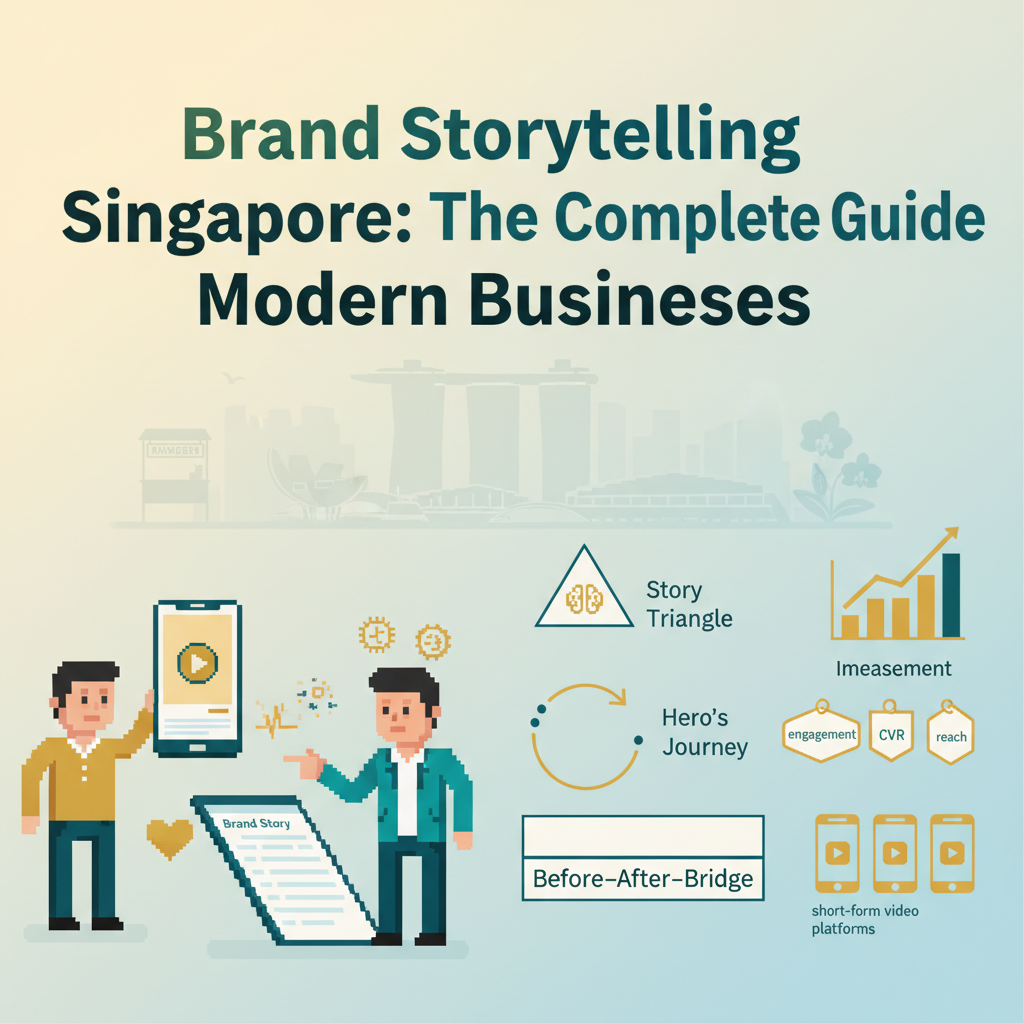
Brand storytelling Singapore: The Complete Guide for Modern Businesses
In a market as saturated and fast-moving as Singapore and Southeast Asia, the ability to cut through noise and build genuine connection with audiences has become a competitive necessity. Every day, consumers are exposed to thousands of marketing messages across multiple platforms. Yet the brands that truly resonate—the ones that drive loyalty, advocacy and measurable business growth—are those that master the art of storytelling.
Brand storytelling is not a luxury or a creative indulgence. It is a strategic discipline that transforms how businesses communicate, build trust and compete. In Singapore’s multicultural, digitally sophisticated market, storytelling has become the primary vehicle for brands to move beyond functional claims and into the emotional territory where real decisions are made.
This guide explores why brand storytelling matters, how to build it systematically, and how to measure its impact on your business. Whether you are a founder, marketer, agency leader or in-house creative team, you will find practical frameworks, worksheets and measurement guidance to implement storytelling at scale.
Understanding brand storytelling: The power of narrative in branding
What is brand narrative and why does it matter?
A brand narrative is the overarching storyline that ties all of your brand communication together. It is not a single advertisement or campaign; it is the long-form arc that answers three fundamental questions: Who is your brand? What problems do you solve? And why does it matter?
At its core, brand narrative uses the elements of story—characters, conflict, tension and resolution—to communicate what your brand believes and how it fits into people’s lives. Rather than listing features or benefits, storytelling focuses on how your brand makes people feel. The emotional outcome is the point.
Feature-led claim: “Our product saves you 30 minutes per day.”
Story-led claim: “Working parents feel guilty they can’t spend meaningful time with their kids. Our product gives them back those moments—and the peace of mind that comes with them.”
The second statement creates emotional resonance. It acknowledges a real tension in the audience’s life and positions the brand as the bridge to resolution. When people engage with a story, their brains experience it; emotion fuels attention, recall and action.
- Creates legibility. People recall your brand more easily when it stands for something clear and emotionally resonant.
- Builds preference. Stories that reflect customers’ values convert awareness into preference and loyalty.
- Enables premium positioning. Compete on meaning rather than price.
- Drives shareability. Emotionally resonant stories are more likely to be shared organically.
- Supports business outcomes. Better engagement, recall, preference and organic sharing.
The role of storytelling in branding for Singaporean companies
Singapore and Southeast Asia are digitally saturated, culturally diverse and highlycompetitive. Audiences are discerning about authenticity and cultural fit. Emotional clarity cuts through noise.
- Localise the truth, not just language. Adapt emotional truths and cultural details per market.
- Trust and values matter. Authentic, purpose-driven narratives drive loyalty.
- Format fit. Short-form for scroll-stopping; long-form for identity and purpose.
- Evidence and transparency. Local case studies and measurable outcomes build trust.
Key elements of effective brand storytelling strategy
Crafting a compelling brand identity storytelling
Identity storytelling is the repeated association of an emotion, situation and point of view with your brand—beyond logos and taglines. Use the Story Triangle:
- Brand Belief (your why) — the point of view that guides every story.
- Audience Truth (their reality) — the felt tension your customers live with.
- Emotional Goal (what they should feel) — pick one emotion and anchor your creative to it.
Emotional branding: Connecting with audiences in Singapore
- Make the customer the hero. Position your brand as the guide.
- Use behaviour-driven details. Show life change, not specs.
- Use real voices and evidence. Testimonials and proof points build trust.
- Design for sharing. Craft moments people want to pass on.
- Respect multicultural nuance. Adapt imagery and social cues per market.
How to develop a storytelling marketing strategy for your brand
Step-by-step guide to building your brand’s story
- Strategy and insight — interviews, ethnography, analytics; complete your Story Triangle.
- Narrative architecture — choose structures: Hero’s Journey; Before–After–Bridge; The Mountain; In Medias Res.
- Creative brief — define the Emotional Anchor; brief to outcomes, not outputs.
- Concepting and script — one-liner promise, hook and emotional anchor; show behaviour.
- Production and local adaptation — master cut + platform-specific edits; localise visuals and casting.
- Test, iterate, scale — A/B hooks; 2–4 week cycles; scale winners.
- Measurement — map assets to KPIs; run dashboards and monthly reviews.
Brand storytelling tips for local relevance
- Use locally resonant tensions as your conflict.
- Design platform-first creative; vertical, captioned edits.
- Include local testimonials and UGC.
- Test micro-variants before scaling.
- Produce modular assets from a single brief.
Choosing a brand storytelling agency in Singapore
What to look for in a local agency
- Strategy-first narrative development and documented process.
- Audience research and local insight capabilities.
- Creative architecture across formats and strong production craft.
- Localisation strength for Singapore and SEA.
- Measurement discipline (emotional + business KPIs).
Ask about process, sample narratives, case studies with results, localisation examples, emotional KPIs, timelines and references. Watch for red flags: visuals without strategy, weak measurement plans, no local insight.
Top agencies and their unique approaches
Options include full-service creative agencies, brand strategy consultancies, production-led shops, creator/content agencies and in-house models. Prioritise partners with regional case studies, measurable outcomes and collaborative ways of working.
Learning and upskilling: Brand storytelling courses and workshops
Overview of available courses and workshops
- University/corporate academies for senior marketers.
- Industry masterclasses (2 days) focused on strategy + execution.
- Tailored in-company workshops (Story Triangle, briefs, content calendars).
- Short practical courses for writers and social managers.
- Regional trainers for platform-native formats and creator collaboration.
Who should attend and what to expect
- Senior marketers, brand managers and CMOs for alignment.
- Content leads and producers for execution.
- Social/performance marketers for hooks and formats.
- Founders and SMEs for pitch-ready narratives.
- Agency strategists for client workshops.
Expect practical frameworks, hands-on exercises, case studies, implementation tools and experienced instructors. Choose programs with clear outcomes, strong instructor backgrounds, useful class composition and follow-up resources.
Inspiring brand storytelling examples from Singapore
Case studies of successful local brands (generalised)
- Heritage and food-origin storytelling — nostalgia + sensory details; bilingual touches; outcomes: footfall and social sharing.
- Luxury-experience positioning — provenance and ritual; premium experiences; outcomes: premium pricing sustained.
- Trust-building in sensitive categories — founder-led narratives and transparency; outcomes: inquiries and conversion.
- B2B and purpose-led storytelling — customer-as-hero; outcomes: partner pipeline and fundraising traction.
- Niche lifestyle/community — platform-native vertical video and relatable transformation; outcomes: sign-ups and referrals.
Lessons learned from Singaporean brand narratives
- Strategy-first storytelling with a single Emotional Anchor wins.
- Match structure to format; optimise for platform behaviour.
- Authentic local detail signals cultural fit.
- High craft and behaviour-first visuals increase credibility.
- Measured rollout and use-case mapping matter.
- Align storytelling to business goals and include proof points.
Conclusion: The future of digital brand storytelling
AI accelerates ideation and personalization; human judgment safeguards authenticity. Short-form video and creators dominate discovery, while social commerce tightens story-to-shop paths. Measurement matures beyond last click to include attention, emotional lift and incrementality. The winners combine efficiency with meaning: strategy-first narratives, local truth, platform-native execution, creator partnerships and rigorous measurement.
Frequently Asked Questions
How long does it typically take to develop and launch a brand storytelling campaign?
Micro/social-first: 4–6 weeks; mid-range: 8–12 weeks; regional: 3–6+ months.
What are typical cost ranges for brand storytelling campaigns in Singapore?
SME social-first: SGD 3k–15k; mid-range: SGD 20k–80k; regional: SGD 150k–1M+ (media separate).
How do I measure the ROI of brand storytelling?
Track attention (VTR, watch time), consideration (branded search lift, time on site), emotion (sentiment, NPS) and business outcomes (CVR, CAC, CLV). Use brand-lift and incrementality tests.
What is the difference between B2B and B2C brand storytelling?
B2C emphasises emotion and community; B2B emphasises credibility and ROI. Use short-form to spark awareness in both; route to long-form evidence in B2B.
How should I adapt storytelling for different social platforms?
Modular assets: vertical, captioned 6–15s for Reels/TikTok; 30–90s for YouTube; evidence-first 30–60s for LinkedIn.
How can I use AI without losing authenticity?
Use AI for ideation, repurposing and personalization; keep sensitive and final creative human-led. Establish guardrails and human-in-the-loop QA.
What’s the difference between storytelling and content marketing?
Storytelling defines identity and emotional promise; content marketing delivers tactical pieces that support it.
How do I know if my storytelling is working early?
Look for above-average watch-through, positive sentiment, branded search lift and NPS improvement. If underperforming, revisit the Story Triangle and Emotional Anchor.
Practical Worksheet: Build Your Brand Story in 30 Minutes
- Brand Belief: ____________________________
- Audience Truth: ____________________________
- Emotional Goal: Relief / Pride / Courage / Calm / Nostalgia / Defiance / Joy / Validation
- Core Tension: ____________________________
- Single-Sentence Story Idea: ____________________________
- Primary KPI: ____________________________
- Narrative Structure: Hero’s Journey / Before–After–Bridge / The Mountain / In Medias Res
- Key Scenes: [1] ___ [2] ___ [3] ___
- Proof Points: [1] ___ [2] ___ [3] ___
- Localisation Notes (SG/SEA): [1] ___ [2] ___
Internal Links and Sources
- Branding Services
- Digital Marketing Services
- Social Media Services
- Video Production in Singapore
- Video Portfolio
- Branding Portfolio
- Advertising Services
- Blog
- Who Are We
- Portfolio