

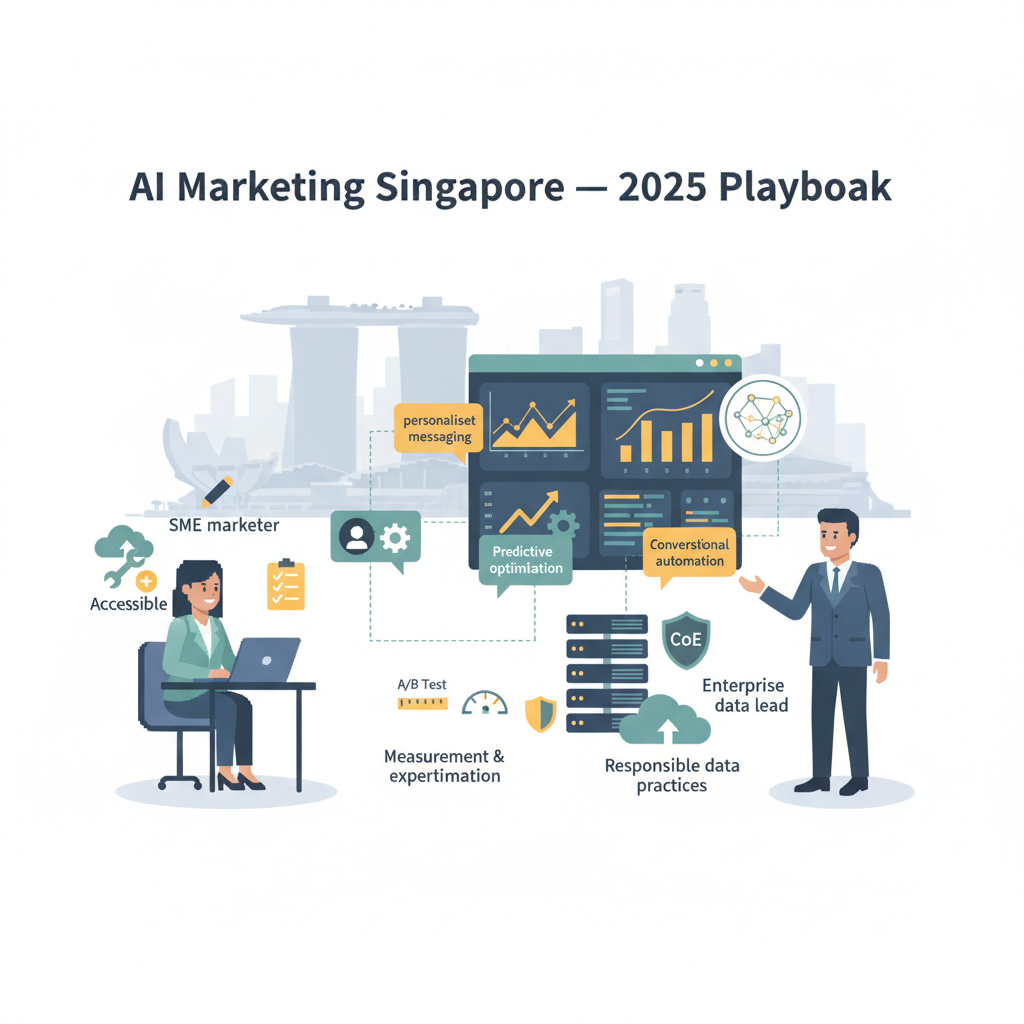
AI Marketing in Singapore: A Comprehensive Playbook for SMEs and Enterprises in 2025
Introduction: Why AI Marketing Matters for Singapore Businesses in 2025
The marketing landscape in Singapore has fundamentally shifted. What was once a speculative technology is now a competitive necessity. In 2024, SME adoption of artificial intelligence tripled from 4.2% to 14.5%, while enterprise adoption climbed to 62.5% [citation]. This acceleration reflects a clear market reality: businesses that integrate AI into their marketing operations are outpacing competitors in customer acquisition efficiency, personalization at scale, and operational productivity.
For Singapore’s SMEs and enterprises, the stakes are particularly high. The city-state’s digital economy reached S$128.1 billion in 2024—representing 18.6% of GDP—and continues to expand rapidly [citation]. Yet this growth is uneven. Larger enterprises with dedicated data and technology teams are pulling ahead, while many SMEs struggle to understand where to start, which tools to adopt, and how to measure success.
This playbook addresses that gap. Over the next sections, we’ll explore the current state of AI marketing in Singapore, examine the tools and use cases delivering measurable ROI today, and provide practical roadmaps for both SMEs and enterprises to implement AI-driven marketing strategies. Whether you’re a marketing leader at a fast-growing startup or managing a team at a multinational corporation, this guide will help you navigate the complexity and unlock the competitive advantage that AI marketing offers.
For broader context on our capabilities, see our digital marketing services.
The State of AI Marketing in Singapore: 2025 Snapshot
Key Trends and Statistics
Adoption momentum: SME AI adoption tripled year-on-year in 2024, reaching 14.5% [citation]. Among firms already using AI, 84% rely on off-the-shelf generative AI tools, 52% use domain-specific AI solutions, and 44% deploy customised or proprietary AI systems [citation].
Workforce integration: Nearly 74% of Singapore’s workforce reported using AI at work, often several times a week or daily [citation].
Economic impact: SMEs using AI under the Productivity Solutions Grant reported average cost savings of approximately 52% in 2024 [citation].
Talent growth: Singapore’s tech workforce expanded to 214,000 in 2024, with particularly strong hiring in AI and data roles [citation].
Regulatory and Market Context
Singapore’s regulatory environment is supportive but requires careful navigation. Local data protection regulations set requirements for how customer data is collected, stored, and used in marketing applications. Additionally, Singapore’s Model AI Governance Framework provides guidance on responsible AI deployment, emphasising transparency, human oversight, and explainability.
- Productivity Solutions Grant (PSG): Subsidises up to 70% of costs for approved AI and digital solutions, making adoption more accessible for SMEs.
- GenAI Sandbox: Allows businesses to test generative AI applications in a controlled environment with regulatory guidance.
- Sectoral AI Centres of Excellence: Industry-specific hubs to co-develop AI use cases.
- TechSkills Accelerator (TeSA) and SkillsFuture: Upskilling programmes to build AI fluency.
How Local Businesses Are Responding
Singapore’s business community is focusing on high-impact, measurable use cases: email personalization, chatbot-driven lead qualification, and predictive analytics for campaign optimisation. The most successful organisations combine clear KPIs, upskilling, and a phased approach that starts small and scales based on proven ROI.
Essential AI Marketing Tools for Singapore SMEs and Enterprises
Overview of Top AI Marketing Tools
Content generation and creative automation
Tools like Jasper, Writesonic, and Frase accelerate content creation for ads, emails, and social posts. They are valuable for multilingual variants and rapid testing. Human editorial oversight remains essential.
SEO and content optimisation
Platforms such as Surfer SEO, SEMrush, Ahrefs, and Frase provide AI-guided keyword research and on-page optimisation with local SERP tracking.
CRM, conversational AI, and sales automation
Pepper Cloud, Zoho Zia, HubSpot, Salesforce, and Pipedrive combine CRM with AI assistants, chatbots, and next-best-action. Local messaging integrations (e.g., WhatsApp) are critical in Singapore. Explore our social media services to pair with conversational automation.
Analytics, attribution, and predictive modelling
Built-in and standalone tools enable causal measurement and LTV/CAC forecasting. Clean data and analytics skills are prerequisites.
Local vs. Global Solutions
Local-first platforms offer regional integrations and support; global suites provide breadth and depth but may require more customisation. The right choice depends on speed-to-value vs. enterprise analytics needs. Ensure brand governance alignment—our branding team can help align AI outputs with your voice.
Criteria for Selecting the Right Tools
- Alignment with priority use cases
- Integration with your stack
- Ease of use and adoption
- Total cost of ownership and ROI timeline
- Data practices and governance
- Vendor stability and local support
High-Impact AI Marketing Use Cases in Singapore
Customer Segmentation and Personalization
AI finds micro-segments via clickstream, transactions, and engagement signals. One retailer saw a 28% increase in repeat purchases in 3 months after micro-segment targeting [citation].
Key metrics: Segment size, segment conversion rates, repeat purchase rate.
Predictive Analytics for Campaign Optimisation
A Singapore B2B company’s lead-scoring model predicted conversion with 78% accuracy; prioritising these leads lifted conversion by 34% [citation].
Key metrics: Model precision/recall, CAC reduction, sales productivity.
Chatbots and Conversational AI
A travel agency’s WhatsApp bot handled ~65% of first-touch inquiries, cut response time to <2 minutes, and qualified 40% of inquiries [citation]. For inspiration, browse our social media portfolio.
Case Studies from Local SMEs and Enterprises
Case 1 (E-commerce): Email personalization lifted open rates by 32% and conversions by 63% in 6 weeks [citation].
Case 2 (Food delivery): AI bidding cut CAC by 41% in 8 weeks [citation]. See more examples in our digital marketing portfolio.
Case 3 (Enterprise B2B): Predictive lead scoring increased conversion for prioritised leads by 34% [citation].
Measuring ROI: How to Quantify AI Marketing Success
Key Metrics and KPIs
- Acquisition: CPA/CPL, ROAS, CAC, CPM
- Engagement: CTR, email open and conversion rates, chat-to-qualified-lead, response time
- Revenue: AOV, LTV, incremental revenue
- Operations: hours saved, automated items, cost savings
ROI Examples
- Email personalization: +32% opens, +63% conversions (6 weeks)
- Campaign optimisation: -41% CAC (8 weeks)
- Lead scoring: +34% conversion for prioritised leads (12 weeks)
For paid activation and media efficiency, explore our advertising services.
Common Pitfalls and How to Avoid Them
- Correlation vs. causation: Use holdouts/A-B tests.
- Data quality: Audit and clean data first.
- Over-automation: Keep human-in-the-loop for customer-facing outputs.
- Compliance: Ensure consent, minimisation, governance.
AI Marketing Strategies for SMEs vs. Enterprises
SME Strategy Priorities
- High-impact, low-complexity use cases first
- Use grants and sandboxes to offset cost
- Hybrid talent: upskill champions + vendor support
- Integration-first tooling
- 8–12 week pilots with clear KPIs
For brand governance as you scale AI content, see our branding approach.
Enterprise Strategy Priorities
- Centre of excellence
- Data infrastructure investment
- Custom models for differentiation
- Governance and monitoring
- Scale across business units
Overcoming Challenges: Adoption, Integration, and Skills
Common Barriers
- Misunderstood business value
- Skills/talent gaps
- Data readiness
- Systems integration friction
- Governance concerns
Solutions for Integration and Upskilling
- API-first SaaS and middleware
- Role-based training; leverage TeSA and SkillsFuture
- Hybrid talent model
- Hands-on experimentation culture
If video is a key channel in your mix, our video production in Singapore capability pairs well with AI-driven testing and optimisation.
Conclusion: Building a Future-Ready AI Marketing Strategy in Singapore
Recap of Key Takeaways
- Start with revenue-linked use cases
- Use available tools and grants
- Measure incrementally and rigorously
- Invest in team upskilling
- Embed governance and responsible AI
The Evolving Role of AI
- Tool consolidation
- Production-grade workflows
- Domain-specific models
- Responsible AI as table stakes
- Talent-driven advantage
Next Steps
SMEs: Define one priority use case, pick 1–2 tools, apply funding, run a 12-week pilot, upskill champions, then scale.
Enterprises: Stand up a CoE, run parallel pilots, strengthen data foundations, deploy custom models, and scale wins.
See how we’ve helped brands like yours in our portfolio.
Contact us to plan your 8–12 week AI marketing pilot and unlock measurable ROI.
Frequently Asked Questions
What’s the best AI marketing tool for a Singapore SME just starting out?
Start with tools that solve your most pressing use case (content, chat, or SEO), integrate with your CRM/analytics, and can be piloted in weeks. Consider local support and funding eligibility.
How long does it take to see ROI from AI marketing?
Most pilots show results within 8–12 weeks. Quick-win use cases can move faster; predictive models may need 12–18 weeks.
What skills do my marketing team need to adopt AI?
Prompt engineering for creatives, experiment design and attribution for growth, and conversational orchestration for ops, plus baseline data literacy and governance awareness.
How do we stay compliant while using AI marketing tools?
Capture consent, minimise data, keep human review for customer-facing outputs, and maintain audit logs. Choose vendors with clear data handling practices.
Should we build custom models or use off-the-shelf tools?
Start off-the-shelf to prove ROI quickly. Consider custom models once data maturity and business case justify the investment.
Related Hamilton & Sherwind resources
- Digital marketing services
- Social media marketing and AI-based engagement
- Branding and AI branding considerations
- AI advertising solutions
- Video production in Singapore
- Singapore brands and success stories
- Digital marketing portfolio
- Social media portfolio
- Contact us for AI marketing
References (to be inserted by editorial)
- Singapore Digital Economy report(s) — exact page for GDP share and contribution [insert link next to claim]
- Model AI Governance Framework — official guidance page [insert link next to mention]
- Productivity Solutions Grant (PSG) — official programme page [insert link next to mention]
- SkillsFuture and TeSA — official programme pages [insert link next to mention]
- Workforce AI adoption studies relevant to Singapore [insert link next to claim]