

SEO Content Strategy Singapore: 2025 Guide for Local Business Success
Introduction: Why a Strong SEO Content Strategy Matters in Singapore for 2025
The digital landscape in Singapore has fundamentally shifted. With over 5.85 million smartphone users and mobile ownership at approximately 80% of the population (Digital 2025 Singapore), the way businesses connect with customers has become inseparable from search engine optimization and strategic content creation. Yet many Singapore business owners still treat SEO as a technical afterthought rather than a core business driver.
In 2025, an effective SEO content strategy is no longer optional—it’s essential for survival and growth. Singapore’s highly competitive market, combined with the rise of AI-powered search and answer engines, means that businesses must be visible not just on page one of Google, but positioned as authoritative sources that AI systems can confidently recommend to users.
This guide walks you through building a localized, actionable SEO content strategy tailored to Singapore’s unique market dynamics. Whether you’re a service provider, e-commerce business, or B2B company, the frameworks and tactics in this article will help you attract qualified local traffic, convert visitors into customers, and build sustainable organic growth.
Understanding the Singapore Digital Landscape
Key trends in digital marketing agency Singapore
Singapore’s digital marketing landscape in 2025 is shaped by three powerful forces: rapid AI adoption, mobile-first consumer expectations, and a shift toward privacy-first, first-party data strategies.
AI as a force multiplier: Digital marketing agencies across Singapore are embedding artificial intelligence into content ideation, social listening, and campaign optimization. Rather than replacing creative teams, AI accelerates workflows—surfacing trending themes, suggesting content formats, and automating routine optimization tasks. The key is combining AI outputs with human editorial oversight to maintain quality and local relevance (Google Blog: AI Overviews).
Omnichannel and personalization: Singapore consumers move seamlessly between apps, search, social media, and physical touchpoints. They expect hyper-personalized experiences across channels. Agencies are responding by integrating customer data platforms (CDPs), consent management platforms (CMPs), and first-party data strategies to deliver relevant messaging without relying on deprecated third-party cookies (Digital 2025 Singapore).
Performance orientation: Singapore clients demand measurable ROI. Vanity metrics like impressions or followers no longer suffice. Agencies are now measured on cost per acquisition (CPA), return on ad spend (ROAS), and lead quality. This shift has made attribution, analytics, and conversion tracking non-negotiable components of any digital strategy.
Local search behavior and consumer expectations
Singapore consumers search with clear intent and expect immediate, relevant results. Understanding their behavior is critical for your SEO strategy.
Mobile-first searching dominates. A large share of local queries originate from mobile devices, often while users are on the move or making immediate purchasing decisions. This means page speed, mobile-friendly design, and click-to-call functionality are not luxuries—they’re requirements.
High-intent, short conversion paths characterize local searches. When a Singaporean searches for “best dentist Orchard” or “HDB renovation cost 2025,” they’re typically ready to take action. Local SEO, optimized Google Business Profiles, and accurate name-address-phone (NAP) data directly influence conversion rates.
Location signals and hyperlocal content work exceptionally well. Campaigns that reference specific neighborhoods, local events, and cultural touchstones achieve significantly higher engagement. For example, brands that aligned content with National Day celebrations saw approximately 27% higher engagement compared to generic campaigns (Digital 2025 Singapore).
Reviews and reputation matter profoundly. In a trust-centric market like Singapore, online reviews and rapid response to customer queries influence purchasing decisions. Integrating reputation management into your local search strategy is essential.
Core Elements of an Effective SEO Content Strategy
Aligning with content marketing Singapore best practices
A strong SEO content strategy in Singapore rests on several foundational elements:
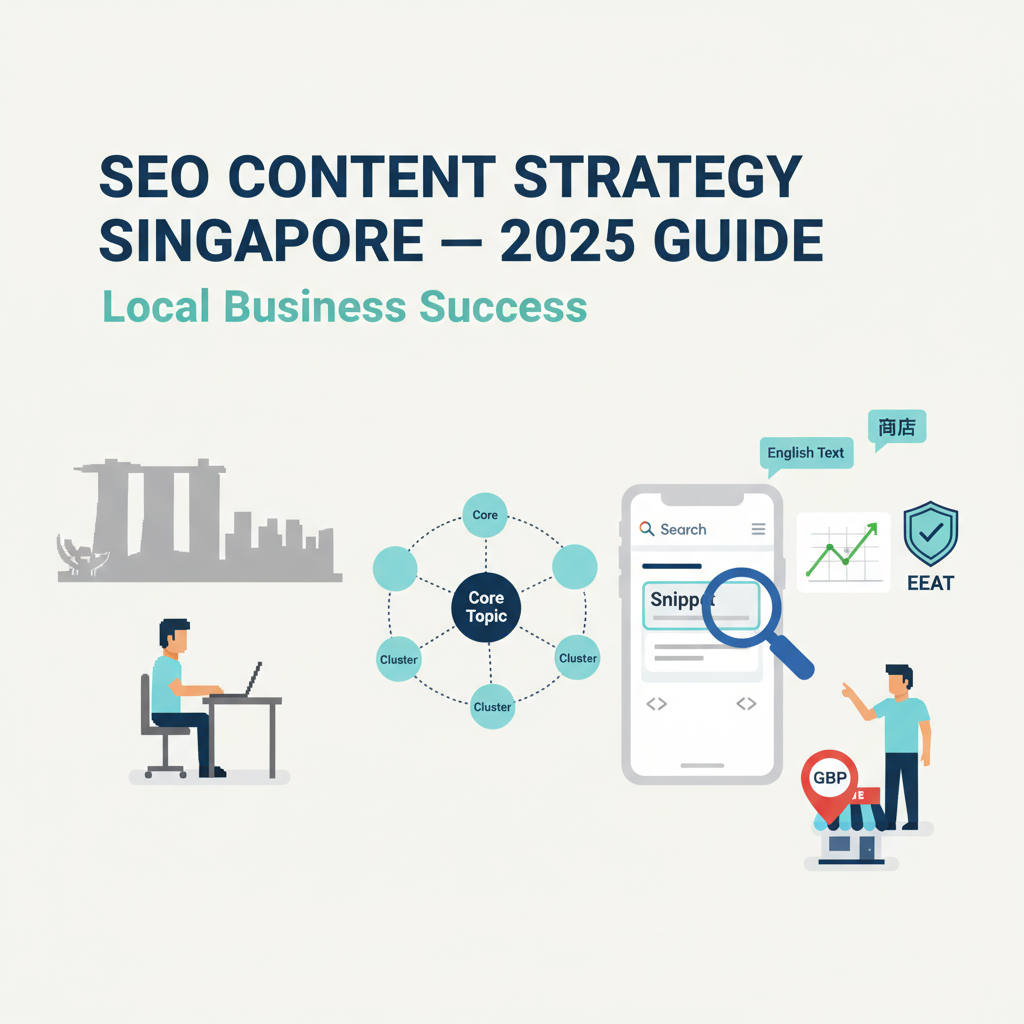
- Topic cluster architecture: Rather than creating isolated blog posts, organize content into pillar guides (comprehensive, authoritative pieces) supported by cluster articles (focused, long-tail pieces). For example, a pillar guide on “Complete Guide to HDB Renovation Singapore 2025” would be supported by cluster articles on district-specific renovations (Tampines, Jurong, Orchard), specific renovation types (kitchen, bathroom), and cost breakdowns. This structure signals topical authority to search engines and improves internal linking (Google Search Central: Featured snippets).
- Local-first and bilingual approach: Target English and Mandarin keyword variants separately. Create neighborhood-specific pages rather than generic citywide content. Hyperlocal pages consistently outperform generic alternatives for high-intent local queries. For instance, “best interior designer Tampines” will rank better than “best interior designer Singapore” for users searching in that district.
- E-E-A-T signals: Expertise, Experience, Authoritativeness, and Trustworthiness are now critical ranking factors. Always include author credentials, first-hand case studies, timestamps showing content freshness, and trust signals like HTTPS, privacy policies, and business registration information.
- Content formats for different stages: Mix long-form pillar guides (authority and ranking), short-form social and video content (awareness and engagement), and concise Q&A-style content (voice search and AI extraction).
Integrating SEO content marketing and user intent
User intent—what the searcher actually wants to accomplish—must drive every piece of content you create.
Search queries fall into four primary intent categories:
- Informational: “How does HDB renovation financing work?” — Users want to learn.
- Commercial: “Best renovation contractor Singapore reviews” — Users are researching options.
- Transactional: “Hire interior designer Singapore” — Users are ready to buy.
- Local: “Renovation contractor near Orchard MRT” — Users want nearby solutions.
Map your target keywords to intent buckets. Then create content that directly addresses that intent. An informational query needs a comprehensive guide; a transactional query needs clear pricing, testimonials, and a call-to-action.
Structure content for AI extraction. Google’s AI Overviews and other answer engines pull content directly from web pages. To be featured, provide concise direct answers (50–120 words) immediately after your H1, use question-based H2/H3 headings, include bulleted lists and numbered steps, and add FAQ or HowTo schema markup (Google Blog: AI Overviews).
Keyword Research for Singapore Businesses
Using SEO keyword research Singapore tools
A robust keyword research toolkit is essential. Here’s what Singapore businesses should use:
- All-in-one platforms: Ahrefs and Semrush both offer strong keyword databases, local SERP analysis, competitor gap analysis, and emerging AI-monitoring features. Both allow you to filter by country (Singapore) and analyze search volume, difficulty, and intent (Google Search Central: Structured data search gallery).
- Google-native tools: Google Search Console provides actual query data and performance metrics for your site. Google Keyword Planner shows search volume and competition levels. Google Trends reveals seasonality and rising queries. Google PageSpeed Insights monitors Core Web Vitals.
- Local and citation tools: BrightLocal and Whitespark specialize in local rank tracking and citation discovery. These are invaluable for monitoring your Google Business Profile visibility and local pack rankings.
- Content optimization tools: Clearscope and SurferSEO score content relevance against top-ranking pages. RankMath and Yoast provide on-page optimization guidance for WordPress sites.
- Question mining: AnswerThePublic and Google’s “People Also Ask” feature surface common questions your audience is asking. These are goldmines for content ideas and featured snippet opportunities.
Identifying local and industry-specific opportunities
A practical workflow for finding high-value local keywords:
Step 1: Audit your current performance. Export queries from Google Search Console filtered to Singapore. Sort by impressions multiplied by low click-through rate (CTR). These pages are ranking but not converting—they need better titles, meta descriptions, or clearer answer sections.
Step 2: Map intent and prioritize. Group queries into intent buckets. Prioritize high-intent local queries for immediate action. These typically convert faster than informational queries.
Step 3: Use local signals. Run Ahrefs or Semrush site/keyword gaps against direct Singapore competitors. Capture marketplace search terms from Shopee and Lazada. Monitor trending keywords on TikTok and Instagram within Singapore.
Step 4: Expand with question mining. Use People Also Ask, AnswerThePublic, and “site:sg” forum searches to surface colloquial phrasing and Mandarin equivalents. Local forums like HardwareZone are goldmines for authentic user language.
Step 5: Validate and prioritize. Check volume with Keyword Planner, seasonal trends via Google Trends, and difficulty via Ahrefs or Semrush. Target a mix of attainable long-tail local queries and one higher-difficulty pillar term per quarter.
Example local keyword opportunities:
- Service + neighborhood: “best dentist Orchard,” “interior designer Tampines,” “moving company Jurong”
- Transactional long-tail: “HDB renovation cost 2025 Singapore,” “affordable moving company Singapore price”
- Question/voice style: “How much is a dental implant in Singapore?” “Can foreigners buy property in Singapore?”
- Mandarin variants: “牙科 医生 新加坡” (dentist Singapore), “室内设计 公司 新加坡” (interior design company Singapore)
Content Creation and Optimization Techniques
Crafting content for SEO content optimization
Creating content that ranks requires balancing human readability with search engine optimization. Here’s the framework:
- Start with user intent and local context. Before opening your keyword tool, document your audience’s need, location, language preference, and likely device. For Singapore, always consider bilingual variants and neighborhood modifiers.
- Conduct people-first research. Combine keyword tools with qualitative signals: customer interviews, online reviews, forum threads, social comments, and local TikTok phrases. This qualitative input helps you craft natural language that matches how real people search.
- Structure for AI and snippets. Answer the user’s question within the first 50–120 words. Use H2/H3 headings phrased as questions. Include bulleted lists, numbered steps, and data tables. Add FAQ and HowTo schema markup. This structure increases your chances of being featured in snippets and AI Overviews.
- Optimize metadata for CTR. Craft meta titles under 60 characters and meta descriptions around 150–160 characters. Include local signals (neighborhood names, price ranges, “near me”) to improve relevance and click-through rates.
- Include EEAT evidence. Add author bylines with credentials, local case studies, client testimonials, and original data. For YMYL topics like finance or health, show verifiable credentials and citations.
- Embed video and visual content. Create short-form videos (30–60 seconds) for YouTube Shorts or TikTok. Embed them on pillar pages with transcripts, captions, and timestamped chapters. Use descriptive filenames and alt text for images. Compress images and use modern formats like WebP to improve page speed.
Leveraging SEO copywriting Singapore principles
- Write for the SERP first. Examine the current search results for your target keyword. If featured snippets dominate, structure your answer to match that format. If People Also Ask boxes are prominent, create FAQ sections that answer those questions.
- Use conversational, voice-search-friendly language. Include natural question phrasings and long-tail conversational variants. For example, “How long does HDB renovation take in Singapore?” captures voice searches better than “HDB renovation timeline.”
- Add a unique differentiator. Original data, a local case study, a downloadable calculator, or an embedded video with a Singapore example sets your content apart from generic AI-generated alternatives. This is how human expertise outperforms thin content.
- Optimize for local relevance. Reference specific neighborhoods, local events, and cultural touchstones. Mention MRT stations, local landmarks, and Singaporean terminology. This signals relevance to both search engines and users.
- Create scannable content. Use short paragraphs, bullet points, and subheadings. Many users scan rather than read. Make key information immediately accessible.
Measuring Success: Analytics and Continuous Improvement
Setting KPIs for SEO services Singapore
Measurement must shift from raw ranking positions to intent fulfillment, engagement, and business outcomes. Here are the primary KPIs to track:
- Discovery and visibility:
- Impressions for target keywords (Google Search Console, country-filtered to Singapore)
- Featured snippet ownership and AI Overview presence
- SERP position for priority local keywords
- Google Business Profile views and actions (directions, calls, website clicks)
- Engagement and quality:
- Organic click-through rate (CTR)
- Dwell time and average engaged time (GA4 ‘engaged sessions’)
- Scroll depth and interaction rate (Hotjar or GA4 events)
- Pages per session and bounce rate for mobile traffic
- Business outcomes:
- Leads from organic (form fills, phone calls tracked via GA4)
- Conversions attributable to organic traffic
- Revenue or transactions from organic (for e-commerce)
- Cost per acquisition compared to paid channels
- Local pack success:
- Visibility in the Google Maps 3-pack
- Direction requests and call clicks from Google Business Profile
- Review volume and average rating
Using analytics to refine your SEO content plan
- Monthly review: Analyze content performance by pillar. Which topics drive the most impressions, engaged time, and conversions? Double down on high-performing topics with additional cluster content.
- Quarterly deep dive: Conduct a content gap analysis against competitors. Identify featured snippet opportunities you’re missing. Review pages with traffic drops and investigate whether Core Web Vitals, EEAT signals, or content freshness are the culprits.
- Continuous optimization: Implement a content refresh schedule. Audit your top 30 pages quarterly for freshness, accuracy, and EEAT improvements. Update publication dates, add new case studies, and refresh statistics.
- Attribution modeling: Use GA4’s multi-touch attribution to understand how organic traffic contributes to conversions. Some users may click organic content, leave, and return via paid ads before converting. Understanding these paths helps you allocate budget effectively.
Future-Proofing Your Strategy: SEO Strategy 2025 and Beyond
Adapting to SEO trends 2025
- Answer engines and zero-click results: Google’s AI Overviews and other LLM-driven results will continue reducing clicks for some queries. The solution is to optimize to be the authoritative source behind answers. Use structured data, clear direct answers, and schema markup to help AI systems confidently recommend your content (Google Blog: AI Overviews).
- AI-assisted indexing and semantics: Search algorithms increasingly use entity and semantic matching. Use schema markup and entity-rich content to help search engines understand context and relationships.
- UX and Core Web Vitals weighting: Page speed, visual stability, and interactivity increasingly affect both rankings and conversions. Treat speed and UX fixes as ranking and revenue work, not just technical debt.
- Visual and voice search growth: Optimize video, images, and conversational long-tail queries. For Singapore, include local and multilingual phrasing used in voice searches.
- Local signals and GBP: Proximity, Google Business Profile completeness, reviews, and local citations gain more weight for “near me” conversions. Maintaining a fully optimized GBP is essential.
Preparing for algorithm updates and evolving user needs
- Monitor updates proactively. Keep a watch feed of Search Engine Land, Moz, and Semrush announcements. When an update hits, prioritize pages with traffic drops and investigate whether Core Web Vitals, EEAT signals, or content quality are the issues.
- Build content resilience. Avoid thin, AI-only content. Always add proprietary local input, case data, author credentials, and original research. Diversify your traffic sources—don’t rely entirely on one keyword or channel.
- Stay ahead of user needs. Conduct quarterly audience research. What questions are your customers asking? What problems are they solving? Update your content strategy to address evolving needs before competitors do.
- Invest in technical excellence. Maintain fast page speeds, mobile-friendly design, and clean site architecture. These fundamentals protect you against algorithm volatility.
Conclusion: Building Sustainable Growth with a Localized SEO Content Approach
An effective SEO content strategy for Singapore in 2025 is not a one-time project—it’s an ongoing commitment to understanding your audience, creating valuable content, and continuously optimizing based on data.
The businesses winning in Singapore’s digital landscape are those that combine global SEO best practices with deep local knowledge. They understand that a Singaporean searching for “interior designer” expects neighborhood-specific results, bilingual content options, and proof of local expertise. They know that mobile speed matters, that Google Business Profile optimization drives conversions, and that authentic, EEAT-rich content outperforms thin AI-generated alternatives.
The frameworks in this guide—topic clusters, intent mapping, local keyword research, content optimization, and analytics-driven refinement—provide a roadmap for building sustainable organic growth. Start with the quick wins: optimize your Google Business Profile, fix critical technical issues, and create one pillar guide with supporting cluster content. Then scale systematically, measuring results and refining your approach quarterly.
The businesses that invest in a localized, strategic approach to SEO content today will capture disproportionate market share tomorrow. Your competitors are likely still treating SEO as an afterthought. Now is the time to build a competitive advantage.
Frequently Asked Questions
How long does it take to see results from an SEO content strategy?
A: Expect measurable traction in 3–6 months for lower-difficulty, long-tail local keywords. Higher-competition pillar topics and significant authority gains typically take 6–12 months. The timeline depends on your starting point, content volume, technical health, and backlink activity. Consistency matters more than speed.
Should I focus on English or Mandarin keywords for Singapore?
A: Both. Singapore is bilingual, and search behavior varies by audience segment. Create separate, naturally localized pages for high-value Mandarin queries rather than literal translations. Monitor search volume and intent for both languages and prioritize based on your target customer profile.
What’s the difference between SEO and content marketing?
A: Content marketing is the broader strategy of creating valuable content to attract and engage audiences. SEO is the practice of optimizing that content to rank in search engines. They’re complementary: great content without SEO optimization won’t reach your audience; SEO without valuable content won’t convert visitors into customers.
How important is Google Business Profile for local SEO?
A: Extremely important. Google Business Profile directly influences local pack rankings, drives direction requests and phone calls, and builds trust through reviews. A fully optimized GBP (bilingual description, high-quality photos, regular posts, prompt review responses) is non-negotiable for any Singapore business targeting local customers.
What’s the best way to handle AI-generated content?
A: Use AI tools for ideation, outlines, and first drafts—but always add proprietary local input, case studies, author credentials, and original research. Fact-check all claims. AI can hallucinate statistics and details. The most effective content combines AI efficiency with human expertise and local knowledge.
How do I measure whether my SEO content strategy is working?
A: Track multiple metrics: impressions and CTR (visibility), dwell time and scroll depth (engagement), form submissions and phone calls (conversions), and revenue attributed to organic traffic (business impact). Use Google Search Console, GA4, and tools like Semrush or Ahrefs to monitor these metrics monthly. Focus on business outcomes, not just rankings.
Should I hire an agency or build an in-house SEO team?
A: It depends on your budget, timeline, and expertise. Agencies bring specialized skills, tools, and external perspective but may lack deep product knowledge. In-house teams understand your business deeply but require training and tool investments. Many Singapore businesses start with an agency for strategy and quick wins, then build in-house capabilities for ongoing optimization.
Internal Links and External Sources
Internal links
- Digital marketing services in Singapore
- Branding services
- Social media marketing
- Video production in Singapore
- Advertising services
- Digital marketing portfolio
- Social media portfolio
- Blog
- Contact Hamilton & Sherwind
External sources (replace [source] placeholders with most relevant)
- Google Search Central: Core Web Vitals
- Google Search Central: Featured snippets
- Google Search Central: Structured data search gallery
- Google Business Profile Help: Add or claim your Business Profile
- Google Analytics 4: Engaged sessions
- Google Blog: AI Overviews in Search
- DataReportal: Digital 2025 Singapore
Talk to a Strategist
Ready to transform your SEO content strategy and capture more local customers? Contact us to discuss a customized approach for your Singapore business.