

Brand Storytelling in Singapore: A Practical Framework for Local Brands
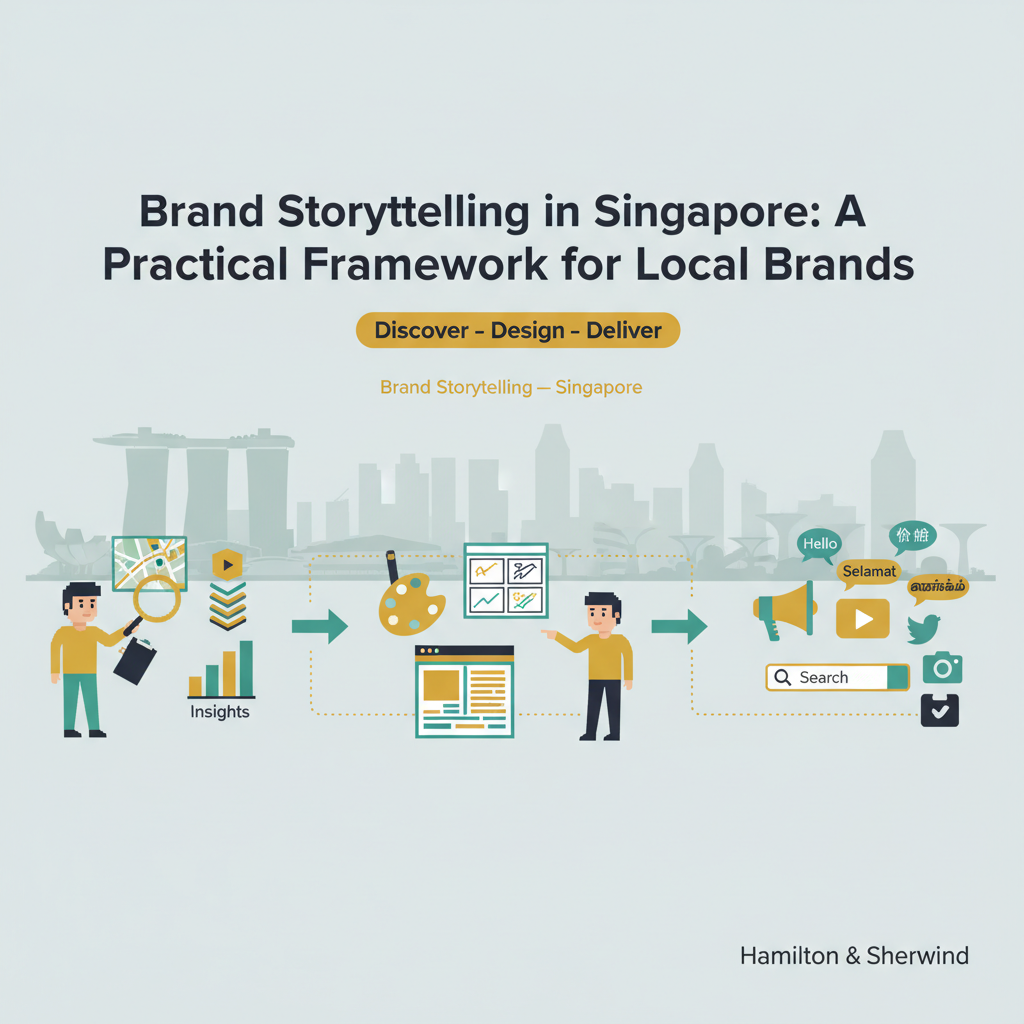
In a market like Singapore, where digital penetration is high, multilingual audiences are the norm, and trust is critical, brand storytelling is not a nice-to-have — it’s a strategic imperative. This long-form guide offers a practical framework tailored for Singapore and Southeast Asia, designed for brand and marketing leaders who want to build durable connections with local audiences. It synthesizes local context, core storytelling elements, a step-by-step framework (Discover–Design–Deliver), channel-adaptive tactics, an implementation playbook with measurement, and tangible examples you can adapt. Throughout, you’ll find precise data anchors, channel-ready templates, and on-site references to Hamilton & Sherwind’s capabilities for brand storytelling services in Singapore.
1. Understanding the Singapore Context for Brand Storytelling
Local consumer behavior and cultural nuances
Singapore’s consumer landscape blends urban speed, affluence, and a rich multiethnic culture. Digital engagement is pervasive, and consumers expect brands to be relevant, responsible, and locally grounded. In a market where trust is a currency, brands win by aligning storytelling with lived experiences—festival rhythms, everyday routines, and community life.
For context, DataReportal’s Digital 2024: Singapore highlights advanced digital usage and social-media engagement patterns, reinforcing why a digitally native, locally aware storytelling approach matters. Best practices rooted in the local marketing culture are codified by the Singapore Tourism Board’s Marketing College — Content Planning & Storytelling. For storytelling fundamentals in a Singapore context, practitioners often reference SMU Academy — Foundations of Brand Storytelling. Strategic perspective: Harvard Business Review on storytelling as a strategic business tool. Journey dynamics: Think with Google — Decoding Decisions: The Messy Middle.
Language considerations in Singapore (English, Mandarin, Malay, Tamil, Singlish)
- Core copy in English for broad reach; bilingual/multilingual variants for targeted communities and cultural calendars.
- Use native linguists for translations that preserve meaning and tone.
- Deploy Singlish sparingly on social to signal authenticity, anchored in a respectful brand voice.
- Localize to channel norms (TikTok, IG, YouTube, Facebook, etc.).
The role of brands in Singapore’s market and consumer trust
- Build narratives around local benefits (time savings, reliability, sustainability) and anchor them with verifiable proof points.
- Demonstrate governance and transparency in communications to accelerate trust.
- Leverage local partnerships and community activities to deepen credibility.
2. Core Elements of a Brand Story
Purpose, audience, character, and conflict
- Purpose: Connect with local needs and be verifiably credible.
- Audience: Define precise Singaporean personas and media habits.
- Character: A local, relatable hero (customer/founder/community archetype).
- Conflict: Real Singaporean challenges (time, cost of living, access, sustainability, trust).
Resolution and brand value proposition
- Resolution: Tangible outcomes (time/money saved, access, safety).
- Value proposition: Concise, proof-backed, and locally nuanced.
Visual and verbal language that resonates locally
- Authentic Singaporean settings and representation.
- English anchor with Mandarin/Malay/Tamil variants for targeted campaigns.
- Respectful, evidence-based tone, especially for sensitive themes.
3. A Practical Framework for Singapore Brands
Discover, Design, Deliver: a step-by-step process
- Discover: Audience/market truths, language preferences, cultural calendars; define KPIs.
- Design: Narrative pillars, archetypes, messaging house, localization rules, templates.
- Deliver: Production, localization, publishing, governance, measurement, optimization.
Templates, playbooks, and governance for local teams
- Narrative Pillar Template; Messaging House; Localization Playbook; Governance Charter.
- Channel Playbooks (Social/Video/Search) with SG-specific rules and asset templates.
- Proof Point Bank (local testimonials, certifications, CSR signals, partner endorsements).
Framework diagram (textual)
Discover → Design → Deliver with a feedback loop; outputs at each stage guide the next, governed by a Brand Story Bible, localization glossary, and governance charter.
4. Adapting Stories to Singapore Channels and Formats
Digital ecosystems (social, video, search)
Non-linear journeys require multi-stage content. See Think with Google — The Messy Middle.
- Social: Short-form video, carousels, Stories/Reels; localized captions and overlays.
- Video: YouTube long-form with subtitles; Shorts/Reels for quick engagement.
- Search: Multilingual landing pages answering local queries.
Localized content formats and campaigns
- Reflect daily life (commutes, hawker culture, HDB living) and festival moments.
- Campaigns: festival narratives, community case studies, how-to series, ESG stories.
- English-led copy with Mandarin/Malay/Tamil overlays where relevant.
Compliance, ethics, and cultural sensitivity
Adhere to ethical standards, clear consent for testimonials/data, and avoid misleading claims. Align with local advertising norms. (Avoid legal PDPA guidance.)
5. Implementation Playbook and Measurement for Local Teams
Content calendar, cross-functional governance
- Quarterly calendar with language variants and festival alignment.
- Role clarity; sign-off gates; recurring reviews.
- Shared Brand Story Bible and localization glossary.
Metrics and experiments to track ROI
- Trust: brand lift, NPS, sentiment.
- Engagement: reach, view time, completion rate, shares/comments.
- Conversion: clicks, conversions, ROAS, incremental revenue.
- Channel: ROI, cost-per-result, attribution accuracy.
- Compliance: moderation quality, policy adherence, consent rates.
Experiments: language-variant A/B tests; multilingual landing pages; neighborhood-targeted creatives; channel mix optimization.
Working with Singapore agencies and partners
- Clear onboarding with localization kits and Brand Story Bible.
- Set native-language, cultural, and compliance expectations.
- Transparent reporting with shared dashboards.
6. Brand Storytelling Examples (Singapore/SEA)
What makes an example effective
- Local relevance, authentic voices, measurable proof, channel-fit execution.
Translating inspiration into your playbook
- Extract core elements; map to pillars/archetypes.
- Create channel templates; build a proof-point bank.
- Establish governance and review cadences.
- Align with branding services, digital marketing, and social media execution as needed.
Explore our branding portfolio and video storytelling portfolio for real-world outcomes and approaches we’ve taken across Singapore and SEA.
7. Frequently Asked Questions (FAQ)
What is brand storytelling, and why is it particularly important in Singapore?
Brand storytelling is the deliberate crafting of a narrative that connects a brand’s purpose, values, and benefits to the needs and lives of its audience. In Singapore, a high-trust, multilingual market with high digital engagement makes storytelling essential to explaining value quickly and credibly across channels and communities.
How should I approach multilingual storytelling in Singapore?
Start with English as the core, then layer in Mandarin, Malay, and Tamil where strategically relevant. Use native-language reviewers and culturally aware translation practices to preserve meaning and tone. Singlish can be used sparingly on social channels to convey authenticity.
How can I measure the ROI of brand storytelling?
Build a dashboard that tracks trust metrics (NPS, sentiment), engagement metrics (watch time, shares, comments), and conversions (impressions-to-conversions, ROAS). Run controlled experiments (A/B tests across language variants, landing pages, and creative formats) to quantify incremental impact.
How do I partner with Singapore agencies for storytelling?
Define scope, SLAs, and sign-off gates clearly; provide a localization kit and Brand Story Bible; ensure native-language capabilities and regulatory awareness. Establish cadence for reviews and performance reporting.
How can I start quickly if my team is resource-constrained?
Begin with a Discover–Design–Deliver mini-framework: identify 2–3 pillars, 1–2 hero archetypes, and a handful of localization templates; run a 90-day pilot across 2 channels to learn quickly before expanding.
Conclusion: Bringing it all together for Singapore brands
Brand storytelling in Singapore is a disciplined, locally grounded approach that connects the brand’s purpose to the daily lives of diverse audiences. Success comes from Discovering local truths, Designing a scalable system (pillars, voice, localization), and Delivering consistently with governance and measurement. For deeper guidance, browse our blog, explore our branding work, review our services, and engage our video storytelling capabilities.
Ready to bring your brand storytelling to life in Singapore and SEA? Contact Hamilton & Sherwind