

AI-driven marketing personalization for Singapore SMEs in 2025: a practical playbook
Why AI MARKETING PERSONALIZATION matters for Singapore SMEs
Personalization is no longer a luxury for Singapore SMEs—it is a practical necessity. In a market where consumers interact with brands across multiple channels and devices, delivering relevant, timely experiences is a differentiator that can translate into stronger leads, higher conversions, and more loyal customers. For small and mid-size businesses with limited budgets, AI-driven personalization offers a way to punch above their weight by automating insight-driven decisions at scale.
Why it matters, in pragmatic terms:
- Relevance at scale: Personalization helps each customer see offers and information that align with their interests, behaviors, and stage in the buyer journey. That relevance compounds across emails, website experiences, messaging apps, and ads.
- Efficiency and velocity: AI accelerates content production, experimentation, and optimization. SMEs can launch more tests, more quickly, without needing large teams.
- Channel coherence: A consistent, personalized experience across website, email, chat, and social reduces friction and builds trust.
- Competitive edge for SEA SMEs: In Southeast Asia, where consumer touchpoints are diverse and multilingual, AI enables localization and rapid adaptation to local preferences and buying signals.
What this means for Singapore SMEs in 2025
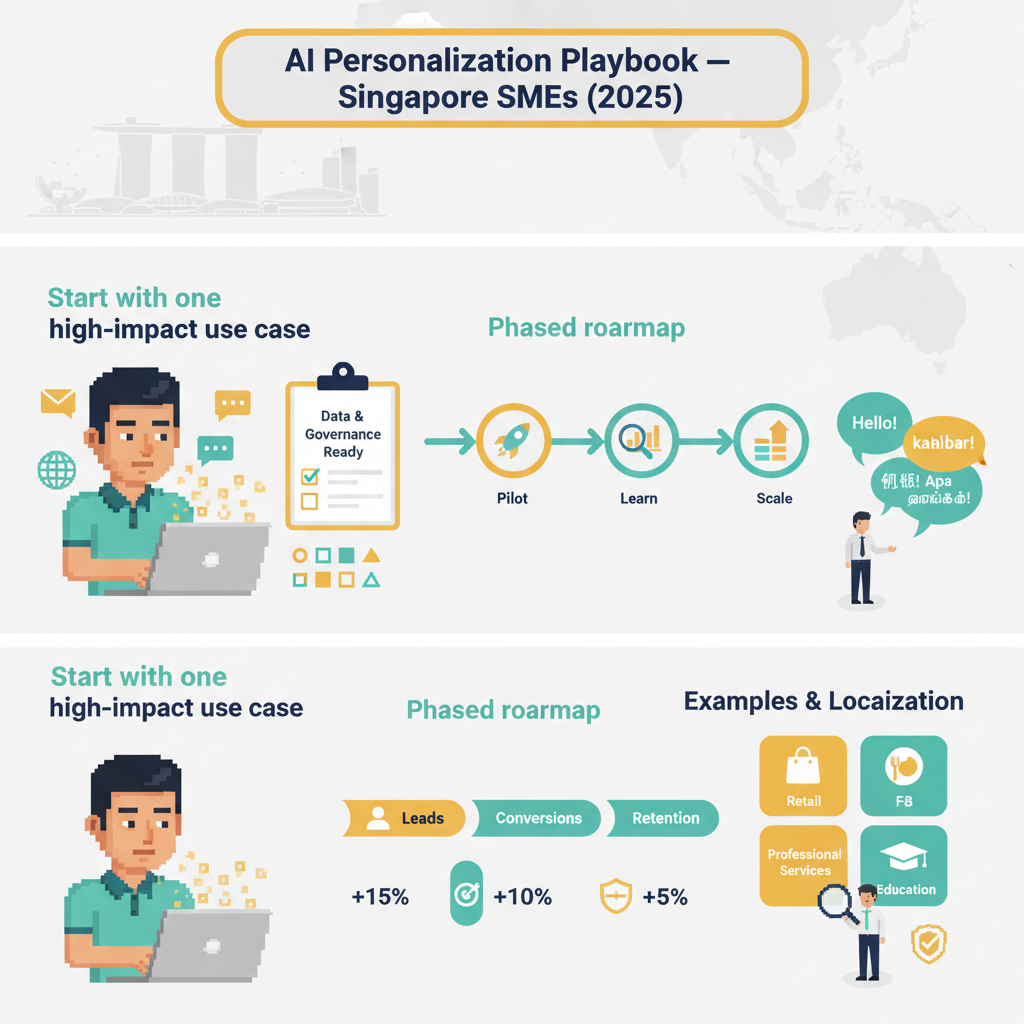
- Start with a narrow, high-impact use case, then expand. A small pilot—such as personalized product recommendations on your site or tailored email journeys—can demonstrate tangible value before broader rollout.
- Leverage the local ecosystem. Singapore’s programs and ecosystem partners provide access to governance, tooling guidance, and potential grants that reduce the risk of early-stage AI projects. This is especially helpful for SMEs with resource constraints.
- Prioritize data readiness and governance. AI personalization is only as good as the data and processes behind it. A clear data map, simple consent practices, and editorial guardrails protect both performance and brand integrity.
- Be multilingual and culturally aware. Singapore and the wider SEA market require content and interactions that respect language preferences and cultural nuances. AI can help scale localization, provided you monitor quality and tone.
- Embrace responsible AI. Use human-in-the-loop oversight for content, ensure transparency about AI-generated interactions, and implement checks to mitigate bias and misrepresentations.
Examples across four sectors to illustrate practical use
- Retail: A small boutique uses AI to tailor on-site product recommendations and follow-up emails based on browsing and purchase history. The store also runs simple A/B tests on dynamic product bundles to increase average order value.
- F&B: A cafe uses a WhatsApp-based personalized menu suggestion and time-of-day promos. AI helps craft concise, locally resonant messages in English and one additional language (e.g., Mandarin or Malay) to reach more customers.
- Professional services: An accounting firm uses targeted content recommendations (blog topics, checklists, whitepapers) for different client segments (SMEs, startups, nonprofits) and schedules appointment reminders with personalized value props.
- Education: A private learning center segments prospects by course interest and delivery mode (online vs. in-person), delivering tailored course bundles and reminder nudges aligned with enrollment windows.
A quick-start checklist for week-one to week-four
- Clarify a single, high-impact personalization use case.
- Inventory existing data sources (CRM, website analytics, support, email history, sales). Identify what data is clean, where gaps exist, and how data could be unified.
- Map channels you will affect first (website, email, WhatsApp, social, ads) and decide a primary channel for the pilot.
- Design a lightweight governance plan (who approves content, who monitors data quality, how bias is checked).
- Establish basic consent and transparency practices (clear notices about personalization and easy opt-out paths).
- Choose a lean tool stack (categories only: CDP/CRM, marketing automation, email, analytics, experimentation). Ensure tools can integrate with your primary channels and support localization.
- Set 2–3 simple success metrics (e.g., improved open rates or click-through rates, early indicators of conversion lift, customer engagement on top channels).
- Plan a short, 6–8 week pilot with a clear start and stop criteria.
Quick wins and ROI for Singapore SMEs
Fast, practical wins deliver early value and reduce risk. Use these as building blocks to prove the case for broader personalization investments.
High-impact quick wins
- Email personalization with minimal lift: Personalize subject lines and recommended products based on recent activity and profile data. Start with a single trigger (e.g., post-purchase cross-sell or browse abandonment) and expand over time.
- On-site dynamic experiences: Implement a lightweight on-site recommendation widget or personalized landing pages that adapt to visitor segments (new visitor vs. returning customer, language preference).
- Conversational AI for common interactions: Deploy chat or messaging automation to handle routine inquiries, appointment bookings, and basic support. Human agents remain on standby for complex issues.
- Localized, multichannel content testing: Run small A/B tests on landing pages or ads with multiple language variants and culturally resonant visuals.
- Simple lifecycle journeys: Create a few starter journeys (welcome series, post-purchase thank-you, re-engagement) with personalized content and offers.
ROI-focused testing framework (simple)
- Define 2–3 primary KPIs per pilot (lead quality, conversion rate, CAC, retention, or LTV).
- Use a control vs. a single variant approach (A/B) for each test.
- Keep test scope small and time-bound (e.g., 2–4 weeks per test) to quickly learn and reallocate budget.
- Track efficiency gains (e.g., content production hours saved, faster campaign setup) separately from revenue metrics.
- Document learnings and a concrete scale plan if results show a positive signal.
Concrete SME-level scenarios (examples)
- Retail: A family-owned shop runs a weekly email with personalized product bundles based on customers’ past purchases and browsing behavior. ROI signal: higher open rates and modest lift in cross-sell conversions.
- F&B: A neighborhood cafe uses a WhatsApp broadcast for personalized daily specials by language group. ROI signal: increased customer visit frequency and redemption of localized promos.
- Professional services: An architecture firm sends personalized industry guides to target segments (SMEs, homeowners, developers) and tracks engagement with each guide. ROI signal: more qualified inquiries and shorter sales cycles.
- Education: A language-center uses behavior-based reminders and personalized course bundles to re-engage leads who showed interest in a course but did not enroll. ROI signal: higher enrollment rates and shorter decision times.
Measurement and learning in the quick-win phase
- Track KPI trends (even if approximate) to validate intent: leads, conversion rate, CAC, revenue per user, retention, AOV.
- Capture qualitative feedback from customers on relevance and clarity of personalized interactions.
- Use simple uplift tests: compare performance of personalized experiences to non-personalized baselines.
Data readiness and governance for AI-DRIVEN PERSONALIZATION
Data readiness and governance are the backbone of effective AI-driven personalization. Without clean data, consistent identifiers, and clear governance, personalization efforts stall or misfire.
Data readiness foundations
- Data inventory: Catalog customer data across sources (CRM, website analytics, e-commerce, support, offline interactions) and identify what can be used for personalization.
- Identity resolution and unification: Plan how to map customer identities across channels (e.g., email, phone, loyalty numbers) so that a single customer view can be built.
- Data quality and cleanliness: Establish basic data hygiene practices (deduplication, standardization, and validation) to improve model inputs.
- Data minimization and relevance: Collect only what is needed for personalization; avoid overfitting by limiting the scope of data features to meaningful signals.
- Language and localization data: Maintain language preferences and locale data to support multilingual personalization.
Governance and ethics
- Roles and ownership: Define a lightweight governance structure (data steward, marketing owner, and a model governance liaison) to oversee data usage and output quality.
- Consent, transparency, and trust: Communicate clearly when personalization is in use and provide straightforward opt-out mechanisms. Be transparent about AI-generated content where appropriate.
- Bias mitigation and content safety: Build guardrails to identify and correct biased outputs, ensure factual accuracy, and maintain brand voice.
- Data security and access control: Limit access to sensitive data, implement role-based permissions, and monitor for unusual activity.
- Documentation and versioning: Keep a simple log of data sources, model iterations, and decision rules to support auditability and troubleshooting.
Data integration and tooling considerations
- Data plumbing: Plan integrations between your CDP/CRM, website, and marketing automation tools so data flows smoothly for real-time or near-real-time personalization.
- Multichannel alignment: Ensure that personalization signals can be used consistently across website, email, chat, and ads.
- Localization support: Ensure the data model accommodates language and locale preferences, enabling region-specific messaging.
- Vendor flexibility and governance: Favor tools with transparent data-handling practices, clear pricing, and robust governance features that suit SME budgets.
A pragmatic 6-step data readiness checklist
- Create a simple data map of sources and key fields needed for personalization.
- Define a single customer identity schema to unify records across channels.
- Establish data quality checks (mandatory fields, deduplication, and consistency across sources).
- Document consent and personalization opt-ins, with clear opt-out paths.
- Set up a lightweight governance process for content quality and outputs.
- Plan a staged data integration approach with milestones for the pilot.
Practical AI techniques for marketing personalization
A toolkit of methods and technologies that enable practical personalization, designed to be affordable and implementable for SMEs.
Categories of tools and capabilities (vendor-neutral)
- CDP/CRM and data orchestration: Unify customer data and create persistent profiles that power personalization decisions.
- Marketing automation and email: Automate personalized journeys and trigger-based messaging across channels.
- Content and creative tools: AI for drafting copy, generating visuals, and producing video assets at scale.
- Advertising platforms with AI features: Dynamic creative optimization, audience segmentation, and automated bidding for more relevant ads.
- Analytics and experimentation: Built-in analytics for channel performance; experimentation tools for A/B testing and uplift measurement.
- Personalization engines: Lightweight recommendation and segmentation capabilities to tailor content and offers.
Best practices for SME teams
- Start small, iterate fast: Choose a few high-impact use cases and iterate quickly on those before expanding.
- Combine automation with human oversight: Use AI to draft content and responses, but assign a human editor to confirm accuracy and tone.
- Localize with care: Ensure multilingual support and culturally appropriate messaging to resonate with Singapore’s diverse market.
- Monitor for quality, not just efficiency: Track content quality, relevance, and user satisfaction, in addition to standard performance metrics.
- Build governance into workflows: Include editorial checks, content approvals, and risk flags as part of standard processes.
What to measure (KPIs aligned to SME outcomes)
- Leads and conversions: number of qualified inquiries and conversion rate from personalized messages.
- Revenue metrics: average order value (AOV), revenue per user, customer lifetime value (LTV).
- Costs and efficiency: customer acquisition cost (CAC), hours saved, campaign time-to-market improvements.
- Retention and engagement: repeat purchase rate, engagement with personalized content, and churn indicators.
- Quality and safety: number of content approvals required, policy violations, and bias flags identified.
Generative AI for content and creatives
Content generation and creative assets are often the fastest path to scale personalization. When used responsibly, generative AI can accelerate output while maintaining brand integrity.
Key capabilities
- Copy and subject lines: Draft body copy, headlines, email subject lines, and landing page copy tailored to segments.
- Visuals and video: Generate or enhance visuals for ads and social content; produce short explainer videos or hero images with localized visuals.
- Multilingual content: Create content in multiple languages or translate with localization notes to preserve nuance.
- Content normalization and adaptation: Convert generic content into region-specific variants while preserving brand voice.
Best-practice guardrails for SG SMEs
- Human-in-the-loop review: Always have a human editor review AI-generated content for accuracy and tone.
- Brand guardrails: Predefine tone, style, and factual constraints to guide AI outputs.
- Authenticity and transparency: Clearly label AI-assisted content where appropriate and avoid misrepresenting information.
- Bias checks: Run outputs through tests to identify biased or unfair representations and correct them before publishing.
Practical implementation tips
- Start with templates: Use AI to draft content from templates with inputs like audience segment, offer, and language preference.
- Create modular assets: Generate reusable blocks (headlines, CTAs, short descriptions) that can be mixed and matched for different campaigns.
- Track performance per variant: Color code or tag variants to monitor which combinations perform best by channel and language.
Implementation roadmap for SG SMEs
A clear, phased plan helps SG SMEs move from concept to execution with guardrails and measurable outcomes.
Phase 0 — Readiness and governance
- Define personalization goals aligned with business outcomes (leads, conversions, retention, AOV).
- Establish lightweight governance: roles, approvals, and content review processes.
- Inventory data sources and channels; identify priority integration points.
- Set expectations for what AI will and will not do; ensure transparency with customers.
Phase 1 — Data alignment and pilot
- Build a unified customer view (identify and resolve overlapping identities across systems).
- Clean and curate essential data; implement basic consent and privacy practices.
- Select a lean pilot use case (e.g., personalized emails and on-site product recommendations).
- Set up an experimentation plan (A/B test, control group, performance metrics).
Phase 2 — Channel-specific pilots
- Implement personalization on primary channels (email, website, and a messaging channel like WhatsApp).
- Deploy a simple content and creative generator for the pilot; incorporate human review steps.
- Monitor performance, gather qualitative feedback from customers, and refine models.
Phase 3 — Scale and optimization
- Expand personalization to additional channels and languages; replicate successful patterns.
- Increase data enrichment and segmentation sophistication where it yields ROI.
- Strengthen governance and risk management; update guidelines as tools and markets evolve.
Phase 4 — Capabilities and ecosystem growth
- Invest in internal AI literacy and cross-functional AI governance.
- Build partnerships with local solution providers and ecosystem programs to access new capabilities and manage costs.
- Regularly review performance, data quality, and content integrity; adjust budget and strategy accordingly.
A practical 90-day starter plan (sample deliverables)
- Quarter 1 deliverables:
- 1-page business case for the pilot
- Prioritized use-case list
- Data readiness assessment
- Pilot plan with success metrics
- Quarter 2 deliverables:
- Implement pilot on a primary channel
- Governance checklist and editorial workflow
- KPI dashboard
- Quarter 3 deliverables:
- ROI report and learnings memo
- Scaling plan for additional channels/use cases
- Quarter 4 deliverables:
- Scaled personalization roadmap
- Budget and risk framework
- Governance updates
Singapore-specific considerations and guardrails
- SME resource constraints: Design pilots that deliver visible ROI quickly; leverage ecosystem programs that support AI adoption to offset costs.
- Multilingual reach: Prioritize languages that matter to your customer base; ensure content quality across languages to avoid misinterpretation.
- Cultural nuances: Tailor campaigns to local preferences and holidays; avoid generic messaging that may feel out of touch.
- Governance and ethics: Use a transparent approach to AI usage, maintain editorial checks, and monitor outputs for bias or misinformation.
- Security and data handling: Keep data access limited to essential teams; implement clear retention and deletion policies.
Conclusion: Next steps for Singapore SMEs
Singapore SMEs can operationalize AI-driven personalization in a practical, cost-conscious way by starting small, staying governance-minded, and scaling as ROI becomes evident. The playbook above emphasizes a lean data foundation, responsible AI practices, and a phased roadmap that respects SME budgets and timelines. By focusing on a few high-impact use cases, SMEs can accelerate growth, improve customer experiences, and stay competitive in a dynamic Southeast Asian market.
Next steps you can take today
- Conduct a quick readiness check: identify 1–2 use cases with the highest potential impact and a realistic ROI pathway.
- Map your data and channels: know where customer data lives and how it flows between systems.
- Choose a lean pilot: select a channel (email or website) and a simple personalization rule to test.
- Establish governance: set up a content review process and a basic consent/opt-out approach.
- Plan for quick wins and learning: schedule a 2–4 week cycle for one A/B test and one content experiment.
Further reading and sources
- McKinsey: Unlocking the next frontier of personalized marketing
- Forbes: AI and Personalization in Marketing
- Salesforce: AI Personalization
- IBM: AI Personalization
- Harvard Business Review: How AI can scale personalization and creativity in marketing
- Bloomreach: AI personalization examples and challenges
- NTU: Transforming marketing for SMEs in Singapore (generative AI)
Ready to personalise your marketing with AI?
We can help you design a 90-day pilot, set up the right guardrails, and scale what works across channels. Contact Hamilton & Sherwind to get started.