

Programmatic SEO and AI Content Operations: A 2025 Singapore Playbook
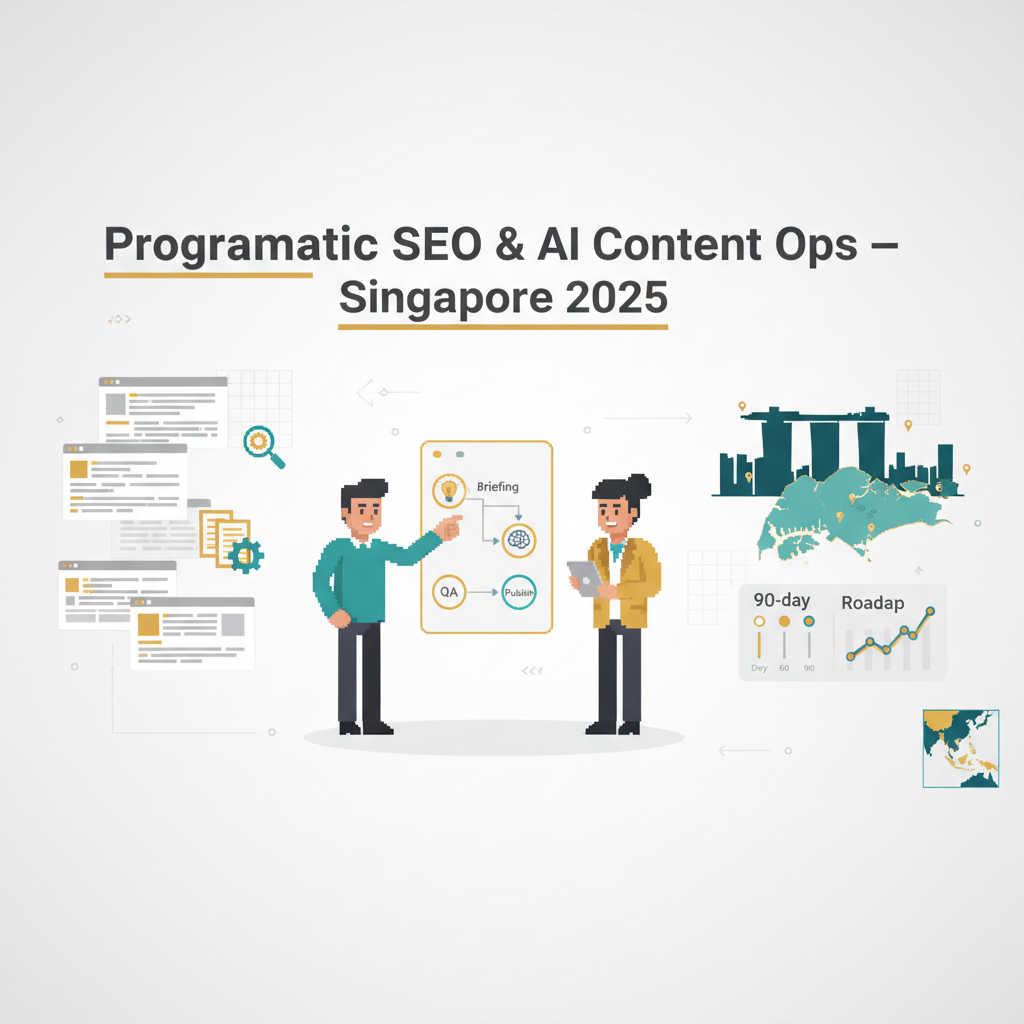
Singapore 2025 Playbook for PROGRAMMATIC SEO and AI CONTENT OPERATIONS
In 2025, programmatic SEO is less a niche tactic and more a scalable operating model for local-market growth. It leverages templated pages that are automatically populated with data to create many high-value pages, each tailored to a specific combination of location, service, or category. AI content operations multiply that velocity—allowing teams to brief, generate, QA, and publish at scale without sacrificing relevance or brand integrity.
This playbook is designed for marketing and SEO leaders in Singapore and across SEA who are building local-market presence for SMEs, marketplaces, multi-location brands, SaaS platforms, or e-commerce players. It explains what programmatic SEO is, why it matters in 2025, how AI content operations become a force multiplier, and who benefits in the Singapore context. You’ll find practical frameworks, step-by-step playbooks, and SG-specific examples you can adapt quickly. This approach pairs well with our Digital Marketing Services and ensures brand consistency in line with our Branding practice.
Foundations of PROGRAMMATIC SEO
1.1 Core concepts
- Templated pages: Build a single, solid template that can be populated with data to produce hundreds or thousands of pages. The template should include SEO basics (title tag, H1, meta description), internal linking logic, and modular content blocks that can be swapped in and out per page.
- Data-driven keyword targeting: Identify scalable patterns that can fill pages across locations and services (for example, “Best [service] in [planning_area]” or “[category] providers in [planning_area]”). Use data signals (volume, relevance, competition) to prioritize patterns.
- Local relevance with scale: In Singapore, neighborhoods and planning areas (Marina Bay, CBD, Bukit Timah, Woodlands, etc.) are critical signals. Tie pages to planning areas, landmarks, and local experiences to boost relevance.
SG-focused tip: Map your templates to SG planning areas and common local intents. Build city hubs that aggregate local content and feed deeper service-area pages for each neighborhood.
1.2 The programmatic SEO stack
- Data sources: internal catalogs/listings, OneMap and data.gov.sg datasets, and licensed partner feeds.
- Schemas and structured data: leverage LocalBusiness, Organization, Service, Offer, FAQPage, BreadcrumbList, ItemList, and GeoCoordinates, following Google’s structured data intro and Schema.org vocabulary. Ensure compliance with structured data policies.
- CMS and templates: no/low-code (e.g., WordPress, Webflow) or headless stacks, depending on capability and scale.
- Automation glue: ETL pipelines, page generation automations, and data lineage with lastUpdated.
- SG-specific governance: localization readiness, SG infrastructure performance, and minimal personal data exposure.
1.3 Opportunity sizing and risk assessment
- Opportunity sizing: model traffic with volume × CTR × share; estimate conversions and value by planning area.
- Risks: thin content, duplication, quality signals, data freshness, incorrect localization, and crawl/indexation waste.
- Performance and UX: optimize for Core Web Vitals (LCP, CLS, INP) to improve discoverability and user experience, grounded in Web Vitals.
Implementing AI CONTENT OPERATIONS
2.1 Workflow design
A practical end-to-end workflow for Singapore-based teams spans briefing → AI generation → human QA → publishing → measurement.
- Briefing: page type, SG intents, data inputs, and tone/formatting rules.
- AI generation: modular prompts for outlines, copy, metadata, and schema.
- Human QA: local relevance, tone, accuracy, and data validation.
- Publishing: versioning and automated checks (schema, links, performance).
- Measurement and iteration: track velocity and outcomes; refine prompts/templates.
SG playbook note: Use a lightweight approval gate for high-visibility SG pages (hubs and category hubs) to preserve brand safety and accuracy.
2.2 Prompt systems and reusable templates
- Build modular prompt libraries for outlines, copy blocks, metadata, and JSON-LD.
- Reusable blocks: Hero, Local Intro, Listings Grid, Map, FAQ, Local Stats, Case Study.
- SG localization prompts: planning areas, landmarks, SGD, SG time/date formats.
2.3 Quality, governance, and brand safety
- Quality standards: factual accuracy with citations; consistent brand voice. See our Branding approach for maintaining tone and identity.
- Governance: tiered reviews, publishing checklists (data provenance, freshness, schema validity, internal links).
- Responsible AI: align with Google’s guidance on AI content and the helpful content principles; avoid spam patterns per core update spam policies.
2.4 Measurement
- Leading indicators: content velocity, freshness, schema pass rate, early engagement.
- Lagging indicators: SG organic sessions, CTR, average position, conversions, local engagement.
- Segmentation: analyze by planning area, category, and template.
Data-driven SEO and Governance
3.1 Building the entity and topic model
- Entities: PlanningArea, Location, Category, ServiceOffering, Listing/Vendor, Page.
- Architecture: pillar → cluster (by planning area) → listings.
- Internal links: hubs → clusters → listings; cross-linking reinforces topical authority. For inspiration on how consistent identity supports this, explore our Branding Portfolio.
3.2 Structured data, page templates, and dynamic components
- JSON-LD schemas for SG pages (LocalBusiness, Organization, Service, Offer, FAQPage, BreadcrumbList, ItemList) based on Schema.org developer docs and JSON-LD best practices.
- Dynamic UI: HubTemplate, ClusterTemplate, ListingTemplate, MapBlock, FAQBlock.
3.3 Technical foundations
- Crawl budget: prioritize hubs/clusters; no-index low-value edges.
- Sitemaps & pagination: sitemap index + canonicalization; consistent URL design.
- Performance & accessibility: optimize Core Web Vitals and mobile UX.
3.4 Experimentation
- A/B test titles, metas, and block variants; pre-register analysis where feasible.
- Track leading and lagging indicators; use SG segment analysis.
Singapore-specific playbook and data sources
4.1 Local data sources and case templates
- Local data: OneMap (coordinates/borders), data.gov.sg (planning areas, contextual datasets), internal catalogs, vendor feeds, events.
- Case templates: by planning area, events-driven, rates/promotions, directories with enrichment.
4.2 Localization: currency, language, UX, cultural cues, trust signals
- SGD formatting; price validity windows when applicable.
- English default; multilingual readiness with glossary/translation memory.
- SG addresses and date formats; landmarks and local testimonials with consent.
4.3 Team and vendor operating model
- In-house: strategy, localization standards, governance, QA. Agency: scale execution, templating, ingestion pipelines.
- Timelines: 2–4 months to lay foundations; 4–8 months to reach 100–500 SG pages.
4.4 90-day roadmap for a Singapore brand
- Weeks 1–4: scope, glossary, data provenance; build hub/cluster templates; connect data sources.
- Weeks 5–8: pilot SG pages; publish and QA.
- Weeks 9–12: scale coverage; tighten governance; implement dashboards; start multilingual readiness.
Conclusion: Key takeaways for 2025 SG
- Build a SG-native data backbone and entity model.
- Localize first; then scale hubs, clusters, and listings.
- Use modular templates for speed and consistency.
- Enforce governance: provenance, freshness, schema validity, internal links.
- Invest in crawl hygiene and rich results with valid structured data.
- Measure leading vs. lagging indicators; segment by planning area.
- Adopt a hybrid operating model for speed with control.
Explore how these methods integrate with our Digital Marketing Services and the brand systems showcased in our Branding Portfolio.
Ready to speak with Hamilton & Sherwind?
If you’re ready to translate this Singapore-focused playbook into action, schedule a conversation with Hamilton & Sherwind. We’ll tailor a 90-day SG rollout plan, align governance and data provenance standards to your stack, and design a pragmatic path to scalable, local-market success.
References
- Core Web Vitals – official documentation (Google)
- Web Vitals overview
- Intro to structured data (Google)
- Structured data policies (Google)
- Schema.org – core vocabulary
- Schema.org – developer documentation
- JSON-LD best practices
- Helpful content update (Google)
- Google Search and AI content (official guidance)
- Core update spam policies (Google)