

AI-driven marketing for Singapore SMEs: practical MarTech playbook
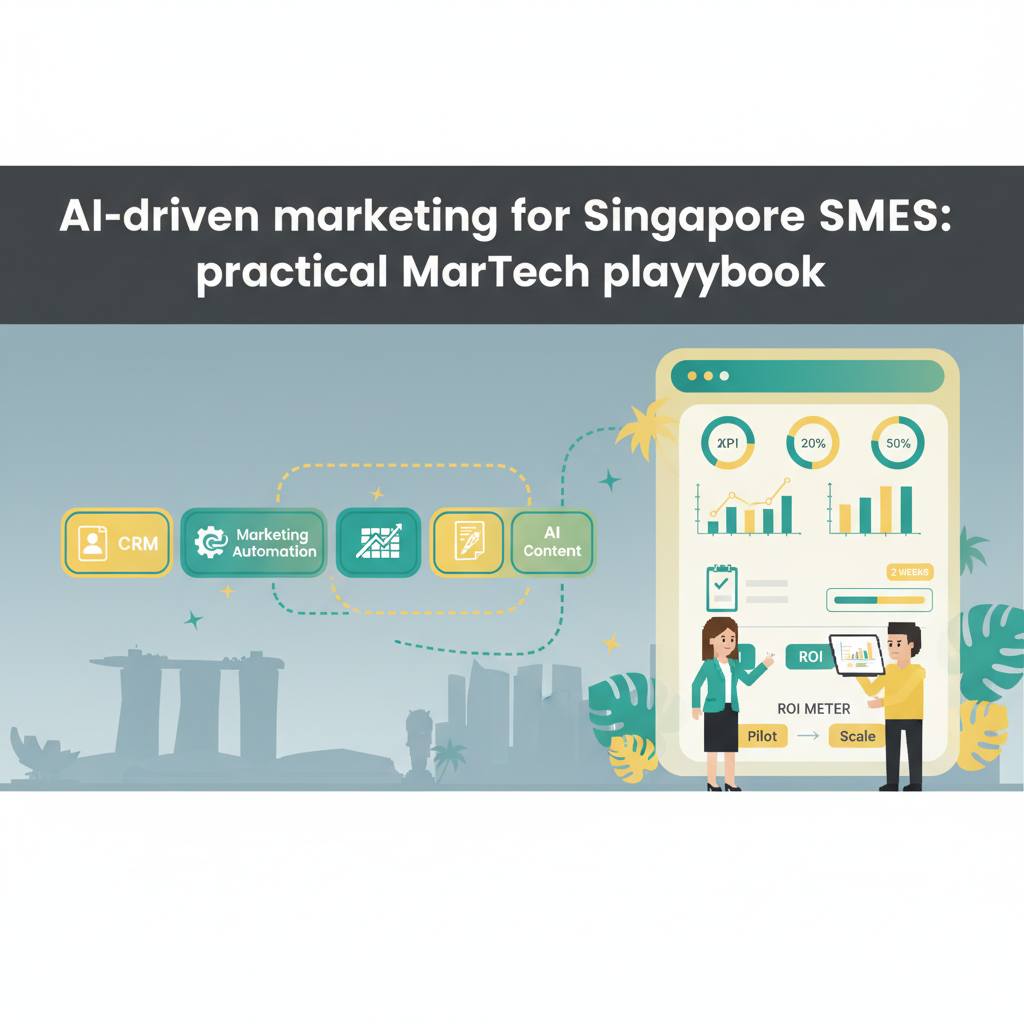
Introduction: AI-driven marketing for Singapore SMEs
AI marketing is no longer a distant ideal for Singapore SMEs. It’s a practical way to stretch limited resources, tailor customer experiences, and accelerate growth in a market that rewards speed and relevance. Across Singapore and the wider SEA region, digital channels—web, mobile, social, and e‑commerce—are the main battlegrounds for customer attention. The right AI-driven approach helps small teams punch above their weight by automating repetitive tasks, surfacing insights, and personalising messages at scale.
What you’ll get from this piece:
- A pragmatic view of AI marketing opportunities for SMEs in Singapore, with the local context in mind.
- A clear blueprint for building and evolving a MarTech stack that scales with your business.
- A practical framework for designing AI-powered workflows that fit small teams, including data flows, collaboration habits, and governance.
- A neutral tour of essential tools and platforms suitable for SMEs, with illustrative vendors across price tiers.
- A KPI and ROI framework you can action in weeks, not quarters, plus a simple ROI calculator you can adapt to your numbers.
- A concrete, action-oriented plan for next steps and quick wins you can start today.
Understanding the AI marketing opportunity for SMEs in Singapore
Market drivers for AI marketing in Singapore
- A thriving digital economy. Singapore’s business environment prioritises digital adoption, skills, and infrastructure. This creates a favourable backdrop for AI-enabled marketing solutions that help SMEs connect with customers across multiple touchpoints—without requiring a large in-house data science team.
- Growing AI adoption among SMEs. Usage has accelerated from experimentation to productivity, as teams leverage approachable tools for AI-assisted content, automated campaigns, and data-driven decisions.
- E-commerce as a core growth engine. Online buying and hybrid retail mean AI can drive personalised recommendations and efficient conversion funnels across digital marketing channels.
- Mobile-first and omnichannel expectations. Customers expect seamless experiences across website, email, social media, and ads—coordinated in real time.
- Government support lowers the barrier to entry. Programmes aimed at digital transformation make it easier for SMEs to pilot and scale AI-enabled marketing with clearer ROI paths.
Local context and quick-start use cases
- Email acceleration. A fashion retailer uses AI-generated subject lines and copy for email campaigns, paired with simple CRM segmentation. Over a few weeks, the team tests variants, measures open rates and conversions, and scales the best performers.
- Always-on customer help. An F&B brand deploys a lightweight site chatbot for common questions and email capture. The bot handles a large portion of routine inquiries, reducing response times.
- Faster content production. A professional services firm implements AI-assisted outlines and drafts for blog and LinkedIn, achieving a more consistent cadence while preserving brand voice through a clear approval workflow.
Building a pragmatic MarTech stack for scale
Core tool categories and integration patterns
- Data sources and a unified data layer. Aggregate CRM, website/CMS, ads, and social data to enable consistent segmentation and activation.
- CRM and marketing automation. The CRM holds customer data; marketing automation orchestrates multi-channel campaigns (email, site experiences, ads, push) using triggers and segmentation.
- Website/CMS and content management. Your CMS should expose APIs for personalisation and content delivery to the data layer and automation tools.
- Analytics and measurement. Track channel performance, conversion events, and engagement to inform optimisations and attribution.
- Content creation and optimisation tools. AI-assisted copy and visuals help scale content while preserving brand voice; partner with a brand strategy team to maintain consistency.
- Ad optimisation and activation. Coordinate across channels to maximise reach and ROI with consistent tagging and attribution.
- Data governance habits. Build consent management, retention controls, and access governance into every data flow and integration.
Integration patterns SMEs can adopt quickly
- API-first integrations: Choose tools with stable APIs and connectors so you can automate data flows and activations with minimal handoffs.
- Data layer as the engine: Use the data layer to feed segmentation, activations, and AI models—ensuring a single source of truth for campaigns.
- Event-driven connectivity: For near-real-time responses (e.g., abandoned cart, site visits), use event-driven triggers.
- iPaaS as a pragmatic helper: Leverage integration platforms to connect CRM, CMS, analytics, and ads with minimal custom code.
Practical checklist for implementing a MarTech stack in SMEs
- Define a focused pilot objective and success metrics (e.g., +10% conversion rate, −15% CAC).
- Map core data sources to a unified layer and set basic governance (consent, retention, access).
- Choose core tools with clean APIs (CRM, marketing automation, analytics) and fit with your CMS and content tools.
- Design a light integration blueprint: CRM → automation → analytics with essential cross-channel triggers.
- Establish measurement: how you’ll attribute revenue and quantify lift from AI-enabled elements.
- Create templates and playbooks: campaign briefs, content prompts, and data mapping templates.
- Run a 4–8 week pilot with two experiments: content automation and a channel activation.
- Leverage experienced partners for implementation support and creative.
- Build team rituals: weekly standups, a shared decision log, and a prompt library.
- Review results, refine prompts, and expand to more channels and data sources.
Designing AI-powered workflows for small teams
End-to-end data flows
- Data sources (CRM, website, ads, social) feed ingestion and identity resolution.
- A unified data layer consolidates data into a ready-to-activate format.
- Segmentation and AI enrichment create audience profiles and content prompts.
- Marketing automation orchestrates multi-channel campaigns driven by triggers and prompts.
- Channels execute and track campaigns; analytics feed back into the data layer for continuous improvement.
Collaboration patterns for small teams
- Roles: Campaign Architect, Data & Integrations Lead, Content Lead, AI/Automation Specialist, Analytics Lead.
- Rituals: Weekly 15–20 minute standups; a shared playbook covering briefs, prompts, data mapping; monthly retros to refine prompts and assets.
- Artifacts: Campaign briefs, a prompts library, data flow maps, dashboards, and a decision log.
Three practical workflow patterns
- Campaign creation with AI-assisted ideation and activation: Define objective and audience; generate 3–5 AI-driven concepts; select and refine; produce copy/assets with AI assistance; set up multi-channel automation; run and optimise.
- Content production pipeline with AI support: Brief → AI research outlines → draft → SEO/readability checks → visuals → publish → measure → learn and adapt prompts.
- Feedback loops and continuous improvement: Collect performance data → AI-driven insights → implement recommendations → update prompts/assets → plan next iteration.
Essential tools and platforms for SMEs
Tool categories and illustrative vendors (neutral examples; choose based on fit and APIs)
- AI marketing platforms: Copy.ai, Jasper, Writesonic (starter); HubSpot Marketing Hub, ActiveCampaign (mid-range); Salesforce Marketing Cloud, Adobe Marketo Engage (premium).
- Marketing automation: Mailchimp Automation, Brevo, MailerLite (starter); ActiveCampaign, GetResponse, Klaviyo (mid-range); HubSpot Marketing Hub, Salesforce Marketing Cloud (premium).
- CRM: HubSpot CRM (free tier), Zoho CRM, Freshsales (starter); Pipedrive, Zendesk Sell (mid-range); Salesforce Sales Cloud, Microsoft Dynamics 365 (premium).
- Customer data platform (CDP): RudderStack (starter), Blueshift/Tealium (mid-market), Salesforce CDP/Oracle Unity (premium).
- Content creation: Canva, Descript, Lumen5 (starter–mid); Adobe Creative Cloud (advanced).
- Analytics and measurement: GA4, Plausible, Matomo; Mixpanel/Amplitude; Tableau/Looker.
- Ad optimisation and media buying: Google Ads, Meta Ads; Optmyzr, AdEspresso; DSPs like The Trade Desk.
When choosing vendors, prioritise API completeness and ecosystem fit with your CRM/CMS and team usability. For brand consistency across content and campaigns, collaborate with a brand strategy and storytelling partner.
Measuring impact: metrics, attribution, and ROI
KPI framework
- Awareness: impressions, reach, ad recall lift, social engagement
- Consideration: sessions, pages per session, time on site, downloads, sign-ups
- Conversion: leads, trials, purchases, conversion rate, CAC, revenue per customer
- Retention: repeat purchases, CLV, churn, renewal rate, upsell/cross-sell
Attribution approaches
- Multi-touch attribution (MTA): Start with time-decay or position-based models; use consistent tagging and IDs across channels.
- Incrementality: Run controlled experiments or holdouts to quantify uplift from AI-enabled elements; compare treated vs. control groups to estimate incremental impact.
Simple ROI calculator
Inputs: baseline revenue (R_base), orders (Orders_base), AOV, repeat revenue (Repeat_base, ARPU_ret), lifts (lift_conv, lift_AOV, lift_ret), monthly cost (Cost_inc).
Outputs: incremental revenue (R_incr), net profit (Net = R_incr − Cost_inc), ROI (Net / Cost_inc), ROAS (R_incr / Cost_inc), payback period (months).
Formula: R_incr = (R_base × lift_conv) + (Orders_base × AOV × lift_AOV) + (Repeat_base × ARPU_ret × lift_ret)
Worked example (Singapore SME): R_base = SGD 150,000; Orders_base = 2,000; AOV = 75; Repeat_base = 800; ARPU_ret = 60; lifts: lift_conv = 0.12; lift_AOV = 0.05; lift_ret = 0.08; Cost_inc = SGD 12,000 → R_incr = 29,340; Net = 17,340; ROI ≈ 1.44x; ROAS ≈ 2.44x; Payback ≈ 0.69 months.
Even with modest lifts, AI marketing pilots can deliver meaningful ROI when costs are controlled and the data foundation is solid. For bespoke modelling and execution support, see our digital marketing services and portfolio.
Related internal resources & case data
- Insights and playbooks on our blog for AI-driven marketing and MarTech ideas.
- Social media services — includes case data from Asia Pacific Furniture Fair, where campaigns generated about $4.9M in sales over 9 days and secured ~1,750 pre-event registrations (see page for details).
- Video portfolio — examples of content production that can plug into AI-assisted workflows.
- Brand strategy and storytelling — align AI-generated content with a coherent brand narrative.
- All services — implementation support across strategy, creative production, and activation.
Ready to build your AI-driven marketing stack?
Hamilton & Sherwind can help you assess your current MarTech, select the right AI marketing platforms, and design pragmatic workflows tailored to your SME. Let’s turn pilots into performance.