

Table of Contents
- Introduction to AI-powered brand storytelling for Singapore SMEs
- What is AI Storytelling and why it matters for brands
- A practical Brand Storytelling Playbook tailored for Singapore SMEs
- AI-powered branding playbook: 4-stage framework
- Regional considerations for Singapore: language, culture, and channels
- Tools, workflows, and governance for AI storytelling
- ROI, measurement, and case study blueprint
- Next steps and resources for Singapore SMEs
- FAQ
- Related services and portfolios
- References
- Talk to Hamilton & Sherwind
Introduction to AI-powered brand storytelling for Singapore SMEs
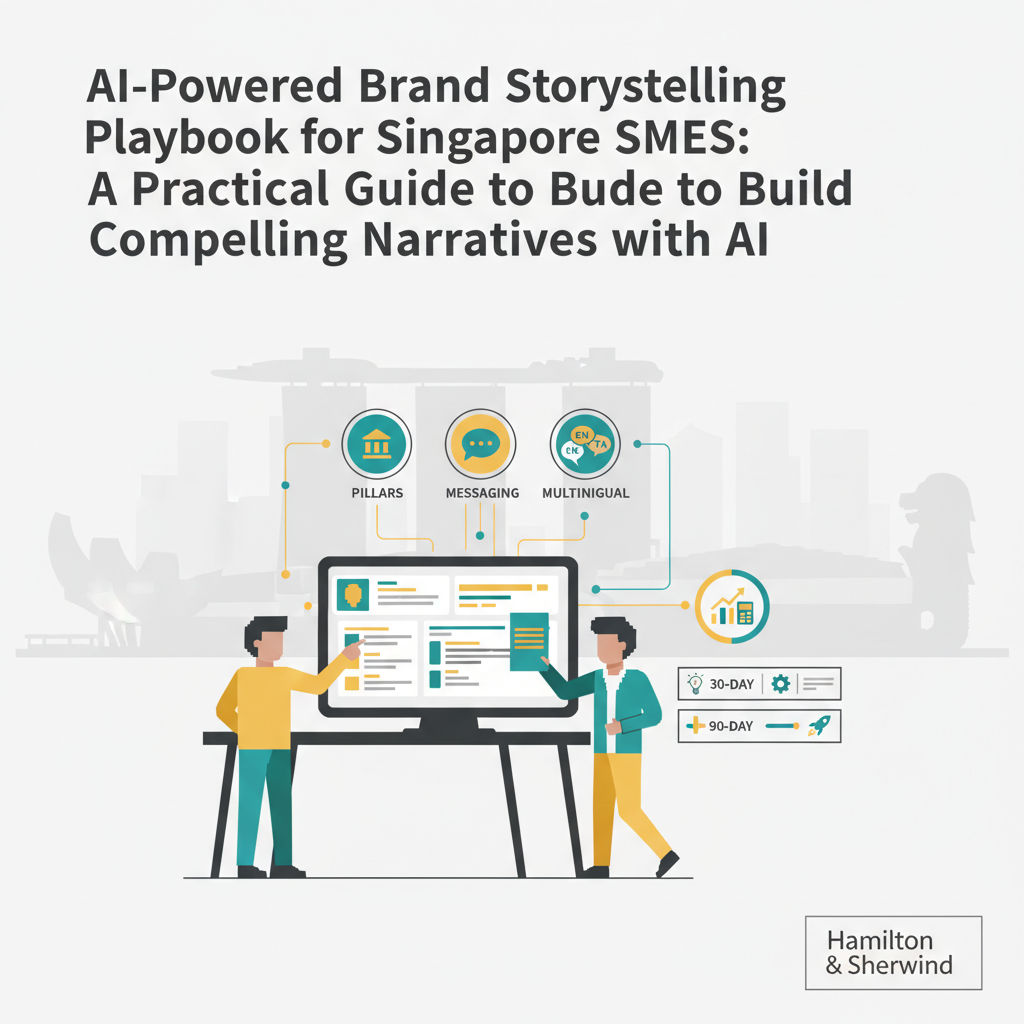
This guide explains how SMEs in Singapore can use AI to elevate brand storytelling, with a practical playbook and region-specific considerations. It blends Singapore’s multilingual context, the dynamics of local sectors (F&B, retail, education, fintech), and a pragmatic approach to building faster, more localized narratives. Expect practical steps, micro-templates, sector examples, and a structured 30/60/90-day rollout you can adapt right away.
What is AI STORYTELLING and why it matters for brands
The basics of AI-assisted storytelling
AI-assisted storytelling is a collaborative practice where human creative leadership teams with AI-powered tools to plan, draft, tailor, distribute, and optimize brand narratives. AI surfaces audience insights, generates content variants across formats and languages, and speeds up iteration—while humans preserve the emotional core, brand voice, and strategic intent. In Singapore’s fast-moving, multilingual market, AI helps brands stay fast, stay locally relevant, and scale storytelling across English, Mandarin, Malay, and Tamil without sacrificing quality. The core stays human-centered; AI acts as a high-velocity co-creator that accelerates research, drafting, localization, and testing. Video Marketing Trends 2025 in Singapore suggests video-first formats and AI-enabled localization are increasingly shaping how SG brands communicate.
Key trends shaping AI storytelling in Singapore and SEA include authentic, docu-style narratives supported by AI-assisted editing and localization; explainers and educational formats that clarify complex offerings; and live, interactive video experiences enhanced by AI-driven captions and real-time localization. These trends are echoed in SG industry discussions about AI-enabled creativity and ethics, emphasizing speed, localization, and human oversight. Practical context for action is provided by SG-focused coverage on AI adoption and practical storytelling approaches. See Brand storytelling in Singapore gets a reboot with AI and AI Content Generation in Singapore — Elevate Your Brand Voice.
AI storytelling is not about replacing teams with machines. It’s about creating a repeatable, quality-checked system where AI accelerates ideation, localization, and multiformat testing, while humans curate, validate, and refine the emotional arc and credibility behind the narrative. This balance is critical in Singapore’s diverse market, where language, culture, and channel preferences differ sharply across segments.
The Singapore SME opportunity with AI
Singaporean SMEs stand to gain from AI storytelling by accelerating content production, enabling multilingual localization at scale, and increasing the pace of testing across channels. The local ecosystem supports pilots and scaled initiatives through guidance, channels, and sector-focused case studies. Industry voices emphasize AI as a productivity amplifier, particularly when paired with clear governance and a well-scoped plan. See SG-centric discussions that frame AI as a practical, ROI-oriented capability for SMEs: EY Singapore: Helping SMEs take the next leap towards AI, CNA: AI adoption grows — practical SME solutions, and The Business Times: Where are Singapore SMEs’ AI story?.
Practical Singapore-specific takeaways
- Use AI to test multilingual variants quickly. In SG, content can be drafted in English and then localized into Mandarin, Malay, and Tamil, with human editors validating tone and cultural resonance. See Marketing to Multilingual Audiences in Singapore.
- Leverage local government and industry support to de-risk pilots. SG programs support digital transformation pilots for smaller teams, making it easier to experiment with AI storytelling. See EY and CNA.
A practical BRAND STORYTELLING PLAYBOOK tailored for Singapore SMEs
Discover phase: audience research, brand archetypes
The Discover phase turns what you know about Singapore’s diverse, multilingual audience into concrete buyer personas and a brand architecture that resonates across languages and cultures. It’s about turning data into actionable insights that guide pillars, messaging, and channel choices.
Discover activities (Singapore-focused)
- Plan multilingual segmentation from day one (English, Mandarin, Malay, Tamil). Cultural cues, regional references, and holiday calendars shape content relevance. See Brew Interactive.
- Build 3–5 personas that reflect language and culture. Use Simon-Kucher’s buyer persona framework to shape personas and journey maps.
- Use archetypes (Explorer, Hero, Caregiver, Everyman, Sage, Creator) to guide tone and story direction; validate via quick language-specific tests.
- Sector examples (SG focus): F&B (Local Flavor, Community), Fintech (Security, Accessibility), Education (Practical Skills, Credible Thought Leadership), Retail (Value, Omnichannel Ease, Trust).
Discover artifacts you’ll produce
- 2–3 page audience research brief (segmentation, personas, journey maps)
- Persona sheets with language considerations and journey touchpoints
- Channel-content fit map and a 1st-phase pilot plan
Practical prompts and templates for Discover
- Audience research prompt (SG-ready): “Create 3–4 SG-target personas representing English, Mandarin, Malay, and Tamil segments. For each, provide: language preference, goals, pain points, content needs, and preferred channels. Include a simple customer journey for awareness to decision.”
- Archetype prompt (SG-ready): “Suggest 1–2 archetypes that fit a [sector] brand in Singapore. Explain why these archetypes resonate with multilingual SG audiences and how to translate them into 2–3 concrete content formats per language.”
- Persona brief template: Sector/Brand | Persona name | Language | Demographics | Goals | Pain points | Buying triggers | Channels | Tone
Define phase: story pillars and messaging
The Define phase turns Discover insights into a stable storytelling framework: pillars and core messaging that can be consistently applied across formats, languages, and campaigns. The SG context calls for pillars that are durable, locally resonant, and adaptable to multiple languages.
Define actions (Singapore-focused)
- Align pillars with business goals and audience insights. Decide on 3–5 pillars that reflect local values (trust, practicality, inclusivity, community) and map to outcomes (awareness, education, conversion) with language-specific formats.
- Draft pillar definitions and audience value. For each pillar, define the audience need, two supporting messages, two proof points, suggested formats, tone, and localization cues.
- Validate pillars with stakeholders and a quick audience sanity check (cross-language workshop; 2–3 language test).
- Build a messaging architecture per pillar (core message, supporting messages, proof points, tone/voice guidance, localization notes) and link pillars to channels and typical SG/SEA journeys.
- Sector tailoring: translate pillars into sector-specific scripts for F&B, Retail, Education, and Fintech; avoid literal translation and adapt idioms, references, and visuals to SG norms.
- Operational templates: Pillars Brief Template; Messaging House Template; Sector-ready Pillar Sheets (with formats and channel playbook).
- Quick-start prompts for pillar creation and localization across English, Mandarin, Malay, and Tamil.
- Governance: define pillar update cadence, translation quality guardrails, cultural sensitivity checks, and escalation paths.
AI-powered branding playbook: 4-stage framework
Create: prompts, templates, and content formats
Use prompts and templates to generate first drafts across formats (social posts, scripts, blogs), then human-edit for tone and accuracy. Maintain a centralized prompt library with localization variants.
Optimize: testing, personalization, and localization
Run multivariate tests across languages and channels. Optimize based on engagement, comprehension, and conversion. Localize with bilingual reviewers and maintain translation memory and glossaries for consistency.
Regional considerations for Singapore: language, culture, and channels
Multilingual content strategy (English, Mandarin, Malay, Tamil)
A practical multilingual strategy treats English as the base language and localizes into Mandarin, Malay, and Tamil with context-specific references, tone, and visuals. See Brew Interactive for guidance.
Channel mix for SMEs in Singapore (social, website, email)
Social media (TikTok, Instagram, Facebook, LinkedIn): short-form video, carousels, micro-posts, live sessions; bilingual captions or language-specific posts; mobile-first, local case studies, and immediate hooks.
Website and landing pages: language selectors with clean URL subfolders, hreflang signals, localized tone/visuals/SEO, SG-diverse imagery, local testimonials and references.
Email and nurturing: segment by language and persona; localized subject lines and preheaders; 1–2 emails per week during campaigns; clear consent and preference controls.
Tools, workflows, and governance for AI storytelling
Practical tool stack (prompt design, content generation, workflow automation)
A lean, Singapore-ready tool stack keeps your workflow efficient and auditable.
- Planning/collaboration: Notion or Airtable; Trello/Asana for sprints and approvals
- AI drafting/editing: GPT-based platforms; centralized prompt library with localization variants; copy polishing plus bilingual QA
- Localization: translation memory and glossaries; bilingual reviewers; structured localization QA
- Visuals/video: Canva or Figma for templates; Descript or Kapwing for captions and editing
- Website/SEO: Multilingual CMS with hreflang; local keyword research per language
- Email/CRM: language-based segmentation and multilingual sends
- Automation/analytics: Zapier or Make; GA4 and Looker Studio dashboards by language and channel
- Governance/security: roles, approvals, escalation paths; privacy-respecting data-handling policies
Note: Align with broad risk management approaches as you mature; maintain a human-in-the-loop review for tone, accuracy, and cultural fit.
Compliance, ethics, and brand guardrails
- Governance framework: align with international best practices for AI risk management and governance, such as the OECD AI Principles and ISO/IEC-oriented risk management approaches (ISO/IEC standards).
- Data considerations and consent: implement clear data-handling practices and consent controls for personalization, with privacy-respecting defaults.
- Cultural sensitivity and authenticity: validate content with language panels; avoid stereotypes; reflect SG diversity in visuals and voice.
- Accessibility and inclusion: ensure captions, alt text, and readable formats across languages.
- Ethical use of AI-generated content: maintain human editorial review and transparency where appropriate.
ROI, measurement, and case study blueprint
Metrics to track (engagement, conversion, cost per story)
- Engagement: impressions, reach, video view time, engagement rate, sentiment by language
- Conversion: clicks, form submissions, trial sign-ups, purchases, revenue signals
- Cost metrics: cost per asset, cost per story, production time savings
- Channel performance by language
- QA and governance signals: localization QA pass rate, tone alignment, content-safety checks
- Attribution signals: initial attribution estimates and improvements over time
ROI model for AI storytelling
Inputs: monthly revenue baseline, uplift from AI storytelling, baseline content costs, AI tooling costs (monthly + setup/training). Outputs: annual revenue uplift, cost savings, total AI costs, net profit, ROI, and payback period.
Rev_uplift_annual = Rev_base × uplift_pct × 12
Cost_savings_annual = C_base × save_pct × 12
Net_profit_annual = Rev_uplift_annual + Cost_savings_annual − AI_costs_total
ROI_annual = Net_profit_annual / AI_costs_total
Payback_months = AI_costs_total / monthly_increment
monthly_increment = (Rev_base × uplift_pct) + (Cost_savings_annual/12) − AI_monthly_cost
Case-study blueprint (fill-in-ready)
- Title: “AI storytelling drives X in SG: ROI in Y months”
- Client background: sector, size, SG location, channels used
- Objective: KPI targets (awareness, leads, sign-ups, revenue uplift)
- Baseline metrics: revenue, CTR, conversions, etc.
- Approach: pillars used, formats, languages
- Implementation: timeline, assets, localization steps, QA, governance
- Data inputs: revenue baseline, engagement baseline, CAC
- Results: engagement, conversions, revenue uplift; ROI and payback
- Learnings and next steps: what worked, what to optimize, how to scale
Sample numbers (illustrative): Rev_base = SGD 60,000/month; C_base = SGD 5,000/month. Model uplift scenarios in a spreadsheet to visualize payback and margin changes.
Next steps and resources for Singapore SMEs
30-day sprint: establish pillars and messaging (3–4 pillars), build a prompts library, and create 6–8 assets (social posts, 1–2 videos, 1 blog, localization notes). Set up a light governance structure and a simple ROI model. Plan a 2-language pilot (English + Mandarin).
60-day sprint: run a focused pilot across 1–2 formats (e.g., social posts and a short video per pillar), produce localized variants and landing-page concepts, and begin A/B testing with small samples. Refine localization QA and tone.
90-day sprint: scale to additional languages and formats; publish landing pages and a batch of emails; pull initial ROI data and refine prompts library and governance. Prepare a one-page executive brief and a longer case-study-ready document for stakeholder sharing.
30/60/90-day rollout plan (quick reference)
- 30 days: Pillar setup, prompts library, 2 assets per pillar (English + one localized language), governance basics, basic metrics
- 60 days: Multi-language test, 4–6 assets per pillar, landing-page variants, 2–3 A/B tests, ROI data collection
- 90 days: Expanded pillar set across channels, full localization QA, landing-page optimization, complete ROI narrative with at least one case-study blueprint
Sector-ready micro-templates and prompts you can use now
- Simple social post prompts (F&B)
- English: “Local flavor, global quality. Enjoy chef‑level meals built on SG ingredients.”
- Mandarin: “本地风味,全球标准。用新加坡本地食材打造的厨师级美味。”
- Teaser video prompt: 60 seconds, SG local ingredient focus, bilingual captions
- Short video storyboard (60–90 seconds)
- Hook: 0–6s — “Singapore’s favourite flavor, reimagined”
- Problem: 7–20s — “Finding balanced meals in a busy day”
- Solution: 21–55s — “Chef-curated menus, locally sourced ingredients”
- Proof: 56–75s — “Local suppliers, health-safety, taste tests”
- CTA: 76–90s — “Visit us today” with SG-friendly link
- On-screen text: bilingual captions, SG-local imagery
- Landing page copy (Singapore)
- English core plus Mandarin localization; clear benefits aligned to SG buyers; localized testimonials and trust signals
FAQ
What is AI storytelling, and how does it differ from traditional marketing content?
AI storytelling uses AI to accelerate ideation, drafting, localization, and testing within a guided human-led storytelling framework. It complements traditional marketing by enabling faster iterations and multilingual scalability while preserving the brand’s emotional core.
Do I need to speak every language in SG to succeed with AI storytelling?
Not necessarily. Start with English as the base and add Mandarin, Malay, and Tamil coverage gradually, focusing on the most relevant segments for your sector and audience. Multilingual testing helps you learn where localized content delivers the best ROI.
How do I measure the ROI of AI storytelling?
Use a practical ROI model: estimate revenue uplift from AI-led content, subtract content costs (including localization and tooling), and account for AI-related costs. Track engagement and conversion metrics by language to understand where the biggest gains come from. A simple payback calculation helps you decide whether to scale.
What sectors benefit most from AI storytelling in Singapore?
Sectors with strong local relevance and frequent content needs—F&B, retail, education, and fintech—are strong candidates. Each sector can leverage pillars tailored to local tastes, trust-building, and channel preferences.
What governance or guardrails should I establish?
Create a lightweight governance framework that covers pillar approval, localization QA, content sign-off, and data handling basics for personalization. Align with international best practices for AI risk management and governance (e.g., OECD AI Principles and ISO/IEC-aligned risk management) to support responsible AI usage and local agility.
Related services and portfolios
- Branding services — how we translate strategy into stories that connect with real people.
- Digital marketing services — integrated campaigns across search, social, and web.
- Social media services — content calendars, creative production, and community management.
- Video production in Singapore — plan, shoot, and localize video storytelling.
- Video production portfolio — examples of visual stories brought to life.
- Who we are — our team and approach.
- Hamilton & Sherwind blog — more insights and playbooks.
References
- VentureStudio: Video Marketing Trends 2025 Singapore
- iSmartCom: Brand storytelling in Singapore gets a reboot with AI
- iSmartCom: AI Content Generation in Singapore
- Brew Interactive: Marketing to Multilingual Audiences in Singapore
- Simon-Kucher: Buyer Personas
- EY Singapore: Helping SMEs take the next leap towards AI
- CNA: AI adoption grows — practical SME solutions
- The Business Times: Where are Singapore SMEs’ AI story?
- OECD AI Principles
- ISO/IEC AI risk management resources
Talk to Hamilton & Sherwind
Ready to turn this playbook into results? Our team can help you craft pillars, localize storytelling across languages, and launch a 30/60/90-day rollout. Contact Hamilton & Sherwind to get started.