

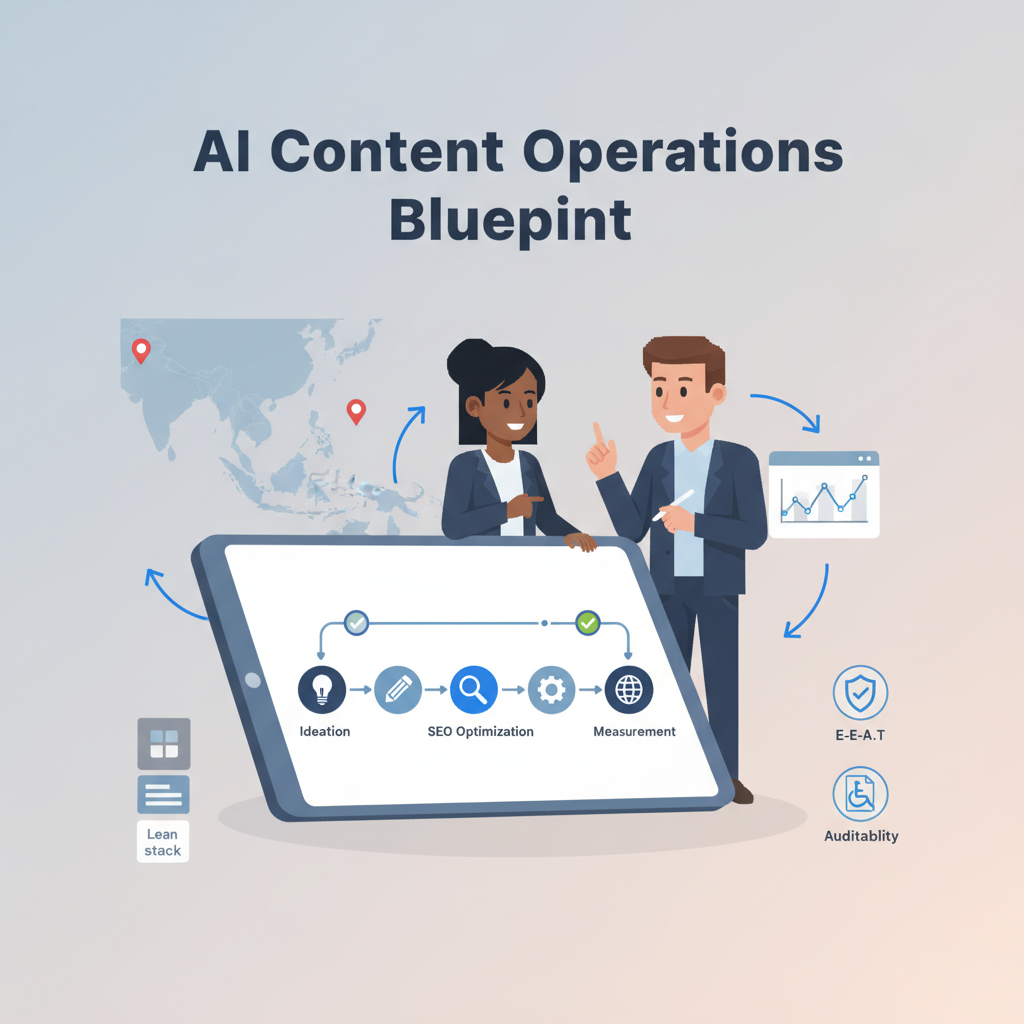
AI Content Operations in Practice: A practical blueprint for scalable, SEO-aligned content workflows
Introduction: why AI content operations matter
In Singapore and across SEA, AI-enabled content operations combine speed with trust to scale ideation, drafting, optimization, localization, and publishing without sacrificing quality. The model pairs automation with clear governance so outputs remain aligned to brand and people-first content and E-E-A-T expectations.
What AI content operations mean for modern brands
AI content operations integrate people, processes, data, and technology to create, optimize, publish, and measure content at scale. Humans apply editorial judgment, factual accuracy, and brand alignment; AI accelerates repeatable tasks. For SEA/SG, workflows should reflect multilingual needs and local search intent. For brand building support, see our Mastering Brand Storytelling Frameworks & Real-World SEA Examples.
- KPI anchors: organic traffic growth, target rankings, meta CTR uplift, time-to-publish, cost per asset.
- Guardrails: human-in-the-loop validation; style guide discipline; auditable decisions.
Core components of AI content operations
1) Data governance
Define data flows, owners, access controls, and retention. Minimize sensitive data in prompts and ensure enterprise-grade terms with AI vendors.
2) Tooling
Lean stack mapped to CMS fields (title, H1, body, meta, alt, schema). Ensure multilingual readiness and auditability.
3) Automation
Automate draft generation, metadata/schema, internal linking suggestions, and distribution; gate all automations through SEO/editorial reviews.
4) Calendar integration
Centralize a calendar for campaigns and localization timing (SGT/UTC+8). Coordinate releases to avoid bottlenecks.
AI content creation and optimization for SEO
Ideation and topic discovery
Build SEA-relevant clusters around pillar pages and local search intent; plan internal links and semantic coverage.
Drafting
Use structured briefs and prompts mapped to CMS fields to reduce rework and accelerate publishing.
Editing and QA
Apply SEO and editorial passes; fact-check data and add precise source links; maintain provenance and author/editor roles.
On-page optimization
- Titles/meta, clean H1/H2/H3 structure, semantic enrichment.
- Structured data: implement Article and FAQPage where relevant.
- Accessibility: adhere to WCAG 2.2 basics and use descriptive link text.
Localization and multilingual SEO
Use hreflang for regional content and apply canonicalization to avoid duplication.
For multimedia content within clusters, explore our Video Production Portfolio for examples of integrated content production.
Establishing AI-driven content workflows and governance
Design a gate-driven lifecycle with clear SLAs: brief → ideation → AI drafting → SEO pass → editorial → SME check → brand/legal → localization → accessibility QA → publish. Keep approvals lean for low-risk assets and expand scrutiny for high-stakes content. Align with Google Quality Rater Guidelines to reinforce quality signals.
Measuring success: metrics and governance
- Strategic outcomes: organic traffic, rankings, meta CTR, pipeline/revenue attribution.
- Operational metrics: time-to-publish, AI-assisted content share, gate SLAs.
- Quality & governance: factual accuracy, accessibility, originality, audit logs.
- Localization metrics: translation quality and regional engagement.
Use PDCA cycles for continuous improvement; maintain dashboards for leadership and operations. See broader evidence for AI’s impact in marketing operations via McKinsey, Gartner, HubSpot, and Deloitte.
Real-world implementation blueprint and case studies
Phase 1 — Pilot (2–6 weeks)
- Scope 2–4 content types, set governance, define metrics, and prove velocity gains.
Phase 2 — Scale (2–4 months)
- Broaden content types/languages, deepen automation, strengthen audit trails.
Phase 3 — Optimize (ongoing)
- Run structured experiments, refresh prompts/templates quarterly, and evolve governance.
Browse selected outcomes and references in our Hamilton Sherwind Portfolio.
Citations and resources
- Google Helpful Content Update
- Google guidance on helpful content and E-E-A-T
- Google Quality Rater Guidelines
- Hreflang for multilingual SEO
- Canonicalization and consolidating duplicate URLs
- Article structured data
- FAQPage structured data
- WCAG 2.2 Quick Reference
- WCAG accessibility fundamentals
- McKinsey: Notes from the AI frontier
- Gartner: Use Cases for Generative AI in Marketing
- HubSpot: State of AI in Marketing
- Deloitte: Generative AI in Marketing
Related on-site resources
- Mastering Brand Storytelling Frameworks & Real-World SEA Examples
- Video Production Portfolio
- Hamilton Sherwind Portfolio
Ready to build an AI-powered content engine? Let’s design a practical, Singapore/SEA-focused blueprint for your team. Contact us.