

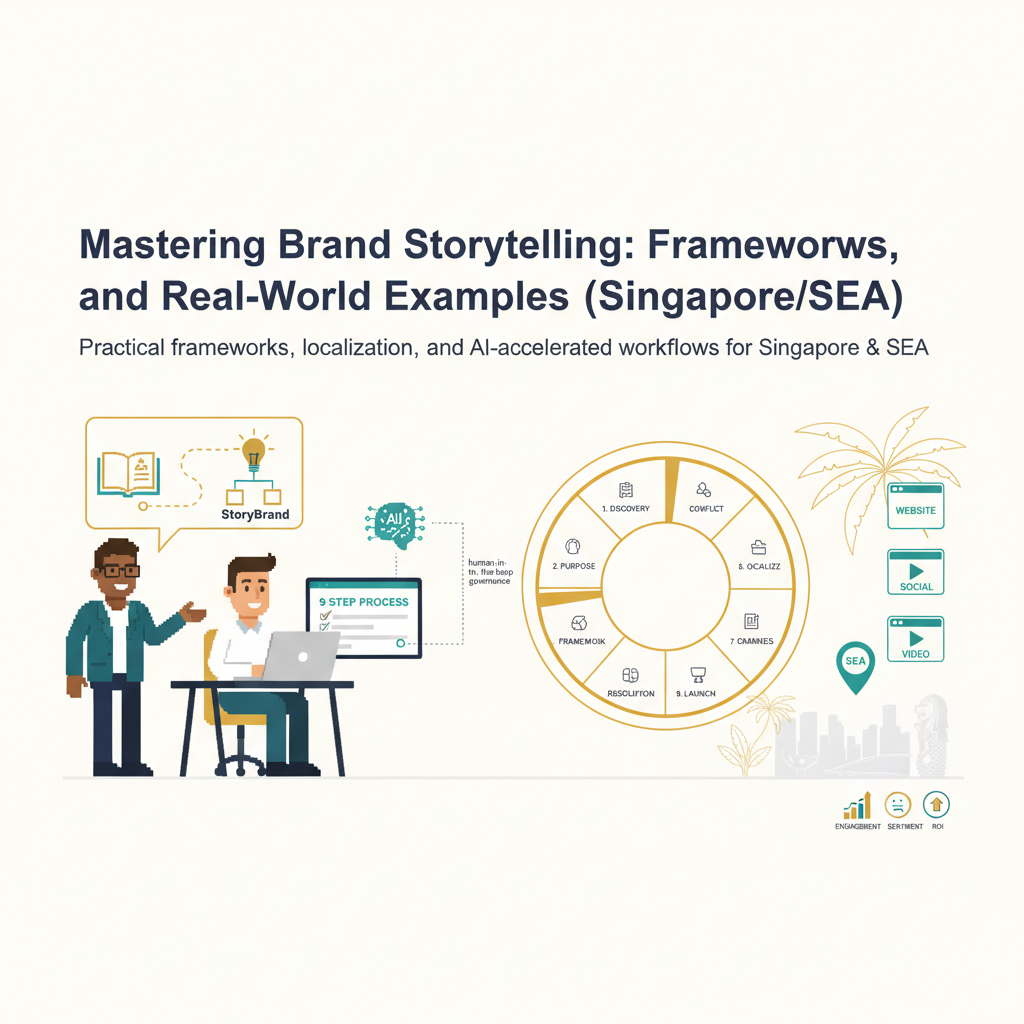
Mastering Brand Storytelling: Frameworks, Narratives, and Real-World Examples (Singapore/SEA)
Brand storytelling is more than a catchy tagline or glossy video. It’s a disciplined, evidence-based approach to communicating who you are, why you exist, and how you help customers navigate a complex world. For leaders in Singapore and SEA markets—SMEs, startups, and growing brands—storytelling becomes a strategic asset that aligns product, culture, and customer experience across every touchpoint.
At Hamilton & Sherwind, we fuse human creativity with AI efficiency to accelerate discovery, craft resonant narratives, and test them at scale without sacrificing authenticity. The practical edge? You gain a repeatable storytelling process that updates in real time to market feedback, language nuances, and evolving customer needs—while keeping the human touch where it matters most: meaning, empathy, and trust.
Defining Brand Storytelling
1.1: What it is and why it matters
Brand storytelling is the intentional construction of a narrative around your brand that clarifies purpose, communicates values, and demonstrates how your product or service helps people achieve meaningful outcomes. It isn’t a clever tagline or a single ad; it’s a coherent narrative architecture that informs product design, customer experience, and communications strategy across channels.
- Stories create memory hooks that improve recall at decision time.
- Compelling narratives build trust and reduce perceived risk; see the Edelman Trust Barometer 2024 for context on trust dynamics.
- In crowded SEA markets, narrative differentiates brands with similar features but different meaning and intent.
SEA mini-example: A Singapore coffee roaster frames its origin story around family heritage and sustainable sourcing from Southeast Asia, threading this narrative through packaging, social posts, and a landing-page mini-documentary. The human-centric arc builds long-tail loyalty beyond price.
1.2: Distinction from plain marketing copy
- Protagonist-centered: the customer as hero, the brand as ally—beyond a feature list.
- Purpose-driven: a “why” beyond profit that aligns with customer values.
- Conflict-and-resolution arc: a challenge resolved through your offering, not just specs.
Quick checklist: Is there a clear protagonist? A purposeful “why”? Cross-channel consistency? Data to refine tone and pacing? Localization plans to preserve meaning across languages?
Core Elements of a Brand Story
2.1: Protagonist, purpose, conflict, and resolution
Protagonist: The customer persona (B2C) or buyer/user (B2B) whose journey the audience follows.
Purpose: The mission and values, often tied to community, sustainability, growth, or access in SEA.
Conflict: The friction customers feel (time, complexity, risk); surface it from their perspective.
Resolution: Your role in eliminating friction and enabling progress, culminating in tangible outcomes.
SEA example: A Singapore fintech positions a shop owner as the hero, with cash-flow gaps as conflict and a transparent lending process as resolution—story threads appear in onboarding, newsletter, and case studies.
2.2: Tone, voice, and narrative pillars
Tone & voice: Choose an emotional cadence (confident, empathetic, pragmatic, aspirational) and keep it consistent across channels.
Narrative pillars: Core truths repeated in every story. Examples for SEA: trust (fintech), community (retail), heritage (F&B), innovation and access (education/tech).
- Retail: inclusivity + local craftsmanship.
- F&B: heritage recipes + local sourcing.
- Education: practical skills + career outcomes.
Brand Storytelling Frameworks
3.1: Hero’s Journey, StoryBrand, and other models
Hero’s Journey (monomyth): A classic structure positioning the customer as hero and brand as guide. See Britannica on the monomyth.
StoryBrand: A clarity-first model—Character, Problem, Guide, Plan, CTA, Failure, Success. Refer to the official StoryBrand site.
Other models include three-act arcs and brand archetypes, adapted to your personality and SEA nuance.
Ground your approach in proven brand storytelling frameworks and align them to channel execution.
3.2: Adapting frameworks to different brands
- Brand personality: Pragmatic voice pairs well with StoryBrand; aspirational voice with Hero’s Journey.
- Audience segmentation: Tailor angles for SME owners vs. enterprise buyers; urban vs. regional SEA.
- Localization: Translate intention, cultural cues, and emotional triggers—not just words.
Quick start: Draft a one-page “story skeleton,” map it to website, video, LinkedIn, and offline; then A/B test with SEA audiences.
See practical case applications in our Singapore/SEA branding portfolio.
Crafting Your Narrative
4.1: Step-by-step process to develop a brand story
- Clarify purpose & impact: One-sentence purpose; define measurable outcomes (speed, savings, confidence, access).
- Define the protagonist: Create SEA personas; map journey stages with story beats.
- Identify conflict and your role: Emotional and practical obstacles; your resolution path.
- Outline pillars & tone: Select 3–5 pillars and match to segments.
- Draft the core narrative: Long-form core with condensed versions for social and landing pages.
- Localize for SEA: Variants for Singapore, Malaysia, Indonesia, Vietnam, Philippines.
- Governance: Human-in-the-loop review across creative, legal, compliance, regional.
- Launch & learn: Deploy, collect early signals, iterate.
- Refresh quarterly: Keep the narrative current.
4.2: Drafting, testing, and refining
Draft a long-form narrative, then scripts for 2-minute and 60-second videos, plus microcopy. A/B test hooks and CTAs across SEA channels; run qualitative feedback with local customers; refine based on early signals (time on page, video completion).
Use AI to generate variations but keep a human editor for tone, cultural fit, and safety. Maintain a “story bible” and brand storytelling services governance checklist.
AI-Driven Brand Storytelling
5.1: AI-DRIVEN BRAND STORYTELLING: benefits and cautions
- Benefits: speed, scale, consistency, personalization, and rapid iteration.
- Cautions: factual risks, cultural nuance, and data governance. Keep humans-in-the-loop.
SEA example: Multimarket testing (Singapore, Malaysia, Indonesia) with AI-generated social hooks reviewed by local editors for colloquialisms and cultural fit.
5.2: Tools and governance for responsible use
- AI for ideation, outlines, variants, first drafts.
- AI-assisted sentiment and topic clustering to monitor brand health.
- Guardrails: voice guidelines, editorial gates, audit trails, and non-sensitive data only.
- Localization: regional leads validate tone and cultural cues.
Channel Strategy and Metrics
6.1: Adapting stories across website, social, and video
Website: House the core story, link to case studies and solution pages. Explore our blog for storytelling insights.
Social: Modular assets for scannable stories—consider support from our social media practice.
Video: Consistent narrative spine across long/short formats—see video production in Singapore and the video portfolio.
Digital marketing: Align campaigns around your story; see digital marketing services.
6.2: Metrics to track engagement, sentiment, and ROI
- Engagement: time on page, scroll depth, video completion, shares.
- Sentiment: social listening and review changes post-campaign.
- ROI: awareness, consideration, preference lift; CAC and revenue impact.
Framework anchors: Britannica on the monomyth, StoryBrand official site. See Edelman Trust Barometer 2024 for trust dynamics and CMI 2024 B2B benchmarks for content effectiveness context.
Conclusion: Start Building Your Brand Story Today
Brand storytelling is a strategic discipline that positions your brand as meaningful, trustworthy, and indispensable in customers’ lives. Our approach blends human creativity with AI-enabled efficiency to unlock faster storytelling cycles, more precise audience resonance, and measurable business impact.
- Define your core narrative (protagonist, problem, guidance, resolution).
- Build three narrative pillars aligned to SEA audiences.
- Create a “story bible” for tone and visuals.
- Map to website, social, and video; run a 4-week pilot with A/B tests.
- Use AI for variants; keep humans for quality and cultural fit.
- Establish governance; refresh quarterly.
Explore our brand storytelling services or talk to our team to get started.
FAQ
What makes brand storytelling more effective than generic marketing copy?
Brand storytelling uses a narrative framework that connects emotionally and cognitively, guiding audiences through a journey tied to purpose and value. See the Hero’s Journey (monomyth) for structure and StoryBrand for practical application.
How can AI help without eroding the brand’s human voice?
AI accelerates ideation and testing; humans preserve tone, nuance, and authenticity via guardrails and review stages. Use human-in-the-loop workflows and localization checks.
What pillars work best for SEA-focused stories?
Trust/reliability, community/belonging, heritage/craft, and accessibility/innovation—validated through local research and testing.
How do we measure storytelling impact?
Track engagement (time on page, video completion), sentiment via social listening, brand lift (awareness, consideration), and ROI (CAC, revenue impact). Use a narrative spine across channels for comparability.
How should we localize for Singapore and SEA?
Keep one core narrative with language and cultural variants per market. Maintain emotional intent; support with local success stories and testimonials.
When should we start experimenting with AI in storytelling?
Once your core narrative and guardrails are in place. Use AI for variants and rapid tests; keep final edits human-led.
What’s the fastest way for a Singapore/SEA SME to begin?
Draft a one-page story skeleton, map it to 2–3 channels, build short-form assets, pilot with a small audience, and iterate. For structure, explore monomyth basics and the StoryBrand brand script.
Ready to craft a Singapore/SEA-ready brand story that blends human creativity with AI efficiency? Contact Hamilton & Sherwind today.