

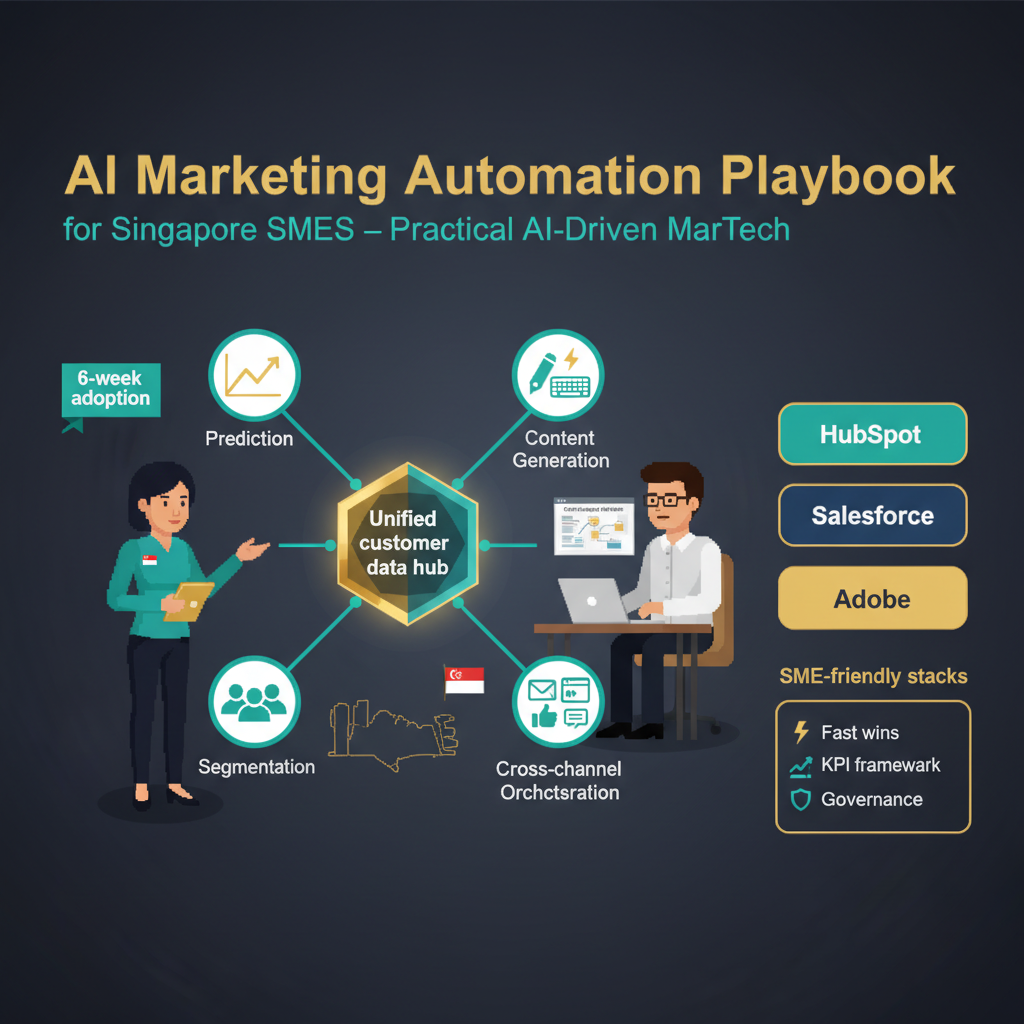
AI Marketing Automation Playbook for Singapore SMEs
This guide is a rollout-focused playbook designed for Singapore SMEs. It translates the promise of AI marketing automation into practical steps, fast wins, and a realistic six-week path to start small, learn quickly, and scale with confidence. You’ll find a practical mix of frameworks, checklists, local context, and concrete examples to help your lean marketing team drive more personalized, cross-channel experiences without overhauling your entire tech stack.
What AI marketing automation is and why it matters
AI marketing automation combines data, AI models, and automated workflows to run, optimize, and personalize marketing at scale across channels. It moves repetitive, rule-based work from people to software, freeing time for strategy and creative experimentation while preserving a consistent customer experience. The value proposition hinges on three core capabilities: predictive analytics, automated customer journeys, and content generation and optimization that stay on-brand across multiple touchpoints.
- Predictive analytics helps you forecast customer behavior, optimize timing, and prioritize actions that maximize engagement and conversions. Inline sources describe how predictive signals guide outreach and resource allocation in real time across platforms (Salesforce Einstein overview).
- Customer journey automation orchestrates personalized experiences at scale. AI-powered automation maps the journey, triggers relevant actions, and ensures consistency across channels and devices (Salesforce Einstein overview; Adobe Sensei).
- AI content generation accelerates asset production and testing. Generative AI helps create emails, landing pages, social posts, and other assets tailored to context and brand, enabling faster time-to-market and more variants for testing (Salesforce Einstein overview; Adobe Sensei).
- AI segmentation adds precision beyond traditional demographics, identifying meaningful groups based on behavior, intent, and predicted value (Adobe Sensei; AI-powered marketing: What, where, and how? (Elsevier)).
- Cross-channel automation unifies messaging and timing across email, web, social, search, ads, and in-app experiences (Salesforce Einstein overview; Adobe Sensei).
A mix of industry sources and academic work points to real ROI from AI marketing automation when data quality and governance are in place. For executives seeking practical implications and ROI framing, vendor platforms and academic syntheses provide concrete examples and best practices (HubSpot on AI in marketing; McKinsey on AI in marketing).
How it helps Singapore SMEs (quick wins, efficiency, and personalization)
Singapore SMEs often operate with lean teams and tight budgets. AI marketing automation offers a path to faster campaigns, more relevant customer encounters, and better decision support—without a heavy, multi-year transformation. Global–local alignment matters: use the same AI concepts, but tailor messages to local languages, preferences, and shopping channels. Local context sources emphasize the value of AI adoption in Singapore’s SME ecosystem and the importance of practical roadmapping in this market (We Are Social Singapore; EY Singapore on SMEs and AI).
Core components: data, AI models, and automation workflows
Data: the backbone you can’t skip
A unified customer data foundation (CRM and/or CDP) is essential. It harmonizes data from website interactions, ads, email, commerce, and offline sources, enabling AI to see the full customer picture and act with context. Salesforce emphasizes its Customer 360 and Data Cloud as the data fabric that unifies data and powers AI-enabled experiences across marketing, sales, and service (Salesforce Einstein overview; Salesforce Data Cloud overview; What is a CDP?).
Real-time identity and data quality matter. Identity resolution and data quality controls ensure accurate AI predictions and consistent activation across channels. Vendor-neutral reviews help SMEs evaluate data-layer platforms that feed AI models (Gartner CDP market reviews).
AI models: what you’re actually running
- Prediction: propensity scores, next-best-action predictions, churn risk estimates.
- Segmentation: data-driven audience groups that reflect behavior and predicted value.
- Content generation: generative AI supports scalable asset creation and variant testing with brand guardrails.
Across models and content, your ecosystem provides practical, production-ready AI features integrated into everyday workflows (Salesforce Einstein overview; Adobe Sensei; HubSpot on AI in marketing).
Automation workflows: orchestration, triggers, cross-channel actions
Orchestration and triggers coordinate campaigns and responses across channels, while maintaining a consistent customer narrative. Salesforce Einstein is designed to drive personalized journeys across Customer 360, and Adobe Sensei supports cross-channel orchestration and asset variations, enabling scalable experiences (Salesforce Einstein overview; Adobe Sensei).
Governance and ethics (how to measure and manage risk)
Use frameworks such as the NIST AI Risk Management Framework and IEEE 7000-2018 to guide data handling, model risk, and ethical design. These guardrails help avoid bias, misrepresentation, and privacy issues as you scale AI in marketing (NIST AI RMF; IEEE 7000-2018; AI-powered marketing: What, where, and how?).
Tools and platforms for SMEs: evaluating AI marketing tools
Evaluation framework for SMEs
- Cost: total cost of ownership, including licenses, data egress, and implementation.
- Ease of use: onboarding speed, intuitive interfaces, and time-to-value.
- Integrations: native connectors and robust APIs for CRM, analytics, ads, social, and content systems.
- Data governance: data quality controls, identity resolution, consent models, and security.
- AI capabilities: predictive analytics, segmentation, content generation, cross-channel automation, model explainability, audit trails.
Core tool categories and SME-fit notes
CRM with AI (core relationship and automation)
Salesforce CRM + Einstein offers enterprise-grade AI integration across sales/marketing, tight data fabric with the CRM, and robust cross-channel capabilities. HubSpot CRM is a more on-ramp-friendly option with native marketing automation, analytics, and content tools.
CDP (data foundation)
Salesforce Data Cloud unifies customer data across Salesforce apps. Adobe Real-time CDP (within the Experience Platform) provides broad activation capabilities (Adobe Sensei). HubSpot’s products offer simpler data unification for SMEs (HubSpot products overview).
Marketing automation
HubSpot Marketing Automation is strong for lean teams. Salesforce Marketing Cloud and Adobe Marketo Engage provide deeper enterprise-grade orchestration.
Analytics
HubSpot Analytics centralizes marketing analytics; Salesforce’s analytics are tightly integrated with CRM data (Salesforce Einstein overview).
Content generation and social
Generative AI in Salesforce and Adobe can accelerate content production and testing (Salesforce Einstein overview; Adobe Sensei). HubSpot’s social tools enable publishing, listening, and measurement (HubSpot Social Inbox).
Practical SME tip: if your team is small and you already use HubSpot, a HubSpot-centric stack (CRM + Marketing Automation + Analytics + Social) delivers quick ROI. If you aim for deeper scale, Salesforce Einstein + Data Cloud is powerful and extensible.
Best practices for implementing AI-driven marketing
- Governance and ethics from day one. Establish an AI governance scaffold that covers data use, model risk, transparency, and ethics-by-design (see NIST AI RMF and IEEE 7000-2018).
- Data quality as the foundation. Aim for a unified customer view via CRM/CDP, identity stitching, and quality controls (Salesforce Data Cloud overview; What is a CDP?; Gartner CDP reviews).
- Start small, learn fast (pilot with measurable ROI). Begin with a low-risk, high-yield use case (e.g., welcome series with AI-suggested content and optimized send times) and scale based on results (McKinsey on AI in marketing; HubSpot marketing ROI calculator; HubSpot Analytics).
- Talent, capabilities, and partner models. Build a lean, cross-functional team; consider partners to accelerate capability building (The gen AI skills revolution).
- Measure what matters. Define a simple KPI set early: engagement, conversion, activation, efficiency, and governance indicators (HubSpot Analytics; HubSpot ROI calculator).
Singapore-specific considerations for SMEs
Lean teams and budget caution are common in Singaporean SMEs. Keep scope tight to deliver early wins, and tailor content and channel choices for local audiences (mobile-first, multi-language). Regional platforms include Facebook, Instagram, TikTok, LinkedIn, and WhatsApp Business—each with unique content and engagement patterns. Design AI-driven journeys that leverage these channels in a coordinated way.
Local sources provide Singapore/SEA perspectives and practical steps for SMEs adopting AI (We Are Social Singapore; EY Singapore on SMEs and AI).
Roadmap to a six-week rollout for AI marketing automation
Week 1: foundation and planning
- Define success metrics (e.g., engagement lift, lead quality, content production time saved).
- Map data sources: CRM, website analytics, ads, social, and offline data.
- Assign roles: rollout owner, data steward, campaign owner/creator.
Week 2: data enablement and pilot scoping
- Stabilize the data foundation and verify identity resolution for the pilot audience.
- Select a pilot use case with clear impact (e.g., welcome series with AI-generated content and optimized send times).
- Set up analytics dashboards to track pilot metrics.
Week 3: implement pilot workflows
- Create a cross-channel journey (email, social, web) with AI-driven content variants.
- Apply governance guardrails and human-in-the-loop checks.
Week 4: measure and refine
- Review results against KPIs; iterate on content, timing, and segmentation.
- Enhance attribution modeling to capture early ROI signals.
Week 5: scale the pilot within a controlled scope
- Add one or two additional channels or audience segments; preserve guardrails.
- Increase the automation footprint while ensuring brand consistency.
Week 6: formalize rollout and plan for expansion
- Document learnings; formalize an expanded roadmap and budget.
- Establish a quarterly review cadence for measurement and optimization.
Quick wins and local case studies for Singapore SMEs
Quick wins you can replicate in Singapore:
- Launch a lightweight welcome series with AI-suggested content variants and predictive send times.
- Create AI-generated landing page and social post variants tailored to local audiences; combine email + social retargeting for reinforcement.
Illustrative local examples (aligned to common SME scenarios):
- A services SME uses AI-driven lead scoring within a CRM to prioritize outreach and deliver a guided onboarding sequence, reducing manual qualification time.
- A retailer synchronizes online/offline data with a CDP-like approach, deploying recommendations and dynamic ad personalization across channels for mobile-first shoppers.
See Singapore/SEA context from We Are Social Singapore and EY Singapore.
Conclusion: key takeaways, metrics to track, and next steps for onboarding
Key takeaways
- AI marketing automation is an evolution: data foundation + AI models + automated cross-channel workflows.
- Start with a well-scoped pilot, prove ROI quickly, and scale with governance.
- In Singapore/SEA, lean teams can achieve outsized impact with localized content and channels.
Metrics to track
- Engagement: open rates, CTR, time on site, social engagement.
- Activation: propensities, next-best actions, time to first action.
- Conversion: MQLs/SQLs, sign-ups, revenue influence.
- Efficiency: content production time saved, setup cycle time, resource utilization.
- Governance: data quality scores, identity resolution accuracy, model monitoring.
Next steps
- Validate a minimal viable stack: CRM + core automation + analytics + a CDP/data layer.
- Run a six-week pilot with a clear ROI target and owner roles.
- Build a governance playbook covering data handling, model risk, and content guardrails.
Talk to Hamilton & Sherwind about a 6-week AI marketing automation rollout
Frequently asked questions (FAQ)
What exactly is AI marketing automation?
AI marketing automation combines data, AI models, and automated workflows to run, optimize, and personalize marketing across channels at scale. It uses predictive analytics for timing and targeting, automates customer journeys, and can generate content and segment audiences for more relevant messages.
How quickly can I see results with a pilot?
You can typically demonstrate tangible improvements within a few weeks of launching a focused pilot (for example, a welcome series or cart-abandonment sequence) if you have clean data and a defined success metric. The ROI may accelerate as you expand to additional channels and refine segments.
What should be my first six-week rollout plan?
Week 1–2: establish data governance, select a pilot use case, assign roles. Week 3–4: implement the pilot workflow and content variants. Week 5: measure results and adjust. Week 6: scale the pilot, finalize an expanded roadmap, and plan for broader rollout.
Which platforms are best for SMEs starting out?
For a quick start with strong integration, HubSpot’s CRM + Marketing Automation offers a cohesive stack. For deeper data scale and enterprise-grade AI, Salesforce with Einstein and Data Cloud provides powerful capabilities, especially if you’re already in the Salesforce ecosystem. Adobe Sensei adds breadth for content generation and cross-channel orchestration.
How do I ensure governance when adopting AI in marketing?
Adopt an AI governance framework from day one: define data usage rules, model risk management, transparency, and guardrails for content. Use established standards (NIST AI RMF, IEEE 7000-2018) to anchor policies, and embed human-in-the-loop review where needed.