

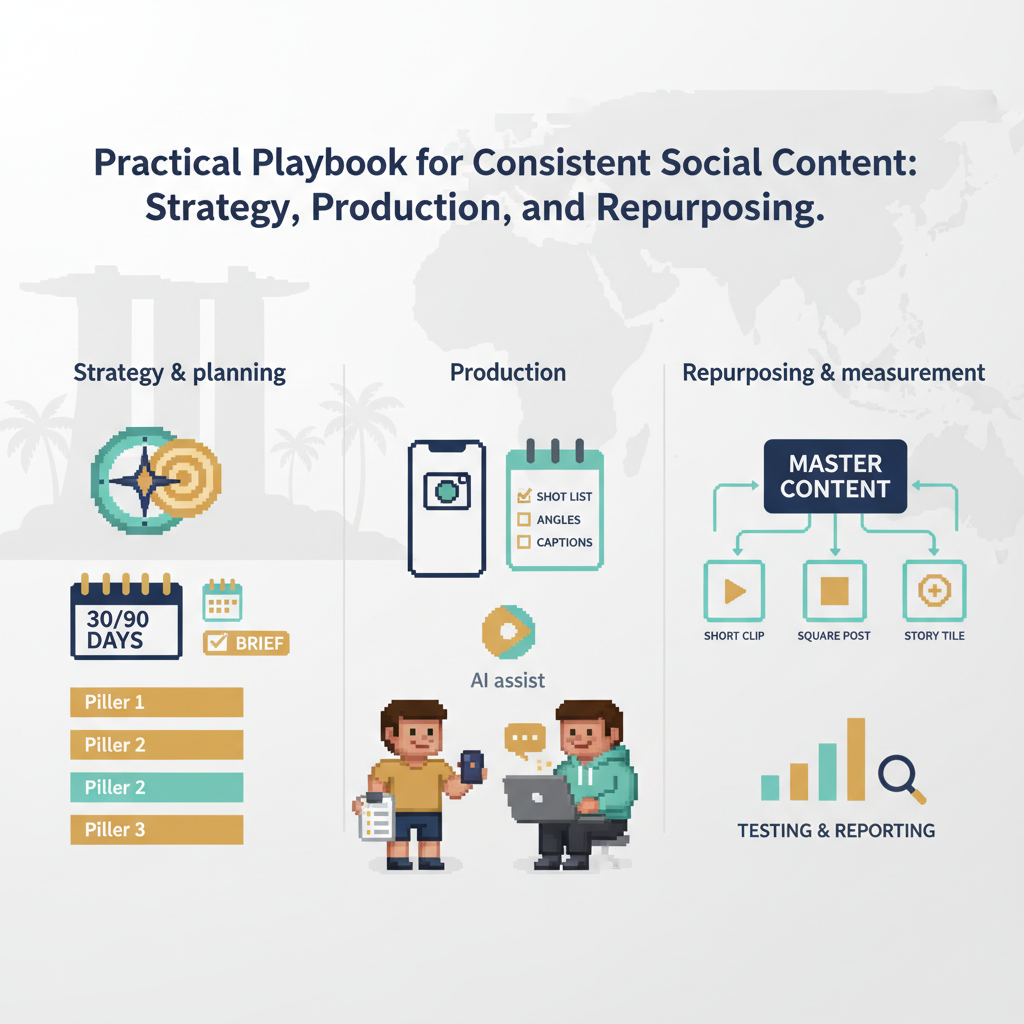
Practical Playbook for Consistent Social Content: Strategy, Production, and Repurposing
Introduction: Why consistent social content matters and what this playbook delivers
Consistent social media content creation is no longer a “nice to have” — it’s the operational backbone of brand growth across Singapore and Southeast Asia. In markets where mobile use is high and short-form discovery dominates, brands that publish reliably win algorithmic reach, audience memory and measurable funnel activity (awareness → consideration → conversion). [1]
This playbook promises a compact, repeatable process you can apply this week: define goals and pillars, generate ideas fast, produce platform‑fit creative at scale, stretch every master asset into derivatives, and test with simple hypotheses. It’s built for social media managers, content marketers and brand leaders who operate in Singapore and the broader SEA region — where platform mixes, languages, commerce behaviors and creator ecosystems differ from Western markets. [2]
Quick snapshot of the framework you’ll follow:
- Set the foundation: align business goals, audience personas and 3–5 content pillars (the backbone of your social media strategy).
- Idea generation & planning: repeatable ideation, a short creative brief, and a 30/90-day social media content calendar blueprint.
- Production workflow: roles, handoffs, format decisions and a short-form social video production checklist.
- Repurpose & optimize: master → five derivatives approach to maximize ROI.
- Tools & team workflow: recommended stack and a 1‑week production sprint example.
- Measure, test, iterate: lightweight testing framework with practical rules and a creative scorecard. [3]
Set the foundation: goals, audience and content pillars
1) Start with business goals and match KPIs
Map 1–3 business goals to social objectives, then pick a north‑star KPI for each. Keep it tight.
- Awareness (business goal: increase brand reach): KPI = monthly unique reach or impressions; supporting = follower growth, share of voice.
- Engagement / consideration (goal: brand preference): KPI = engagement rate (engagements ÷ reach), average watch time, saves.
- Lead generation (goal: pipeline growth): KPI = social‑attributed leads/month, CTR to landing page, cost per lead (CPL).
- Conversion / revenue (goal: sales): KPI = purchases from social, ROAS, CPA.
- Loyalty (goal: retention): KPI = repeat buyer rate, referral volume, sentiment lift.
Practical tip: choose one north‑star KPI per business goal and 1–2 supporting metrics to avoid reporting clutter. For benchmarking ideas, see the Sprout Social benchmarks by industry.
2) Build 3–5 content pillars that align with funnel stages
Pillars reduce creative friction. Choose pillars that intersect brand expertise, audience needs and sustainable formats.
Example pillar set (D2C FMCG, SEA):
- How‑to / use cases (Awareness/Consideration): TikTok/Reels demos.
- Real customer UGC (Consideration/Trust): reposts, short testimonials.
- Product promos & launches (Decision): shoppable posts, quick demos.
- Local culture & community (Awareness/Community): festival tie‑ins, BTS.
- Sustainability / values (Retention/Advocacy): deeper posts, case stories.
For B2B SaaS, swap in industry insights, how‑to tutorials, customer case studies and product adoption content.
3) Persona checklist (use before every brief)
Make this a mandatory one‑page in the brief:
- Demographics: age, city, preferred language(s).
- Work/lifestyle: job title or lifestyle cohort.
- Goals & top 3 pain points (verbatim where possible).
- Platform behaviors: where they discover vs evaluate vs buy.
- Format preferences: short video, long video, text, carousel.
- Tone & language: formal, casual, witty; local idioms to avoid.
- Decision triggers and objections.
- Measurement signal that proves you reached them (e.g., CTR to demo page).
4) SEA / Singapore nuances to bake in
- Singapore: English‑first, polished production; urban audiences respond to aspirational visuals and clear CTAs.
- Regional markets: require transcreation (not literal translation); local CTAs (COD, Shopee/Lazada links) often increase conversion.
- Short-form video is essential across SEA; platform mix is usually TikTok + Reels + YouTube Shorts + platform-native commerce where relevant. [1]
Idea generation and planning: rapid ideation, briefs and a 30/90-day calendar
Repeatable ideation loop
Adopt this weekly/monthly cadence: listen → mine → ideate → batch → publish → measure → iterate.
- Weekly micro‑listening (30–45m): capture 5 trends, 5 high‑engagement comments and 3 competitor wins.
- Monthly deep mine (60m): export top posts, run Google Trends and TikTok/IG trending checks; generate 12 actionable ideas (3 per week).
Idea sources and prioritization
- Data mining: top posts (reach, saves, watch time), search spikes, hashtag velocity.
- Competitor & community listening: comments, group threads, marketplace reviews.
- Seasonal hooks: commerce dates (9.9, 11.11, 12.12), national holidays (SG National Day), religious festivals across SEA.
Quick prioritisation matrix: Trend velocity vs brand fit vs conversion potential — act on high trend + high fit; adapt high trend + low fit.
One‑page creative brief (use this for every asset)
Required fields (one page only):
- Campaign / Post name
- Business goal + north‑star KPI
- Pillar & funnel stage
- Target persona (one‑line)
- Platform(s) & primary format
- Single‑sentence objective
- 3‑line creative angle (MANDATORY):
- Hook (≤8 words)
- What we prove (one sentence)
- CTA (one sentence; include exact UTM)
- Deliverables & specs, tone, localization notes, legal flags, approvers, timeline.
Why the 3‑line angle: forces clarity and speeds approval.
Calendar blueprint: batching vs rolling vs hybrid
- Batching (70–80%): shoot multiple assets in concentrated sessions — efficient for pillar content and repurposing.
- Rolling/reactive (20–30%): reserved for trend hijacks and community responses.
- Hybrid (recommended): batch pillars and keep slots for reactive content.
Sample 30‑day cadence (D2C):
- Weekly rhythm: Mon = how‑to Reel, Tue = UGC repost, Wed = product post, Thu = local culture, Fri = Q&A/live clip, Sat = trend clip, Sun = roundup story.
For B2B, rotate thought leadership, short demos, case snippets and webinar promos.
AI for social media content (practical uses & prompts)
- Role: accelerate ideation, produce caption/script variants, generate localization first drafts.
- Guardrails: human review mandatory, validate claims, native reviewer for local languages, don’t feed PII into public LLMs.
- Example prompt (D2C SG): “Generate 12 TikTok/Reels concepts for hydration serum aimed at Singapore women 25–40. For each: 6‑word hook, 15–30s scene breakdown, suggested sound type, 1‑line CTA with UTM placeholder.”
Production workflow: formats, templates and a short-form video checklist
Roles & handoffs (fast)
- Planner / Head of Social: sets calendar & approves briefs.
- Producer: logistics, shoot coordination, contracts.
- Copywriter: scripts, captions, CTAs.
- Shooter / Director: captures footage, uploads rushes.
- Editor: edits, captions, thumbnails, exports.
- Social Publisher: schedules and publishes.
- Approvers (brand/legal/local): final sign‑off.
Format decision guide (when to use which)
- Static image: product hero, polished announcements.
- Carousel: education, step‑by‑step guides, comparisons.
- Short vertical (Reels/TikTok/Shorts): discovery, demos, trends.
- Stories: ephemeral nudges, polls, reminders.
- Long form (YouTube): tutorials, case studies, SEO content.
- Ads: concise messages optimized for CTR and conversions.
Short-form video production checklist (practical)
Scripts by length:
- 15s: Hook (0–2s) → problem (2–6s) → solution (6–12s) → CTA (12–15s).
- 30s: Hook (0–3s) → set up (3–10s) → demo/proof (10–22s) → CTA (27–30s).
- 60s: Story arc with results and quote; include on‑screen bullets for stats.
Shot list essentials:
- Establishing (wide), mid shot (talent), close-ups (product), POV/action, reaction, B‑roll, CTA end card. Capture pickups and 5–10s silent clean plates.
Framing & mobile UX:
- Compose for 9:16 vertical safe zone; avoid important text in top 10% / bottom 15% (UI overlays). Keep faces central and readable on small screens.
Sound & music:
- Use lavalier/shotgun for dialogue; platform music libraries for in‑app posting; licensed music needed for ads and cross‑platform uses. Always capture room tone.
Captions & thumbnails:
- Burn captions for all short videos. Thumbnails should be high contrast close‑ups with short text when possible.
Export settings (recommended presets)
- Codec: H.264 MP4, Rec.709, AAC audio.
- Vertical short video: 1080×1920, 30fps, 8–12Mbps.
- Square feed: 1080×1080; portrait feed: 1080×1350.
- YouTube long form: 1920×1080, 8–12Mbps.
Singapore / SEA production notes
- Shoot English first for SG; capture alternate language voiceovers or subtitle files for regional markets.
- Protect gear from humidity; plan for noisy environments (markets, streets) and secure location/talent releases.
- Music rights: use platform libraries for in‑app use but secure commercial licenses for paid ads.
Quick short-form upload checklist (before publish)
- Hook in first 3s, captions present, CTA and UTMs correct, music rights cleared for ads, mobile preview tested.
Repurpose and optimize: stretch one asset into many pieces
The repurposing framework (master → five derivatives)
Create one high‑quality master asset and produce these five predictable derivatives:
- Full post (anchor): longer clip or article for YouTube/LinkedIn.
- Short clip (discovery): 15–60s vertical for Reels/TikTok/Shorts.
- Quote card: shareable image with a punchline or stat (1080×1080).
- Ad slice: 15–30s conversion‑focused video with explicit CTA and UTM.
- Story highlight: sequence of 10–15s micro moments for Stories.
Cross‑platform adaptation rules (practical)
- Aspect ratios: vertical 9:16 for short discovery; square 1:1 or 4:5 for feed; landscape 16:9 for YouTube.
- Caption length: lead with the hook — IG first 125 chars, TikTok short text + hashtags, LinkedIn 150–300 chars.
- CTAs: platform‑appropriate phrasing and localized offers (e.g., “Free shipping SG” or “COD available PH”).
- Hashtags: TikTok 3–5 relevant + trending; Instagram 3–10 mixed niche/brand; LinkedIn 3 industry tags.
Batching tips to create repurposable masters
- Shoot the longest, most flexible master possible (interviews, demos) with multiple hook takes and alternate CTAs recorded.
- Capture clean audio stems, separate VO takes for each language, and lots of B‑roll to support derivatives.
- Create export presets and caption templates so editors can produce variants fast.
Stepwise recipe to create derivatives (quick)
- Short clip: pick best 3s hook, vertical crop, add burned captions, add 1–2s brand bump, export 9:16.
- Quote card: pull a 6–12 word soundbite, design on brand template, create 2 language variants.
- Ad slice: choose a conversion clip, ensure visual-first messaging, add CTA overlay and UTM; test thumbnails.
- Story highlight: cut 3–6 micro moments and add interactive stickers (polls, questions).
SEA localization rules
- Transcreation is preferred over literal translation; always use a native reviewer for idioms and festival messaging.
- Local commerce signals (payment, delivery) should be explicit in captions for conversion in markets like PH, ID, MY.
- For festivals, plan 4–6 weeks in advance and localize visuals and copy to cultural norms.
Operational hygiene
- Immediately generate transcripts for the master asset. This single step unlocks clips, quote cards and captions.
- Maintain asset naming and metadata (timestamps, pillar, locale, rights expiry) to enable fast pulls.
Tools, roles and a sample team workflow for a 1-week production sprint
Recommended tool stack by job (practical list)
- Briefing & planning: Notion or Airtable (briefs, calendar).
- Capture & ingest: Filmic Pro (phone), Hedge/ShotPut Pro for checksum offload, Frame.io for proxies & review.
- Editing: Premiere Pro / DaVinci Resolve; CapCut or Descript for fast vertical edits.
- Graphics: After Effects, Canva / Figma for quick templates.
- Scheduling: Sprout Social, Meta Business Suite, TikTok Scheduler.
- Asset management: Airtable for registry, Google Drive or Brandfolder for storage.
- Analytics: native platform analytics + Looker Studio / Sprout for dashboards.
- Payments: Wise, PayNow (SG), Stripe, platform escrow for creators.
Sample compressed 1‑week sprint timeline (deliver 6 short verticals + assets)
- Day 0: Sprint brief + approvals SLA set.
- Day 1: Kick‑off + final scripts + shot plan.
- Day 2: Shoot day — capture master, 3 hook takes, B‑roll, language VO if needed.
- Day 3: Rough edit + transcript; editor flags 10 clip candidates.
- Day 4: Create derivatives (shorts, quote cards, ad slice); mobile QA.
- Day 5: Final approvals (24 hr SLA), localization.
- Day 6: Schedule + soft launch + small boosts.
- Day 7: Monitor, boost winners, sprint retro.
Naming conventions & storage best practices (one schema)
- Root: /CLIENT_CAMPAIGN_SPRINTYYYYMMDD/
- Example file name: ACME_Launch_HowTo_SG_EN_MASTER_20251002_CAM01_V001.MOV
- Keep proxies for editors, masters in archived storage, and maintain a single Airtable row per asset with metadata.
Remote collaboration tips
- Use proxies for editing speed; hand back to master for final color/audio.
- Frame.io for time‑coded feedback; Loom for short recorded change requests.
- Daily 15m standups scheduled to accommodate regional timezones; use Slack threads per asset.
Creator marketplaces & payment notes (SG/SEA)
- Discovery: Aspire, CreatorIQ, Nuffnang, TikTok Creator Marketplace; combine global platforms with local agencies.
- Payment norms: deposit 30–50% common; pay via Wise/PayNow/Stripe; include usage rights and GST/tax notes for Singapore creators.
- Contracts: always include usage scope, region, duration and deliverable acceptance criteria.
Quick sprint templates to copy
- One‑page brief (use the 3‑line creative angle).
- Publish checklist (final approvals, UTM, captions, music rights).
- Asset naming template (client_campaign_pillar_locale_format_length_version).
Measure, test, iterate: simple KPIs and creative experiments
Separate creative vs distribution metrics
- Creative metrics: average watch time, view %/retention curve, saves, shares, comments — these show content resonance.
- Distribution metrics: reach, impressions, CPM, CTR, CPC, conversions (CPL/CPA), ROAS — these show how efficiently you reached the right audience. [3]
Lightweight testing framework (practical)
- Hypothesis: one sentence (example: “If we move the benefit into the first 2s hook, CTR will increase ≥20%”).
- Variants: keep one variable per test (hook, thumbnail, CTA, localization).
- Runtime & signal thresholds:
- Organic short‑form: 24–72 hrs for early signal, 7 days to stabilize.
- Paid: 3–7 days (allow learning phase); ensure min impressions per variant (≈1,000) or min conversions (50–100) for conversion tests.
- Decision rules:
- Scale: ≥20% uplift on primary KPI with sufficient sample.
- Iterate: 5–20% uplift or mixed signal — tweak and retest.
- Kill: >10% decline vs baseline.
Creative scorecard & feedback loop
- Record each experiment in an experiments log (Airtable): hypothesis, variant, runtime, primary/supporting metrics, verdict, action.
- Add a “Recent learnings” section to the next creative brief. Require creatives to call out how they will incorporate the winning hook/CTA/style.
- Reserve 20–30% production capacity for retests and reactive scaling.
Reporting cadence & dashboard basics
- Daily snapshots for first 72 hrs after publish.
- Weekly creative review to share winners, losers and micro learnings.
- Monthly pillar performance review (north‑star KPI vs target).
- Dashboard essentials: north‑star KPIs, asset heatmap (impressions, watch%, engagement, CTR, CPA), retention curves, experiments log.
For sector/region benchmark context, consult the Sprout Social Index and IMDA Digital Society statistics.
SEA considerations for tests
- Smaller markets (like Singapore) may need longer run times or pooled tests for sample size; rely more heavily on watch% and engagement signals when conversions are sparse.
- Always test English vs local language variants — localization often lifts conversion even when English garners reach.
- Pre‑test festival creatives ahead of major commerce days (9.9, 11.11, 12.12).
Conclusion: One-page checklist to start your first production sprint
10-step sprint kickoff checklist (do this week)
- Define up to 3 business goals and set one north‑star KPI per goal.
- Pick 3–5 content pillars and map them to funnel stages and primary platforms.
- Create 1 persona sheet per target audience using the persona checklist.
- Populate an idea bank (Airtable/Notion) and run a 60‑minute monthly deep mine to draft 12 ideas.
- Fill the one‑page creative brief for each asset (include the 3‑line creative angle).
- Plan a hybrid calendar: batch 70–80% of content, reserve 20–30% for reactive content.
- Run a 1‑week sprint: shoot a repurposable master, produce 5 derivatives, localize captions and create ad slices.
- Implement publish checklist: approvals, UTMs, captions, music rights and mobile QA.
- Run one micro experiment per sprint (hook, thumbnail or localization); log results in an experiments register.
- Hold a weekly retro: apply learnings to the next brief and update templates and export presets.
Consistency is both creative and operational. Start with templates: the one‑page brief, caption templates, export presets, file naming conventions and a simple experiments log. Use AI for ideation and first drafts — but safeguard with human review and native localizers for SEA languages. As you build muscle, automate repetitive tasks (transcriptions, caption burns, export presets) and standardize production so creativity can scale without slowing down.
Hamilton & Sherwind — regional context: For teams in Singapore and SEA, this playbook is calibrated for the region’s platform mix, multilingual audiences and commerce behaviors. Hamilton & Sherwind’s experience working with brands across SEA shows that combining polished Singapore‑grade creative with localized variants and a disciplined repurposing strategy produces the best balance of brand building and conversion.
Need a done-with-you content sprint?
Work with Hamilton & Sherwind to build a custom 30‑day calendar, fill your creative brief template, and run a one‑week production sprint tailored to your brand and markets.
References and internal links
Internal links
External sources
- Sprout Social Index 2024 — Research on social behaviors, engagement, and measurement.
- Social media benchmarks by industry — Sector‑specific engagement benchmarks from Sprout Social.
- IMDA Digital Society statistics — Government statistics on digital adoption and internet activity in Singapore.