

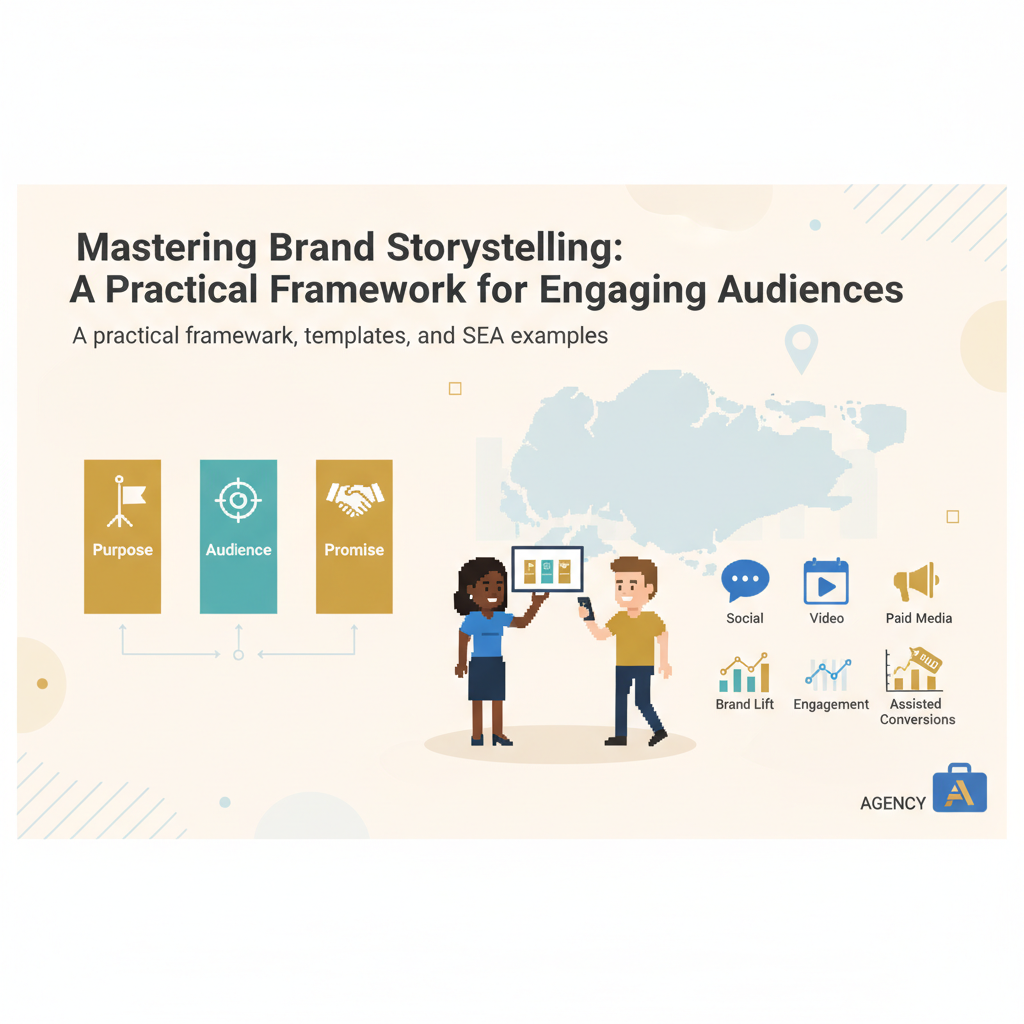
Mastering Brand Storytelling: A Practical Framework for Engaging Audiences
The essentials of brand storytelling have never been more crucial for brands operating in Singapore and the broader Southeast Asia region. In a marketplace crowded with choices, well-told stories cut through saturation, creating memory, meaning, and measurable impact. For marketing leaders, brand managers, and founders across Singapore and SEA, a practical storytelling framework should be actionable, repeatable, and adaptable to local realities—without sacrificing consistency across markets and channels. For helpful context on story fundamentals and examples, see Harvard Business School Online’s guide to brand stories.
This guide delivers a practical, framework-driven approach: a foundation, a core narrative framework, techniques and templates, real-world SEA examples, methods to measure and iterate, and a plan to implement storytelling across teams and campaigns. It builds toward a clear, repeatable playbook you can deploy in 4–6 weeks and scale thereafter. Where relevant, we reference industry frameworks such as the StoryBrand (SB7) framework and industry research you can use to benchmark performance.
The Brand Story Foundation
Defining your brand purpose, audience, and promise
- Why this matters — A clear brand purpose anchors all decisions, then translates into audience-focused promises and proof across touchpoints. With SEA markets’ linguistic and cultural diversity, purpose acts as a unifying north star that can be localized without losing integrity. For a services partner to help articulate your purpose and promise, explore our branding services.
- Practical steps
- Apply the Golden Circle: Why → How → What. Start with the purpose (Why) to tap into emotional and social drivers that matter in SEA markets, then explain How we do it, and finally What we offer.
- Draft a concise brand purpose statement: one sentence that expresses the enduring reason the brand exists beyond profits.
- Build 1–3 regional audience personas: identify distinct segments by region, language, channel preferences, and job-to-be-done.
- Align the brand promise across touchpoints: define what customers can consistently expect at every brand moment (product, service, support, and communications).
- Singapore/SEA adaptation tips
- Co-create with local teams to reflect community values and everyday life in each market.
- Ground the Brand Why in local realities; map the How to regionally differentiated capabilities that still square with the Why.
- Keep language intentional: design a messaging architecture that can flex across languages while preserving the core promise.
Why narratives resonate: establishing context and trust
Narratives help brands earn attention, memory, and trust in markets where people rely on story, social proof, and shared meaning to reduce risk. In SEA and Singapore, narratives work by anchoring everyday life in a brand’s value system, and by aligning with local norms, aspirations, and daily routines. On the role of narrative arcs in marketing, see the American Marketing Association’s guide to narrative arcs.
Trust grows when stories pair emotion with credible proof (customer stories, localized data, transparent processes). Research on trust consistently finds that business is among the most trusted institutions and that people rely heavily on friends/family and brand websites as credible sources—use these insights to guide your proof strategy.
Core Elements and Narrative Framework
Brand purpose and audience
Your purpose should answer why the brand exists beyond making money and how it serves people in everyday life. Build 1–3 core regional personas per market, capturing motivations, pain points, preferred channels, and decision drivers. Map the audience’s jobs-to-be-done to the brand’s Why and How, and attach 1–2 proof points (customer quotes, case results, or third-party validation) to strengthen credibility.
Value proposition, emotional hooks, and consistency across channels
A strong value proposition clarifies who you serve, what problem you solve, and why you’re uniquely capable. In SEA, keep it concrete and locally relevant. Useful emotional hooks include trust and safety; belonging and community; pragmatic progress and efficiency; local pride; and warm, everyday relatability. Ensure consistency by translating a centralized narrative core (Why/How/What) into region-specific messages and proofs across channels.
Crafting the Message: Techniques and Templates
Story structures (beginning, conflict, resolution)
- Classic 3-Act Story: Beginning (scene and need) → Conflict (friction, stakes) → Resolution (brand intervention, outcome, CTA).
- Pixar Story Spine: Once upon a time → Every day → One day → Because of that → Because of that → Until finally → Ever since.
- Problem–Agitate–Solve (PAS): State the pain → Agitate consequences → Solve with a clear plan.
- Hero’s Journey: Ordinary world → Call to adventure → Mentor/guide → Trials → Transformation → Return with gift.
- SB7/StoryBrand-style: Character, Problem, Guide, Plan, Call to Action, Failure, Success. Learn more in the StoryBrand framework.
Templates you can customize (archetypes, one-liners, and micro-stories)
Use archetype templates (Hero, Everyman, Sage, Explorer, Caregiver, Creator) and one-liners to keep stories concise and repeatable. Adapt micro-stories with local settings, protagonists, and outcomes to reflect Singapore/SEA realities.
Real-world Inspiration: Examples
Case examples and what makes them effective
Singapore heritage brand caselet — A local confectionery leaned into heritage and family legacy to differentiate. The story connected tradition with modern retail experiences, reinforced by packaging storytelling and social content. Key lesson: tie product benefits to living culture and keep messaging consistent.
SEA niche storytelling — A micro-niche brand used a warm, human voice and locally flavored packaging to stand out; another used real customer stories around daily business pain points. Lessons: local authenticity and credible proof beat generic campaigns.
Templates adapted from real campaigns for quick use
- 3-Act Video Script: Hook (0–15s) → Build (15–45s) → Resolution (45–90s).
- Pixar Story Spine: 7-step sequence for multi-part campaigns.
- PAS for social: Problem → Agitate → Solve → CTA → Proof.
- 4-Frame Carousel: Pain → Agitation → Solution → Proof & CTA.
- Singapore bilingual micro-script: English base with localized reassurance and proof lines.
Measuring Impact and Iteration
Metrics to track storytelling effectiveness
- Awareness: unaided/aided awareness, ad recall, share of voice.
- Engagement: video completion, average watch time, engagement rate, saves, mentions, sentiment. See Wistia’s video engagement benchmarks for guidance.
- Consideration: story page sessions, time on page, demo requests, newsletter sign-ups.
- Conversions/ROI: direct and assisted conversions, ROAS, CPA. For measuring upper-funnel impact, consider Nielsen Brand Lift and their drivers of lift in emerging channels.
- Loyalty/Advocacy: repeat purchases, CLV, NPS, UGC participation, referrals.
- Qualitative: social listening, audience feedback, focus groups.
For Singapore planning, factor local digital habits: DataReportal’s Digital 2024: Singapore notes high social media usage and time spent, with platform trends summarized by We Are Social Singapore.
How to refine narratives based on feedback and data
- Content testing: run 2–3 narrative variants per market; measure engagement, recall, and early conversion signals; iterate quickly.
- Social listening: monitor sentiment, emerging themes, and misperceptions; adjust narrative or proof points.
- UX research: test how audiences consume stories on pages/apps; refine copy, structure, and CTAs.
- Cadence: adopt a 6–8 week test-learn-implement cycle.
Practical Implementation for Teams
Roles, workflows, and governance for brand storytelling
Establish clear roles (Brand Owner, Brand Manager, Copywriter, Designer, Social/Community Manager, Analytics, Localization, Legal/Compliance, Production/Video). Create a Brand Voice Guide and Narrative Guardrails covering integrity, cultural sensitivity, and approvals. For consistent production and cross-channel execution support, see our social media services.
Integrating storytelling into creative processes and campaigns
- Integrated workflows: align master narrative across social, video, events, paid media, and web.
- Social content: brief → concepts → localized copy/visuals → QA → publish → listen → iterate.
- Video production: concept → script/shotlist → production → edit with subtitles → localization QA → distribute. Browse our video storytelling portfolio for examples.
- Events/activations: event narrative → on-site storytelling assets → live stories → recap content.
- Paid media: narrative-to-creative briefs → platform-specific adaptations → tracking and optimization.
Conclusion: Key Takeaways and Next Steps
- Establish your Brand Story Foundation (Why/How/What), define 1–3 SEA personas, and draft a concise Brand Promise.
- Create a narrative framework (3-Act, PAS, Pixar, Hero’s Journey) and build 2–3 ready-to-use templates (archetypes, one-liners, micro-stories).
- Compile a Real-world Inspiration library of SEA caselets and ready-to-use templates; craft 1–2 Singapore-specific narratives.
- Set up a Measurement framework (awareness, engagement, consideration, conversions, loyalty) with a cross-channel attribution plan.
- Build governance (roles, voice guide, guardrails) and implement a cross-market storytelling calendar.
If you’re ready to move from theory to execution, Hamilton & Sherwind can help with brand narrative workshops, content production, AI-assisted content ops, and measurement—tailored to Singapore/SEA.
Contact us to start building your brand storytelling playbook.
FAQ
What is the core purpose of brand storytelling in SEA and Singapore?
Brand storytelling in SEA and Singapore serves to translate a brand’s Why into locally resonant messages that connect with people’s daily lives, values, and aspirations. It aligns product benefits with meaningful human outcomes, uses credible proof, and travels across channels with consistency. This approach reduces risk, builds trust, and creates lasting affection for the brand.
How do I start building a practical storytelling framework quickly?
Start with the Brand Story Foundation (Why/How/What) and define 1–3 SEA personas. Create a simple Brand Promise and a 1-page Narrative Brief for a pilot campaign. Choose a story structure (3-Act, PAS, or Pixar Spine) and develop 2–3 templates (archetypes, one-liners, micro-stories). Run a 2–4 week pilot to test resonance, collect feedback, and iterate.
What metrics should I track for storytelling campaigns?
Track a mix of awareness (unaided/aided recall, ad recall), engagement (video completion, time-on-page, shares, sentiment), consideration (demo requests, site visits), conversions (purchases, sign-ups), and loyalty (repeat purchases, referrals, NPS). Include qualitative signals from social listening and customer feedback. Use attribution models and holdouts to isolate narrative impact.
What roles and governance structure best support SEA storytelling programs?
Set up roles across brand, creative, analytics, localization, legal/compliance, and production. Establish a Brand Voice Guide, Narrative Guardrails, an approvals workflow, localization SLAs, a shared content library, and quarterly narrative reviews. Use a RACI model for campaigns to ensure accountability and speed.
How can I implement SEA storytelling across channels quickly?
Start with a master narrative and two regional variants. Develop 2–3 templates (e.g., 3-Act video, PAS copy, micro-stories). Create a 4-week cross-channel calendar (social, video, paid media, events) and align all assets to the master narrative. Use a simple measurement plan to capture early signals (engagement, recall, sign-ups) and iterate rapidly.
How do I tailor storytelling to Singapore’s multilingual environment?
Use English as the base and thoughtfully localize with key phrases or captions in Mandarin, Malay, or Tamil where natural. Subtitles and bilingual content work well for accessibility and reach. Ground the narrative in local life (MRT rides, hawker culture, city-living realities) with authentic voices and credible proof from Singaporean customers.