

How to Choose the Right Creative Marketing Agency in Singapore
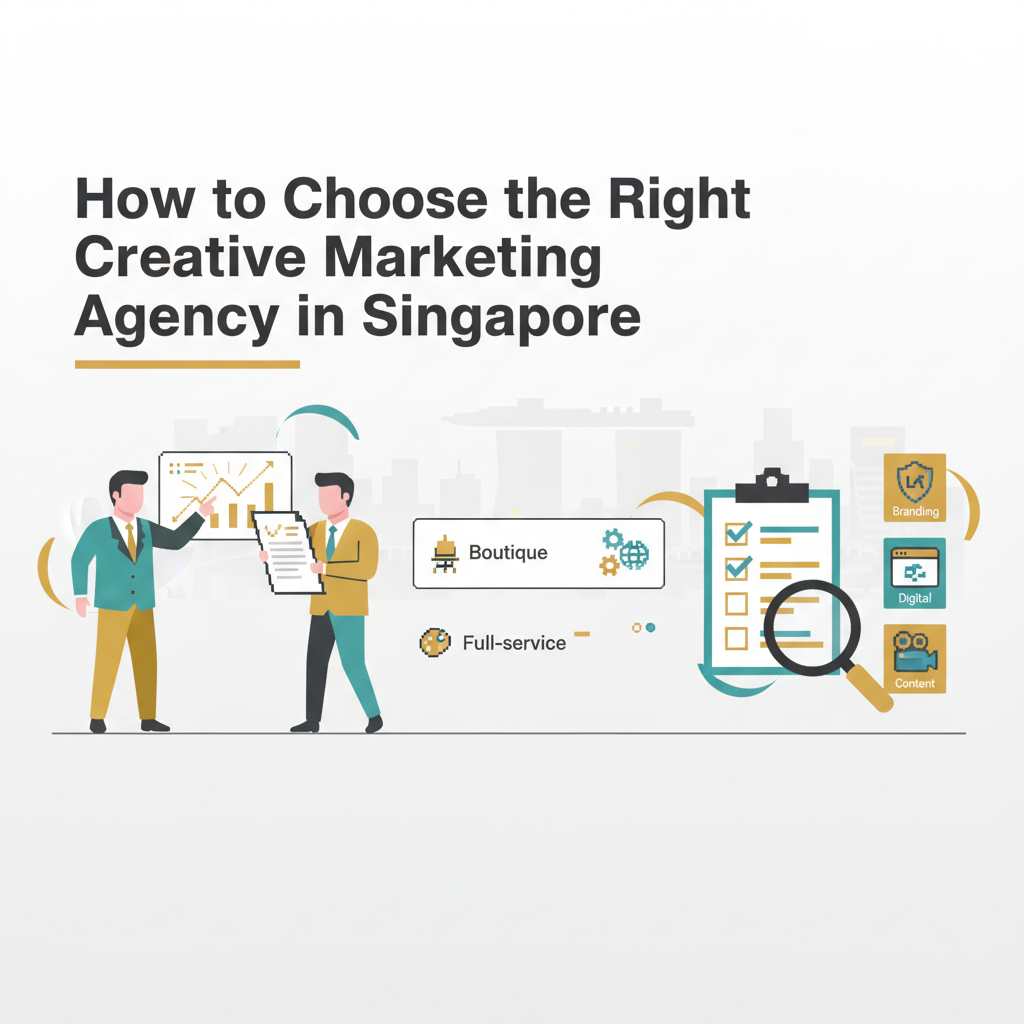
Introduction – Understanding the Value of a Creative Marketing Agency Singapore
Singapore stands as Southeast Asia's most mature advertising and creative hub, a position reinforced by its status as the regional headquarters for the global "big six" holding companies—WPP, Omnicom, Publicis, IPG, Dentsu, and Havas—alongside hundreds of home-grown independent agencies. With more than 1,000 registered creative and marketing agencies operating across the island, the landscape has become both remarkably diverse and increasingly competitive. This expansion reflects Singapore's role as the APAC launch-pad for multinational brands and the growing professionalization of local SMEs seeking to elevate their market presence.
For marketing leaders and business owners navigating this ecosystem, selecting the right creative marketing agency Singapore partner is far more than a procurement exercise. It's a strategic decision that shapes how your brand is perceived, how your campaigns perform, and ultimately, how your business grows. The stakes are high: a misaligned partnership can waste months and significant budget, while the right agency becomes an extension of your team, driving innovation and measurable results.
The challenge lies in the sheer variety of options available. Do you need a full-service integrated powerhouse that handles everything from strategy to media buying? Or would a nimble boutique studio with specialized expertise better serve your needs? Should you prioritize digital performance specialists, or do you need a partner with deep sector knowledge in your industry? This guide walks you through the decision-making framework that leading Singapore companies use to evaluate and select their creative partners.
The Agency Landscape: Boutique vs Full-Service Options
Singapore's creative agency ecosystem has evolved into distinct categories, each with its own strengths and limitations. Understanding these segments is the first step toward making an informed choice.
Full-Service Integrated Agencies represent the traditional powerhouse model. These organizations typically employ 80 to 300 staff members and operate either as part of global holding-company networks or as substantial independent firms. Their value proposition centers on offering strategy, brand and communications planning, creative concepting, media buying, CRM, performance marketing, in-house production, and data analytics all under a single P&L. This integration is particularly valuable for blue-chip corporations and government accounts that require multi-market rollouts, stringent compliance processes, and consolidated reporting across multiple channels.
Boutique Creative and Brand Studios occupy the opposite end of the spectrum. These lean consultancies—typically 5 to 40 people—build their reputation on depth of creative craft, senior talent accessibility, and organizational agility. Boutiques frequently specialize in specific sectors such as luxury, food and beverage, fintech UX, or employer branding, allowing them to develop deep expertise and distinctive visual languages that set their clients apart.
Digital and Performance Specialists have emerged as a third major category, driven by the rise of data-driven marketing. These agencies focus on SEO/SEM, social paid media, programmatic advertising, and analytics-driven content strategies. Their pitch is straightforward: faster ROI, transparent data dashboards, and flexible retainer models that align costs with performance.
Sector-Specific Vertical Shops serve industries with unique regulatory or sales-cycle requirements. Healthcare, hospitality, property marketing, and education each support dedicated creative shops that understand the nuances of their sectors—from advertising codes to the extended sales cycles typical in property development.
In-House Content and Production Studios have become increasingly common as agencies seek to reduce turnaround times and maintain quality control. Many full-service agencies now operate sister entities handling video, photography, 3-D animation, and event fabrication, allowing clients with high asset volumes to work directly with production specialists.
Comparing Boutique and Full-Service Models
The choice between boutique and full-service agencies hinges on your specific needs, budget, and organizational culture.
Boutique agencies offer several compelling advantages:
- Senior attention from founders or creative directors who remain hands-on with client work.
- Specialized expertise and distinctive visual styles that differentiate your brand.
- Lower overheads that typically translate to project fees 10–30% cheaper than network agencies.
- More flexible terms for SMEs and noticeably faster decision-making.
However, boutiques come with limitations:
- Narrower in-house capabilities—media buying, deep MarTech, or large-scale localization often require partners.
- Scaling challenges when you need multi-country adaptation or always-on social media management.
- Dependence on a small core team, which can become stretched when many large projects overlap.
Full-service agencies excel at integration:
- Creative, media, and data capabilities under one roof simplify performance attribution and reporting.
- Regional bench strength and established production processes reduce risk for complex or regulated briefs.
- Streamlined procurement and a single point of accountability for large organizations.
The trade-offs are also clear:
- Layered hierarchies mean longer approval loops and less agility.
- Higher blended hourly rates due to overhead and regional structures.
- Smaller brands may feel “lost” among global retainers, with a risk of conservative, consensus-driven work.
Core Services Explained
A comprehensive understanding of what a creative marketing agency in Singapore actually delivers is essential before you begin your selection process. The service landscape has expanded significantly beyond traditional advertising.
Branding & Design
Branding and design services form the foundation of what most creative agencies offer. This goes far beyond logo design, though that's often the most visible output. A full branding engagement typically encompasses:
- Brand strategy and positioning
Agencies conduct market research, competitive analysis, and stakeholder interviews to define your brand's unique value proposition, personality, and positioning in the market. For a Singapore SME, that might include understanding how you sit relative to regional competitors in Malaysia, Indonesia, and Thailand. - Identity systems
This includes logo design, colour palettes, typography systems, iconography, and imagery guidelines that create visual consistency across all touchpoints—from your website to physical signage. - Brand guidelines and documentation
Comprehensive brand books (often including digital asset libraries) ensure consistency whether your brand appears on a business card, website, video lower-third, or outdoor banner along Orchard Road. - Naming and verbal identity
For new products or companies, agencies develop naming strategies, taglines, messaging frameworks, and tone-of-voice guidelines that shape how your brand communicates in Singapore’s multilingual context. - Packaging and retail design
Particularly strong in Singapore's F&B, FMCG, and cosmetics sectors, this service extends branding into the physical retail environment—from shelf presence in supermarkets to café interiors in neighbourhoods like Tiong Bahru. - Environmental and experiential design
Agencies design physical spaces—from office environments and exhibition booths at Suntec to pop-up brand activations—that bring your identity to life.
In short, branding work done well creates a platform that makes all future campaigns more coherent and effective.
Digital & Social Campaigns
Digital and social media services have become central to modern marketing. A strong digital marketing agency in Singapore will typically offer:
- Social media strategy and content calendars
Developing platform-specific strategies (e.g., TikTok vs LinkedIn) and content themes mapped to your sales funnel. For example, a B2B brand in Singapore might use LinkedIn for thought leadership and Facebook for retargeting webinars. - Paid social advertising
Campaign concepting, audience targeting, creative asset production, and ongoing optimisation across Facebook, Instagram, TikTok, and LinkedIn. Agencies will usually A/B test visuals, headlines, and calls-to-action to improve click-through and conversion. - Search engine marketing (SEM & SEO)
Keyword research, ad copywriting, landing page optimisation, and technical/onsite SEO to capture high-intent traffic for terms like "creative agency singapore" or "digital marketing agency singapore". - Display and programmatic advertising
Running prospecting and retargeting banners across news and lifestyle sites popular in Singapore, with creative variants tailored for different audience segments. - Email marketing and marketing automation
Designing email sequences for lead nurturing, abandoned-cart recovery, or customer onboarding, and integrating them with platforms such as HubSpot or Salesforce. - Influencer partnerships and ambassador programmes
Identifying and managing relationships with KOLs and micro‑influencers who are credible with your audience, whether that’s food vloggers, tech reviewers, or parenting creators. - Community management and social listening
Ongoing monitoring of comments and brand mentions, escalation protocols, and sentiment analysis so that issues are caught early and engagement feels human and on-brand.
A strong digital partner will tie all of these back to business outcomes rather than vanity metrics.
Content & Storytelling
Content is increasingly the thread that connects your brand across channels. A capable content marketing agency singapore will have expanded its capabilities to include:
- Video production
From short-form Reels and TikToks filmed around familiar Singapore locations to corporate brand films and explainer videos for regional launches. This can include scriptwriting, storyboarding, filming, editing, and motion graphics. For examples of how this looks in practice, you can explore Hamilton & Sherwind’s social media video production strategies in Singapore. - Motion graphics and animation
2D/3D animation, product visualisation, and kinetic typography that can simplify complex ideas (for example, explaining a fintech product to SME owners). - Photography and visual content
Campaign photography, lifestyle shoots, product imagery, and event coverage that align with your visual identity. - Copywriting and content strategy
Developing narratives, long-form content, and messaging hierarchies that work across your website, blog, email sequences, and social platforms. If you’re looking to scale this, a partner with strong content marketing for brand leadership capabilities will help. - Podcasts and audio content
Concepting and producing branded podcasts or audio series, especially relevant for B2B or education/insights-led brands in the region. - Livestream events and virtual experiences
Planning and producing webinars, product launches, and hybrid events for audiences across Southeast Asia. - User-generated content campaigns
Encouraging and curating content from your community—reviews, testimonials, or creative challenges—to build social proof and engagement.
High-quality content and storytelling are what transform a list of services into a brand people remember and share.
Evaluation Guide: Portfolio, Process & People
Once you've identified potential partners among the many marketing agencies singapore has to offer, the evaluation phase becomes critical. This is where many organisations make mistakes by focusing too heavily on awards or flashy portfolios while overlooking the factors that actually predict partnership success.
Portfolio Relevance and Case-Study Depth
Begin by examining the agency's portfolio, but look beyond surface-level aesthetics. The most important question is: have they solved problems similar to yours?
Look for:
- Vertical expertise
Have they worked in your industry or with similar customer segments in Singapore/SEA? For example, B2B professional services, consumer retail, or government-linked projects all have very different dynamics. - Scope of work
Do case studies show omnichannel campaigns—brand, digital, social, and events—rather than isolated design pieces? This reveals whether the agency can think holistically. - Business impact
Strong case studies will show outcomes, not just outputs. Look for metrics such as uplift in leads, improvements in engagement, or campaign ROI, even if figures are approximate. - Complexity and scale
Have they managed projects of similar budget and ambition to what you’re considering? A team that has only done small, one-off design jobs may struggle with a regional integrated launch.
When reviewing the work, ask the agency to walk you through one or two projects in depth: brief, insight, idea, execution, and results. Their ability to articulate this clearly is often a better signal than the visuals alone. You can also browse a potential partner's portfolio—such as Hamilton & Sherwind's branding and video production portfolio—to understand their breadth.
Senior Team Commitment and Continuity
One of the most common sources of disappointment is the "pitch team vs delivery team" problem: you buy into the senior talent you meet during the pitch, then find yourself working mostly with juniors.
To reduce this risk:
- Ask who is doing the work
Request a proposed account team with names, roles, and percentage of time allocated to your brand. - Clarify escalation paths
If something stalls or goes off-track, who can you call to unblock it? How often will senior leaders join reviews? - Discuss continuity
What is their plan if a key person resigns or is reassigned? How will knowledge transfer be handled? - Meet the working team
Before committing, have a working session (not just a credentials presentation) with the actual designers, strategists, and account managers who will support you.
Agencies that are transparent and confident about their team structure are usually easier to partner with long term.
Culture & Communication Fit
The relationship between client and agency is fundamentally a human one, and cultural fit matters more than many organisations realise—especially in a fast-paced market like Singapore.
Consider:
- Communication style
Does the agency listen more than they sell? Do they ask thoughtful questions about your business and customers? Are they comfortable giving honest feedback when they disagree? - Decision-making speed
If you operate like a startup, will they be able to turn around concepts and content in days, not weeks? If you’re a large enterprise, can they handle structured approvals and procurement processes? - Openness to collaboration
Are they comfortable co-creating with your in-house team, or do they prefer to work in a black box? Many marketing leaders now favour hybrid models where the agency and in-house team share responsibilities. - Diversity and local insight
Does the team reflect the diversity of the audiences you’re targeting across Singapore and the wider SEA region? Local nuance often makes the difference between generic creative and work that truly resonates.
Your early conversations are a strong predictor: if alignment feels hard during chemistry meetings, it usually doesn’t get easier once deadlines and budget pressures kick in.
Tools & Technology Stack
In an increasingly technology-driven marketing environment, the tools and platforms an agency uses directly affect how efficiently they can work with you and how well they can measure impact.
Key questions to explore:
- Creative and collaboration tools
Do they use modern tools such as Figma for interface design, online proofing systems for artwork review, and shared asset libraries so your team can access files easily? - Analytics and reporting
How will they track and report the performance of your campaigns? Can they integrate with your existing analytics setup, CRM, or CDP? - Marketing automation and CRM familiarity
If you use platforms like HubSpot, Salesforce, or Klaviyo, do they have references or certifications that show hands-on experience? - AI and automation
Are they exploring AI to speed up ideation, personalisation, and testing while keeping human judgment in control? This can materially change the speed and scale at which campaigns run. - Security and governance
Particularly for larger organisations, how do they manage access, approvals, and data handling in a way that aligns with your internal policies?
The goal here isn’t to select the “flashiest” stack, but to find a partner who can work smoothly with how your organisation is already set up, and who can help you mature over time.
Budgeting, Contracts & Performance Metrics
The commercial arrangement is where even promising partnerships can go off the rails. Clarity upfront on pricing, scope, and success measures will save a lot of pain later.
Pricing Models and Fee Structures
Common models you’ll encounter with a creative marketing agency in Singapore include:
- Project-based fees
A fixed price for a defined scope (e.g., SGD 20,000 for a rebrand, or SGD 8,000 for a three-month social campaign). Best when the brief is clear and there’s a natural start and end. - Retainers
A monthly fee for a bundle of ongoing services—strategy, creative, content production, and optimisation. Works well when you need always-on support and predictable budget. - Hybrid models
A modest base retainer to secure the core team plus separate project fees for major campaigns or launches. This balances stability with flexibility. - Performance-linked components
Particularly in digital and performance marketing, some agencies will structure bonuses around hitting agreed KPIs such as cost per lead or ROAS. These often sit alongside paid advertising campaigns that are tightly measured. - Time and materials
Less common for pure creative work, but sometimes used for consulting, workshops, or discovery phases where the output is not yet fully defined.
As a rule of thumb, SMEs and startups often prefer clear project-based pricing to control risk, then move into retainers once they’re confident about the relationship and volume of work.
Contracts & Scope Definition
Before you sign, ensure the contract clearly documents:
- Scope of work – deliverables, formats, channels, and responsibilities (e.g., who handles media buying, who uploads content, who manages community responses).
- Number of concepts and revision rounds – to avoid misaligned expectations.
- Timelines and dependencies – including what the agency needs from you (e.g., approvals within a defined timeframe, access to data, subject-matter experts).
- Approval and sign-off process – who has authority on your side, and how changes to the brief are handled.
- IP ownership and usage rights – whether you own all source files and how assets can be reused across regions or campaigns.
- Termination and notice – fair exit terms for both sides if priorities change.
Good agencies will often share a standard MSA and SOW template; treat that as a starting point for discussion, not a take‑it‑or‑leave‑it document.
Establishing Performance Metrics and KPIs
Finally, align on what success actually looks like.
For brand and creative:
- Brand awareness, consideration, or preference shifts (measured via research).
- Improvements in branded search volume or share of voice.
- Engagement quality, not only quantity (e.g., saves, shares, meaningful comments).
For digital and performance:
- Lead volume and cost per qualified lead.
- Conversion rates across the funnel (click‑through, sign‑up, purchase).
- Return on ad spend (ROAS) or marketing efficiency ratio.
- Content performance benchmarks by platform (view-through rates, completion rates).
Agreeing on baselines, targets, and reporting cadence (e.g., weekly optimisation, monthly performance review, quarterly strategy reset) keeps everyone focused on outcomes, not just deliverables.
Conclusion – Moving Forward with Confidence
Selecting a creative marketing agency Singapore partner is one of the most consequential marketing decisions you’ll make. The right choice can unlock new audiences, sharpen your positioning, and drive sustained revenue growth. The wrong one can burn precious budget and time.
By:
- Understanding the local agency landscape and whether you’re better served by a boutique, full-service, or specialist partner.
- Clarifying the mix of services you actually need—branding, digital, content, or all of the above.
- Evaluating portfolios, people, processes, and technology, not just awards and reels.
- Structuring fair contracts with clear scope, pricing, and success metrics.
…you dramatically increase your chances of building a partnership that feels like an extension of your own team.
If you’re a Singapore or SEA-based brand looking for a strategic, story-led partner that blends creativity with data and emerging tech, Hamilton & Sherwind can help—from brand transformation and integrated campaigns to social, SEO, video and AI‑enhanced marketing workflows. You can explore our full range of digital marketing services in Singapore, including social media marketing expertise, TikTok marketing strategies, and brand identity development.
To explore what the right agency partnership could look like for your organisation, contact us here and let’s discuss your goals, constraints, and next big brief.