

Social Media Video Production in Singapore: Strategy, Short-Form, and Scalable Workflows
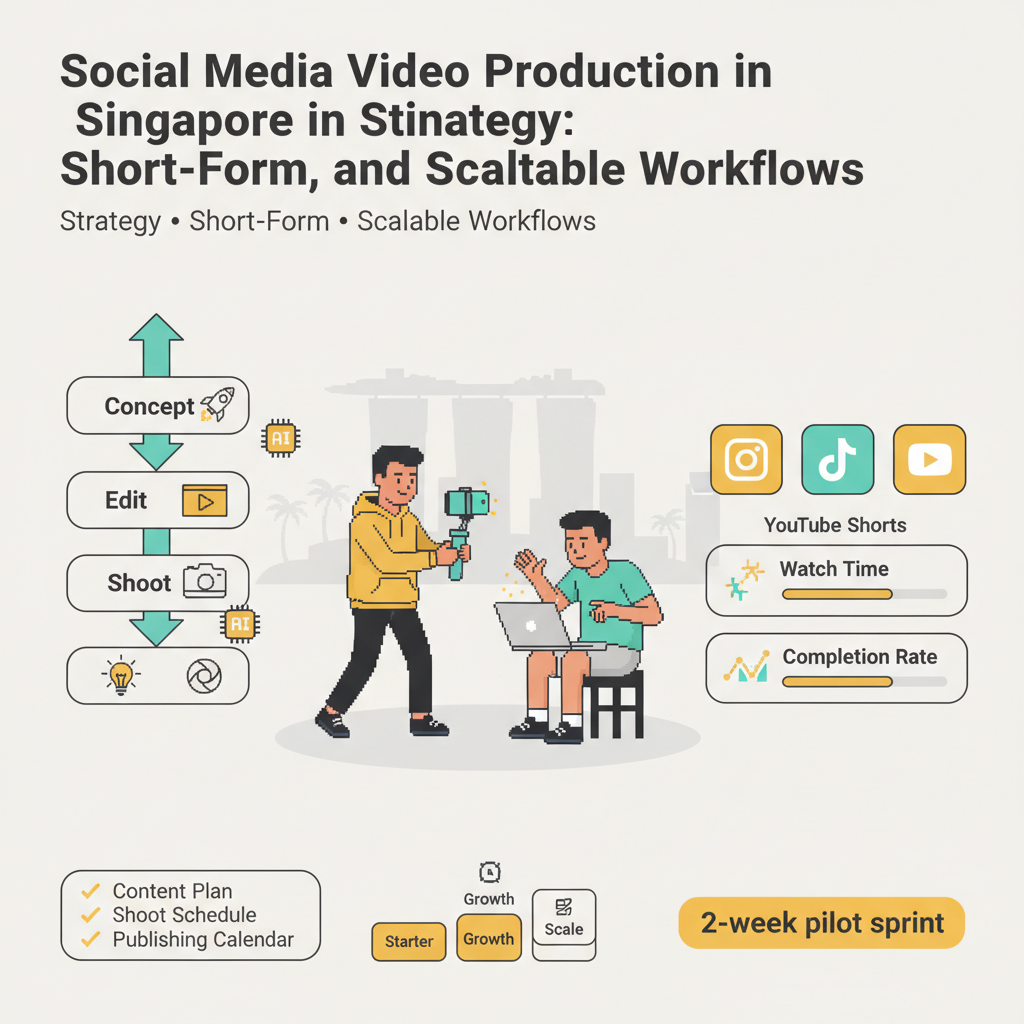
In today’s fast-moving digital landscape, short-form social video is a powerful growth lever for brands in Singapore and the wider SEA region (see Digital 2025: Singapore social media trends). For marketers, social video isn’t just a creative luxury; it’s a lean, scalable engine for awareness, consideration, and action. The most successful campaigns combine speed with quality through repeatable workflows, platform-aware formats, and storytelling that resonates locally.
This guide presents a practical, platform-neutral blueprint to design and produce social video that works on Instagram Reels, TikTok, and YouTube Shorts—without getting bogged down in bespoke, high-cost production every time. You’ll find concrete tactics, checklists, budget tiers (DIY, hybrid, full-service), and three mini-examples tailored to Singapore/SEA realities. You’ll also see how AI-assisted workflows (for ideation, shot lists, captions, and auto-subtitling) can scale production—while keeping human direction and brand safety front and center. For end-to-end help, explore our Social Media Services and Video Production in Singapore.
Section 1: Understanding social video basics
What counts as a social media video
Social video on top platforms is designed for mobile-first, rapid consumption. It emphasizes vertical framing, clear on-screen messaging, and quick value delivery so viewers can understand, engage, and act even when muted. Across Instagram Reels, TikTok, and YouTube Shorts, the core aim is the same: hook early, deliver value fast, and guide viewers toward a meaningful next step. For current format and sizing norms across networks, see this Social media video specs guide.
Platform differences: Instagram Reels, TikTok, YouTube Shorts
- Instagram Reels: Discovery surfaces include the main feed, Reels tab, Stories, and Explore, with Shop integrations available. See official guidance on quality and specs in Instagram Help.
- TikTok: The For You feed drives discovery through highly personalized, trend-driven content. Review video specs and feature guidance in the TikTok Help Center.
- YouTube Shorts: Shorts benefit from the Shorts shelf, homepage, and search, and can act as an entry point to longer YouTube content. See YouTube Shorts help for dimensions and best practices.
Singapore/SEA note: Regional audiences show strong appetite for short-form content across all three platforms; localized hooks, bilingual captions, and creator partnerships can lift performance (see Singapore social media statistics).
Section 2: Core elements of a high-performing concept
Concept development and brief creation
High-performing concepts start from one clear truth: a single, compelling idea that can be expressed quickly and scaled across formats. A strong hook, a crisp audience insight, a tangible benefit, and a clear call to action anchor the concept. Use lean, reusable templates to move from idea to approved content in hours rather than days.
Rapid approach:
- Refresh a one-page Creative Brief (objective, audience cue, single idea, key messages, tone, primary platform, deliverables, timeline, success metrics).
- Run a 30–60 minute ideation sprint to generate 6–12 micro-ideas; rank by impact and feasibility; select the top 2–3 to develop.
- Consolidate into a Concept Brief and apply a simple scoring rubric (Impact × Feasibility × Differentiation).
- Build a plug-and-play asset library (hooks, end frames, lower-thirds) to speed post-production across formats.
Script, storyboard, and pacing
A strong script and storyboard keep production efficient and consistent. Pacing matters on mobile: use the first 3 seconds for hook and relevance, then a tight sequence of visuals that match the music and on-screen text. Use a modular approach: one master script and multiple micro-beats that can be re-cut into 15s, 30s, or 60s formats without re-shooting. For Singapore/SEA audiences, local language cues and clear, legible captions help retention and comprehension.
Section 3: Production workflow from pre to post
Pre-production checklist
- Finalize brief, objective, audience, and deliverables.
- Lock a one-page script and a lightweight storyboard.
- Prepare a modular asset library (hook lines, end cards, lower-thirds).
- Confirm locations, talent, wardrobe, and props; secure permits if needed.
- Build a realistic run-of-show with timeboxing by shot type.
- Prepare gear kits (cameras/phones, mics, lights, batteries, backups) and backup plans for weather or location changes.
- Plan localization assets (captions, translations) early to avoid re-edits.
On-set tips for efficient shoots
- Start with a tight schedule and maintain visible pace on set.
- Use a modular shot list and parallel tasks (shoot main dialogue while B-roll is captured).
- Lock essential details early: final scripts, end-frame CTAs, and core visuals.
- Prioritize audio quality: lav mics, capture room tone, and monitor audio live.
- Lighting that travels: compact 3-point setups or portable LEDs to maintain consistency across locations.
- Shoot with multiple takes but minimize drift; capture slight variations, then select the best options in post.
- On-set QA: preview rough cuts on a monitor; confirm captions, text overlays, and timing align with visuals.
Post-production that balances speed and quality
Post-production should be template-driven and modular. Create a master edit template with placeholders for VO, captions, on-screen text, and CTAs. Use color grading presets and audio templates to ensure consistency across outputs and formats. Localization should be modular: hooks and CTAs can be swapped with language-specific blocks without re-editing the core cut. The aim is to deliver high-quality content quickly, while preserving the brand voice and platform tailoring. For creator-friendly retention tips, see watch time and retention.
Section 4: Editing for engagement and accessibility
Editing techniques to boost retention
- Hook fast with clear value in the first 3 seconds.
- Maintain rhythm: for the first 8–12 seconds, use frequent cuts to maintain momentum; then modulate pace to support the message.
- Use a modular shot list and reuse 8–12 core shots across 15s, 30s, and 60s variants.
- Align motion and text with the platform’s native expectations (e.g., native sounds for TikTok, Instagram-friendly hooks, YouTube-friendly narrative flow).
- Use on-screen text to reinforce the hook and CTA; avoid overcrowding.
Captioning and accessibility considerations
Captions and accessibility are both moral and practical imperatives:
- Captions: accurate, synchronized, and readable; use 1–2 lines per caption with 30–40 characters per line.
- Language strategy: include English captions for broad SEA audiences, plus localized captions (Mandarin, Malay, Tamil, etc.) where appropriate.
- Visual accessibility: high-contrast text and legible overlays; avoid relying on color alone to convey meaning.
- Audio considerations: ensure essential information is conveyed in captions; consider audio descriptions for denser content when feasible.
- Follow the WCAG captions guidance to support inclusive video production.
Section 5: Platform-specific optimization and formats
Customizing for IG Reels, TikTok, Shorts
- IG Reels: Create native-feel content with strong hooks, quick cuts, and a natural fit into the Instagram ecosystem (Shop, Explore). Use cover images with minimal text and brand accents; optimize captions to support discovery and engagement. Reference: Instagram Help.
- TikTok: Lean into trend-relevant hooks, native sounds, and quick narratives. Start with a bold visual in the first 1–2 seconds; align CTAs with platform norms (e.g., link in bio, in-app shopping). Reference: TikTok Help Center.
- YouTube Shorts: Prioritize a clear value proposition within the first 2–3 seconds; ensure thumbnails are legible and compelling. Reference: YouTube Shorts help.
Thumbnails, hooks, and call-to-action considerations
- Thumbnails/Covers: Keep them crisp, high-contrast, and legible; e.g., 1280×720 for Shorts. See specs guide.
- Hooks: Mix visual curiosity, problem statements, and data-driven claims; tailor hook types to each platform’s vibe while maintaining a consistent brand voice.
- CTAs: Align with platform flows (Shop links on IG, in-bio CTAs on TikTok, description/CTA links on Shorts). Use end frames to reinforce the desired action.
Section 6: Distribution, measurement, and iteration
Key metrics to track (watch time, retention, completion rate)
- Watch time and average watch time: total watch time and average per view indicate how compelling the content is over time. See definitions and best practices in this retention guide.
- Retention by moment: track where viewers drop (first 3 seconds, mid-video, end) to improve hooks and pacing.
- Completion rate: percentage of viewers who finish the video; higher completion signals cohesive storytelling and strong CTA positioning.
- Engagement: likes, comments, shares, saves—indicators of resonance and potential for organic reach.
- Click-throughs and conversions: track downstream actions to link video performance to outcomes.
- Reach, impressions: understand breadth vs depth of impact across platforms.
- Language-version performance: break down metrics by language to optimize localization.
How to run quick tests and iterate
- Quick hook tests: run 2–3 hooks per platform; monitor first-3s retention and early completion over the first 3–5 days.
- Length experiments: create 15s, 30s, and 60s variants; compare retention and watch time to decide the best length per concept and market.
- Caption and localization tests: compare English-only vs bilingual/localized captions; measure impact on completion and CTR.
- Thumbnail tests: A/B cover frames to boost CTR; prioritize platforms where thumbnails matter (especially Shorts).
- Language and cultural relevance: test language variants and local hooks; measure uplift in retention and action rate.
- Time-of-day tests in SEA markets: post at different SEA local times to discover optimal windows; iterate accordingly.
Three mini-examples of Singapore/SEA campaigns
Example 1: F&B launch (Singapore)
Concept: “New flavor, new mood” – quick sensory moment with a signature sound cue.
Pre-production: script (hook + product reveal), storyboard, two locations (kitchen, tasting bar), B-roll of ingredients and tasting moment; bilingual captions (English + Mandarin).
Shoot day: 1–2 hours; capture macro shots of the drink, pour, fizz, and persona enjoying the sip; record ambient sound; ensure 1–2 mouth-watering close-ups.
Post: quick edit using modular assets; captions; 15s and 30s cuts; localized caption variants.
Distribution: publish as Reels and Shorts; test Shop integration on IG where available.
Example 2: Retail promo (SEA region)
Concept: “Limited-time deal, fast — 3 steps to save.”
Pre-production: brief with simple 3-step flow; storyboard 3–4 panels; plan bilingual captions; compile in-store shots and product grid.
Shoot day: one location; 2–3 hours; capture hands-on product usage and price reveal; B-roll of queue or excitement cues.
Post: parallel edits for Reels and Shorts; teaser thumbnails; captions reflect deal specifics and CTA (store locator, promo code).
Distribution: push across IG Reels, TikTok, and Shorts; use a consistent promo code and a landing page with the same messaging.
Example 3: B2B event highlight (Singapore/SEA)
Concept: “Event in a minute: the value, the people, the outcomes.”
Pre-production: script highlighting speaker moments, a demo, and a CTA to the full event recap; storyboard 5–7 micro-beats (teaser, keynote, networking, outcomes).
Shoot day: multi-location capture; collect testimonials and quick product demos; B-roll of expo floor and attendees.
Post: 60s highlight with social proof and a CTA to watch the full session or register for the next event; localized captions for SEA markets.
Distribution: Shorts and Reels to maximize reach; CTA to the event landing page and a follow-up email nurture flow.
Conclusion: Key takeaways and next steps
Key takeaways:
- Short-form video (Reels, TikTok, Shorts) is a primary growth format for brands in Singapore and SEA, with sustained usage across platforms (Singapore Digital 2025).
- Balance speed with quality by using modular templates, pre-approved hooks, and a consistent asset library. AI-assisted workflows for ideation, captions, and auto-subtitling can scale output, but human creative direction remains critical.
- Platform-specific optimization matters: customize for Reels, TikTok, and Shorts with tailored hooks, thumbnails, and CTAs, while maintaining a unified brand voice.
- A structured production workflow—from pre-production checklists to on-set efficiency and post-production templates—delivers consistent results while reducing time-to-publish.
- Measurement and iteration drive growth. Track watch time, retention, completion rate, and engagement; run quick tests and apply learnings across the next wave of content.
Ready to translate these principles into high-impact, scalable social video for your brand? Explore our Social Media Services, view our Video Portfolio, and speak to our team today via our Contact page.