

How to Choose the Right Branding Agency in Singapore (Step-by-Step Guide)
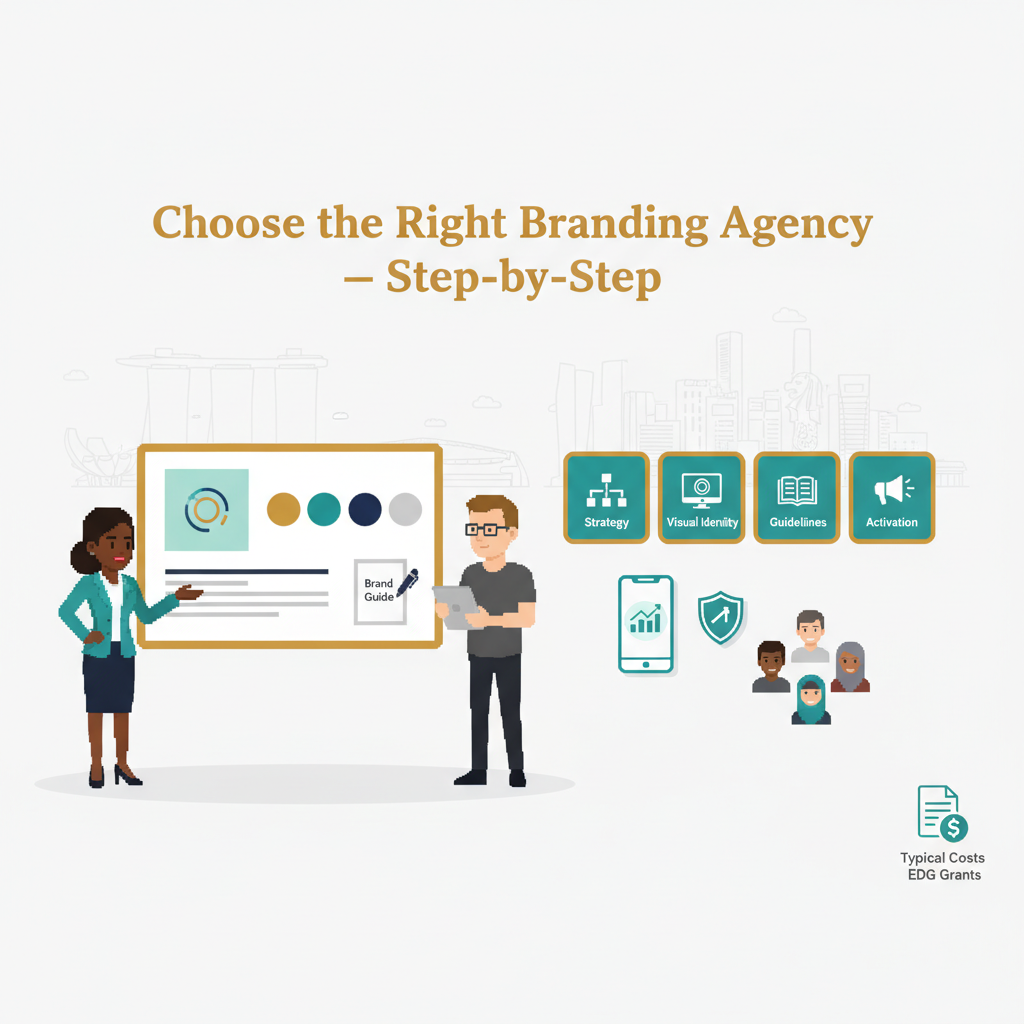
Why Strong Branding Matters in Singapore’s Competitive Market
Singapore’s business landscape is saturated with digital noise. With a relatively small population and very high internet penetration, competition for consumer attention is fierce across every sector—from fintech startups disrupting traditional banking to F&B concepts fighting for shelf space in a crowded marketplace. In this environment, a strong, cohesive brand isn’t a luxury; it’s a survival mechanism.
Many local businesses operate with fragmented visual identities, inconsistent messaging, and outdated brand positioning that fails to resonate with today’s digitally native audiences.
This is where professional branding becomes critical. A well-executed brand strategy doesn’t just make your business look good—it clarifies your market position, aligns your team around a shared purpose, and creates the foundation for sustainable growth. Whether you’re a startup launching your first product, an SME refreshing a dated identity, or an enterprise managing multiple sub-brands, choosing the right branding agency in Singapore can be the difference between blending in and standing out.
The challenge, however, is that Singapore’s branding agency landscape is diverse and sometimes opaque. Agencies range from one-person freelancers to global networks, from design-focused boutiques to strategy-heavy consultancies. Fees vary wildly—from a few thousand dollars for basic identity work to six- or seven-figure investments for complex, multi-market rebrands. Without a clear evaluation framework, business owners often make costly mistakes: hiring agencies that don’t understand their market, paying for services they don’t need, or worse, ending up with a beautiful logo that doesn’t drive business results.
This guide cuts through the noise. We’ll walk you through what branding agencies actually deliver, the unique challenges and opportunities in Singapore’s market, how to evaluate potential partners, and the metrics that matter for ROI. By the end, you’ll have a practical framework for selecting an agency that aligns with your business goals and budget.
What a Branding Agency in Singapore Actually Delivers
Before you start shortlisting agencies, it’s essential to understand what you’re actually buying. “Branding” is an umbrella term that means different things to different agencies—and to different clients. Some agencies focus purely on visual identity (logo and color palette), while others position themselves as strategic consultancies that reshape how your entire organization operates.
Here’s what a full-service branding engagement typically includes:
Brand Discovery & Research
This is the foundation. A credible branding agency will invest time understanding your business, market, and audience before sketching a single logo. This phase usually involves stakeholder workshops (often a half-day to full-day session with your leadership team), competitor audits, and sometimes quantitative research using surveys or focus groups. The goal is to uncover insights that inform strategy—not just assumptions.
For example, a boutique brand consultancy might conduct a series of stakeholder interviews, analyze dozens of competitors, and synthesize findings into a research brief. A larger agency might layer in customer perception surveys or social listening data. The depth depends on your budget and the complexity of your market.
Brand Strategy & Positioning
Once research is complete, the agency distils findings into a clear strategic framework. This typically includes:
- Purpose statement: Why your brand exists beyond making money
- Target audience personas: Who you’re trying to reach and what they value
- Positioning statement: How you’re different from competitors
- Brand values: The principles that guide decisions
- Brand promise: What customers can expect from you
Many agencies crystallise this into a one-page “Brand DNA” or “Brand Pillar” document—a reference tool that guides everything from hiring decisions to customer service protocols. This is where strategy-led consultancies add the most value; they treat brand strategy as a management tool, not just a creative exercise.
Verbal Identity
Your brand needs a voice, not just a look. This includes:
- Messaging architecture: Core messages, supporting messages, and proof points
- Tone of voice: How you communicate (formal vs conversational, authoritative vs approachable)
- Taglines and elevator pitches: Memorable ways to describe what you do
- Content guidelines: How to write for different channels (social media, email, website)
A design-led boutique might provide a master messaging document plus a few exemplar pieces (e.g. sample social posts or email templates). A full-service partner might bundle this with content planning and ongoing content creation.
Visual Identity
This is what most people think of when they hear “branding”—but it’s just one piece. Visual identity includes:
- Logo design: Your primary mark, plus variations for different applications
- Colour palette: Primary and secondary colours with specific codes
- Typography: Font choices for headlines, body text, and accents
- Iconography and imagery style: How you represent concepts visually
- Photography direction: The aesthetic and mood of images used in marketing
The best agencies don’t just design a logo in isolation; they build an identity system that works across digital and physical touchpoints—from your website and social media to packaging and office signage. If you later work with a dedicated design or branding portfolio team, this system becomes their North Star.
Brand Guidelines
This is the rulebook. A comprehensive brand guideline document codifies all the rules for using your brand consistently. It covers logo usage, colour specifications, typography rules, imagery guidelines, tone-of-voice examples, and more. In Singapore’s multilingual context, guidelines often include specifications for English, Chinese, and sometimes Malay or Tamil.
Modern guidelines are increasingly digital-first. Rather than a static PDF, many agencies now deliver interactive brand centres—online platforms where your team can download assets, access templates, and stay updated as the brand evolves.
Collateral & Activation
Once the core brand is defined, agencies typically help you activate it across key touchpoints:
- Stationery (business cards, letterheads)
- Digital assets (website UI, social media templates, email signatures)
- Pitch decks and sales presentations
- Packaging (for F&B, FMCG and D2C brands)
- Signage and environmental design (office, retail, events)
- Launch campaign materials (press kits, launch visuals, social content)
Some agencies prototype these in real-world conditions before finalising designs—for example, testing packaging on shelf or signage in-store.
Ongoing Brand Management
This is where agency models diverge. Some agencies hand off after the launch and let you manage the brand independently. Others offer retainer-based partnerships that include:
- Brand management and design support
- Content and social media services
- Performance and digital marketing to drive traffic to your new brand assets
- Brand evolution and periodic refreshes
Subscription-based or “design-as-a-service” models (fixed monthly fees for ongoing creative work) can work well for SMEs that need constant assets but may lack the strategic depth of a one-off, research-heavy brand strategy project.
If you want a more holistic relationship that covers identity, content and campaign roll-out, it can be useful to explore integrated branding and identity services that bring strategy, creative and digital under one roof.
Local Market Insights: Singapore-Specific Branding Challenges & Opportunities
Singapore’s branding landscape is unique. Understanding the local context is crucial for selecting an agency that can navigate these nuances effectively.
Multicultural Complexity
Singapore is home to four official languages and a deeply multicultural population. A brand that resonates with Chinese-speaking audiences may fall flat with Malay or Indian communities. This isn’t just about translation; it’s about cultural authenticity and relevance.
Leading branding firms in Singapore account for this by:
- Building multilingual messaging from the start, not as an afterthought
- Ensuring typography supports multiple scripts where needed
- Conducting research across different cultural segments
- Testing brand concepts with diverse focus groups
If you’re in F&B, retail, education, healthcare or consumer services, cultural fluency is non-negotiable.
Digital-First Consumer Behaviour
Singaporeans are among the world’s most digitally engaged consumers. Mobile penetration is extremely high, and social commerce is booming. Your brand identity must work beautifully on a phone screen, not just on a signboard.
Strong brand guidelines now include:
- Social tile and story templates
- Motion logo specifications for video and Reels
- Dark mode variants for apps and websites
- Rules for how your brand lives on platforms like Instagram, TikTok and LinkedIn
This is where partnering with an agency that also understands digital marketing services can be an advantage—the brand is designed for performance channels from day one.
Sector-Specific Dynamics
Different industries face different branding challenges in Singapore:
- Fintech: Highly regulated and crowded; you must balance innovation and trust.
- F&B: Intense competition and high churn; you need a distinctive story and experience.
- Healthcare: Strict rules on claims; you must signal credibility and empathy.
- Education: Speaking to both parents and students; you need to balance aspiration and authenticity.
- B2B services: Often complex offerings; clarity and credibility are key.
When evaluating agencies, look for case studies and portfolios in your sector so you can see how they have handled similar challenges before.
Grants and Support
The Enterprise Development Grant (EDG) administered by Enterprise Singapore can subsidise branding and marketing strategy work for eligible SMEs. Many Singapore-based agencies are familiar with EDG or are accredited under various government programmes and can advise on scoping brand projects to be grant-eligible. This can substantially reduce your out-of-pocket investment and change what level of branding work becomes feasible.
Evaluating Agencies: Key Criteria & Due-Diligence Questions
Now that you understand what branding agencies deliver and the Singapore-specific context, how do you evaluate potential partners? Use these criteria.
Portfolio Fit, Process Transparency & Team Expertise
Portfolio fit
Look for:
- Work in your or adjacent industries
- A range of scales (startup, SME, regional, enterprise)
- Before/after examples where possible
- Evidence of implementation (not just logo concepts on mock-ups)
Red flags:
- All brands look suspiciously similar
- No clear explanation of the brief or the challenge
- No mention of business outcomes or impact
Process transparency
Ask agencies to walk you through a typical project:
- Discovery and research
- Strategy and positioning
- Concept development
- Refinement and testing
- Guidelines and handover
- Launch and post-launch support
You want clear milestones, decision points and responsibilities. If an agency wants to “jump straight into design” without structured discovery, be cautious.
Team expertise
Clarify:
- Who leads strategy?
- Who leads design and creative direction?
- Who manages the project day-to-day?
- Whether senior people you meet in pitch meetings will stay involved after you sign.
You should be comfortable with the actual delivery team, not just the sales lead.
Metrics That Matter: From Awareness to Revenue Impact
Branding ROI is multi-layered. You can measure:
- Awareness: branded search volume, reach, recall studies
- Perception: surveys on trust, quality, innovation, etc.
- Engagement: social engagement, time on site, email performance
- Business impact: conversion rates, customer lifetime value, pricing power
When you talk to potential agencies, ask them:
- How do you define success on a branding project?
- What KPIs do you recommend tracking in the first 3–12 months?
- How will you help us establish a baseline and measure change?
You’re not just buying a logo; you’re investing in a brand system that should support marketing, sales and recruitment.
Budget & ROI: Understanding Costs of Branding Services in SG
Common Pricing Models
Agencies in Singapore typically use one or a combination of these pricing models:
- Project-based – fixed fee for a defined scope (common for rebrands and new launches).
- Retainer-based – ongoing monthly fee for continuous design/content/consulting support.
- Hybrid – project fee for the core rebrand + optional retainer for roll-out and optimisation.
What Drives Cost
Key cost drivers include:
- Depth of research (desk research vs full stakeholder and customer work)
- Breadth of deliverables (identity only vs identity + website + campaigns)
- Sector complexity (e.g. healthcare, finance, public sector)
- Timeline (rush work usually costs more)
- Whether you include downstream activities such as video or social media advertising
Rather than fixating only on headline price, weigh:
- Strategic depth
- Quality and flexibility of the identity system
- Support for internal roll-out and training
- Ability to integrate brand with ongoing marketing activities
When branding is done well, it becomes an asset you build on for years, not just a campaign.
Shortlisting Partners: Comparison Framework + Mini Case Study
Create a simple comparison sheet for each agency you speak to covering:
- Sector experience and case studies
- Strengths (strategy, design, digital, activation)
- Proposed process and timeline
- Measurement and ROI thinking
- Budget, payment terms, and any grant experience
Mini Case Example: B2B SaaS Company in Singapore
Imagine a B2B SaaS company serving regional clients from Singapore.
Needs
- Clear positioning vs global competitors
- Updated visual and verbal identity
- Website overhaul with improved lead-generation
- Sales pitch decks aligned to the new brand
Shortlist criteria
- Demonstrated work in B2B or SaaS
- Ability to simplify complex offerings into clear stories
- Strong web, UX and content capabilities
- Understanding of regional audiences (SEA, not just SG)
The chosen partner should demonstrate in the proposal how they will dig into your sales cycle, customer decision drivers and product roadmap—not just your logo.
Future-Proofing Your Brand: Trends Behind Successful Rebrands
Brands that age well in Singapore over the next 3–5 years tend to:
- Use modular, responsive identity systems, not rigid templates
- Start with digital use cases (social feeds, websites, apps) before print
- Embrace authenticity and clarity over buzzwords
- Design with inclusivity and multicultural nuances in mind
- Build content-ready systems so marketing teams can ship quickly without going off-brand
Ask any potential agency:
- How will this brand behave on social and in motion?
- How easy will it be for my internal team to use without breaking it?
- What happens when we launch new products, markets or sub-brands?
Conclusion: Next Steps to Launch Your Rebrand
To move from reading to action:
- Clarify your brief – objectives, constraints, budget range, timelines.
- Map your stakeholders – who must be involved at which milestones.
- Shortlist and meet agencies – treat this like hiring senior leadership.
- Evaluate on fit, not just price – process, chemistry, thinking, and track record.
- Plan implementation – brand training, asset roll-out, website/social updates, sales enablement.
A strong brand becomes the backbone of your marketing, from your website and branding portfolio to your social presence and sales activity. Investing the time to choose the right partner in Singapore will pay off in clearer differentiation, stronger customer loyalty and easier decision-making across your organisation.
If you’d like expert help planning or executing a brand refresh or full rebrand, you can start a conversation with a specialist team today via the official channel: contact us here.
Frequently Asked Questions
How long does a typical branding project take?
Timeline depends on scope. A startup brand build typically takes 6–10 weeks. A brand refresh for an SME often takes 8–14 weeks. An enterprise rebrand can take 4–8 months, especially if it involves multiple markets and internal alignment across regions.
What is the difference between a brand refresh and a full rebrand?
A refresh evolves your existing brand—updating the logo, refining colours and typography, tightening messaging. A full rebrand is more fundamental: new positioning, potentially a new name, and a new visual and verbal system. Refreshes are usually faster and less disruptive; rebrands require more research, planning and change management.
How much should a branding project cost in Singapore?
Costs vary widely with scope and agency type. Smaller identity projects may start from five figures, while complex, research-heavy, multi-market rebrands can reach six or seven figures. The key is to map the investment to the size of your opportunity and the role brand plays in achieving your business goals, rather than chasing the lowest quote.
Do I need a specialised branding agency, or can a general marketing agency do this?
Some digital or creative agencies have strong brand strategy and identity practices; others are more campaign-focused. If you are undertaking a major repositioning or creating a new brand in a complex sector, a team with dedicated brand strategy and identity experience is valuable. For smaller refreshes tied closely to campaigns, a more generalist agency with strong creative and digital marketing capability may be sufficient.
How do I know if an agency is the right fit for my organisation?
Beyond portfolios and proposals, pay attention to chemistry and how they think. Do they listen and challenge you constructively? Do they demonstrate understanding of your sector and customers? Are they transparent about process, pricing and limitations? A branding engagement is an intense, collaborative process—working style and trust matter as much as capabilities.