

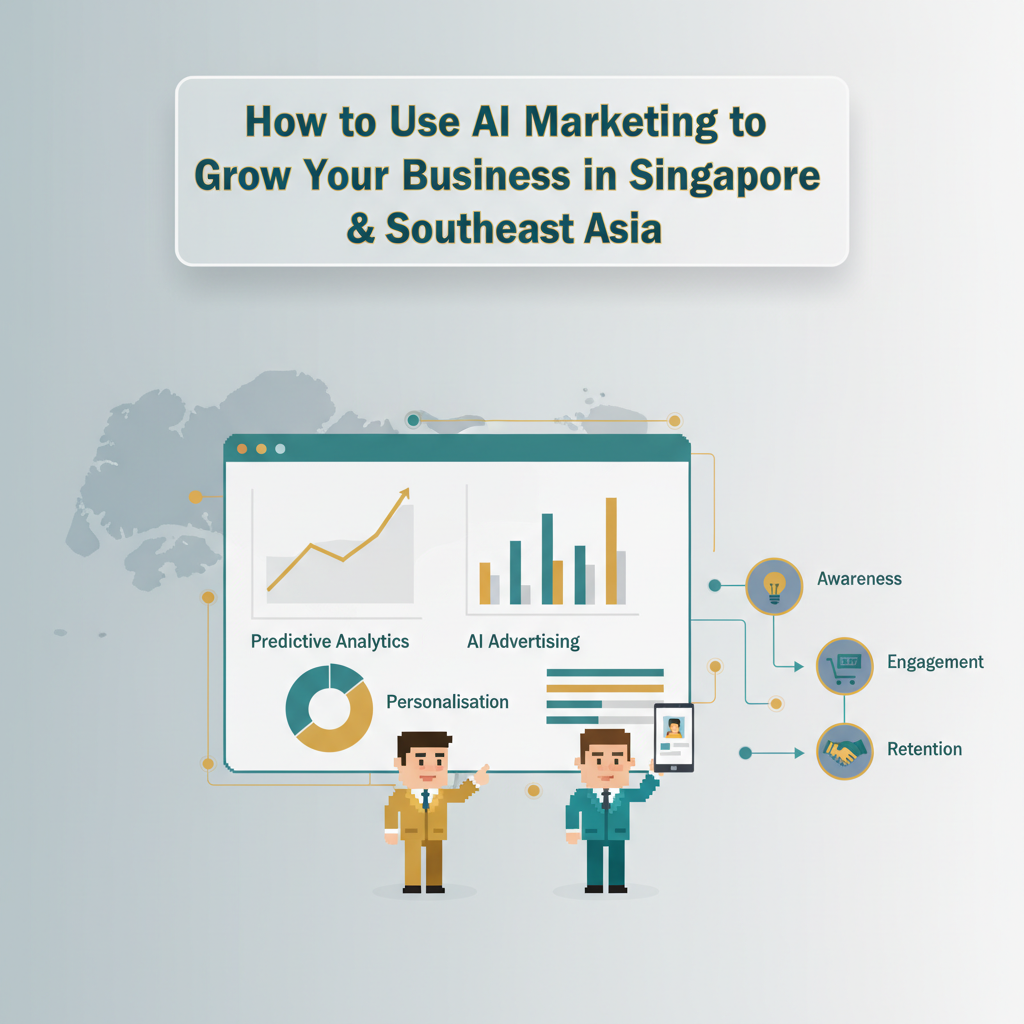
How to Use AI Marketing to Grow Your Business in Singapore & Southeast Asia
Opening Insights: Why 2025 Is the Year of AI Marketing
The marketing landscape in Singapore and Southeast Asia is undergoing a seismic shift. Over 70% of companies in Singapore have already adopted artificial intelligence in some form, and this isn’t a trend that’s slowing down—it’s accelerating. What makes 2025 distinctly different from previous years is that AI marketing has moved from being a competitive advantage to becoming a competitive necessity.
Consider the numbers: Southeast Asia’s AI sector is projected to grow into a multi‑billion‑dollar market over this decade, with AI contributions expected to add several percentage points of incremental GDP growth to key economies in the region. Globally, surveys of marketing professionals frequently show that a clear majority now rate “AI for campaign personalisation and optimisation” as one of the most impactful trends for the next 12–24 months. In Singapore specifically, analysts have argued that AI adoption will be a key lever to sustaining GDP growth in a high‑cost, talent‑constrained economy.
But here’s what should capture your attention as a business owner or marketer: this isn’t just about technology adoption. It’s about survival and growth. Companies embedding AI marketing into their strategies report:
- 3–15% top‑line revenue growth uplift from better targeting and personalisation
- 10–20% improvements in sales ROI from smarter budget allocation and predictive lead scoring
- Significant productivity gains, as repetitive tasks (reporting, basic copywriting, manual optimisation) are automated
Meanwhile, customer expectations have shifted permanently:
- Consumers increasingly expect brands to “know them” and tailor content and offers to their needs.
- In e‑commerce and travel—two sectors particularly strong in Singapore and Southeast Asia—recommendation engines and dynamic pricing algorithms powered by AI already influence the majority of purchase journeys.
The gap between leaders and laggards is widening rapidly. Senior executives in high‑performing organisations consistently say their future competitive advantage hinges on advanced AI capabilities. The question isn’t whether to adopt AI marketing—it’s how quickly you can do it effectively, and in a way that fits your brand, your data maturity and your local market realities.
Foundations of AI-Driven Marketing
Definition, History & Key Capabilities
AI marketing refers to the application of artificial intelligence technologies—including machine learning, natural language processing, computer vision and predictive analytics—to automate, optimise and personalise marketing activities at scale. It’s the intersection of data science and marketing strategy, where algorithms learn from customer behaviour and continuously improve campaign performance without manual intervention.
The journey to today’s AI marketing landscape has been gradual but sharply accelerating:
- Rules and basic automation (2000s–early 2010s)
Email automation and rules‑based journey builders allowed marketers to schedule campaigns and trigger simple workflows (e.g., “if cart abandoned, send reminder email”). Intelligence was limited; everything depended on human‑defined rules. - Machine learning and programmatic advertising (mid‑2010s)
As ad platforms adopted machine learning, they began to optimise bids, placements and audiences automatically based on outcomes like clicks and conversions. Recommendation engines on platforms such as e‑commerce marketplaces and streaming services also matured. - Full‑funnel AI marketing (late 2010s–early 2020s)
AI moved beyond ads to influence content performance prediction, lead scoring, churn prediction and personalisation across web, app, CRM and customer service channels. - Generative AI (2023 onwards)
Large language models and image/video generation systems made it possible to create high‑quality copy, images and even video variations in minutes, at scale, while still benefiting from machine learning‑driven optimisation.
Today, in 2025, most serious AI tools for marketing combine several of these capabilities. At a high level, key capabilities include:
1. Hyper‑personalisation at scale
AI models dynamically update web pages, app screens and ad creatives in real time, surfacing different product recommendations and messages to each individual based on:
- Browsing and purchase history
- Behavioural signals (time on page, scroll depth, interactions)
- Context (device, time of day, location)
What used to be “segmentation” (grouping thousands of people) is becoming “personalisation” (optimising for one person at a time).
2. Predictive analytics
Instead of reacting to what customers did last month, predictive models forecast:
- Which leads are likely to convert in the next 30 days
- Which customers are at high risk of churn
- Which products each segment is likely to buy next
- Which channels and creatives will deliver the highest return
These insights feed directly into AI marketing tools that adjust bids, budgets and content automatically.
3. Generative content creation
Generative AI supports:
- Copywriting (ad headlines, email subject lines, landing‑page variants)
- Content drafting (SEO articles, scripts, campaign concepts)
- Visual creation (social posts, campaign visuals, storyboards)
This doesn’t replace creative strategy—but it dramatically speeds up production and enables large‑scale A/B testing.
4. Automated campaign optimisation
Ad platforms’ AI engines constantly test variations and automatically allocate budget to the best‑performing combinations of audience, creative and placement. Marketers define goals and guardrails; the system does most of the daily optimisation work.
5. First‑party data intelligence and segmentation
With third‑party cookies disappearing, AI is essential for turning your own customer data—CRM, website analytics, transaction history—into usable segments and lookalike audiences, especially in privacy‑sensitive markets like Singapore.
Under the hood, most of this is powered by machine‑learning models trained on large datasets. They “learn” patterns that humans would never spot manually, and they get better as more data flows through them.
Applications Across the Customer Journey
Personalized Content & Segmentation
The customer journey—from first impression to repeat purchase and advocacy—can be enhanced by AI at every stage.
1. Awareness: Smarter reach and creative
- Dynamic creative optimisation: AI automatically tests different images, headlines and calls‑to‑action to discover which combinations drive higher click‑through rates for different audience clusters in Singapore, Jakarta, Bangkok or Manila.
- Context‑aware targeting: Instead of setting rigid targeting rules, you specify your ideal customer profile and let AI learn which interests, demographics and behaviours correlate most strongly with conversions.
Example (Singapore B2C brand):
A fitness brand promoting a new studio uses AI advertising on social platforms. The system learns that office workers in the CBD engage best with “lunchtime express” class creatives during 11am–2pm, while suburban audiences respond better to “weekend reset” messaging on Friday afternoons and weekends. Budget automatically shifts to the most effective segments and time slots.
2. Consideration: Behaviour‑driven journeys
AI‑powered segmentation goes beyond age and income. It groups people based on behaviour, propensity and value:
- “Browsed pricing page twice, no sign‑up yet”
- “Added to cart, didn’t check out, returned within 48 hours”
- “Clicked on email offers but never purchased”
- “High‑value customer likely to buy again in 30 days”
Each segment can receive a different journey: educational content, social proof, limited‑time offers, or loyalty perks.
Example (SEA e‑commerce):
An online marketplace in Southeast Asia uses AI tools for marketing to analyse browsing and purchase patterns. The system identifies a “window shoppers” cluster—users who frequently browse but rarely purchase. When they return, the homepage highlights time‑sensitive bundles and reviews for products they viewed, increasing their conversion rate.
3. Conversion: Real‑time decisioning
At the decision point, AI helps optimise:
- Pricing and discount levels (predicting the minimum incentive needed to convert)
- Checkout experience (surfacing the right payment options for each market)
- Cross‑sell offers (based on what similar customers bought)
Example (Singapore hospitality):
A hotel chain targeting regional travellers uses an AI marketing tool to recommend room upgrades and add‑ons (late checkout, airport transfer) based on past behaviour of similar guests. This can lift average booking value without heavy discounting.
4. Post‑purchase: Retention and advocacy
AI supports:
- Churn prediction and win‑back campaigns
- Next‑best‑offer recommendations
- Triggered loyalty communications at milestones
- Smart frequency management to prevent over‑messaging
For subscription businesses—SaaS, telco, media—this is often where AI marketing delivers the highest ROI.
Predictive Analytics & Campaign Optimization
Predictive analytics is one of the most powerful AI in digital marketing applications because it directly affects revenue and cost.
Common use cases include:
1. Lead scoring and sales prioritisation
A B2B software company in Singapore integrates website, CRM and campaign data into an AI model that scores leads from 0–100 based on their likelihood to convert in the next 30 days. Sales focuses first on leads above a certain score threshold, which:
- Increases close rates
- Shortens sales cycles
- Reduces time wasted on low‑quality leads
2. Budget allocation and channel mix
Instead of splitting budget evenly across channels, predictive models forecast:
- Expected conversions from each channel at different spend levels
- Diminishing‑returns curves (when extra spend stops being efficient)
- Impact of spending more on upper‑funnel vs lower‑funnel campaigns
Your media plan becomes a data‑driven investment plan.
3. Churn prediction
For subscription and membership businesses, AI can flag customers with high churn risk based on:
- Decreasing usage patterns
- Support tickets and sentiment
- Late or failed payments
- Lack of engagement with content
You can target them with retention offers or personal outreach before they leave.
4. Creative and content performance prediction
Some AI marketing tools can predict which content—blog topics, video formats, creative angles—is most likely to perform well with your audience, based on historical performance and broader trend data. This helps your team prioritise.
5. Always‑on optimisation
With AI‑driven optimisation:
- Bids and budgets adjust automatically in near real time
- Under‑performing ads pause; strong ones scale
- Audience targeting refines continuously as more conversion data flows in
Instead of major campaign changes every few weeks, performance improves daily. For many brands, this can drive double‑digit percentage uplifts in ROAS (return on ad spend) within the first few months.
Selecting & Implementing AI Marketing Tools
Evaluation Criteria & Comparative Matrix
With hundreds of vendors promising “AI for marketing,” choosing the right stack can feel overwhelming. A structured evaluation framework helps.
1. Start with business objectives
Clarify what you want to improve:
- Lead generation and sales?
- Average order value and cross‑sell?
- Retention and lifetime value?
- Content production velocity and experimentation?
Different solutions focus on different parts of the funnel. A content‑focused AI tool may not solve your ad‑buying challenges, and vice versa.
2. Data integration and privacy
Key questions:
- Can the tool connect to your CRM (e.g., HubSpot, Salesforce), email platform, web analytics, ad accounts and data warehouse?
- Does it support regional platforms common in Singapore/SEA (e.g., local marketplaces, chat apps)?
- How does it handle data residency and privacy compliance, especially in relation to Singapore PDPA‑style requirements and similar regional regulations?
Poor integration is one of the most common reasons AI projects fail.
3. Ease of use and team skills
Given that many marketing teams in Singapore already juggle multiple martech platforms, look for:
- Intuitive user interfaces
- Clear documentation and support resources
- Minimal need for coding or data‑science skills for day‑to-day use
If your team can’t or won’t use a tool, its theoretical power doesn’t matter.
4. Capabilities and roadmap
Evaluate:
- Personalisation depth (web, email, app, ads)
- Availability of predictive models (lead scoring, churn, next‑best‑offer)
- Built‑in generative AI for content and creative
- Multilingual support relevant to SEA markets
- Vendor roadmap and update frequency
5. Cost and scalability
Understand:
- Pricing model (per user, per contact, per volume of data, per campaign, or hybrid)
- Hidden costs (implementation, custom integrations, training)
- How pricing scales as your database and usage grow
6. Transparency and governance
Prefer platforms that:
- Explain why they made a recommendation (“explainable AI”)
- Allow you to set guardrails (brand safety, exclusion lists, approval flows)
- Offer robust role‑based permissions and audit trails
Here’s a simple comparative scoring approach you can adapt:
| Criteria | Weight | Tool A | Tool B | Tool C |
|---|---|---|---|---|
| Data Integration | 25% | 9/10 | 7/10 | 8/10 |
| Ease of Use | 20% | 7/10 | 9/10 | 6/10 |
| Personalisation Capability | 20% | 9/10 | 8/10 | 9/10 |
| Predictive Analytics | 15% | 8/10 | 6/10 | 9/10 |
| Cost Efficiency | 10% | 6/10 | 8/10 | 7/10 |
| Support Quality | 10% | 7/10 | 8/10 | 6/10 |
| Weighted Score | 100% | 7.95/10 | 7.65/10 | 7.85/10 |
Integration Roadmap & Change Management
Even the best AI digital marketing agency or platform cannot deliver value without a clear implementation plan and thoughtful change management.
Phase 1: Discovery and data foundation (Weeks 1–4)
- Conduct a data audit: what customer data do you have, where is it stored, how clean is it?
- Map core systems (CRM, marketing automation, web analytics, ad platforms, offline POS, etc.).
- Define target use cases (e.g., “improve lead‑to‑sale conversion rate by 20% with AI lead scoring”).
- Set up secure integrations and data pipelines; align with your IT and compliance teams.
Phase 2: Pilot use case (Weeks 5–12)
Choose one high‑impact but contained use case, such as:
- AI‑driven email personalisation for a specific segment
- AI‑powered product recommendations on selected category pages
- AI‑based lead scoring for one market or sales team
Define clear success metrics (e.g., uplift in click‑through rate, conversion rate, or revenue per visitor). Run the pilot long enough to gather meaningful data (typically 6–8 weeks).
Phase 3: Team enablement and process design (Weeks 8–16)
- Assign an internal “AI champion” responsible for evangelising and coordinating efforts.
- Provide training sessions tailored to marketers (not only technical staff).
- Document playbooks: how to brief the tool, how to interpret results, how to escalate issues.
- Integrate AI workflows into existing processes (campaign planning, content production, CRM operations).
Phase 4: Scale and optimisation (Weeks 16+)
- Expand to additional segments, channels and markets.
- Layer on more advanced use cases: predictive churn, dynamic pricing, multi‑touch attribution.
- Review performance monthly and refine models, messaging and targeting based on learnings.
Throughout, keep change management front and centre:
- Communicate that AI is augmenting, not replacing, the marketing team.
- Celebrate early wins to build momentum and confidence.
- Set realistic expectations—AI amplifies good strategy; it doesn’t fix weak positioning, poor offers or misaligned products.
Measuring Success & Future Outlook
To justify investment in AI tools for marketing Singapore or broader SEA, you need clear measurement.
1. Revenue and profit impact
Track:
- Incremental revenue generated from AI‑powered journeys vs control groups
- Change in ROAS and overall marketing ROI
- Impact on margin (e.g., smarter discounting leading to higher profit per sale)
2. Efficiency and capacity
Measure:
- Hours saved per week on manual tasks (reporting, list building, basic copywriting)
- Increase in number of tests or campaigns launched per month
- Reduction in time from idea to launch
AI should free your team to focus on strategy, creativity and customer insight.
3. Customer metrics
Monitor:
- Engagement rates (open, click, view, dwell time) on personalised vs non‑personalised touchpoints
- Conversion rate changes for AI‑optimised vs baseline journeys
- Churn rates and repeat‑purchase rates before vs after AI rollout
4. Economics: CAC and LTV
The combination of better targeting and higher retention should:
- Lower customer acquisition cost (CAC)
- Increase customer lifetime value (LTV)
Aim for a healthier LTV:CAC ratio over time.
5. Internal adoption and confidence
Every quarter, ask your marketing and sales teams:
- “How confident are you using our AI marketing tools to hit KPIs?”
- “Which parts of the tools feel confusing or under‑used?”
Address gaps with further enablement or process changes.
Future outlook
Looking ahead, expect:
- Hyper‑personalisation becoming table stakes. What’s differentiated today will be expected tomorrow. Companies that don’t personalise at scale will lose customers to those that do.
- Ethical AI and transparency becoming competitive factors. Consumers increasingly care about data privacy and how their data is used. Transparent, ethical AI practices will become part of brand trust.
- Integrated AI stacks. Instead of multiple disconnected tools, more businesses will move towards unified platforms handling personalisation, prediction and content generation in one place.
- First‑party data as a strategic asset. As third‑party tracking declines, brands with strong first‑party data and AI capabilities will enjoy a structural advantage.
- AI‑driven customer experience as the norm. Every touchpoint—web, app, chat, social, offline—will be informed by AI‑driven insights and optimisation.
Conclusion: Key Takeaways and Next Steps
AI marketing isn’t a buzzword in Singapore and Southeast Asia anymore—it’s a practical, accessible set of capabilities that can drive measurable business growth when implemented thoughtfully.
Key takeaways
- AI marketing is now table stakes. Competitors are already using AI‑driven personalisation, predictive analytics and automated optimisation. Waiting risks losing market share.
- Strong data foundations matter. AI is only as good as the quality and completeness of your data.
- Start with clear business goals. Tie every AI initiative to concrete outcomes—revenue, efficiency, customer metrics.
- Begin small but design for scale. Pilot one or two high‑impact use cases, prove value, then expand.
- Invest in people and processes. Tools alone don’t deliver transformation; trained teams and new workflows do.
- Measure rigorously. Track uplift against control groups and iterate continuously.
Practical next steps for Singapore/SEA businesses
- Audit your current martech stack and data landscape.
- Identify 1–2 priority use cases (e.g., AI‑driven lead scoring; AI‑based recommendations on high‑traffic pages).
- Shortlist tools or an AI marketing agency partner who understands both AI and the nuances of the Singapore/SEA market.
- Run a tightly defined 60–90 day pilot with clear KPIs.
- Build an internal AI playbook based on your learnings and roll out in phases.
If you’re exploring how AI marketing can work for a brand in Singapore or the wider region, partnering with a team that combines strategic, creative and technical expertise can dramatically shorten your learning curve.
You can see how Hamilton & Sherwind approaches digital and AI‑enabled campaigns on our Digital Marketing Services page and explore our past work in the Portfolio.
To discuss how AI marketing can be applied to your specific situation—whether you’re an SME, regional brand or fast‑growing startup in Southeast Asia—get in touch with us.
Contact Hamilton & Sherwind to explore how AI‑driven marketing can help you grow faster and more efficiently.