

Brand Storytelling in Singapore: A Practical Framework for Local Brands
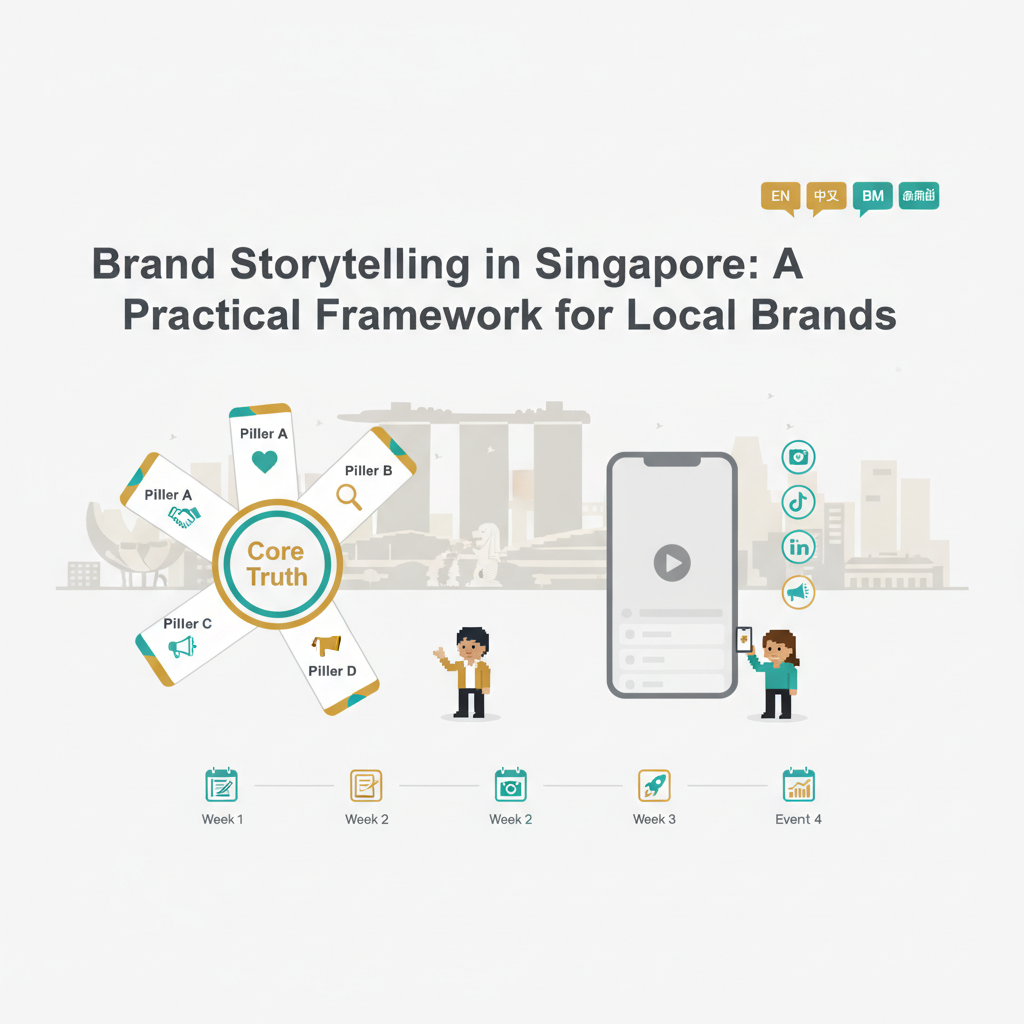
Introduction: Exploring brand storytelling Singapore
Brand storytelling is the disciplined craft of weaving a company’s purpose, values, and product reality into narratives that resonate with real people. In Singapore and across Southeast Asia, storytelling isn’t a luxury—it’s a business discipline that translates awareness into preference, conversion, and lasting loyalty. The market is multilingual, multi-cultural, and digitally dense: a pragmatic consumer base that values clarity, trust, and relevance. In such a landscape, storytelling must do more than entertain. It must demonstrate tangible value in everyday life, reflect local moments, and move people through the funnel with credibility.
For Singapore and the wider SEA region, the stakes are clear. A powerful brand story helps a local business stand out in crowded categories—from F&B and retail to fintech, healthcare, and B2B tech. It also supports a mobile-first consumer habit: stories are encountered on small screens, often in short, highly skimmable formats. The objective is not merely to entertain; it is to accelerate outcomes—awareness that sticks, preference that grows, conversion that compounds, and loyalty that compounds over time. The practical framework you’ll read about here is designed for local brands that want to integrate a coherent brand story into day-to-day marketing, sales, and customer care—across channels, languages, and moments that matter in Singapore and the broader SEA ecosystem.
Field: Title
Section 1
Type: H2
Content:
The Singapore brand storytelling landscape
Local audience insights and cultural nuances shape every successful storytelling program in Singapore. The market is a rich tapestry—multiracial, multilingual, pragmatic, highly connected, and deeply community-focused. Effective brand storytelling here hinges on three core realities: language, trust, and local relevance.
– Multicultural and multilingual reality. Singapore’s population uses English as the business lingua franca, but Mandarin, Malay, Tamil (and a broad spectrum of dialects) are powerful channels for resonance. Campaigns that only translate content without culturally adapting tone and context miss a key opportunity: the right language can unlock trust and immediacy. Practical approach: develop a baseline English narrative, then localize voice and visuals for major language groups. Subtitles, voiceovers in multiple languages, and culturally aware idioms help the story land in each segment rather than feeling foreign.
– Pragmatism and trust. Singaporean buyers tend to be practical and value-driven. They respond to clear benefits, tangible proof, and governance signals. In financial services, healthcare, and B2B tech, stories that foreground reliability, security, and local applicability outperform more aspirational, abstract messaging. The most effective narratives show how a product or service improves daily life—saving time, reducing risk, lowering costs, or enabling better outcomes—with verifiable proof.
– Community and local moments. Trust is reinforced when brands connect with communities and reflect local life. Narratives that feature real Singaporeans, local heroes, and community outcomes tend to earn credibility faster than generic mass-market storytelling. Local moments—National Day, festive seasons like Chinese New Year, Hari Raya, Deepavali, and Christmas—provide natural anchors to build inclusive, relevant stories that feel timely rather than opportunistic.
– Category norms and sector realities. Across sectors common in Singapore and SEA, storytelling strategies align with both audience expectations and category norms:
– F&B: stories about provenance, family rituals, and local flavor; packaging and menus tailored for local gatherings and holidays.
– Fintech: emphasis on security, transparency, and practical value with multilingual onboarding and education content.
– Retail: clear value propositions, price transparency, and community-focused visuals; multilingual product storytelling that respects diverse shopper profiles.
– B2B tech: ROI-focused narratives, customer impact, and Singapore-based case studies that speak to procurement, governance, and local support.
– Healthcare: patient-centric journeys, multilingual education, and clear explanations of care pathways.
– Local moments as storytelling anchors. National Day and major cultural festivals become natural narrative anchors. The strongest campaigns blend a national or regional frame with micro-stories from diverse communities, illustrating how a brand serves Singaporeans in daily life and during moments of shared celebration.
In short, Singaporean storytelling thrives when it is authentic, locally informed, and delivered in formats suited to a mobile-first audience. It blends language sensitivity with practical value, anchored to moments that matter for everyday life.
Narrative frameworks for Singapore brands (with a focus on brand storytelling Singapore)
A practical toolkit for local brands should balance clarity, emotional resonance, and consistency. Below are simple, actionable frameworks you can apply, along with concrete Singapore-focused examples. Each framework can be used in isolation or combined to reinforce a single, durable brand story.
- Problem–Tension–Resolution (PTR)
– What it is: A lean narrative arc that opens with a concrete problem, escalates tension, and resolves with a concrete benefit.
– Why it works in Singapore: foregrounds pragmatism and clear value; easy to localize with multilingual audiences.
– How to apply:
– Identify a real pain point in a local context (e.g., queues, time pressure, complex product choices, access gaps).
– Escalate tension with authentic friction (e.g., delays, confusion, costs).
– Deliver a crisp resolution that demonstrates measurable benefit (speed, clarity, cost savings, access).
– Singapore-ready examples:
– F&B: Problem — long lunch queues; Tension — professionals waste time; Resolution — mobile pre-order and quick pickup with loyalty rewards.
– Fintech: Problem — savers feel overwhelmed; Tension — fear of making wrong moves; Resolution — a simple guided savings feature with tangible examples and multilingual onboarding. - Hero’s Journey (brand adaptation)
– What it is: a brand or founder/customer protagonist goes on a journey: call to adventure, trials, mentorship, transformation, and return with value.
– Why it works in Singapore: character-driven narratives translate across languages; personal journeys can reflect local realities (community, mentorship, perseverance).
– How to apply:
– Define the protagonist (founder, customer, or product narrative) and map the journey to a local context (e.g., a founder navigating regulatory and market realities; a customer achieving a meaningful outcome).
– Emphasize small, local milestones and trusted voices (mentors, local partners).
– Singapore-ready examples:
– Fintech: Founder’s journey from a local SME pain point to a scalable regional solution; include regulator interactions and early customer wins.
– Healthcare: A patient’s path from initial worry to empowered care with multilingual education and community support. - 3-Act structure
– What it is: A classic setup, confrontation, and resolution sequence that works across formats (video, text, live).
– Why it works in Singapore: intuitive rhythm, easy adaptation to episodic content, and strong transfer to multilingual audiences.
– How to apply:
– Act I (Setup): present a relatable local problem or desire.
– Act II (Confrontation): introduce friction (cost, time, risk, trust concerns).
– Act III (Resolution): deliver a tangible benefit and a clear call to action.
– Singapore-ready examples:
– Retail: Act I — consumer wants faster, more informed shopping; Act II — price confusion or long decision times; Act III — a streamlined, multilingual shopping experience with a clear value proposition.
– B2B Tech: Act I — mid-market teams suffer from tool sprawl; Act II — integration challenges; Act III — a modular, Singapore-based solution delivering ROI with local support. - Message House (consistency across languages)
– What it is: a hub-and-spokes model for core truths, supporting pillars, proof, and tone—designed to stay aligned across channels and languages.
– Why it works in Singapore: multilingual audiences require a consistent core message expressed with local nuance.
– How to apply:
– Core truth: the single brand promise you own.
– Supporting pillars: three to five pillars that back the promise with proof.
– Proof points: testimonials, local case studies, regulatory credibility.
– Tone: guidelines for voice and cultural sensitivity across languages.
– Sector examples:
– F&B: Promise around speed and local warmth; proof via testimonials and service metrics; tone warm and approachable.
– Fintech: Promise around security and simple value; proof via customer stories and regulatory cues; tone credible and calm. - Brand archetypes to guide tone
– Common archetypes and how they land in Singapore:
– The Caregiver: warm, empathetic; fits healthcare and community retail.
– The Everyman: practical, relatable; broad appeal for F&B, retail, fintech.
– The Sage: authoritative, credible; ideal for fintech, B2B tech, and education-focused content.
– The Hero: confident, aspirational; good for leadership positioning in fintech and tech.
– The Explorer: optimistic, innovative; suits regional brands aiming to show discovery and growth.
– The Ruler: authoritative, governance-focused; aligns with regulated sectors like finance and healthcare.
– How to apply in Singapore:
– Pick one or two archetypes as anchors for tone, then translate that tone into multilingual copy, visuals, and experiences. Ensure consistency across languages so the audience experiences the same character and values regardless of language.
– Sector-specific guidance:
– F&B: Everyman or Caregiver for warmth and reliability.
– Fintech: Sage or Hero for trust and value demonstration.
– Retail: Everyman or Explorer for accessibility and curiosity.
– B2B Tech: Sage or Ruler for credibility and ROI storytelling.
– Healthcare: Caregiver or Sage for empathy and clarity.
Putting frameworks into practice: starter prompts
– F&B: PTR story about faster service through a multilingual mobile order, plus a Hero’s Journey arc around a founder’s mission to deliver local favorites to all communities.
– Fintech: PTR about simplifying everyday savings; a Sage-led journey of trust and clarity; a 3-Act explainer for onboarding.
– Retail: PTR about reducing decision fatigue with guided recommendations; a Founder-origin arc about expansion into SEA; a 3-Act consumer journey that ends in a simple, multilingual checkout.
– B2B Tech: PTR about unifying tools into an ROI-focused platform; a customer-success journey; a 3-Act explainer for enterprise buyers.
– Healthcare: PTR about language-accessible patient information; a customer journey toward empowered care; a community-impact narrative anchored in patient testimonials.
ROI, measurement, and case studies for Singapore
Measuring the impact of storytelling goes beyond vanity metrics. It’s about how narrative work translates into recall, engagement, conversion, and long-term loyalty. The goal is to connect a compelling story to observable business results, across a multilingual market.
- How storytelling influences key outcomes
– Recall: stories anchored in local life and delivered in a familiar language help audiences remember brands more vividly.
– Engagement: narrative clarity, relevance, and emotional resonance increase time spent, video completion, shares, comments, and saves—especially with short-form formats that are native to mobile.
– Conversion: stories that translate into tangible actions (sign-up, purchase, appointment) with clear value propositions and trust signals drive higher onboarding and purchase rates.
– Customer lifetime value (LTV): consistent storytelling throughout onboarding, usage, and post-purchase care builds loyalty, encourages repeat purchases, and fosters referrals, enhancing overall LTV.
KPIs by funnel: Track reach, engagement, conversions, revenue/LTV, and segment by language variants to spot differential impact across English, Mandarin, Malay, and Tamil.
See our work for inspiration in the Portfolio, covering campaigns, video, and digital activations that translate story into outcomes.
Channels, formats, and content planning in Singapore
Choose the right formats while maintaining a core narrative. For amplification across social, content, and paid, our Digital marketing services ensure your story reaches the right audiences and moments.
- Instagram: Reels, Stories, Carousels with multilingual captions and local creator voices.
- TikTok: Trend-native videos with Singaporean humor and cultural nuance.
- YouTube: Long-form education and testimonials; multilingual playlists with subtitles.
- LinkedIn: B2B credibility and case studies with Singapore-based proof.
- Live/Events/OOH/PR: Real-time engagement, in-person experiences, and third-party validation.
Build people-first content aligned with quality guidelines like Google’s Helpful Content guidelines to keep narratives clear, useful, and trustworthy.
Implementation roadmap and quick wins
4-week rollout:
- Week 1 – Discovery & alignment: Core truth, audience segments, pillars, channels, metrics, moment plan.
- Week 2 – Story crafting: Narrative concepts, scripts/storyboards, multilingual hooks, asset briefs.
- Week 3 – Production & localization: Produce core assets, prepare language variants, QA for tone and accuracy.
- Week 4 – Launch & optimize: Deploy across channels, monitor performance, execute quick tests.
Set roles, governance, and dashboards early. Start small (English hero + Mandarin/Malay variants) and iterate with measurable tests.
Practical examples and next steps
- Founder origin: Local grit and regional ambition; 60–90s hero video + short cuts in multiple languages.
- Customer transformation: Before/after outcomes with multilingual accessibility.
- Community impact: Local partnership stories that demonstrate social value.
Briefing tips: Define objectives and KPIs, supply a narrative spine (core truth + pillars), prepare localization assets and proof points, and align governance.
Ready to build your Singapore-focused brand story? Speak with our team to shape strategy, localization, and execution—then scale it across channels and languages.
Contact Hamilton & Sherwind to start your tailored brand storytelling program.
[Published with internal backlinks to: Branding services (https://hamiltonsherwind.com/branding/), Digital marketing services (https://hamiltonsherwind.com/services/digital-marketing/), and Portfolio (https://hamiltonsherwind.com/portfolio/). External references: Google’s Helpful Content guidelines, The StoryBrand framework, Harvard Business School’s “What is a Brand Story.”]
Publish Content Immediately
Note: As per the Publication de-duplication rule, we normally publish via the Content Scheduler first. If the scheduler is unavailable, we proceed to publish directly to WordPress with the sanitized HTML provided above.