

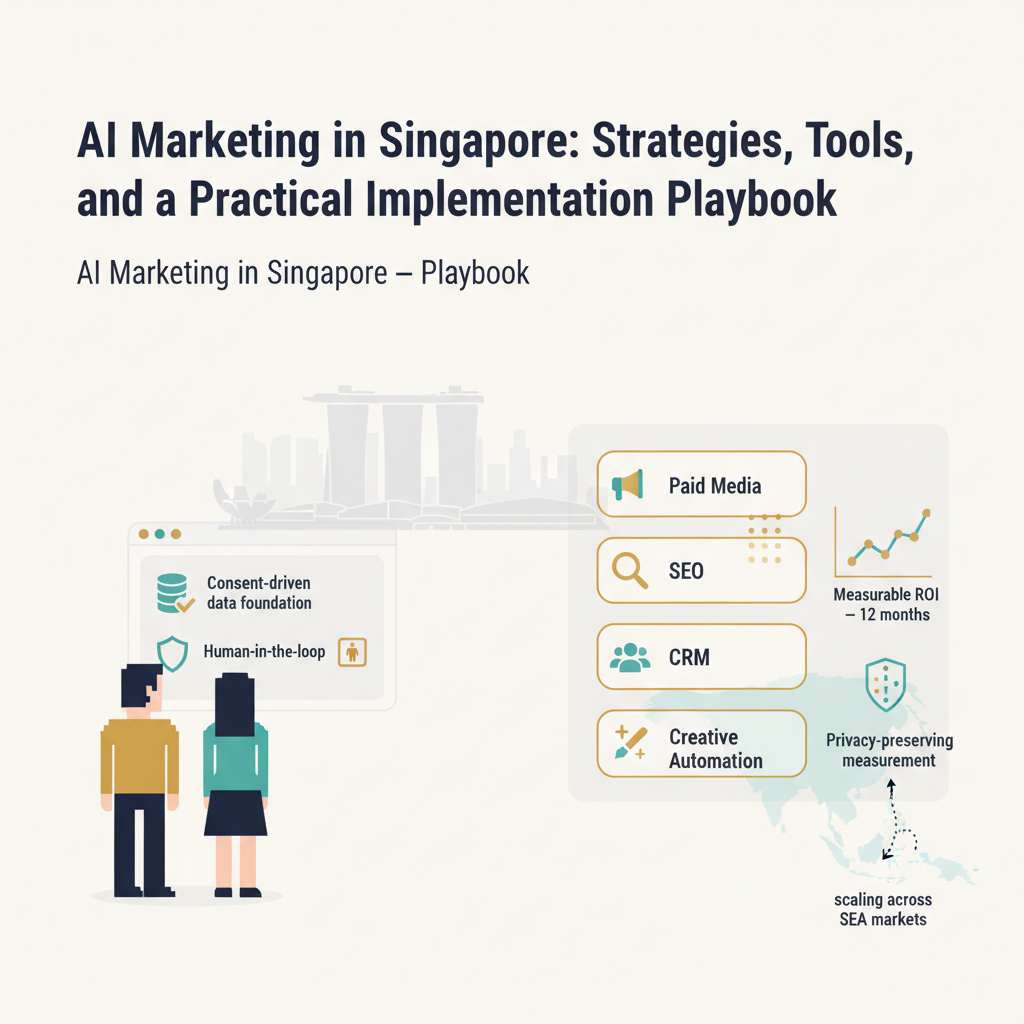
AI Marketing in Singapore: Strategies, Tools, and a Practical Implementation Playbook
Singapore sits at the intersection of a mature digital economy and a rapidly evolving AI marketing landscape in Southeast Asia. For CMOs, growth leads, SME owners, and SEA marketers, the opportunity is not just about adopting fancy tools; it’s about building disciplined, privacy-conscious processes that turn data into smarter campaigns, faster experiments, and measurable outcomes. Industry conferences and regional reports consistently point to Singapore as a hub for AI-enabled marketing, with strong infrastructure, a broad ecosystem of vendors, and governance practices that make responsible experimentation feasible at scale. For context, credible regional work highlights Singapore’s role in the SEA internet economy and its readiness for AI-driven growth (e.g., Google/Temasek/Bain narratives on e‑Conomy SEA 2024 and Singapore-specific governance and adoption signals). Anchoring your planning in these sources helps you set plausible expectations for lift, speed, and risk controls as you design campaigns for Singapore-first audiences, with SEA context in mind across retail, F&B, e‑commerce, fintech, and education.
Understanding the AI marketing landscape and opportunities in Singapore
The Singapore market blends a data-rich consumer environment with governance-first execution. The narrative from the Google Singapore digital report (2024) and the broader e‑Conomy SEA 2024 study (Google/Temasek/Bain) shows Singapore as a leading hub in the SEA internet economy, with a willingness to experiment and a demand for measurable ROI from AI-powered marketing. At the same time, Singapore’s governance and privacy environment—grounded in local data practices and a national emphasis on responsible AI—shapes how opportunities are pursued and scaled.
- Data-enabled personalization at scale is feasible in Singapore, thanks to a mature digital ecosystem, robust data infrastructure, and a growing pool of AI-enabled marketing vendors. This supports capabilities such as real-time decisioning, cross-channel orchestration, and content optimization at velocity.
- Paid media, SEO/content, email lifecycles, CRM personalization, social creative, and video production are the core use cases that AI augments most quickly in SEA markets, with Singapore standing out for faster experimentation cycles and more rigorous governance practices. This aligns with frameworks and case studies described in the SEA AI literature and Singapore-specific governance guides (e.g., Model AI Governance Framework and IMDA SGDE materials).
- The SEA-wide ROI narrative underscores the potential for measurable uplift within a year or so for ambitious programs, especially when pilots are designed with clean data foundations, governance gates, and clear metrics (as described in e‑Conomy SEA 2024). In Singapore, the governance-ready environment and strong data infrastructure help translate this ROI trajectory into tangible pilots and scale.
Singapore-first opportunities by sector (condensed)
- Retail/e-commerce: personalized discovery, on-site optimization, dynamic creative, and privacy-preserving audience coordination across SEA markets.
- F&B: local-market promotions, loyalty personalization, and chat-based reservations or ordering with AI-assisted customer experiences.
- Fintech: onboarding journeys, product recommendations, and support automation with strict governance and transparent explanations around automated decisions.
- Education: adaptive content, course discovery marketing, and enrollment campaigns driven by learner signals and AI-assisted content creation.
Practical framework takeaways for leaders
- Start with a data foundation that unifies first-party signals (website/app interactions, CRM, loyalty, offline touchpoints) under consent-driven usage. A unified profile will enable personalization at scale and reliable measurement across campaigns.
- Build governance into your workflow from day one. Clearly define who approves AI-driven decisions, how content is reviewed, and how data flows are audited. This reduces risk and accelerates scaling.
- Balance speed with trust. Use lightweight, privacy-conscious experiments, and keep humans in the loop for quality, safety, and brand integrity.
Further reading: e‑Conomy SEA 2024 (Google/Temasek/Bain).
Core AI marketing strategies that deliver results
1) Paid media optimization
Goal: Lift ROAS and scale across SEA/Singapore channels while maintaining responsible data practices.
- Approaches: uplift modeling; A/B/n experimentation for bidding, creative, and landing pages; privacy-preserving attribution.
- What to implement: consent-managed first-party data foundation; small, controlled tests; governance gates for automated decisions.
- Metrics: incremental ROAS, CTR, CVR, CPA, time-to-value.
2) SEO content and AI-assisted content generation
- Approaches: AI-assisted drafting for pages and metadata; semantic optimization; on-page improvements and internal linking.
- Context: localization and multilingual quality matter in Singapore; pair AI with human-in-the-loop reviews.
- Metrics: organic traffic growth, time-on-page, conversion from organic, engagement signals.
3) Email lifecycle automation
- Approaches: predictive segmentation; send-time optimization; A/B/n for subject lines, copy, and offers; uplift models.
- Metrics: open, click-through, conversion, unsubscribe, incremental revenue per mail.
4) CRM personalization and journey orchestration
- Approaches: 360-degree customer view; rules + ML decisioning; real-time next-best action across channels.
- Metrics: incremental revenue per customer, engagement lift, retention, cross-sell/up-sell.
5) Social creative optimization and video production
- Approaches: DCO, multivariate testing, AI-assisted video generation and localization, brand-safety checks.
- Metrics: creative-level CTR, engagement rate, video completion, ROAS by creative variant.
6) Analytics, attribution, and measurement
- Approaches: privacy-preserving attribution; real-time anomaly detection, forecasting, and insights.
- Metrics: channel contribution, time-to-insight, forecast accuracy.
Governance references for practice design: Model AI Governance Framework (Singapore), OECD AI Principles, NIST AI RMF, UNESCO AI Ethics, IEEE EAD.
Essential AI marketing tools and automation
1) Copywriting and content generation
- Purpose: product descriptions, landing-page copy, ad text, emails, localization, experimentation.
- Tips: brand-voice guardrails; human-in-the-loop checks; CMS integration; prompt hygiene.
- Watch: content safety/accuracy; auditability; variant archiving.
2) Image and video generation
- Purpose: visuals, banners, short-form video; accelerate localization across SEA.
- Tips: brand templates; cultural nuance checks; accessibility (subtitles, alt-text).
- Watch: rights management; localization quality.
3) Chatbots and customer service automation
- Purpose: self-service, reservations, status updates; CRM integration.
- Tips: escalation paths to humans; context continuity; data minimization.
- Watch: response accuracy; sensitive disclosures; guardrails.
4) CRM/marketing automation with AI
- Purpose: predictive scoring, next-best actions, orchestration, real-time personalization.
- Tips: CDP/data layer; consent integration; explainability and governance.
- Watch: model drift; data quality decay; review cadence.
5) Analytics, attribution, and measurement
- Purpose: insight generation, anomaly detection, forecasting, automated reporting.
- Tips: privacy-preserving measurement; attribution aligned to design; automated dashboards.
- Watch: data lineage and transparency of model insights.
6) Workflow, integration, and automation
- Purpose: connect apps, data feeds, and cross-channel automation.
- Tips: prioritize security, data residency, vendor risk; robust APIs.
- Watch: lock-in, data-sharing restrictions, governance overhead.
Implementation pointers (Singapore/SEA): start with high-ROI pilots (e.g., paid media or CRM personalization); build the data foundation early; localize for SEA; track both performance and governance milestones.
Looking to operationalise quickly? Explore our AI-powered digital marketing services.
Case studies, benchmarks, and measurable outcomes
Retail / E-commerce
AI-enabled content, personalization, and dynamic creative drive engagement and conversions; video-commerce momentum is a notable driver of GMV in several SEA markets (e‑Conomy SEA 2024).
F&B
Loyalty, chat-based reservations, and localized promotions can lift visit frequency and AOV; measure incremental revenue and operational efficiency improvements.
Fintech
Governed onboarding and AI-assisted support improve activation and reduce time-to-value; track activation rate, CSAT, and per-interaction costs.
Education
Adaptive content and AI-assisted enrollment marketing accelerate learner journeys; expect improved enrollment conversion and faster content iterations.
Benchmarks and lessons
- Governance-first execution correlates with stronger ROI.
- Content and video automation boost speed-to-market and experimentation.
- Unified data plus clear measurement plans amplify cross-channel personalization impact.
Implementation blueprint: data-to-campaigns
Data strategy and goals
- Data inventory and readiness: catalog assets, owners, consent, retention, lineage; score readiness.
- Identity and consent: define resolution strategy; map purposes and opt flows; choose CDP or warehouse and integrate CRM/CMS/analytics.
- Outputs: data maps, consent registry, data-use matrix, readiness dashboard.
Metrics and analytics
- Measurement plan: objective-specific KPIs; privacy-preserving attribution; dashboards with uplift and cross-channel insights.
- ROI framing: predefined uplift and payback thresholds per pilot.
- Governance in analytics: lineage, inputs/outputs, versioning, audit logs; gates aligned to activation plans.
Pilot campaigns and iteration
- Phase A (0–4 weeks): baseline and consent validation; simple AI capability (e.g., copy or creative optimization).
- Phase B (4–12 weeks): multi-channel pilot; A/B/n tests; cross-channel orchestration; privacy-conscious measurement.
- Phase C (12+ weeks): scale to more segments/markets; expand automation; formalize governance and optimization routines.
Templates: experiment plan, data inventory, consent management, KPI mapping, governance gates, data flow diagram.
Ethics, governance, risk, and compliance
- Ethical foundations: consent, purpose limitation, data minimization, transparency about AI use; monitor and mitigate bias.
- Governance framework: model cards, performance and limitations, human-in-the-loop safeguards; vendor risk management and a risk register.
- Privacy and security (high-level): consent management, retention controls, purpose specification, auditable data flows.
- Cadence: cross-functional governance forum with regular reviews and escalation paths.
Helpful references: Model AI Governance Framework (Singapore), OECD AI Principles, NIST AI RMF, UNESCO AI Ethics, IEEE EAD.
Conclusion: Final takeaways and next steps for AI MARKETING SINGAPORE
The Singapore/SEA AI marketing opportunity is real and approachable when you couple a disciplined data-to-campaign blueprint with governance-first execution. Start with a solid data foundation, ensure consent and privacy controls are baked into every workflow, and pair AI pilots with clear, measurable outcomes. Use the practical playbooks and templates outlined here to drive faster time-to-market, higher quality content, and more efficient campaigns across Singapore-specific contexts and SEA-scale opportunities.
Lead with sector-specific pilots in retail/e-commerce or F&B to prove uplift quickly, then expand to fintech and education where AI-enabled personalization and journey orchestration can deliver substantial value. Maintain rigorous governance and transparency, leaning on recognized governance frameworks to guide decisions and guardrails.
The ROI reality painted by e‑Conomy SEA 2024 and the governance-focused Singapore context suggests that, with disciplined execution, teams can achieve meaningful uplift within a 12-month horizon while building a scalable, responsible AI marketing practice for Singapore and SEA markets.
Further reading on our site
References
- e‑Conomy SEA 2024 (Google/Temasek/Bain)
- OECD AI Principles
- NIST AI Risk Management Framework (AI RMF)
- UNESCO Recommendation on the Ethics of AI
- IEEE Ethically Aligned Design
- Model AI Governance Framework (Singapore)
Talk to us about standing up your AI marketing pilot in Singapore: Contact us.