

Brand Storytelling: A Practical Guide to Crafting Your Brand Narrative (Singapore/SEA)
Introduction
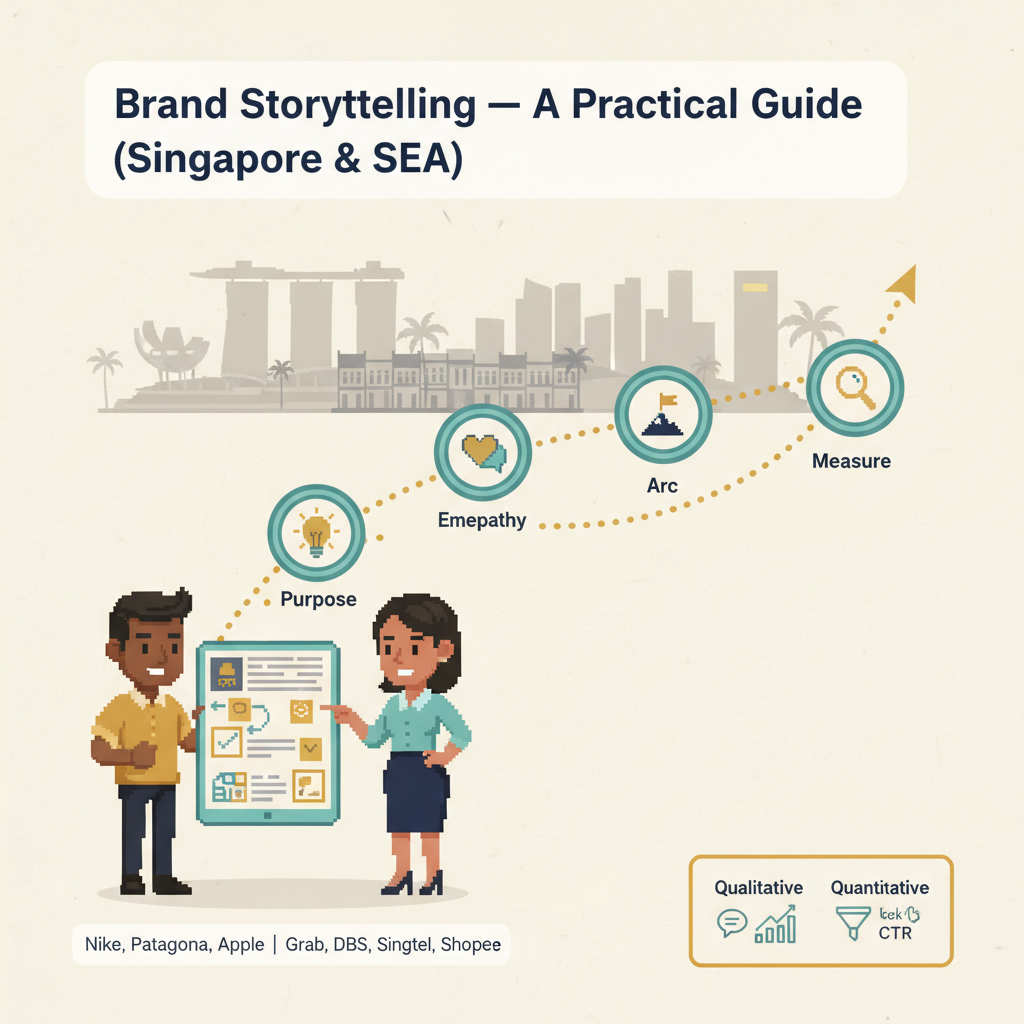
In the crowded Singapore/SEA market, brand storytelling is a core capability, not a nice-to-have. This guide distills definitions, core elements, proven frameworks, real-world examples, and a step-by-step process to build a narrative that drives trust and measurable growth. For brand leaders who want help putting this into practice, our branding services translate strategy into stories across campaigns, content, video, and social.
Understanding Brand Storytelling
What is brand storytelling?
Brand storytelling is the strategic use of narrative to convey who you are, why you exist, and how you create value across every touchpoint. Unlike isolated product promotions, a brand story persists beyond any single launch, connecting purpose, values, and proof into a coherent experience. For foundational primers, see Harvard Business School Online’s explanation of a brand story and Harvard Business Review on why good companies are storytellers.
Why it matters for brands
Compelling narratives build trust, loyalty, and pricing power by giving customers meaning to affiliate with. Purpose-driven storytelling, when operationalized, is linked to competitive advantage; see Deloitte on brand purpose as a competitive advantage and McKinsey on moving from purpose “why” to execution “how”.
Core Elements of a Brand Story
Brand purpose and mission
Purpose is your enduring “why” beyond profit; mission is how you act on it today. Define a crisp purpose, map it to customer value, and connect it to 3–4 storytelling pillars with proof points. For structured approaches, read HBR: From Purpose to Impact and Put Purpose at the Core of Your Strategy.
Audience empathy and character
Empathy transforms segments into relatable characters. Use interviews, personas, and empathy maps to capture language and motivations. See NN/g’s empathy mapping guide and the Interaction Design Foundation on personas.
Narrative arc and resolution
Structure stories with arcs that evolve emotion and meaning. For practical planning, see HBR: Your Strategy Needs a Story, Khan Academy: Pixar in a Box, and BBC Bitesize on narrative structure.
Frameworks and Templates
The Hero’s Journey
Recast customers as heroes; your brand plays the mentor. Map content to stages from “ordinary world” to “return with value.” For research and applications, see Exploring narrative structure and hero enactment in brand storytelling (PMC) and Think with Google on the future of brand storytelling.
The Pixar arc / 3-act structure
Use setup–conflict–resolution to anchor content cadences and emotional progression. See Pixar in a Box and HBR’s strategic storytelling. To activate frameworks through production, explore our video production in Singapore and social media services.
Examples and Case Studies
Global examples
- Nike: “Dream Crazy” shows values-led storytelling and brand courage. Analyses: Forbes: Nike Dream Crazy and brand management; MIT Sloan on Nike’s Kaepernick ads.
- Patagonia: “Don’t Buy This Jacket” aligns narrative with environmental activism. See Patagonia’s official story and HBR’s analysis.
- Apple: “Think Different” connects creativity with the brand’s identity. Coverage: The New York Times and Forbes on the real story.
For examples of our work, browse our branding portfolio, video portfolio, and advertising portfolio.
Singapore/SEA examples
- Grab: Documentary-style storytelling around real drivers and communities: Marketing Interactive campaign coverage.
- DBS: Digital-first creativity and storytelling at scale: Think with Google case.
- Singtel: AI-powered storytelling for SG60: Marketing Interactive and Branding in Asia.
- Shopee: Content-driven ecommerce and live formats: Campaign Asia and Marketing Interactive.
- Carousell: Community narratives and trust: Carousell Case Studies.
- GovTech: Public service impact storytelling: GovTech’s official page.
Explore more real-world work in our portfolio and ongoing insights on the Hamilton & Sherwind blog.
How to Create a Brand Story
Step 1: Define purpose
Articulate a one-sentence purpose and translate it into a measurable mission. Align 3–4 storytelling pillars to proof points and governance. See HBR: What is the Purpose of Your Purpose?.
Step 2: Define audience
Build personas and empathy maps through interviews and social listening. Reference NN/g’s empathy-mapping guide and IDF on personas.
Step 3: Map narrative arc
Choose either the 3-act structure or the Hero’s Journey, then map beats to awareness, consideration, adoption, and advocacy. See HBR’s narrative strategy piece and Pixar Story Structure.
Step 4: Draft and test
Prototype with short-form assets for SEA channels—9–15s videos, captions, and headlines. Apply A/B testing (e.g., Optimizely, VWO) and creative guidance from Think with Google. For execution support across channels, see our social media services and video production in Singapore.
Measuring Impact
Qualitative metrics
Track brand lift, sentiment, and share of voice to gauge narrative resonance. Practical guides include Sprout Social’s brand health tracking. Qualitative insights inform creative iteration and channel mix.
Quantitative metrics
Tie stories to outcomes: click-through rates, conversion rates, retention, and repeat purchase rates. Blend with qualitative signals to prove impact and optimize investment.
Conclusion & Next Steps
Brand storytelling integrates purpose, empathy, and structure into every touchpoint, guided by practical frameworks and measured by outcomes that matter. If you want a partner to turn strategy into a story system that performs in Singapore and across SEA, explore our branding and marketing services and who we are.
Contact Hamilton & Sherwind to craft your brand story and build a measurement-ready storytelling program.