

How Singapore brands can build an AI-driven MarTech stack in 2025
Introduction
In 2025, AI is no longer a nice-to-have add-on for marketing technology. It is redefining how brands in Singapore and across Southeast Asia plan, execute, and measure customer journeys. An AI-driven MarTech stack is not just about adding flashy tools; it’s about integrating data, decisions, and activation in a governance-forward operating model that can scale across markets and language contexts. For brands in Singapore—where data maturity, cloud adoption, and privacy-conscious consumer expectations are front and center—the opportunity is to evolve from siloed point solutions into an AI-powered marketing stack that treats data as a strategic asset and AI as a discipline for continuous optimization. This article maps the practical architecture, tools, implementation playbooks, and governance practices you can adopt to win in 2025 and beyond. Think of this as a practical guide built for marketers who want to connect strategy with execution, with pointers to our broader capabilities in Branding, Digital Marketing, and Portfolio to illustrate real-world outcomes.
Market context for AI MARTECH in 2025
Market context in 2025 shows AI-powered MarTech moving from a collection of stand-alone tools to an integrated operating system that orchestrates data, decisioning, and activation across channels. This shift is particularly relevant for Singapore and the broader SEA region, where cloud adoption, data maturity, and regulatory awareness influence how brands approach AI MarTech. As observed in global analyses, the path to value is not a single tool deployment but a holistic program that aligns executive sponsorship, governance, and measurable ROI. (Source: McKinsey – Rewiring martech: From cost center to growth engine) and (Source: ChiefMartec 2025 Marketing Technology Landscape). A third, practical perspective comes from MarTech.org, which highlights the transition from “tech tangle” to growth-oriented, governed intelligent systems. (Source: MarTech.org – From tech tangle to growth engine, martech gets a do-over).
For Singapore and SEA brands, a few realities shape how you should think about AI MarTech adoption:
- Enterprise-scale adoption tends to lead the way, with cross-functional sponsorship and a living data strategy that ties data to business outcomes. The ROI-focused playbooks outlined by McKinsey emphasize governance and a layered stack that keeps data, decisioning, and activation aligned.
- SMEs increasingly access AI-native capabilities via cloud-based platforms, enabling faster pilots and quicker time-to-value, provided there is a clear data foundation and guardrails to ensure governance and security.
- Data maturity and identity resolution are differentiators. A unified customer view across channels is a prerequisite for real-time personalization and accurate measurement. ChiefMartec’s landscape underscores the central role of data warehouses and coherent activation platforms in modern MARTECH stacks.
- Regional data governance and privacy considerations shape tool selection and data flows. While this piece does not dive into PDPA specifics, privacy-by-design and consent governance remain essential for trust and sustainable scale in SEA markets.
Key implications for marketers in Singapore/SEA:
- Prioritize data foundation first: invest in a CDP or data lakehouse, identity resolution, data quality, and consent governance before heavy AI investments.
- Plan for an AI-native architecture: aim for a layered stack where data foundation, decisioning, activation, and measurement are interoperable and governed.
- Adopt an ROI-driven governance model: define clear KPIs and a repeatable ROI framework—so AI investments translate into measurable business impact.
For a broader, Singapore-focused interpretation of these shifts, see related coverage in our blog and our portfolio for practical case examples. For more on services and capabilities, you can explore our Services and Digital Marketing pages.
Core architecture for an AI-powered marketing stack
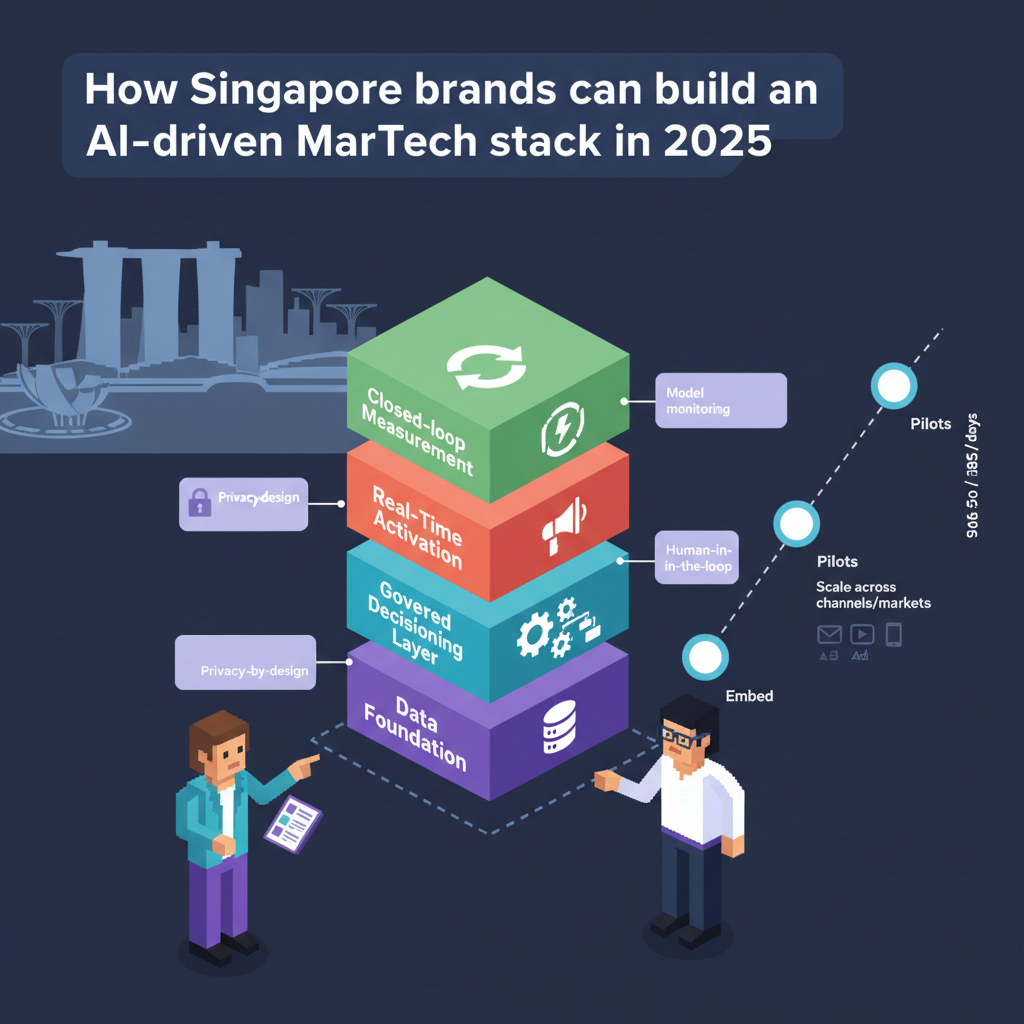
At a high level, a robust AI-powered marketing stack is organized as four interconnected layers that complement each other and evolve together. The architecture is grounded in governance, data discipline, and agile decisioning to enable fast learning and scalable activation. This layered approach is consistent with the AI-martech guidance from McKinsey, ChiefMartec, and Google’s thinking on marketing AI. (Sources: McKinsey – Rewiring martech, ChiefMartec – 2025 Landscape, MarTech.org – AI-driven evolution, Google – Generative AI for marketing)
The four layers and their handoffs:
- Data foundation (CDP or data lakehouse, consent management, identity resolution, data quality, data catalogs, and lineage). This is where data from CRM, ecommerce, websites, apps, offline systems, and support channels are ingested, standardized, and unified to form a trusted customer view. A strong data foundation is the prerequisite for reliable AI and for cross-channel activation. Governance here is about consent, access, and quality controls that ensure data can be used responsibly for AI-driven decisioning. See examples of governance and data-centric stacks in McKinsey and ChiefMartec’s perspectives.
- Decisioning & ML layer (feature store, model registry, real-time scoring, experimentation, and MLOps). This layer translates data into actionable signals using AI models and rules, and then makes near real-time or batch decisions that determine what to do, when, and where. The decisioning engine orchestrates the outputs to activation channels and can adapt over time with continued learning.
- Activation channels (web, mobile, email, ads, social, in-app experiences, and content delivery). The activation layer executes AI-driven decisions through channels, delivering personalized experiences, offers, content variants, and messages. Real-time delivery is increasingly expected, with latency targets measured alongside engagement outcomes.
- Measurement (attribution, MMM, experimentation, dashboards). This layer quantifies impact, provides ROI visibility, and closes the loop by feeding outcomes back into data foundation and ML features to continuously improve the system.
A practical maturity path aligns with these layers, starting from a consolidated data source and simple decisioning, advancing to real-time cross-channel orchestration and closed-loop optimization, and finally reaching enterprise-scale AI marketing operating system maturity. For a Singapore/SEA perspective on how these layers interact in practice, consider pilots that center on a unified data foundation and a single real-time activation path before expanding to additional channels and markets.
Practical considerations for vendors and tools include:
- Data foundation: Look for CDP/data lake/warehouse options with strong identity resolution and privacy controls. Cloud-native data platforms that support regional data residency can help meet latency and governance requirements. See the landscape discussion in ChiefMartec and the data-centric amplification described by McKinsey.
- Decisioning and ML: A feature store and model registry support reusability and governance. Plan for MLOps tooling, drift monitoring, and explainability as you scale AI across campaigns.
- Activation: Real-time orchestration requires reliable APIs and latency budgets that match use cases (e.g., <100–300 ms for on-site personalization where feasible).
- Measurement: A cross-channel attribution framework, combined with experimentation, ensures reliable ROI calculations and learning loops.
Key sources to ground this architecture include McKinsey’s “Rewiring martech” and ChiefMartec’s 2025 landscape, which emphasize the move toward data-centric, AI-native stacks, governed by cross-functional leadership. These frameworks provide the backbone for designing an architecture that Singapore brands can implement with confidence. (McKinsey: Rewiring martech; ChiefMartec: 2025 Landscape)
Internal alignment matters here as well. To explore how these architectural layers can map to real-world services, you can read more in our Services overview and in our Digital Marketing capabilities. For brand strategy alignment, see Branding.
Practical tools and vendor categories for Singapore Brands
To operationalize AI MarTech in Singapore and SEA, categorize tools into six practical groups and then evaluate vendors against interoperability, governance, and ROI criteria. This framework draws on AI-martech guidance from McKinsey, ChiefMartec, MarTech.org, and Google’s marketing AI resources, and it is designed to help regional brands move from tool-hopping to an integrated, value-driven stack. (Sources: McKinsey, ChiefMartec, MarTech.org AI hub, Google – Generative AI for marketing)
1) AI content and creative generation
- What it covers: AI-assisted copy, visual assets, video, and variants for testing; automated creative optimization and localization.
- Vendor considerations: Localization support, brand guardrails, latency for dynamic creative, and content governance.
2) Predictive analytics and MMM / advanced attribution
- What it covers: Propensity scoring, churn modeling, LTV, and marketing mix insights for budget allocation.
- Vendor considerations: Access to historical data, cross-channel visibility, and integration with MMM frameworks.
3) Personalization and decisioning (real-time orchestration)
- What it covers: Real-time scoring, cross-channel decisioning, content recommendations, dynamic messaging.
- Vendor considerations: Latency targets, API robustness, and support for multi-language, cross-market personalization in SEA.
4) Marketing automation with AI
- What it covers: AI-enabled email, social, push campaigns, and smart workflow automation that adapts to user behavior.
- Vendor considerations: Ecosystem alignment with existing CRM, multi-market capabilities, and regional support.
5) Data platforms (CDP, data lake/warehouse, governance)
- What it covers: Unified customer data platforms, data lakes/warehouses, data cataloging, and consent governance.
- Vendor considerations: Data residency, security posture, interoperability with activation platforms, and real-time data pipelines.
6) Customer service/CRM add-ons with AI
- What it covers: AI-assisted customer support, CRM augmentation, and service-automation integrated with marketing data.
- Vendor considerations: Cross-channel data sharing, consent, and value alignment with marketing outcomes.
Evaluation rubric (interoperability, APIs, latency, model governance, cost-to-value, security & compliance)
- Interoperability: Look for open, standards-based APIs, data contracts, event streams, and native connectors to your CDP/data lake and activation platforms.
- APIs & latency: Real-time or near-real-time capabilities with clear SLAs. Understand the trade-offs between batch workflows and real-time inference for your use cases.
- Model governance: Versioning, drift monitoring, explainability, and a clear process for model updates and rollbacks.
- Cost-to-value: TCO including licenses, data ingestion, compute, and ongoing integrations; track ROI per pilot and as you scale.
- Security & compliance: Encryption, access controls, regional data residency, and privacy-by-design practices; track security certifications and audit readiness.
Contextual note for SEA brands: given regional diversity in language and consumer behavior, select tools that offer multilingual support, localization capabilities, and regional services in SEA. This ensures your AI-driven experiences respect local nuances while maintaining a cohesive regional data framework. For brand strategy alignment, review how these tools integrate with Branding and Digital Marketing capabilities.
Implementation playbook for Singapore brands
A practical 90/180/365-day plan helps Singapore brands move from a theory of AI MarTech to a working, ROI-driven reality. The playbook below distills best practices from industry frameworks and tailors them for Singapore/SEA contexts. It emphasizes audit, data readiness, quick-win pilots, enablement, governance, measurement, and scaling. (Guidance sources: McKinsey – Rewiring martech; ChiefMartec – 2025 Landscape)
90 days — audit, data readiness, and quick-win pilots
- Audit: Conduct a current-state assessment of data sources, data quality, consent governance, and current activation channels. Map existing tools, data flows, and owner responsibilities. Establish a cross-functional steering group with Marketing, Data/Tech, Compliance, and Finance.
- Data readiness: Define the data foundation scope: CDP/data lake, identity resolution, consent governance, and data contracts. Prioritize data quality signals and establish data quality dashboards.
- Quick-win pilots (2–3 pilots):
- Pilot 1: Real-time on-site personalization for a high-traffic channel (web or app) using a single ML score and a simple decisioning rule.
- Pilot 2: AI-assisted content optimization for a flagship campaign (dynamic variants and automated A/B testing).
- Measurement framework: Define a minimal KPI set for pilots, establish attribution approaches, and implement dashboards for pilot tracking.
- Enablement & governance: Start basic training for marketing and data teams; document decision rules and governance workflows.
180 days — enablement, stronger measurement, and initial scaling
- Data & architecture hardening: Expand data sources, improve identity resolution, and mature data governance practices (catalogs, lineage, access controls).
- ML/decisioning enablement: Roll out ML Ops capabilities (model registry, drift monitoring, version control). Implement a feature store for reusable signals and deploy a real-time decisioning engine for multiple channels.
- Activation expansion: Extend cross-channel orchestration to additional channels and markets; start regional localization considerations for SEA markets.
- Measurement maturation: Implement cross-channel attribution with MMM where appropriate; begin reporting ROI per region and per pilot; standardize dashboards for leadership.
- Enablement & change management: Expand training to broader teams; establish a regional MARTECH Center of Excellence; refine governance processes and document lessons learned.
p>365 days — scale, governance maturity, and regional expansion
- Enterprise-wide rollout: Scale the stack across more brands, products, and SEA markets with a standardized data foundation and governance model.
- Advanced analytics & optimization: Mature mix optimization, automated experimentation frameworks, and closed-loop learning to continuously improve performance and cost efficiency.
- Governance maturity: Full model governance with risk assessments, bias checks, privacy-by-design controls, and transparent documentation (model cards, data sheets, data lineage).
- Regional expansion: Prepare for multi-market deployment with localization, language-specific personalization, and regional data stewardship aligned to SEA regulations and business objectives.
Risks and mitigations
- Data readiness risk: Mitigation—phased data integration with quality gates and early, ROI-linked pilots.
- Change management risk: Mitigation—clear sponsorship, regular comms, training, and cross-functional communities of practice.
- ROI risk: Mitigation—define ROI upfront, run controlled pilots, and maintain a transparent measurement framework.
- Talent risk: Mitigation—center of excellence, regional partnerships, and ongoing upskilling programs.
- Privacy & governance risk: Mitigation—privacy-by-design, consent governance, data minimization, and clear data handling policies.
- Interoperability risk: Mitigation—prefer open APIs, modular architectures, and staged vendor ecosystem expansion.
- Performance risk: Mitigation—optimize data pipelines, leverage edge processing where possible, and set realistic latency targets.
p>Singapore/SEA context notes
- Regional data residency and cross-border data flows require regional planning, data controls, and multi-region deployments where appropriate.
- Localization and language considerations must be embedded early to ensure personalization is relevant across SEA markets.
- Vendor ecosystems with SEA presence and regional support can reduce risk and speed deployment.
p>Assessment of governance and ROI in practice
- Track CAC/LTV, incremental lift, and channel ROI; measure content velocity and quality, and monitor brand lift where feasible.
- Document model performance, drift signals, and governance decisions to ensure ongoing accountability and trust.
p>For a practical, Singapore-ready approach to your roadmap, Hamilton & Sherwind can tailor this into a concrete project plan with owners, milestones, and a vendor shortlist. See our comprehensive Blog for reflections on execution and case studies, and explore our Portfolio for real-world outcomes.
Metrics, governance, and ongoing optimization
Defining the right metrics and establishing disciplined governance are the twin engines of a successful AI MarTech program. A measurement-first mindset ensures AI investments translate into tangible business outcomes, while governance protects data integrity, fairness, and customer trust. This approach aligns with the ROI-centric and governance-focused narratives from leading industry analyses, including McKinsey’s Rewiring martech and ChiefMartec’s 2025 Landscape, complemented by AI-martech perspectives from MarTech.org and Google.
1) Core success metrics to track
- CAC/LTV: Track customer acquisition cost and lifetime value by cohort, and attribute changes to AI-enabled campaigns. Use a combination of marketing spend, sales costs, and customer margin to calculate LTV.
- Incrementality: Measure the uplift attributable to AI-enabled campaigns using randomized tests or uplift modeling to separate the AI-driven impact from baseline growth. This is central to proving ROI. (McKinsey framework).
- Channel ROI: Evaluate ROI by channel (paid, owned, earned) and understand cross-channel interactions to optimize budget allocation. At SEA scale, cross-channel attribution can reveal unique regional effects.
- Content velocity and quality: Monitor how quickly assets are produced and deployed, and the engagement quality of those assets (CTR, time-on-site, scroll depth, etc.). Faster, higher-quality content accelerates experimentation and value realization.
- Brand lift: Where feasible, measure changes in brand awareness, consideration, and ad recall as AI-enabled personalization and messaging evolve.
2) Governance: ensuring responsible AI and trustworthy outcomes
- Model monitoring: Implement ongoing performance monitoring (accuracy, calibration), drift detection, and alerting for degraded performance. Maintain a model registry with versioning and clear lineage for auditability.
- Bias and fairness: Regularly test for disparate impact across audience segments; adjust data, features, or thresholds to mitigate bias and ensure fair treatment across segments.
- Privacy-by-design: Build privacy considerations into data collection and use in every pipeline (data minimization, purpose limitation, consent signals, and traceability). This approach aligns with broader privacy-by-design practices and enhances consumer trust.
- Human-in-the-loop: Preserve human oversight for high-stakes decisions (e.g., sensitive content personalization, high-risk offers) to ensure accountability and guardrails are respected.
- Documentation: Maintain documentation artifacts (model cards, data sheets, data lineage, API contracts, and decision logs) to support transparency and governance reviews.
3) Ongoing optimization: closing the loop
- Closed-loop learning: Use measurement results (ROI, incrementality, brand lift) to recalibrate models and features; treat the marketing stack as a living system that grows with your business.
- Experimentation discipline: Institutionalize a robust experimentation framework (A/B/n tests, multi-armed bandits) to accelerate learning and minimize risk when rolling out new AI-enabled capabilities.
- ROI-driven prioritization: Prioritize use cases with the strongest ROI signals and strategic alignment; scale gradually and measure value before broader deployment.
4) Singapore/SEA governance considerations (no PDPA deep dive)
- Privacy-by-design and local data handling policies should be embedded in your data flows and governance documentation, ensuring compliance with regional expectations and consumer trust.
- Regional data residency considerations are important for latency-sensitive deployments and cross-border data sharing; design for multi-region data pipelines where appropriate.
- Model governance practices should be consistent across markets while allowing localization nuances in personalization strategies.
4) Practical references for governance and measurement
- McKinsey’s governance emphasis in Rewiring martech (ROI, governance, and enterprise-wide adoption. (Source: McKinsey – Rewiring martech)
- ChiefMartec’s 2025 Marketing Technology Landscape (AI-native growth, data-centric stacks). (Source: ChiefMartec – 2025 Landscape)
- MarTech.org AI hub coverage on governance and intelligent systems in martech. (Source: MarTech.org – AI-driven evolution)
- Google – Generative AI for marketing guidance (scaling AI-enabled marketing). (Source: Think with Google – How to use AI for marketing)
Internal knowledge-sharing and next steps
To translate these governance principles and metrics into actionable plans for your Singapore/SEA teams, consider tapping into Hamilton & Sherwind’s broader capabilities: our Services for martech strategy, Digital Marketing implementation, and Portfolio showcasing outcomes from AI-driven campaigns. Our Blog also hosts practical insights and field-tested playbooks that teams can adapt to local markets. If you’re ready to begin, reach out to us via Contact Us.
Conclusion: Next steps for Singapore brands
Building an AI-driven MarTech stack in 2025 is about more than technology—it’s about governance, data discipline, and an operating model that learns from each campaign. For Singapore brands, the most actionable path is to start with a solid data foundation and a few high-value pilots that demonstrate measurable ROI, then scale with rigorous governance and cross-market discipline. The right architecture, tools, and playbook can unlock faster experimentation, more relevant customer experiences, and better business outcomes across SEA markets.
Ready to chart your AI MarTech journey? Hamilton & Sherwind can help you map your road to a scalable, ROI-focused AI marketing stack tailored for Singapore and the SEA region. Explore our Services, learn from success stories in our Portfolio, and read more on our Blog for insights. When you’re ready, contact us to start the conversation: Contact Us.
Added on-site backlinks
– AI-powered social media content production in Singapore: https://hamiltonsherwind.com/how-ai-powered-social-media-content-production-is-transforming-brands-in-singapore/
– MarTech and AI-Driven Marketing: A Practical Guide for Singapore Brands: https://hamiltonsherwind.com/blog/martech-and-ai-driven-marketing-a-practical-guide-for-singapore-brands/
– AI-driven content operations for SEO: a practical playbook for scalable, governance-led optimization in Singapore: https://hamiltonsherwind.com/blog/ai-driven-content-operations-for-seo-a-practical-playbook-for-scalable-governance-led-optimization-in-singapore/
CTA: https://hamiltonsherwind.com/contact/