

AI Marketing: What It Is and Why It Matters in 2025
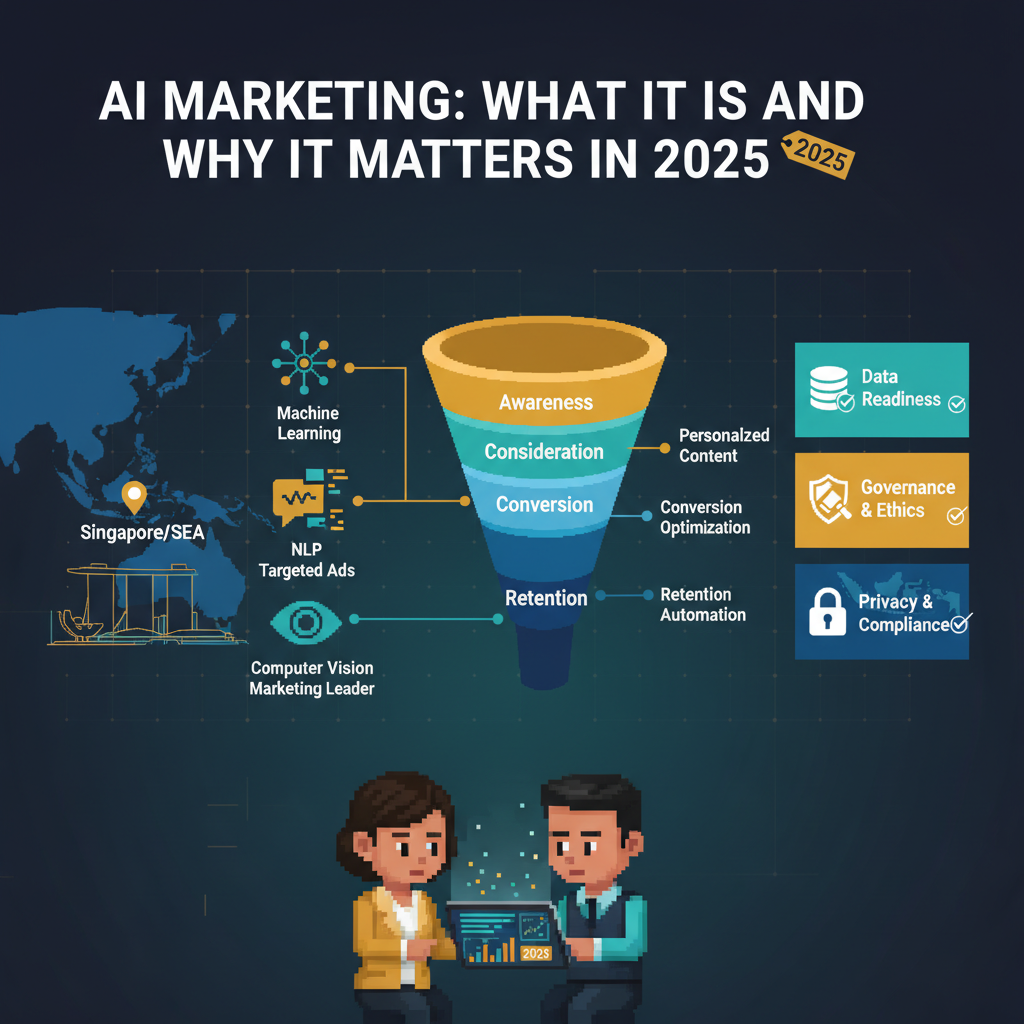
Artificial intelligence has moved from the realm of theoretical possibility to practical necessity in modern marketing. In 2025, AI marketing is no longer a competitive advantage—it’s table stakes. For marketing leaders and business owners across Singapore and Southeast Asia, understanding how to harness AI marketing tools and strategies has become essential to staying relevant in an increasingly crowded digital landscape.
AI marketing refers to the application of machine learning, natural language processing, and computer vision technologies to automate, optimise, and personalise marketing activities at scale. Rather than replacing human creativity and strategy, AI marketing amplifies it, enabling teams to process vast amounts of data, identify patterns invisible to the human eye, and deliver hyper-personalised experiences to customers across every touchpoint.
The stakes are high. According to McKinsey's 2025 State of AI survey, marketing and sales remain the top business functions seeing measurable revenue impact from AI adoption, with high performers reporting significant uplift in revenue and cost savings driven by AI-enabled personalisation, pricing, and media optimisation (McKinsey State of AI Survey 2024). High-performing organisations are redesigning their workflows so algorithms handle bid management, budget allocation, and creative rotation, while human strategists focus on vision, governance, and brand storytelling. This shift isn't just about efficiency—it's about competitive survival.
For businesses in the SEA region, where digital adoption is accelerating and consumer expectations are rising, AI marketing offers a pathway to compete globally while serving local markets with unprecedented precision. Whether you're a D2C brand scaling across multiple countries, a SaaS company targeting enterprise buyers, or a retailer optimising in-store and online experiences, AI marketing tools provide the infrastructure to do more with leaner teams and tighter budgets.
The Technology Powering AI Marketing
Machine Learning, NLP & Computer Vision Explained
At its core, AI marketing is built on three converging technologies: machine learning, natural language processing, and computer vision. Understanding how each works—and how they integrate—is crucial for any marketing leader evaluating AI marketing platforms or building an internal AI marketing strategy.
Machine Learning: The Optimisation Engine
Machine learning powers the predictive and optimisation backbone of modern AI marketing. ML models analyse historical data—customer behaviour, campaign performance, purchase patterns—to forecast future outcomes and automatically optimise marketing decisions in real time.
In practice, this means:
- Predictive lead scoring: ML models identify which prospects are most likely to convert, allowing sales teams to prioritise high-value opportunities. Harvard’s 2025 digital and AI trends primer outlines how marketers increasingly use predictive models to anticipate who will open an email, click-through, and purchase (Harvard Digital, Data & AI Trends 2025).
- Demand forecasting: Retailers and e-commerce brands use ML to predict which products will sell, when, and to whom—enabling smarter inventory and promotional planning.
- Autonomous media buying: Platforms like Albert.ai and Smartly.io use reinforcement learning to continuously adjust ad bids, budgets, and creative rotations across Meta, TikTok, Google, and Amazon. Rather than humans manually tweaking campaigns, algorithms spot micro-patterns and reallocate spend to the highest-performing combinations.
- Recommendation engines: WordStream’s analysis of AI marketing trends shows that ML-powered product recommendations can drive 20% or higher increases in average order value by tailoring suggestions to each visitor’s behaviour and similarity to past buyers (WordStream AI Marketing Trends).
The key insight: ML supplies the “engine room” of AI marketing—spotting patterns across billions of signals and compounding small optimisations into significant revenue gains.
Natural Language Processing: From Data to Dialogue
Natural language processing (NLP) is the bridge between raw data and human-ready insight. It enables machines to understand, analyse, and generate human language at scale, transforming unstructured text into actionable marketing inputs.
Key applications include:
- Sentiment analysis and brand monitoring: Tools like IBM Watson Discovery analyse reviews, social media posts, and forum discussions in minutes instead of days, extracting emotions, emerging topics, and early-warning signals about brand perception. This intelligence feeds directly into campaign strategy and crisis management.
- Conversational commerce: AI-powered chatbots and virtual assistants handle customer inquiries, qualify leads, and even summarise performance data. A synthesis of chatbot ROI benchmarks compiled by Amra & Elma indicates that companies can achieve cost savings of up to 30% and ROI exceeding 1,200% when deploying chatbots effectively (Amra & Elma Chatbot ROI Statistics).
- Copy generation and optimisation: Platforms like Persado, Phrasee, and Jasper combine GPT-style language generation with ML testing loops to produce subject lines, ad copy, and landing-page text that match brand voice while lifting open rates and click-through rates by double digits. For SEA marketers managing campaigns across multiple languages and cultural contexts, this capability is particularly valuable.
NLP has evolved beyond simple chatbots. It is now the on-demand copywriter that localises, tests, and personalises language at industrial scale—critical for brands operating across diverse markets like Singapore, Indonesia, Thailand, and Vietnam.
Computer Vision: Bringing Sight to Digital Marketing
Computer vision enables machines to analyse and understand visual content—images, videos, and real-world scenes. In marketing, CV is unlocking new channels and insights that were previously invisible.
Applications include:
- Visual search and discovery: A 2024 Fortune feature on Pinterest’s AI strategy highlights how computer vision combined with a “taste graph” lets shoppers search by image rather than keywords—a behaviour Gen Z users show a strong preference for when discovering products (Fortune on Pinterest Visual Search). This shift is reshaping retail discovery and creative optimisation.
- AR and virtual try-on: Beauty and fashion brands are already seeing conversion lifts and fewer returns when using AR to let customers virtually try products. Platforms like Cortex analyse every frame of creative to advise on colour, layout, and subject matter.
- In-store intelligence: Ceiling cameras and shelf sensors (e.g., AiFi, Trigo, Amazon Go) help reduce queues, cut shrink, and maintain planogram compliance with high accuracy. For retailers in SEA, this technology bridges the gap between physical and digital retail, feeding real-world behavioural data back into AI marketing systems.
How These Technologies Converge
The real power of AI marketing emerges when ML, NLP, and CV work together within integrated platforms. Leading solutions like Salesforce Marketing Cloud, HubSpot, and Marketo ingest clickstream, social, POS, and sensor data; embedded ML models score and segment audiences; NLP surfaces insights in plain English; and CV tags images and videos. This unified data backbone enables seamless workflows where insights flow from raw data to personalised experiences without friction.
Benefits and Business Impact
Efficiency Gains, Cost Savings & Revenue Growth
The business case for AI marketing is compelling. Beyond the hype, real organisations are seeing measurable improvements across three dimensions: operational efficiency, cost reduction, and revenue growth.
Efficiency Gains: Doing More With Less
AI marketing automates time-consuming, repetitive tasks, freeing teams to focus on strategy and creativity. Consider these efficiency improvements:
- Campaign setup and optimisation: What once took days of manual configuration—audience segmentation, creative versioning, bid management—now happens in hours or minutes. Marketers spend less time on execution and more on insight and strategy.
- Data analysis and reporting: NLP-powered dashboards surface insights in plain English. Instead of spending hours in spreadsheets, marketers ask questions like “Which campaign had the highest conversion rate last week?” and get instant answers.
- Content production: Generative AI tools reduce the time to produce first drafts of copy, social posts, and email campaigns by 50% or more. While human review remains essential, the speed-to-market advantage is substantial.
- Customer service: AI chatbots handle routine enquiries, freeing customer service teams to focus on complex issues. For SEA businesses managing 24/7 customer support across time zones, this is particularly valuable.
Cost Savings: Smarter Spend
AI marketing delivers cost reductions across multiple areas:
- Chatbot ROI: As reported by Amra & Elma, properly deployed chatbots can cut service costs by up to 30% and deliver ROI in the four-digit range by deflecting routine queries and enabling always-on support (Amra & Elma Chatbot ROI Statistics).
- Compliance and review: AI-assisted copy generation can reduce compliance review time from hours to minutes per campaign, an especially important benefit in regulated sectors.
- Media spend efficiency: Autonomous bidding algorithms reduce wasted ad spend by continuously reallocating budget to top-performing placements. McKinsey’s State of AI research notes that top-quartile adopters report 10–20% improvements in marketing spend effectiveness once AI is embedded in media optimisation (McKinsey State of AI Survey 2024).
- Reduced churn and improved retention: Predictive models identify at‑risk customers before they leave, enabling proactive retention campaigns. Retention-focused AI campaigns often generate significantly higher ROI than acquisition campaigns, due to lower relative cost and higher lifetime value preservation.
Revenue Growth: Conversion and AOV Lifts
The most compelling benefit of AI marketing is revenue growth:
- Product recommendations: WordStream’s AI marketing analysis cites retailers using AI-powered product recommendations achieving around 20% lifts in average order value by tailoring cross-sells and upsells at checkout (WordStream AI Marketing Trends).
- Conversion rate optimisation: AI-driven A/B testing and personalisation routinely deliver 10–30% CR uplifts depending on baseline performance, by serving the right message and creative to each microsegment.
- Virtual try-on and AR: Case studies in fashion and beauty show double-digit conversion improvements and significant reductions in return rates when AR and virtual try-on features are deployed at scale.
- Demand forecasting: By aligning inventory with predicted demand, AI reduces both stockouts and overstock situations, improving revenue capture and margins, especially for omnichannel retailers.
For marketing leaders in Singapore and SEA, these metrics translate to a clear ROI case: AI marketing investments typically pay for themselves within 6–12 months through a combination of efficiency gains, cost reductions, and revenue growth, particularly when deployed against high-impact use cases first.
Real-World Use Cases Across the Customer Journey
Awareness: Smart Ad Targeting
At the awareness stage, the challenge is reaching the right audience with the right message at the right time. AI in digital marketing transforms this through intelligent audience segmentation and dynamic creative optimisation.
How it works
ML models analyse first-party data (website visitors, email subscribers, app users) and third-party signals (lookalike audiences, contextual data) to identify high-intent prospects. Rather than broad demographic targeting, AI marketing enables precision targeting based on behaviour, intent, and predicted propensity to convert.
Regional example
A Singapore-based fintech startup uses an AI marketing platform integrated with Meta and TikTok. The platform’s ML engine automatically tests hundreds of audience combinations, creative variations, and placements across Singapore, Malaysia, Indonesia, and the Philippines. Within two weeks, it identifies that 25–34-year-old professionals in Jakarta who have visited financial comparison websites are three times more likely to sign up than the average audience. The algorithm automatically reallocates 60% of budget to this segment, reducing cost-per-acquisition by 40%.
Practical benefits
- Reduced ad waste by targeting high-intent audiences
- Faster time to optimal performance (days instead of weeks)
- Ability to scale campaigns across multiple markets without manual optimisation
- Real-time budget reallocation based on performance
Consideration: Chatbots & Recommendations
During the consideration stage, prospects are evaluating options and need information to make decisions. AI marketing delivers personalised guidance through conversational interfaces and intelligent recommendations.
How it works
- NLP-powered chatbots answer product questions, qualify leads, and guide prospects through the evaluation journey.
- ML-powered recommendation engines suggest relevant products or content based on browsing history and similar customer profiles.
Regional example
An e-commerce brand selling home furnishings across SEA integrates an AI chatbot into its website and WhatsApp Business account. When a visitor asks, “What’s the best sofa for a small apartment?”, the chatbot:
- Understands the intent,
- Asks clarifying questions about budget, size, and style,
- Recommends three products with dimensions and photos,
- Offers a limited-time discount code to encourage purchase.
Behind the scenes, ML models analyse which recommendations convert best for different customer segments and automatically fine-tune future responses.
Practical benefits
- 24/7 customer support without hiring additional staff
- Faster sales cycles through instant product guidance
- Higher conversion rates through personalised recommendations
- Reduced support ticket volume for routine questions
Loyalty: Predictive Retention
At the loyalty stage, the goal is to retain high-value customers and prevent churn. AI marketing identifies at-risk customers and delivers targeted retention campaigns before they leave.
How it works
ML models analyse customer behaviour patterns—purchase frequency, engagement levels, support interactions—to predict which customers are likely to churn. Once identified, marketers can deploy targeted retention campaigns: special offers, personalised content, or proactive customer service outreach.
Regional example
A SaaS company headquartered in Bangkok serving clients across SEA uses Salesforce Einstein to predict churn. The model identifies that customers who:
- Haven’t logged in for 14 days,
- Haven’t attended a training session,
- And have more than two unresolved support tickets,
are five times more likely to cancel. The system automatically triggers:
- A personalised email from the customer success manager,
- An invitation to a live training session tailored to their use case,
- And, where appropriate, a one-time renewal incentive.
This intervention prevents a significant proportion of predicted churn, preserving hundreds of thousands of dollars in annual recurring revenue.
Practical benefits
- Proactive identification of at-risk customers
- Targeted retention campaigns with higher ROI than broad win-back efforts
- Reduced churn rate and improved customer lifetime value
- Data-driven prioritisation of customer success efforts
Crafting an Actionable AI Marketing Strategy
Data Readiness & Integration Checklist
Before implementing AI marketing tools, organisations must ensure their data foundation is solid. Poor data quality will undermine even the most sophisticated AI models.
Key readiness criteria
- Data consolidation
Customer data should flow from multiple sources—website, CRM, email, social, POS, mobile app—into a unified data warehouse or customer data platform (CDP). Without this integration, AI models work with incomplete information. - Data quality
Audit your data for accuracy, completeness, and consistency. Remove duplicates, standardise formats, and validate key fields. AI models are only as good as the data they are trained on. - Historical data
Most ML models perform best with 12–24 months of historical data. If you are earlier in your digital journey, begin capturing detailed behavioural data now and treat the first 6–12 months as a learning phase. - Customer consent and compliance
Ensure you have explicit consent to use customer data for marketing purposes in each jurisdiction you operate in. This is critical in SEA, where regimes like Singapore’s PDPA and Indonesia’s personal data protection laws impose meaningful penalties for misuse. - API connectivity
Verify that your marketing stack (CRM, email platform, ad platforms, analytics tools) can exchange data via APIs. This enables real-time data flows, event-based triggers, and unified reporting. - Security and access control
Implement role-based access, encryption in transit and at rest, and clear protocols for third-party tool access.
Integration checklist
- [ ] Unified customer data platform or data warehouse in place
- [ ] Data quality audit completed; remediation plan in progress
- [ ] 12+ months of key behavioural and transactional data available
- [ ] Customer consent and compliance framework documented for each SEA market
- [ ] API connectivity tested between CRM, email, ad platforms, and analytics
- [ ] Data governance policies defined (ownership, access, retention)
- [ ] Security, privacy, and incident response procedures in place
Governance, Ethics & KPI Setting
As AI marketing becomes more autonomous, governance and ethics become critical. Organisations must establish guardrails to ensure AI systems operate within brand values and regulatory requirements.
Governance framework
- Model transparency: Aim for explainable models where possible. If an AI system decides to offer a discount, segment a customer, or block a keyword, you should be able to understand and review that logic.
- Bias detection: Regularly audit AI models for bias. For example, does a churn prediction model unfairly classify certain demographic groups as “high risk”? Biased models can create discriminatory outcomes and regulatory exposure.
- Human-in-the-loop: Keep humans in control for high-impact decisions, especially those touching pricing, creative, and customer experience. AI should propose; humans should approve.
- Audit trails: Maintain logs of AI actions and decisions. This helps with troubleshooting, learning, and regulatory compliance.
Ethics considerations
- Transparency with customers: Where material, make it clear that AI is helping personalise their experience. Transparent brands typically enjoy higher trust and engagement.
- Data minimisation: Collect only the data you genuinely need for agreed purposes. More data means more risk and compliance overhead.
- Fairness and inclusivity: Test personalisation and targeting strategies across segments to ensure certain groups are not systematically disadvantaged or excluded.
KPI framework
Define clear metrics before implementing AI marketing. These should align with business objectives and be baseline-measured first.
- Efficiency KPIs: Time to launch campaigns, manual hours per campaign, time spent on reporting.
- Effectiveness KPIs: Conversion rate, cost-per-acquisition, click-through rate, return on ad spend.
- Customer experience KPIs: CSAT, NPS, chatbot resolution rate, average response time.
- Business impact KPIs: Revenue growth, gross margin impact, churn rate, customer lifetime value.
Track these KPIs before and after AI deployment to quantify impact and build the internal business case for further investment.
Selecting AI Marketing Tools & Platforms
The AI marketing tool landscape is crowded. Choosing the right platform depends on your specific needs, budget, and technical capabilities.
Evaluation framework
- Fit with existing stack
Does the AI tool integrate natively with your CRM (e.g., HubSpot, Salesforce), your ad platforms (Meta, Google, TikTok), and your analytics stack? Poor integration leads to manual workarounds and siloed data. - Ease of use
Can your team adopt the platform quickly, or will you need specialist hires? Look for intuitive interfaces, strong local support, and robust documentation. - Customisation vs out-of-the-box
Highly customisable platforms (e.g., enterprise marketing clouds) offer flexibility but require technical depth. Out-of-the-box tools reduce complexity but may limit advanced use cases. - Vendor stability and roadmap
Review the vendor’s financial health, reference customers in Asia, and published product roadmap. You want partners who are investing in AI, not just adding buzzwords. - Cost structure
Understand pricing—per user, per contact, per message, per API call, or percentage of media spend. Model total cost of ownership, including onboarding, training, and required data infrastructure. - Support and community
Local or regional support, implementation partners, and active communities can dramatically reduce time-to-value.
Platform categories
- All-in-one marketing clouds
Salesforce Marketing Cloud, HubSpot, Marketo – ideal for organisations seeking an integrated marketing, sales, and service platform with embedded AI. - Creative and media engines
Smartly.io, Albert.ai, performance-focused tools that specialise in media buying optimisation, dynamic creative, and cross-channel experimentation. - Customer data platforms (CDPs)
Segment, mParticle, Tealium – best for organisations that need to centralise data and orchestrate journeys across multiple tools. - Specialised AI tools
- Persado, Phrasee – AI copy and subject line optimisation.
- Conversion rate optimisation and experimentation platforms, often including AI-based personalisation.
- Creative analytics tools like Cortex that score visual content.
- Managed AI marketing services
Agencies and consultancies that layer strategy and managed execution on top of best-of-breed tools.
For most SEA organisations, a pragmatic path is to start with AI capabilities in existing platforms (e.g., Meta Advantage+, Google’s Performance Max, email send-time optimisation) and then graduate to CDPs and dedicated AI tools as maturity grows.
Future Trends & Emerging Challenges
Generative AI for Creative Production
Generative AI is transforming creative production. Tools like GPT-style writers, DALL·E, and Midjourney are enabling marketers to produce copy, images, and even video variants at unprecedented speed and scale.
Current applications
- Copy generation: Tools such as Jasper and Copy.ai draft email subject lines, ad copy, blog outlines, and social media content. These drafts then go through human editing for brand tone and compliance.
- Image generation: Visual models generate product images, conceptual artwork, and campaign concepts. This is particularly useful in early-stage ideation and for filling visual gaps where photography is unavailable.
- Video support: AI is increasingly involved in script assistance, auto-captioning, and basic editing—compressing production timelines and enabling more personalised video variants.
Challenges
- Brand consistency: Generative outputs can be inconsistent. Without strong brand guidelines and prompt libraries, your content may “sound” different across channels.
- Copyright and IP: The legal landscape around training data and generated assets is evolving. Organisations should maintain clear policies and consult legal counsel when using AI-generated content at scale.
- Authenticity and trust: Overuse of generic AI content can feel impersonal. Customers still respond strongly to authentic stories and local nuance—especially in culturally diverse markets like SEA.
Outlook
Generative AI will be a standard part of the marketing toolkit, augmenting human creatives. The teams that win will use AI to handle repetitive or lower-value tasks while reserving high-impact storytelling and conceptual work for humans.
Privacy Regulations & First-Party Data
The privacy landscape is tightening globally, with direct implications for AI marketing in SEA.
Key shifts
- Regulatory tightening: Laws like Singapore’s PDPA, Thailand’s PDPA, and Indonesia’s data protection act require clear consent, purpose limitation, and secure handling of personal data.
- Cookie deprecation: The phase-out of third-party cookies in major browsers (fundamentally completed by 2025) means marketers can no longer rely on cross-site tracking for granular targeting.
Implications for AI marketing
- First-party data focus: Organisations must prioritize building rich first-party datasets through loyalty programmes, gated content, and value-exchange experiences.
- Consent management: Implement consent management platforms that capture and honour user preferences across channels and jurisdictions.
- Data minimisation: Collect only what is necessary and clearly explain why. This improves trust and reduces compliance risk.
- Model design: Build AI models that rely heavily on first-party and contextual signals rather than opaque third-party data.
Opportunity
Brands that treat privacy as a design principle rather than a compliance chore can differentiate on trust. Clear communication about data use and strong privacy practices can become part of your brand story, enhancing customer loyalty.
Conclusion: Key Takeaways to Get Started
AI marketing is no longer a future possibility—it is a present reality reshaping how organisations reach, engage, and retain customers. For marketing leaders and business owners in Singapore and SEA, the question is not whether to adopt AI marketing, but how to do it strategically and responsibly.
Key takeaways
- Start with strategy, not tools
Clarify your objectives—e.g., reduce acquisition cost, lift conversion, improve retention—and map them to specific AI use cases before buying technology. - Invest in data foundations
Consolidated, high-quality, consented data is the prerequisite for effective AI. Prioritise CDP or data warehouse projects that enable unified customer views. - Begin with high-impact, low-friction use cases
Examples: AI-powered audience targeting, send-time optimisation, product recommendations, and basic chatbot support. These can show results quickly and build internal momentum. - Keep humans in the loop
Use AI to augment, not replace, your marketers. Maintain human oversight on creative, targeting policies, and major customer decisions. - Define and track KPIs from day one
Establish baselines and measure uplift in conversion, AOV, cost efficiency, and satisfaction to prove the ROI of AI initiatives. - Design for privacy and trust
Respect local regulations, adopt privacy-by-design principles, and be transparent with customers about how AI uses their data. - Build capabilities and culture
Develop data literacy, experimentation culture, and cross-functional squads that combine marketing, data, and tech skills.
For organisations in Singapore and across SEA, those that move early and thoughtfully will define what “good” looks like in AI marketing for the region—shaping not just campaigns but entire customer experiences.
If you want a partner who understands both brand-building and the realities of AI-powered execution in our region, Hamilton & Sherwind can help you translate strategy into AI-enabled stories that scale.
Contact us to plan your AI marketing roadmap and turn data, creativity, and automation into measurable business growth.
Further reading from Hamilton & Sherwind