

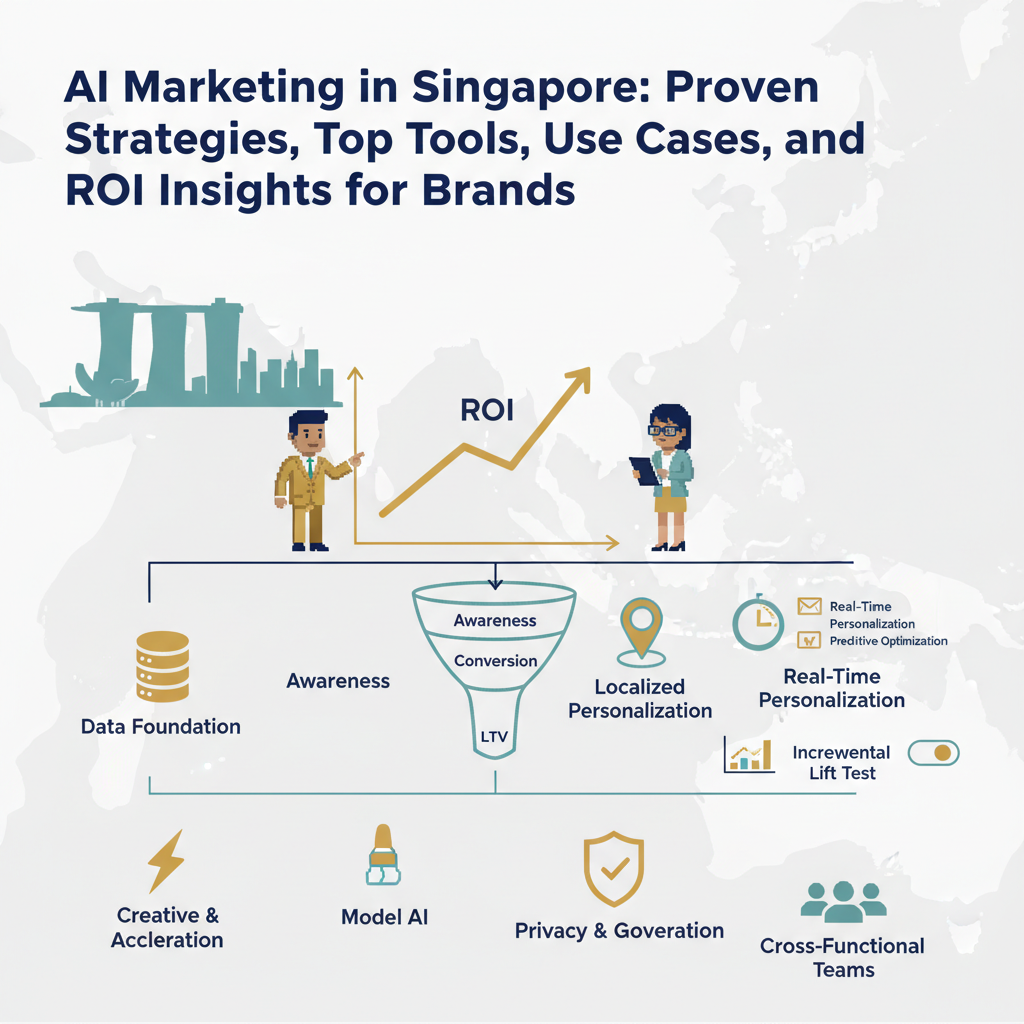
AI Marketing in Singapore: Proven Strategies, Top Tools, Use Cases, and ROI Insights for Brands
Field Type: Rich Text
Introduction: Unlocking the Power of AI Marketing Singapore for Modern Brands
Artificial intelligence is reshaping how brands in Singapore and Southeast Asia connect with customers, optimize campaigns, and drive measurable business outcomes. What once seemed like a distant future—AI-powered personalization, automated content creation, and predictive customer insights—is now operational reality for leading organizations across the region.
The numbers tell a compelling story. Global business AI adoption climbed to approximately 78% of organizations in 2024, up from 55% the previous year, driven largely by generative AI investment and deployment. In Southeast Asia specifically, the AI sector was valued at over US$4 billion in 2024, with expectations of multi-fold growth through the early 2030s. Singapore, functioning as the regional hub for AI investment, R&D, and talent, is attracting both multinational enterprises and ambitious local startups eager to harness AI’s marketing potential.
Yet adoption in the region isn’t uniform. While some brands—like DBS, Grab, Shopee, and Lazada—have industrialized AI across marketing functions and achieved measurable ROI, many organizations remain uncertain about where to start, which tools to invest in, and how to measure success in a region as diverse and dynamic as Southeast Asia.
This comprehensive guide addresses that gap. We’ll explore proven AI marketing strategies tailored to Singapore and SEA, review the leading tools and platforms available to businesses of all sizes, examine real-world case studies from the region, establish frameworks for measuring ROI, and provide practical guidance on overcoming common implementation barriers. Whether you’re a marketing professional at a mid-market e-commerce firm, a digital strategist at a financial services company, or a brand manager exploring AI for the first time, this article will equip you with actionable insights to accelerate your AI marketing journey.
Understanding AI Marketing Strategies in Singapore
Field Type: Rich Text
Key drivers of AI adoption in Singapore’s marketing landscape
Singapore’s rapid embrace of AI marketing is driven by several converging forces that create both opportunity and urgency for brands.
Rapid digitalization and high smartphone penetration form the foundation. Southeast Asia boasts a large, young, digitally native consumer base comfortable with mobile apps and personalized online services. This creates immediate demand for AI-powered personalization, recommendation engines, and conversational interfaces. In Singapore specifically, smartphone penetration exceeds 90%, and consumers expect seamless, personalized experiences across channels.
Cloud and AI-as-a-Service availability has dramatically lowered barriers to entry. Major cloud providers—AWS, Google Cloud, and Microsoft Azure—operate Asia-Pacific regions including Singapore, enabling local hosting, lower latency, and data-residency compliance. This means even mid-market firms can now consume machine learning and generative AI capabilities through managed services rather than building models from scratch. The cost of AI inference has fallen significantly, making experimentation and scaling more economically viable.
Generative AI momentum has accelerated interest and experimentation across marketing functions. From creative content generation to customer service automation and personalization, the GenAI boom has prompted fast trials and pilots. Marketing teams are discovering that generative AI can dramatically speed content production, localization, and campaign iteration—addressing a critical pain point in a multilingual, multi-market region.
Government strategy and infrastructure provide structural support. Singapore’s national digital and AI programs, including the National AI Strategy 2.0 and substantial public investment in AI R&D, have attracted talent and investment. Across ASEAN, national strategies and public investment are catalyzing enterprise adoption. This creates a supportive ecosystem where regulatory guidance (like Singapore’s Model AI Governance Framework) helps organizations implement responsibly. Also see Singapore’s National AI Strategy 2.0 and the IMDA Model AI Governance Framework for GenAI.
Business ROI pressure and competitive urgency drive adoption. Marketers are prioritizing AI projects that improve conversion rates, reduce customer service costs, and accelerate content production. The competitive intensity of SEA’s e-commerce and fintech sectors means brands that don’t adopt AI risk losing market share to those that do.
How local brands are approaching AI-driven marketing
Successful implementations across Singapore and SEA follow a consistent pattern: staged pilots moving to scale, with emphasis on measurement and localization.
Start with low-risk, high-ROI pilots. Many companies begin with chatbots for customer service or recommendation engines for e-commerce, measure uplift rigorously, then expand. Retail, financial services, and digital platforms have emerged as early adopters, with proven playbooks that other sectors can learn from.
Platform partnerships are the norm. Rather than developing foundational models in-house, marketing teams increasingly stitch together cloud AI services (Microsoft, AWS, Google), specialized martech vendors, and analytics platforms to run personalization and campaign automation. This approach reduces time-to-value and capital requirements.
Cross-functional squads combine data engineers, ML specialists, and marketers to operationalize models into the martech stack. Leading organizations like DBS have demonstrated that pairing business and technical ownership—what DBS calls the “two-in-a-box” model—accelerates adoption and ensures models deliver business value. See DBS’s transformation overview from McKinsey.
Local language and cultural adaptation are non-negotiable. Brands adapt generative AI outputs through human-in-the-loop editing and custom prompts to ensure culturally appropriate and localized messaging. This is essential given SEA’s linguistic diversity (Malay, Thai, Vietnamese, Filipino, and others).
Measurement focus distinguishes winners from experimenters. Successful rollouts emphasize A/B testing and clear KPI measurement (conversion lift, CAC reduction, CSAT improvements) before scaling. Organizations that can’t measure incremental impact struggle to justify continued investment.
Essential AI Marketing Tools for Singaporean Businesses
Field Type: Rich Text
Overview of leading platforms and solutions
The AI marketing technology landscape in Singapore and SEA is mature and diverse. Brands have access to the same global tools used elsewhere, plus regional vendors and localized implementations focused on multilingual support and local integrations.
Marketing automation and CRM platforms form the foundation. HubSpot, ActiveCampaign, Mailchimp, Zoho CRM (with Zia AI), Salesforce Marketing Cloud, and Adobe Marketo all provide campaign automation, lead scoring, audience segmentation, and journey orchestration with embedded AI capabilities. These platforms are cloud-based, accessible across SEA, and supported by strong partner ecosystems in Singapore, Malaysia, Indonesia, and the Philippines.
Personalization engines and experimentation platforms like Adobe Target, Dynamic Yield, Optimizely, and Braze deliver real-time product and content recommendations, site personalization based on behavior and segments, and multi-variate testing. These are typically enterprise-grade solutions with contract pricing, though smaller e-commerce companies often use embedded personalization from their platform (Shopify apps, Klaviyo recommendations).
Chatbots and conversational AI have become essential for customer support and sales. Freshchat (with Freddy AI), Google Dialogflow, ManyChat, Tidio, Yellow.ai, Verloop.ai, and Intercom offer rule-based and ML hybrid bots with NLP for local languages, handoff to humans, and automation across web, WhatsApp, and social channels. Yellow.ai and Verloop.ai specifically focus on large regional customers requiring multilingual support.
Content generation and creative AI tools accelerate creative production. OpenAI’s ChatGPT, Jasper, Copy.ai, Writesonic, Canva Magic Studio, Runway, Lumen5, and Adobe Firefly generate ad copy, social posts, landing page content, image assets, and short videos. Marketing teams combine global GenAI services with local language post-editing to ensure cultural relevance.
Analytics, product analytics, and CDP platforms provide the measurement foundation. Google Analytics 4, Amplitude, Mixpanel, Pendo, mParticle, Segment, and Pecan.ai enable user journey measurement, event analytics, attribution, cohort analysis, and predictive modeling. CDPs unify identity and feed personalization engines.
Choosing the right tools for your business size and needs
Tool selection depends on organizational maturity, budget, and specific use cases.
For SMEs and startups (budget-sensitive, need speed): Start with all-in-one stacks and freemium generative AI. HubSpot Free or Starter tier, ActiveCampaign, MailerLite, Canva, and ManyChat or Tidio provide quick wins without heavy engineering lift. These platforms offer freemium or low-cost tiers, making them ideal for testing and learning.
For mid-market companies (growth and regional scale): Adopt integrated CRM plus automation (HubSpot Professional, Klaviyo for e-commerce), basic CDP or Segment, an AI chatbot (Freshchat, Intercom), and API-based generative AI for content workflows. Invest in measurement (Amplitude or Mixpanel) to track incremental impact. Budget typically ranges from SGD 5,000–20,000 per month depending on scale and feature depth.
For enterprise organizations (complex data, compliance, scale): Deploy enterprise martech suites (Salesforce Marketing Cloud, Adobe Experience Cloud, Oracle), CDP (mParticle or Segment), and enterprise personalization engines. Consider BYOC (Bring Your Own Cloud) or dedicated cloud regions for data residency and use vendor professional services for integration and governance. Annual contracts typically range from SGD 200,000 to several million depending on scope.
Implementation tips for SEA and Singapore teams:
- Localize early: multilingual prompt templates and human-in-the-loop editing improve conversion across SEA markets.
- Start with proven use cases: chatbots for support, recommendation engines for e-commerce, and generative AI for draft content; measure uplift before wide rollout.
- Mind data residency and privacy: regulated industries may require in-region hosting; confirm vendor region and encryption.
- Use partners: local integrators and vendor partners in Singapore, Malaysia, and Indonesia shorten time to value and handle language and custom integrations.
Explore our digital marketing services and branding capabilities to see how we integrate AI into strategy and execution across channels.
Real-World AI Use Cases in Marketing Across Singapore and SEA
Field Type: Rich Text
Case studies from retail, finance, and hospitality
DBS (Financial Services, Singapore): DBS built a decade-long data and AI program rather than one-off pilots. They created large data factories, central data lakes, and governance principles (PURE: purposeful, unsurprising, respectful, explainable). The bank paired business and IT leaders in “two-in-a-box” operating model and industrialized model development with reusable libraries and deployment pipelines. See McKinsey’s DBS transformation case.
Grab (Mobility and Delivery, Regional): Grab used Google Analytics 4 Audience Trigger to convert complex user behavior into event triggers feeding AI-driven app campaigns, supported by Singapore’s AI ecosystem including the Grab AI Centre of Excellence in Singapore.
Shopee (E-commerce, Regional): Shopee explored AI-assisted shopping and AI agents in collaboration with OpenAI, as reported by SEA Limited: Shopee AI collaboration.
Lazada (E-commerce Platform, Regional): Lazada announced a suite of GenAI features for shopping and seller experiences in SEA; see Lazada GenAI features.
Lessons learned and best practices
- Instrumentation and first-party data wins. High-quality event capture fuels AI models and reduces acquisition costs.
- Measure tightly and scale only proven plays. Use lift tests and country-level KPIs before regional rollouts.
- Data governance and trust are essential. Align to PDPC’s guidance and IMDA best practices.
- Operationalization matters. Cross-functional squads, reusable pipelines, and training beat raw model sophistication.
- Use platform AI for quick wins. Combine first-party signals with platform AI for immediate impact.
See examples in our portfolio and digital marketing portfolio.
Measuring AI Marketing ROI: Metrics and Frameworks
Field Type: Rich Text
Setting realistic KPIs for AI-driven campaigns
Measuring ROI for AI marketing requires a unified approach combining strong first-party data, clear business-aligned KPIs, and a blended measurement strategy using experiments, causal attribution, and Marketing Mix Modeling.
- Start from baseline. Use historical period metrics (last 3–6 months) and target relative improvements.
- Tie to finance. Align CAC with CLV; many brands aim for CLV:CAC ≥ 3:1, adjusted for margins.
- Define MDE and sample size before tests to ensure statistical power.
- Phase targets by maturity (pilot → scale → optimize) and set country-level KPIs for SEA variability.
Tools and methods for ROI measurement in Singapore
- Core KPIs: CPA, CPL, CVR, ROAS/iROAS, ROMI, CLV, lift, churn, AOV, margin contribution.
- Framework: instrument → attribute/experiment → MMM → budget reallocation.
- Methods: data-driven attribution; lift experiments; MMM; causal modeling.
- CLV: use cohort or predictive; set CPA ceilings based on predicted value.
- Tools: GA4, server-side tagging, Ads Data Hub, Meta CAPI, Amplitude, Mixpanel, Optimizely, Segment, mParticle, BigQuery, Snowflake.
Our blog regularly shares measurement frameworks and Singapore/SEA case studies.
Emerging AI Marketing Singapore Trends and Future Outlook
Field Type: Rich Text
Personalization, automation, and predictive analytics
- Real-time contextual personalization with streaming signals and low-latency inference.
- Value-based personalization via predictive CLV and propensity-driven bidding.
- Privacy-preserving personalization with federated learning and server-side measurement.
- Autonomous marketing loops with human-approved guardrails.
- AI agents for marketing ops across planning, reporting, creative iteration, and test design.
- Dynamic creative and programmatic automation for scaled creative testing.
Regulatory and ethical considerations in the region
Singapore’s pragmatic approach provides clear baselines for responsible AI. See PDPC’s Model AI Governance Framework and IMDA’s GenAI guidance for marketers.
Overcoming Challenges: Implementing AI-Driven Marketing Singapore
Field Type: Rich Text
Common barriers for local brands
- Data quality, fragmentation, and integration
- Skills and talent gaps (data science, ML engineering, MLOps)
- Organizational resistance and change management
- Budget constraints and unclear ROI
- Legacy systems and infrastructure limits
- Governance, compliance, and safety concerns
- Language, cultural, and bias issues
Solutions and expert recommendations
- Prioritized data catalogues, CDP/warehouse with identity stitching, and automated data quality checks
- Hire hybrid roles, upskill marketers, and partner with regional experts
- Value-focused pilots with lift tests; “two-in-a-box” ownership
- Staged funding; prioritize quick-payback automation
- Pragmatic integration and regional cloud zones
- Operational AI governance and GenAI-specific safeguards
- Localization, human-in-the-loop, and locale A/B testing
Explore our social media services, advertising capabilities, and video production to see how AI can accelerate creative and performance outcomes.
Conclusion: The Road Ahead for AI Marketing in Singapore and SEA
Field Type: Rich Text
The trajectory is clear: AI marketing in Singapore and Southeast Asia is moving from experimentation to operationalization. Organizations that once ran isolated pilots are now building industrialized AI programs—like DBS’s 800+ models across 350 use cases, or Grab and Shopee’s AI-driven acquisition engines delivering double-digit efficiency gains.
The opportunity is substantial. Brands that master AI marketing will achieve measurable advantages: lower customer acquisition costs, higher lifetime value, faster content production, and deeper personalization. But success requires more than technology. It demands strong data foundations, cross-functional teams, rigorous measurement discipline, and thoughtful governance aligned to Singapore’s pragmatic regulatory framework.
The barriers are real—data fragmentation, skills gaps, organizational resistance, and legacy systems slow many organizations. But they’re surmountable. The playbook is clear: start with high-value, measurable pilots; prioritize first-party data and event instrumentation; pair business and engineering ownership; use cloud and platform AI services for speed; measure incrementally; and scale only proven plays.
For marketing professionals, business owners, and digital strategists in Singapore and SEA, the time to act is now. The competitive window is open, but it won’t stay open forever. Organizations that begin their AI marketing journey today—with clear KPIs, strong measurement discipline, and a commitment to responsible AI practices—will lead their categories tomorrow.
Ready to accelerate your AI marketing strategy? The frameworks, tools, and case studies in this guide provide a roadmap. The next step is to assess your current state, identify your highest-impact use case, and launch a measurable pilot.
Let’s talk about how to bring AI marketing to life for your brand. Contact us to discuss your specific challenges, explore the right tools and strategies for your organization, and build a roadmap to AI-driven marketing success in Singapore and Southeast Asia.
Sources and further reading
- PDPC: Model AI Governance Framework
- IMDA: Model AI Governance Framework for GenAI (Public Consultation)
- EDB: Singapore’s National AI Strategy 2.0
- McKinsey: DBS transformation case
- Grab AI Centre of Excellence (Singapore)
- SEA (Shopee) AI collaboration
Hamilton & Sherwind is a Singapore-based branding and digital marketing agency helping organizations translate strategy into stories that connect with real people. Explore our blog, portfolio, and who we are.