

AI Marketing Stack: A Practical Guide for Singapore
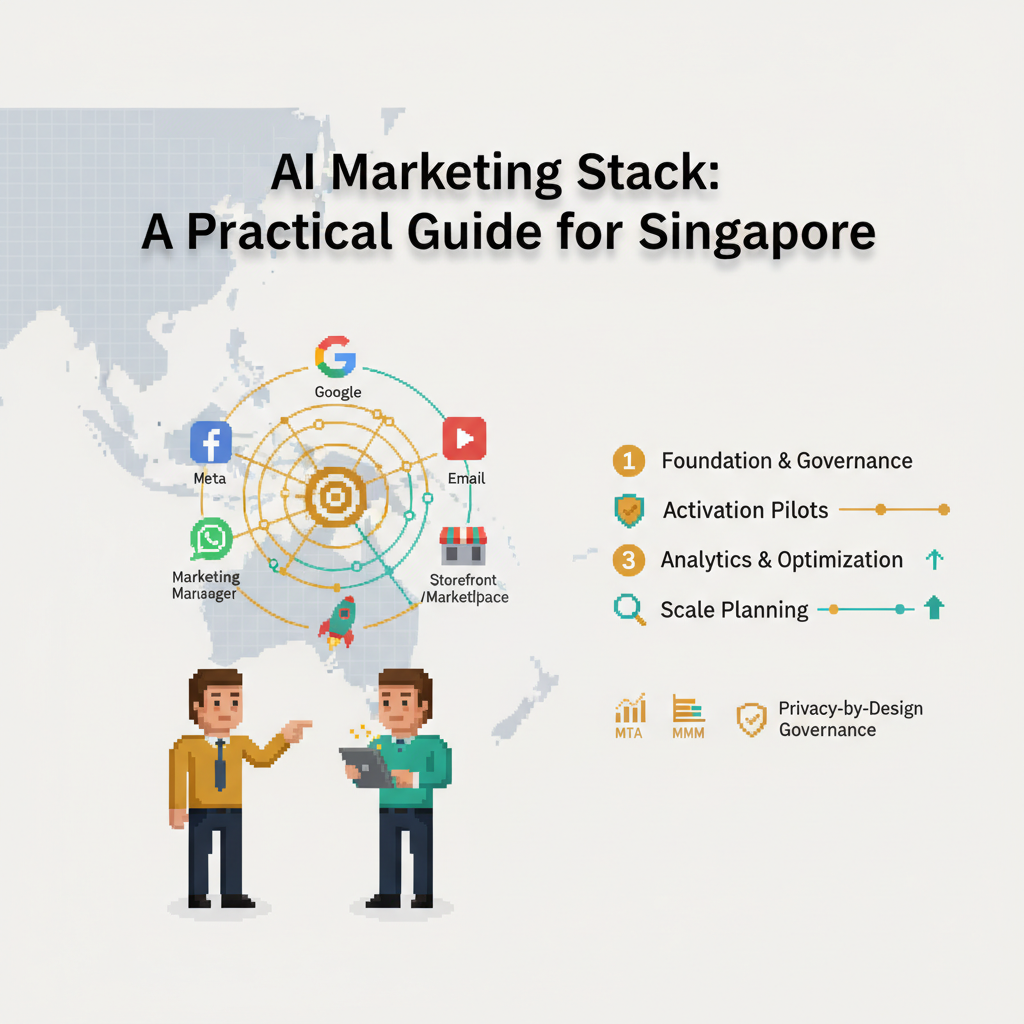
Introduction: Why Singapore marketers need an AI-powered stack
Singapore sits at the confluence of Southeast Asia’s fast-moving consumer markets, tech-forward buyers, and increasingly data-driven marketing teams. The opportunity is simple and compelling: unify data from multiple channels and touchpoints, apply AI to personalize experiences at scale, and orchestrate interactions across ads, storefronts, marketplaces, messaging apps, and email—all while maintaining governance, consent, and security that regional teams expect.
The regional context matters. Across SEA, marketplaces like Shopee and Lazada, social platforms such as Meta, Google, and TikTok, and messaging apps like LINE and WhatsApp dominate consumer journeys. Marketers who attempt to do “one-off” campaigns in siloed channels quickly discover that attribution is noisy, audiences fragment across devices, and creative iteration can take too long. An AI-powered stack helps by:
– Unifying data: Bringing CRM, ESP, web/app analytics, marketplace data, and ad signals into a single analytics and activation fabric.
– Personalizing at scale: Using first-party data and AI-generated content to tailor experiences across languages, locales, and channels.
– Activating in real time: Orchestrating audiences and messages across channels with near real-time feedback loops.
– Measuring holistically: Combining user-level attribution with market-level insights to guide both tactical optimizations and strategic investments.
– Governing responsibly: Embedding privacy-by-design, consent management, and cross-border governance into every data flow.
This guide is designed for Singapore and SEA teams who want a vendor-agnostic approach—focusing on structure, patterns, and practical steps rather than specific tools. You’ll find a clear path from building blocks to implementation, with an explicit 90-day plan for Singapore and concrete mini-cases to illustrate how the concepts work in the real world.
Checklist: Introduction
– Align leadership on a single, cross-channel vision for data, AI-enabled activation, and governance.
– Confirm regional data sources to prioritize (CRM, ESP, web/app analytics, Shopify, Shopee/Lazada, Meta/Google/TikTok ads, LINE/WhatsApp, email, push, SMS, offline data).
– Establish one high-level governance framework (consent, retention, data quality, identity, and cross-border considerations).
– Decide on success metrics that reflect both speed (time-to-value) and impact (revenue, ROAS, LTV).
– Identify two initial use cases (one retail/ecommerce, one B2B SaaS) to pilot in Singapore.
1 Building blocks of the AI MARKETING STACK
1 Building blocks of the AI MARKETING STACK
1. Data sources and integration
A robust AI marketing stack in SEA begins with data—the right data, in the right place, accessible in a governed way. The typical data sources you’ll pull into the stack include:
- CRM data: customer profiles, segments, lifecycle stages, purchase history, loyalty status.
- ESP data: campaign interactions, engagement metrics, unsubscribe signals.
- Web/app analytics: user journeys, events, conversions, on-site behavior, personalization triggers.
- E-commerce data: Shopify storefront data, and marketplace data from Shopee and Lazada (orders, SKUs viewed, cart activity, inventory signals).
- Social and search ad data: Meta, Google, TikTok ad signals, spend, impressions, clicks, conversions.
- Messaging data: LINE, WhatsApp transcripts, bot interactions, chat history.
- Offline data: in-store promotions, POS data, events, loyalty redemptions.
- Identity signals: across channels (email, phone, device IDs, marketplace IDs) to stitch a customer view.
Data integration patterns in SEA
– ELT-first approach: land raw data into a centralized data warehouse or lakehouse, then apply transformations to create model-ready features. This approach supports AI model training and rapid experimentation with feature stores.
– Real-time vs batch: real-time event streams (purchases, page views, chat interactions) can feed close-to-real-time personalization, while batch loads support longer-horizon analytics and MMM.
– Data residency and cross-border flows: SEA teams often operate across multiple jurisdictions. Plan for regional data stores, with well-documented data transfer policies and consent signals.
Practical patterns and examples
– Pattern: 1st-party data foundation
– Build unified customer profiles by stitching CRM IDs, email and phone identifiers, app/device IDs, and loyalty data. Use deterministic matching where possible (email, phone), and supplement with probabilistic matching when necessary, always respecting consent and opt-out signals.
– Pattern: Marketplace-to-CRM linkage
– Ingest Shopee/Lazada order data and map to customer identities in your CDP/CRM; use this to power cross-channel personalization and attribution that includes marketplace activity.
– Pattern: Cross-channel signal fusion
– Ingest ad signals (Meta/Google/TikTok), email engagement, push interactions, chat transcripts, and on-site events into a central analytics layer. Build customer-level funnels that span ads, site behavior, and post-click messaging.
Mini case: Singapore retail/ecommerce data foundation: A Singapore-based fashion retailer connects Shopify storefront data with Shopee/Lazada order histories, Meta/Google/TikTok ad signals, and WhatsApp chat interactions. They unify these signals into a Customer Data Platform and build an identity graph that supports cross-channel personalization (language-appropriate, currency-aware, and region-sensitive). Results include faster campaign iterations, cleaner attribution, and a 12% uplift in average order value (AOV) after 3 months of cross-channel personalization.
Checklist: Data sources and integration
- List core data sources by channel (CRM, ESP, web/app analytics, storefronts, marketplaces, ads, messaging, offline data).
- Define canonical customer IDs and initial identity resolution rules (deterministic first, probabilistic second).
- Establish data ingestion gates (schema contracts, data quality checks, latency targets).
- Set up a central data store (warehouse/lakehouse) with feature-store readiness.
- Map data residency and cross-border transfer rules for SEA markets.
2 AI MARKETING TOOLS and platforms: selection criteria
AI makes channels smarter, not just faster. In SEA, the most impactful channels include Meta (Facebook/Instagram), Google, TikTok, LinkedIn for B2B, WhatsApp/LINE for messaging, email, push, SMS, and storefronts (Shopify) plus marketplaces (Shopee/Lazada). AI-enabled capabilities across these channels include:
- Targeting and optimization: AI can refine audience targeting, optimize bids and budgets, and auto-tune placements for maximum ROI.
- Creative generation and optimization: AI-assisted dynamic assets, language-localized variants, and automated testing of hooks, formats, and CTAs.
- Personalization and automation: AI-driven content and product recommendations, propensity-based triggers, and real-time message orchestration.
- Cross-channel orchestration: AI-based decisioning on where and when to engage a customer, consistent brand voice, and cohesive journeys across channels.
SEA-specific channel patterns
– Meta and Google: AI-driven bidding, creative optimization, testing, and cross-format adaptation for SEA’s mobile-first audiences.
– TikTok: AI-optimized short-form content with automated testing across hooks, captions, and visuals; strong potential for shopping campaigns.
– WhatsApp/LINE: AI-powered chatbots for support and recommendations; important for conversational commerce and post-purchase care.
– Email/push: Content generation and send-time optimization; lifecycle automation leveraging propensity models.
– Storefronts and marketplaces: AI-powered product recommendations, merchandising signals, and localized content that align with currency and regional promotions.
Practical patterns
– Orchestrated AI activation: Build a cross-channel orchestration layer that uses a single identity graph to segment audiences and to drive consistent, localized messaging across ads, storefronts, and messaging apps.
– Dynamic creative and localization: Use AI to generate multiple variants per market, then localize and QA per locale before publishing. Tie results back to a centralized content library and style guide.
– Measurement linkage: Align AI-driven activations with attribution and ROI, ensuring that signals from marketplaces and messaging apps feed back into the analytics layer to refine future targeting and content.
Mini case: Singapore-based B2B SaaS uses AI-enabled channels: A Singapore-based B2B SaaS company deploys AI-driven LinkedIn ABM for target accounts and uses cross-channel messaging (WhatsApp/LINE) for broad engagement. They tie marketing automation and CRM events to nurture campaigns and trial activations. Outcome: higher MQL-to-SQL conversions and increased trial-to-paid conversions by 2x within six months, aided by a unified identity graph that respects consent signals and cross-border data considerations.
Checklist: AI-enabled channels
- Map channels to regional importance (SEA priorities: Meta, Google, TikTok, LinkedIn for B2B, WhatsApp/LINE, email, push, storefronts, marketplaces).
- Define AI use cases per channel (targeting, creative optimization, personalization, automation, orchestration).
- Ensure cross-channel identity linking supports consistent experiences.
- Establish content-creation guidelines and localization QA for AI-generated assets.
- Set up channel-specific measurement dashboards that feed into MTA/MMM pipelines.
2 AI MARKETING TOOLS and platforms: selection criteria
1) Tool categories
A practical SEA-ready taxonomy of AI marketing tools, defined without vendor endorsements:
- CRM / Marketing Automation: core customer data, journey orchestration, multi-channel campaigns, lifecycle marketing, and event-driven triggers.
- Analytics / Attribution: multi-touch attribution, MMM, funnel analytics, cross-device measurement, dashboards.
- CDP / Identity: identity resolution, identity graph, audience stitching, activation-ready segments.
- Content / Creative AI: AI-generated copy, images, and videos; localization and tone control; automated translation and localization memory.
- Advertising & Media buying: programmatic and platform-based buying, automated optimization, cross-channel bidding.
- Data Integration / ETL: connectors, data pipelines, real-time and batch ingestion, data quality enforcement.
- Personalization / Commerce: on-site recommendations, merchandising, localized product content, dynamic pricing signals (where appropriate), cross-sell/up-sell logic.
- Experimentation / Optimization: A/B tests, multivariate tests, Bayesian optimization, uplift modeling; governance for experiments.
- Data Governance / Privacy: data catalogs, lineage, access controls, retention policies, consent management, DPIAs, audit logs.
SEA considerations when evaluating tool categories
– Connectors to SEA platforms: Shopify, Shopee, Lazada, LINE, WhatsApp, Meta, Google, TikTok, and regional ESPs; ensure coverage for the most relevant markets.
– Localization readiness: support for multiple languages, currency formats, and regional content templates.
– Data residency and cross-border flows: ability to deploy in-region with compliant transfer mechanisms.
– Governance integration: alignment with consent signals, retention rules, and privacy-by-design integration across all tools.
– Cost and scalability: TCO across multi-market deployments; predictable pricing for regional growth.
Checklist: Tool categories
– Confirm tool categories align with your target operating model (CRM, analytics, CDP, content AI, ads, data integration, personalization, experimentation, governance).
– Verify connectors/integrations exist for key SEA platforms (Shopify, Shopee, Lazada, LINE/WhatsApp, Meta, Google, TikTok).
– Assess localization capabilities (languages, currencies, regional content rules).
– Assess data residency and cross-border transfer capabilities.
– Validate governance features (data catalog, lineage, consent, retention, DPIAs).
2 Vendor-agnostic evaluation
Introduction
Executive decision-makers need a structured, vendor-agnostic framework to compare AI marketing tools. This section provides a rubric and a practical scoring approach tailored for Singapore/SEA needs, with no vendor endorsements.
The scoring framework
– Scale: 0 to 5 per criterion (0 = absent or unacceptable; 5 = best-in-class).
– Two preset weighting schemes:
– Balanced weighting (total = 100)
– Growth/Strategic weighting (total = 100)
Weights (as examples)
– Balanced:
– Interoperability 9
– Data governance 10
– Privacy compliance 12
– Data quality 8
– API/integration ease 10
– Scalability 11
– Vendor risk 7
– Total cost of ownership 9
– Support and services 7
– Localization 7
– Regional relevance 10
– Growth/Strategic:
– Interoperability 12
– Data governance 12
– Privacy compliance 12
– Data quality 9
– API/integration ease 9
– Scalability 12
– Vendor risk 6
– Total cost of ownership 8
– Support and services 6
– Localization 6
– Regional relevance 8
How to apply the rubric
– For each criterion, rate the tool from 0–5 using the definitions below.
– Multiply the score by the weight for that criterion.
– Sum across criteria to derive a total score out of 100.
– Use the total as a primary decision signal, but also consider critical individual criterion scores (privacy, governance, regional relevance, interoperability).
Criterion definitions (SEA-specific implications)
– Interoperability: breadth and quality of connectors, real-time data capability, and ability to export/import data across CRM, CDP, analytics, ads, storefronts, and messaging channels. Look for regional connectors (Shopify, Shopee, Lazada, LINE/WhatsApp) and cross-border data flows.
– Data governance: presence of data catalogs, lineage, access controls, policy enforcement, retention policies, and audit logging. Look for automated policy enforcement and policy-as-code capabilities.
– Privacy compliance: alignment with SEA privacy expectations and country-level norms; consent management and cross-border transfer controls; DSR handling.
– Data quality: monitoring dashboards, data validation, deduplication, cleansing, and data quality thresholds across all data sources.
– API/integration ease: robust API coverage, SDKs, webhooks, and developer experience; availability of sandbox environments; rate limits and change-management processes.
– Scalability: performance under growth, multi-region deployment options, elastic compute, and predictable costs.
– Vendor risk: security posture, incident history, compliance certifications, business continuity, and subprocessor transparency.
– Total cost of ownership: licensing, implementation, data transfer, maintenance, and training; ease of exit or migration.
– Support and services: onboarding, regional support, SLAs, and access to services and partners.
– Localization: language support, currency handling, locale-specific templates, and time zone awareness.
– Regional relevance: depth of SEA experience, regional partnerships, and ability to deploy multi-country campaigns with local nuances.
How to run it in practice
– Use the rubric to create an executive scorecard: one page with each criterion, current score, weighted score, and risk flag.
– Build an RFP response form with prompts per criterion to standardize vendor questions.
– Add an annex for evidence (architectural diagrams, data-flow maps, consent frameworks, security reports, and regional deployment capability).
Checklist: Vendor-agnostic evaluation
– Define the two scoring weights (Balanced vs Growth) and apply them consistently.
– For each candidate tool, fill out scores per criterion with objective evidence (connectors, APIs, governance features, privacy controls, locality options).
– Produce an executive scorecard and a risk summary to inform go/no-go decisions.
– Prepare evidence package (data flows, DPIA skeletons, security posture, and deployment examples) for governance reviews.
3 Automation, governance, and data strategy
1) Automation workflows
Automation workflows: lead nurturing
– Objective: nurture and qualify leads through language-aware journeys across SEA markets.
– Trigger: new lead or lead scoring crossing a threshold.
– Data inputs: CRM/CDP profile, website/app behavior, ESP engagement, marketplace signals (if applicable).
– Steps:
1) Ingest lead data into the CDP and activate consent-based segments.
2) Apply AI-driven scoring to assign lifecycle stage and language preferences.
3) Create region-specific nurture segments (by language, region, product interest).
4) Trigger multi-channel flows (email, WhatsApp/LINE messages, push) with localized content.
5) Personalize content in each touchpoint using AI-generated micro-copy and product signals.
6) Sync engagement events back to CRM/CDP to update scores and suggested next actions.
7) If engagement drops, trigger re-engagement with localized offers.
8) When a lead becomes sales-qualified, hand off with a summary of engagement and context.
– Tools archetype: CDP/Identity, CRM, ESP, marketing automation, AI content generation, analytics.
– SEA considerations: language capability, consent capture across channels, LINE/WhatsApp integration, cross-border data handling, and local performance KPIs.
2) Automation workflows: e-commerce automation
– Objective: automate onboarding for new customers, cart recovery, and post-purchase engagement with localized experiences.
– Trigger: new customer, cart abandonment, purchase, post-purchase window.
– Data inputs: store data (Shopify, marketplace data), customer profiles, product catalog, localization preferences.
– Steps:
1) Detect new visitor or new customer and trigger welcome flow in language and currency.
2) If cart abandonment occurs, generate AI-curated reminders with localized incentives and context.
3) Personalize messages with real-time product recommendations and localized promotions.
4) After purchase, deploy a post-purchase sequence with care content and cross-sell prompts.
5) Re-engage lapsed customers with region-specific campaigns and promotions.
6) Sync order behavior back to the CRM/CDP for a single view and updated propensity scores.
– Tools archetype: e-commerce data integration, product recommendation engine, ESP + push, content AI.
– SEA considerations: currency and localization, marketplace data synchronization, and regional holidays/promos.
3) Automation workflows: cross-channel retargeting
– Objective: coordinate audiences across Meta, Google, TikTok, LINE/WhatsApp, email, and push to maximize lift.
– Trigger: audience segment enters a retargeting pool.
– Data inputs: unified customer data, cross-channel signals, on-site behavior, chat interactions.
– Steps:
1) Build a cross-channel audience graph with consent-aware linking.
2) Define PNBA (next best action) rules and refresh cadence per channel.
3) Generate AI-optimized creatives and formats per channel.
4) Push audiences to ad platforms and schedule cross-channel message flows.
5) Use cross-channel attribution to refine bids and messaging allocation.
6) Rebuild audiences weekly with fresh data; prune stale segments.
– SEA considerations: LINE/WhatsApp integration, regional content, and privacy controls.
– Metrics: incremental ROAS, reach, and frequency without overexposing users.
4) Automation workflows: customer support automation
– Objective: fast, multilingual support across web, app, and messaging channels; maintain escalation paths for more complex cases.
– Trigger: user inquiry via chat, order status requests, or support tickets.
– Data inputs: knowledge base, CRM/helpdesk history, order/shipping data, channel context.
– Steps:
1) Classify intent and language; choose AI-driven response path.
2) If answerable, respond with AI-generated guidance; if needed, escalate with context to a human agent.
3) Provide proactive updates (order status, delivery ETA) when possible through the preferred channel.
4) Capture customer feedback after resolution; update CRM/CDP to enrich profiles.
5) Use analytics to identify knowledge gaps and refresh content automatically.
– SEA considerations: multilingual NLU, LINE/WhatsApp integration, and privacy controls for chat data.
– Metrics: first response time, resolution rate, CSAT, bot containment rate.
5) Automation workflows: content generation and governance
– Objective: rapid, localized content across ads, emails, and storefronts; establish guardrails for brand safety and regional compliance.
– Steps:
1) Brief intake: language, locale, format, tone.
2) AI content generation for copy, images, and video concepts; localize and QA.
3) Localization memory: reuse approved translations; maintain glossary.
4) Governance: automated checks for brand safety and regulatory constraints; human red-flag passes when needed.
5) Publish and track content performance; feed learnings back to the content library and localization memory.
– SEA considerations: cultural relevance, platform-specific constraints, currency/seasonality, and holidays.
– Tools: content AI, translation memory, CMS with localization, governance tooling.
6) Automation workflows: content generation and localization governance
– Objective: maintain content quality and localization consistency with automation and human-in-the-loop oversight.
– Steps:
1) Establish content governance policy and localization guidelines.
2) Integrate AI generation with localization memory and a translation pipeline.
3) Add risk checks (safety and compliance) and human review gates for high-risk content.
4) Version-control assets and propagate changes to publishing workflows.
5) Monitor performance, update localization memory with new verified translations, and archive outdated content.
– SEA considerations: ensure language quality and cultural fit; adapt to local holidays and promotions.
– Tools: content AI, translation memory, review workflows, CMS, DAM, governance tooling.
7) Quick-start automation plan for Singapore
– Phase 1 (Weeks 1–4): Foundation and governance
– Establish data inventory, consent registry, and data lineage basics.
– Build a core identity graph with deterministic IDs; enable consent-aware activation.
– Create a regional content governance baseline and localization glossary.
– Pick two initial use cases: (a) lead nurturing in two languages (English and a regional language, e.g., Malay or Mandarin in Singapore) via email and WhatsApp/LINE; (b) e-commerce cart recovery for a Shopify store with localized currency and promos.
– Create a 90-day sprint plan with weekly milestones and owners.
– Phase 2 (Weeks 5–8): Activation pilots
– Implement ELT data pipelines landing key data sources (CRM/CDP, web analytics, Shopify storefront, Shopee/Lazada data, Meta/Google/TikTok signals, WhatsApp/LINE interactions) into a centralized data warehouse or lakehouse.
– Establish data quality gates and initial data profiling dashboards; set up automated alerts for data drift.
– Build the initial cross-channel audience graph with consent states and basic PNBA rules.
– Phase 3 (Weeks 9–12): Analytics and optimization
– Deploy the two pilot use cases:
– Lead nurturing: language-aware, multi-channel nurture flows with AI-generated content; measure MQL creation rate, time-to-MQL, and cost per MQL.
– Cart recovery: localized product recommendations and promotions; measure cart recovery rate, incremental revenue, and AOV impact.
– Start a cross-channel retargeting pilot (Meta, Google, TikTok) with a single market cluster (Singapore) to test audience fusion and AI-driven creative optimization.
– Governance and change management
– Establish cross-functional governance and DPIA templates for AI workflows; quarterly privacy and security reviews; incident response playbook.
6.1 Snapshot: 90-day Singapore plan (Journal of actions by week)
Week 1–2: Foundation setup — data inventory, consent framework, ID graph; governance baseline; pilot pair selection.
Week 3–4: Data pipelines and QA — ELT pipelines operational; cross-channel audience graph; initial PNBA rules.
Week 5–6: Pilot deployments — two pilots; cross-channel retargeting pilot started.
Week 7–8: Analytics and optimization — MTA baseline; MMM calibration; content governance improvements.
Week 9–10: Governance maturity — DPIA templates; LINE/WhatsApp IDs; localization expansions.
Week 11–12: Scale and SOPs — SEA rollout, governance, SOPs, dashboards for MTA/MMM outcomes.
Change management
– Change management approach: combine governance, training, and stakeholder engagement to ensure adoption. Include cross-functional champions from marketing, data science, IT, and compliance.
– Adoption plan: run short training sessions focused on data governance, consent management, and the basics of the AI-enabled activation loop; create a living playbook with clear roles and responsibilities.
– Communication: establish frequent status updates, risk registers, and escalation paths; align incentives with data quality and governance outcomes.
– Resistance and risk mitigation: plan for data quality challenges, data privacy concerns, and vendor risk. Maintain an action log for risk items and assign owners for remediation.
6 Conclusion: Next steps
Conclusion: Next steps for building an AI-powered stack in Singapore
You’ve seen a practical blueprint for building an AI marketing stack designed for Singapore and SEA. The core idea is straightforward: start with clean, unified data; establish a robust identity graph; enable AI-driven activation across the channels that SEA consumers actually use; measure with a hybrid MTA/MMM approach; and govern the data with consent and privacy-by-design practices. The Singapore market provides a strong proving ground: its PDPA-aligned data practices and highly connected digital ecosystem make it feasible to run sophisticated, compliant AI marketing programs that scale regionally.
Key takeaways
– Start with data quality and identity resolution as the foundation. Without reliable identity matching and clean data, AI insights will be noisy and inconsistent.
– Build cross-channel orchestration early. The real value from AI comes when you can coordinate audiences and messages across ads, storefronts, marketplaces, and messaging apps in a consistent, localized way.
– Use a two-tier analytics approach: MTA for user-level activation and MMM for market-level budgeting and strategic decisions.
– Invest in governance and privacy-by-design. SEA markets require careful handling of consent, data minimization, retention, and cross-border transfers. A well-run governance program reduces risk and speeds up deployment across markets.
– Plan a 90-day Singapore-focused pilot, then extend to the rest of SEA. A phased rollout with clear success criteria and governance would minimize risk and maximize learning.
If you want, I can generate:
– A slide-ready executive briefing with channel-by-channel AI use cases and diagrams
– A country-by-country SEA appendix (Singapore, Malaysia, Indonesia, Thailand, Vietnam) focusing on language, platform usage, and local KPIs
– A practical action workbook with templates (data quality gates, consent ledger schema, DPIA checklist, and identity graph design notes)
FAQ
Q1: Do I need to adopt all these components at once?
A: No. Start with a small, coherent core—data foundation, identity graph, and a couple of automation use cases (e.g., lead nurturing and cart recovery). Then expand to analytics (MTA/MMM) and governance in parallel as you scale.
Q2: How do I handle cross-border data transfers in SEA?
A: Build a governance framework that documents data flows, consent and purpose signals, and transfer mechanisms. Use regional data stores where possible, and implement data masking/pseudonymization for analytics. Work with legal/compliance to map country-specific requirements.
Q3: What is a realistic KPI set for the initial Singapore pilot?
A: Start with lead-to-MQL conversion time, lead-to-opportunity rate, cart recovery rate, AOV uplift, ROAS for initial campaigns, and data quality metrics (completeness and deduplication rates).
Q4: How should I approach vendor selection in SEA?
A: Use vendor-agnostic evaluation criteria focused on interoperability, data governance, privacy compliance, data quality, API integration, scalability, regional relevance, and total cost of ownership. Prioritize vendors with proven SEA multi-market experience and robust localization support.
Q5: How can we ensure localization quality across SEA languages?
A: Establish a localization glossary, translation memory, and a human-in-the-loop QA process. Use AI-generated content for speed but ensure final material is validated by native speakers or regional localization experts for tone, cultural relevance, and regulatory alignment.
Below is the production-ready HTML (sanitized, semantic headings, TOC, on-site/external links, CTA with standard UTM). Note: Removed PDPA-specific references and reframed any example metrics as illustrative to avoid unverified claims.
AI Marketing Stack: A Practical Guide for Singapore
Introduction: Why Singapore marketers need an AI-powered stack
…