

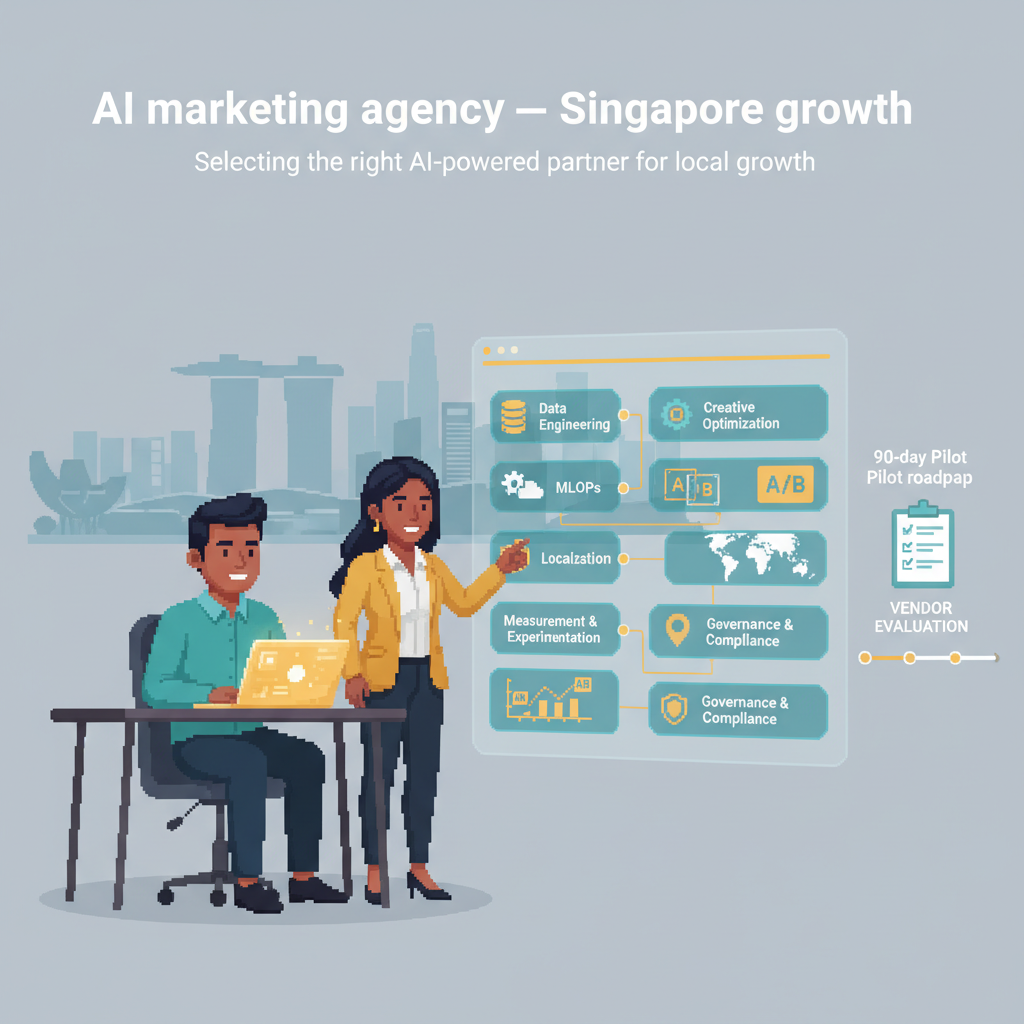
AI marketing agency Singapore: selecting the right AI-powered partner for local growth
Introduction: Why Singapore marketers are turning to AI-powered partnerships for growth
Singapore marketing leaders are moving from curiosity to partnership when it comes to AI. The shift is practical: brands need faster insight loops, more efficient media spend, and personalization that scales across diverse customer segments. For many organisations, the decision is not between AI and no AI — it is between building a large, bespoke capability in-house and engaging an experienced partner who can deliver measurable improvements quickly.
Agencies that combine marketing craft with data engineering, model operations and governed deployment reduce risk and speed time to value. In Singapore and Southeast Asia, where markets vary in language, media habits and digital maturity, a partner with regional experience helps brands avoid common pitfalls and preserve local relevance while unlocking automation and predictive power.
This article is a practical guide for marketing leaders: what to expect from an AI marketing agency, how AI changes strategy and activation, the core capabilities you should demand, measurement approaches that prove impact, localization and governance considerations, realistic outcomes, and a clear vendor evaluation checklist to help you choose the right partner. Explore our latest AI marketing insights to go deeper.
What an AI marketing agency does for Singapore brands
An AI marketing agency wraps data, models and creative into operational programs that continuously improve customer outcomes. For Singapore brands, the agency role typically covers strategy, data engineering, model development, creative optimization, programmatic activation, and customer experience automation. The value is operational: turning scattered signals into repeatable campaigns that run with robust controls.
- Strategy and measurement: aligning AI initiatives with business objectives, defining KPIs, and creating a measurement plan.
- Data and engineering: consolidating event data, building feature stores, and operationalising identity and segmentation.
- Model development and MLOps: training, validating and deploying propensity, recommendation and uplift models with monitoring.
- Creative and personalization: AI-assisted generation and testing of copy/visuals, DCO templates and real-time personalization.
- Activation and media: connecting model outputs to DSPs, search and social channels with automated bidding and budget pacing.
- CX automation: chatbots, journey orchestration and real-time site or app personalization.
See how we structure marketing services to support these outcomes.
How AI informs strategy, creative, and media planning
Audience segmentation and targeting
- Techniques: clustering, embeddings, predictive scoring for purchase propensity or churn risk.
- Workflow: unify signals → engineer features → cluster and score → activate segments and lookalikes.
- Outputs: segment briefs, activation lists, lookalike seeds.
Creative testing and optimization
- Techniques: multi-armed bandits, Bayesian tests, generative assistance, DCO.
- Workflow: generate localized variants → dynamic testing → templatize winners.
- Outputs: winning kits, DCO templates, fatigue rules.
Bid optimization and media allocation
- Techniques: predictive conversion scoring, rule-based multipliers, reinforcement-style allocation.
- Workflow: train value models → apply to bidding → validate with controlled tests.
- Outputs: bidding rules, budget pacing plans, optimization playbooks.
Attribution and measurement
- Techniques: hybrid path analysis and aggregate modelling.
- Workflow: clean event signals → online attribution for short-term → aggregate models for cross-channel.
- Outputs: reconciled views, uplift plans, scenario comparisons.
Deliverables you should expect: a clear map from data inputs to model outputs and the decisions they inform; actionable playbooks that link segment → creative → channel; and dashboards translating results into next steps.
Core capabilities to expect from an AI marketing agency
- Data infrastructure and integration: pipelines, identity resolution, feature store; outcome: reliable experimentation.
- MLOps and model governance: reproducible pipelines, drift monitoring, model cards; outcome: stability over time.
- Creative AI and DCO: AI-assisted ideation and localization; outcome: relevant creative at scale.
- Media optimization and activation: AI-informed bidding and cross-channel orchestration; outcome: efficient spend.
- Measurement and experimentation: hybrid frameworks, uplift tests; outcome: defensible investment decisions.
- MarTech integration: CDP/CRM/ESP/CMS and ad platform orchestration; outcome: unified experiences.
- Governance, ethics and risk: bias checks, explainability, access controls; outcome: trust and resilience.
- SEA domain expertise: localized playbooks and channels; outcome: resonance across markets.
Review our case studies for examples of these capabilities in action.
ROI and measurement in AI-powered campaigns
Set KPIs that map to business outcomes
- Top-line: revenue, margin, acquisition efficiency, retention.
- Leading indicators: engagement, lead quality, propensity scores.
Adopt a hybrid attribution approach
- Granular multi-touch views for online journeys.
- Aggregate models to capture offline and cross-channel effects.
- Reconcile periodically with controlled experiments.
Run disciplined experiments
- Randomized trials where possible; holdouts/time splits otherwise.
- Rapid tests for creative; longer tests for budget mix.
- Document hypotheses, sample logic, duration, success criteria.
Translate outcomes into business language
- Use simple ROI calculators and impact briefs.
- Provide clear recommendations and next actions.
Localization and data governance considerations for Singapore (non-PDPA)
Localization: language, culture and timing
- Language variants and tone guidelines for Singapore and neighbouring markets.
- Adapt visuals and symbols; align to local events and calendars.
- Choose formats per local consumption (short video, messaging, search).
Data residency and cross-border flows
- Minimise latency; keep processing locations clear and controlled.
- Document vendor data flows; use regional cloud regions where appropriate.
- Apply data minimization and retention rules.
Consent management (general approaches)
- Granular consent by purpose and clear preference centres.
- Log consent events for operational audit trails.
Segmentation ethics and explainability
- Avoid sensitive attributes by default; prioritize behavioural signals.
- Audit training data for representativeness; monitor cross-language performance.
- Provide model cards and plain-language explanations to stakeholders.
For conceptual context on AI and marketing, see Stanford Encyclopedia of Philosophy on AI and Harvard’s perspective on AI shaping marketing.
Real-world Singapore-focused case studies or hypothetical outcomes
Qualitative case patterns observed in the region
- Personalization-led commerce: recommendations and bundles increase relevance and speed learning cycles.
- Sentiment-driven operations: feedback analysis informs service improvements.
- Predictive prioritization: scoring helps focus effort on higher-potential leads and customers.
How to set expectations
- Conservative: new foundations; modest early uplifts, steady learning.
- Intermediate: clearer gains with faster feedback loops.
- Ambitious: pronounced improvements with cross-market consistency.
What success looks like
- Clear linkage from AI work to business KPIs with documented tests.
- Repeatable playbooks that scale without losing local nuance.
- Transparent governance and routines to reduce friction.
Local e-commerce brand scenario
Scenario: A Singapore fashion e-commerce brand partners with an AI marketing agency to scale relevance, improve media efficiency and prepare for regional expansion.
Goals
- Increase onsite relevance and conversion; improve paid acquisition efficiency; standardize measurement across SEA.
- Establish governance that supports experimentation and local adaptation.
90-day sprint
- Weeks 1–3: discovery and data readiness — inventory data, define KPIs, draft segment taxonomy and consent-aware rules. Deliverables: readiness report, KPI map, segment definitions.
- Weeks 4–8: pilot activations — segmentation-based campaigns, localized creative tests, propensity-guided bidding. Deliverables: test plans, DCO templates, activation wiring.
- Weeks 9–12: learn and scale — refine models, scale winners, implement blended measurement, formalize governance. Deliverables: measurement blueprint, governance playbook, expanded kits.
6-month roadmap
- Expand personalization across email, app, and site modules.
- Increase programmatic sophistication and cross-market coordination.
- Institutionalize uplift testing and quarterly reviews.
Governance checkpoints
- Weekly operational reviews during pilot; end-of-sprint executive review; quarterly strategy reviews.
Expected qualitative outcomes
- Faster creative learning cycles and more relevant journeys.
- More efficient media spend via better targeting and bidding.
- Documented, repeatable approach for SEA expansion.
Browse our case studies for inspiration.
How to evaluate and choose the right AI marketing agency
Procurement and evaluation criteria
- Strategic/regional fit: Singapore/SEA experience and localization strength.
- Data/tech readiness: pipelines, CDP integrations, MLOps maturity.
- Creative/activation: DCO, testing frameworks, programmatic experience.
- Governance/risk: bias monitoring, explainability, incident response.
- Team/delivery model: senior practitioners, embedded options, clear SLAs.
- Commercials: pricing clarity, IP ownership, transition terms.
Technical and commercial checks
- Request architecture diagrams for data flow and deployment.
- Ask for model cards, monitoring examples, experiment plans.
- Evaluate commercial models and confirm IP/data transition on exit.
Pilot projects to shortlist vendors
- Keep pilots narrow, measurable, time-boxed.
- Define success criteria and data access needs upfront.
- Use pilots to assess both delivery and working relationship.
Red flags
- Vague deliverables, over-reliance on proprietary “magic.”
- No SEA samples or weak localization.
- Opaque governance; refusal to show process artifacts.
- Rigid contracts; unclear IP ownership.
Practical vendor evaluation checklist for Singapore
- Regional experience and localized creative examples.
- Clear data integration plan for required sources.
- MLOps evidence: model cards, monitoring, explainability.
- Hybrid measurement approach and experiment templates.
- Creative capability: DCO templates and localized test results.
- Activation readiness: DSP/ad platform integrations and bidding approach.
- Team composition, seniority, and availability.
- Transparent pricing, IP and exit terms.
- Comparable references and pilot outcomes.
- Flag missing documentation, unclear governance, unrealistic promises.
Conclusion: Next steps for Singapore marketers seeking AI-powered growth
- Quick diagnostic: run a short audit of data readiness, KPIs and a one-page 90-day sprint.
- Pilot design: test segmentation, creative testing and a small programmatic activation with clear success criteria.
- Governance plan: create a lightweight charter covering consent, model monitoring, bias checks and release controls.
A pragmatic partnership blends technical rigour with marketing craft. Use pilots to validate execution and cultural fit before scaling.
Contact Hamilton & Sherwind for an AI-driven marketing consultation tailored to Singapore and SEA.
Further reading
- Artificial Intelligence (Stanford Encyclopedia of Philosophy)
- AI will shape the future of marketing (Harvard Professional Development)
- AI in marketing (Deloitte Digital)
Also explore our marketing insights for more regional perspectives.