

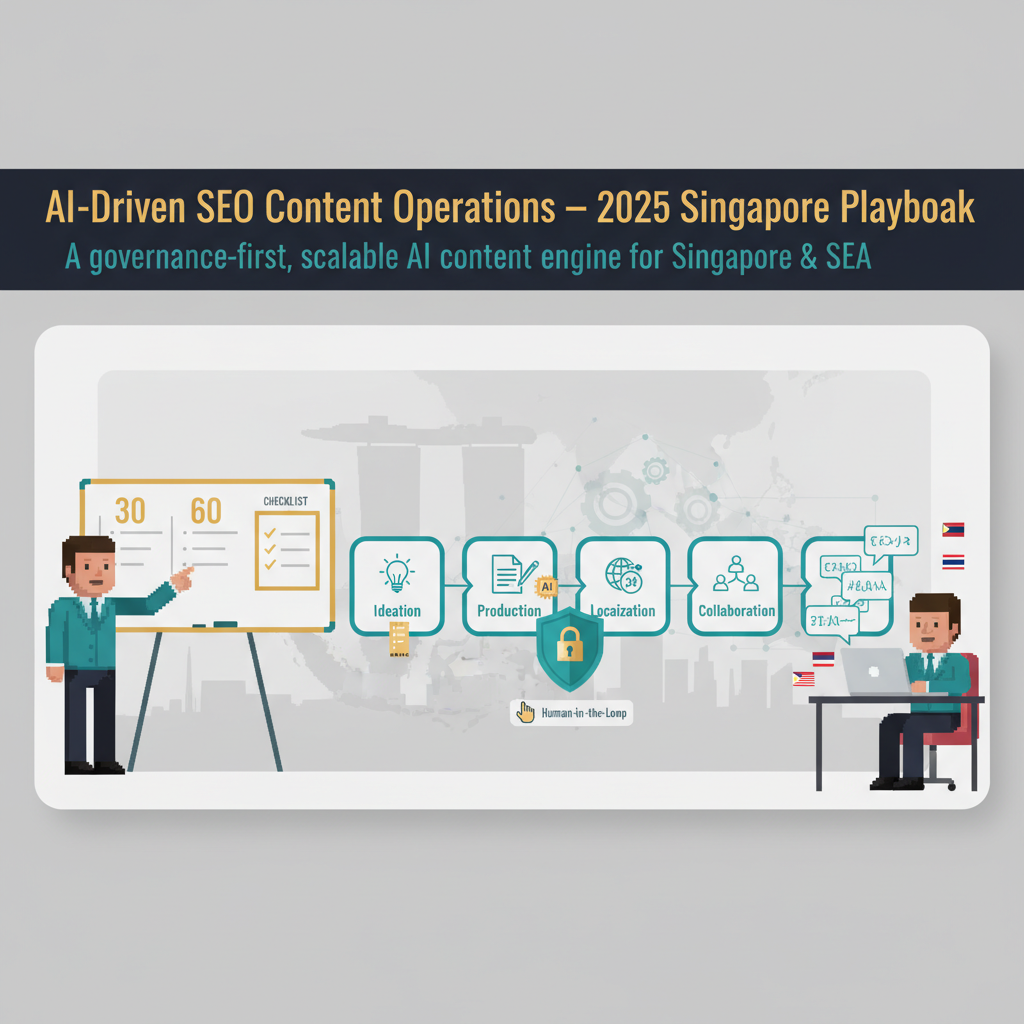
AI-Driven SEO Content Operations: The 2025 Singapore Playbook for a Scalable Content Engine
Mastering AI Content Operations for Modern Content Teams
In today’s fast-evolving marketing landscape, AI content operations stands as the backbone for scalable, high-quality content that speaks to diverse audiences across Singapore and the broader SEA region. When thoughtfully designed, AI content operations weave together ideation, production pipelines, governance, and measurement into a single, repeatable engine. This playbook translates AI capabilities into tangible business outcomes: faster ideation cycles, multilingual localization at scale, consistent brand governance, and continuous improvement driven by data.
For marketing leaders, the promise is simple: a content factory that expands capacity without compromising quality or brand integrity. The reality, however, requires disciplined frameworks, clear roles, and governance rituals that prevent AI from becoming a chaos generator. This article maps out a practical, regionally aware playbook—grounded in real-world Singapore/SEA considerations—so CMOs, Heads of Marketing, Content Ops leads, and SEO managers can design, operate, and optimize an AI-powered content engine that supports modern content teams.
Note: Throughout this article, primary keyword usage centers on AI content operations, with secondary terms woven naturally to reflect AI content strategy, AI-assisted content production, AI-powered content automation, content operations optimization, and scalable content operations.
The Foundation: What AI Content Operations Really Means for Your Team
End-to-end lifecycle concepts and core components
- Ideation: The intentional use of AI to surface themes, formats, and channels aligned to brand strategy and regional audience signals. In SEA, ideation must account for multilingual needs, local holidays, cultural nuance, and platform preferences (e.g., TikTok and regional portals alongside LinkedIn and Facebook in Singapore; YouTube and regional social apps across SEA).
- Production pipelines: A modular end-to-end flow from brief to publish-ready assets, combining AI drafting and design with human review, translation/localization, SEO optimization, accessibility checks, and channel-ready formatting.
- Governance: Editorial standards, brand voice guardrails, compliance checks, and audit trails that ensure quality, accountability, and repeatable outcomes at scale.
- Measurement and learning: Feedback loops that translate performance data into improved prompts, better localization decisions, and smarter workflows.
A simple IPOF framework you can adopt today
- Inputs: Brand strategy, audience insights, regional calendars, content briefs, localization rules, asset libraries, and channel requirements.
- Processes: AI-assisted ideation, drafting, localization, QA, approvals, and publishing, all with auditable logs.
- Outputs: Publish-ready content variants, multilingual assets, metadata, and governance records.
- Feedback: Performance data by market/language, QA results, and post-mortems that feed back into future ideation.
SEA-focused lens and practical notes
- Multilingual considerations: Singapore’s bilingual environment and multilingual consumer bases mean ideation must surface language-aware themes from the start. This requires glossary management and localization planning embedded in ideation briefs.
- Platform and tooling alignment: Use a CMS and DAM that support multilingual content and regional channel publishing. Translation management systems (TMS) should integrate with the chosen CMS to flatten handoffs between AI outputs and human editors.
- Governance as a speed enabler: A robust governance framework accelerates scale by reducing rework, ensuring brand consistency, and enabling rapid regional rollouts without sacrificing quality.
- Practical outcomes: In SEA contexts, you’ll typically look for improved time-to-publish, more localized content variants, and stronger alignment between product messaging and regional campaigns.
Defining a practical SEA-ready playbook
- Ideation templates informed by regional signals (languages, formats, channels, and holidays).
- Production blueprints that define when AI drafts require human review, and what checks must occur before publishing.
- Localization workflows with TMS-integrations, glossary governance, and native-language QA.
- Editorial gate management to maintain brand voice and compliance.
- Audit trails that capture prompts, outputs, approvals, and publish history for every asset.
Concrete SEA examples
- Singapore bilingual content: Ideation surfaces topics with English base copy, then localizes into Mandarin and Malay, with a separate path for Tamil where needed. The production pipeline ensures brand voice remains consistent while language variants reflect local nuance.
- Regional product launch: An SEA-wide launch uses AI to draft explainer content, social posts, and blog assets; translations roll through a TMS with glossaries; QA checks confirm accessibility across languages.
Strategy: Building an AI Content Operations-Driven Content Strategy
An AI content operations-driven content strategy translates business goals into a scalable, multilingual content engine. It aligns with SEA market realities, including Singapore’s bilingual landscape, varied SEA languages, and the region’s diverse digital platforms. The strategy centers on a disciplined blend of AI-powered ideation, human-led governance, and performance-driven iteration.
Key strategic objectives for SEA and Singapore
- Align content with business outcomes: Every content initiative should map to demand generation, product launches, or awareness goals and tie to measurable outcomes in the SEA market context.
- Scale localization with quality: Build a localization-first mindset, ensuring that multilingual content is accurate, culturally relevant, and on-brand across languages and markets.
- Preserve brand integrity at speed: Use a centralized governance framework to maintain consistent brand voice while enabling regional adaptations.
- Drive pipeline impact: Use data-driven content that supports marketing-qualified leads (MQLs), sales-ready opportunities, and overall revenue in SEA markets.
- Foster cross-functional alignment: Integrate marketing with product and sales to ensure consistent messaging and timely enablement assets across channels.
Guiding principles for SEA AI content strategy
- Human + AI synergy: AI accelerates ideation, planning, and templated production, but humans decide on claims, translations, and culturally sensitive considerations.
- Governance as a value driver: A robust governance ecosystem reduces risk, improves quality, and speeds up iteration cycles—crucial for multi-market SEA campaigns.
- Regional capability-building: Invest in AI literacy and localization competence to scale across languages and markets in SEA.
- Pilot-to-scale approach: Start with a two-market pilot (e.g., Singapore and Malaysia/Indonesia), then scale to additional SEA markets with standardized templates and guardrails.
OKRs and success metrics (SEA-ready)
- Objective: Improve content velocity and regional relevance
- Reduce ideation-to-brief cycle time by 25–40% within 3–6 months.
- Increase publish-ready multilingual variants by 30–50% Q/Q.
- Achieve on-time publishing for 90%+ of planned calendars across SEA in the first wave.
- Objective: Localization quality and speed
- Localization QA pass rate ≥ 95%.
- Time from final brief to localized-ready asset reduced by 20–30%.
- Glossary adherence rate ≥ 90% across languages.
- Objective: Campaign impact
- Content-driven MQLs/SQLs uplift; regional pipeline attributable to content campaigns.
- Engagement improvements (CTR, video watch-time) by a measurable SEA-specific margin.
- Objective: Governance and risk management
- Zero material regulatory or brand safety violations; audits pass with minimal remediation.
- AI disclosure adherence in content where appropriate.
- Objective: Localization economics
- Demonstrated savings from translation memories and reuse; cost per publish asset decreases over time.
Playbook for AI-assisted ideation and planning (practical)
- Ideation sprint: AI prompts surface themes and formats tuned for SEA audiences; human checks ensure cultural sensitivity and feasibility. Output: prioritized ideas backlog with localization notes.
- Validation and prioritization: AI surfaces signals from past campaigns; humans rank based on goals and calendar fit. Output: rank-ordered briefs with localization context.
- Briefing and localization planning: AI drafts multilingual briefs; humans validate tone, accuracy, and alignment. Output: ready-to-action briefs.
- Resource planning and risk assessment: AI forecasts resource needs and flags risks; produce mitigations and escalation paths.
Roadmap for adoption (SEA-focused, 12–18 months)
- Foundation and pilots (0–6 months): Establish governance charter; map tooling and data flows; run a 2-market pilot (Singapore + one other SEA market).
- Scale and refine (6–12 months): Expand to additional SEA markets; standardize AI prompts, QA checklists, and localization loops.
- Optimize and sustain (12–18 months): Institutionalize data-driven optimization; perform ethics audits; establish a Center of Excellence for AI-enabled marketing in SEA.
Sample RACI for AI content operations (SEA-ready)
- Ideation & Briefing — A: SEA Marketing Lead; R: Content Ops Lead; C: Product Manager SEA, Sales Enablement, Localization Lead, Legal; I: Regional Marketing
- Drafting & Design — A: Content Ops Lead; R: Copywriters, Designers; C: Brand Manager SEA, Localization Lead, Product Manager SEA, Legal; I: Sales Enablement, Regional Marketing
- Localization & Translation — A: Localization Lead; R: Translators/Editors; C: Content Ops, Brand Manager SEA, Product Manager SEA; I: Regional Marketing
- Legal/Compliance Review — A: Legal/Compliance Counsel; R: Content Ops Lead; C: Brand Manager SEA, Product Manager SEA; I: CMO, Regional Marketing
- Brand, Accessibility & SEO QA — A: Brand Manager SEA; R: QA Team; C: Localization Lead, Product Manager SEA; I: Marketing Leadership
- Final Approval & Publishing — A: Regional Editor-in-Chief; R: Content Ops Lead, Publishing Manager; C: Legal, Product Manager SEA; I: Regional Sales, Agencies
7-step quick-start checklist
- Define governance and roles across SEA markets; appoint key leads.
- Map tooling and integrations (CMS, TMS, DAM, SEO, AI connectors).
- Build repeatable playbooks (ideation briefs, production templates, localization checklists).
- Pilot with a two-market test; measure cycle times and QA quality.
- Establish rituals and cadences (stand-ups, planning, governance reviews).
- Create an auditable governance log (prompts, outputs, approvals, versioning).
- Measure, learn, and iterate with dashboards and closed feedback loops.
Case-style vignettes (SEA)
SME in Singapore: A 25-person team operating in English, Mandarin, and Malay implements AI-assisted drafting and TMS-driven localization. Within 6–9 months, output increases ~40–55%, time-to-publish drops from ~14 days to 5–7 days, and localization cost per asset decreases ~25% due to translation memory reuse.
Enterprise across six SEA markets: A mature, governance-forward AI content operations approach reduces time-to-publish per language by ~30–40%, improves localization throughput by 35–50%, and strengthens auditability and cross-functional alignment for multi-market launches.
Production: Designing an AI-Driven Production Pipeline
Target-state architecture (SEA-focused)
- Multilingual, headless CMS with language variants and regional channel publishing.
- AI creator layer connected via APIs to CMS/DAM; centralized TMS with glossaries and translation memories.
- SEO and accessibility automation embedded in QA; human QA for high-stakes content.
- Governance logs capturing prompts, outputs, approvals, and publish history.
End-to-end workflow map
- Brief & ideation
- Drafting & design
- Localization & translation
- Review gates (linguistic/cultural, brand/style, legal, accessibility/SEO)
- Publishing & distribution
- Performance tracking with feedback into ideation
Tooling patterns
- CMS: Contentful, Sanity, or Strapi
- TMS: Lokalise, Memsource, or Phrase
- Design/DAM: Figma, Bynder/Cloudinary; Canva for quick assets
- AI & automation: model APIs; workflow automation (Make/Zapier)
- SEO/QA: Semrush/Ahrefs; accessibility checks (axe-core)
Regional examples
- Singapore bilingual blog and product explainers with English base localized to Mandarin and Malay.
- Indonesia/Malay campaigns leveraging translation memory reuse for recurring campaigns.
- Vietnam/Thai social content with rapid localization and local editor validation.
Operational guardrails & quick wins
- Gate-based approvals; transparent AI usage logs; glossary-driven localization.
- Reduce time-to-publish for multilingual campaigns; increase throughput while maintaining quality.
Governance: AI Governance for Content
Core governance approach
- Brand safety & tone: Centralized brand voice with language-specific adaptations; cultural sensitivity monitoring.
- Compliance & approvals: Documented review chain from ideation to final approval; claims substantiation processes.
- Audit trails: Log prompts, model versions, inputs/outputs; maintain versioned content history and approvals.
Roles, rituals, and risk management
- Daily AI safety checks; weekly gate reviews; monthly governance briefings; quarterly audit-readiness exercises.
- Risk flags with escalation paths (high, moderate, low).
- Audit artifacts: AI usage logs, content audit trails, localization QA records, risk logs.
SEA-specific considerations
- Language-specific guardrails for English, Mandarin, Malay, Tamil, and other SEA languages.
- Regionally aware content labeling and disclosures where appropriate.
- Bias checks and transparency practices to preserve trust.
Collaboration: Orchestrating Cross-Functional Content with AI
Drive clear ownership, quality handoffs, and transparent workflows across SEA markets.
RACI model (SEA-ready template)
- Ideation & Briefing — R: Content Ops Lead; A: SEA Marketing Lead; C: Localization Lead, Product Manager SEA, Sales Enablement; I: Regional Marketing
- Drafting & Design — R: Copywriters/Designers; A: Content Ops Lead; C: Brand Manager SEA, Localization Lead, Legal; I: Sales Enablement, Regional Marketing
- Localization & Translation — R: Translators/Editors; A: Localization Lead; C: Content Ops, Brand Manager SEA; I: Regional Marketing
- Legal/Compliance Review — R: Legal/Compliance Counsel; A: Legal; C: Brand Manager SEA, Product Manager SEA; I: CMO, Regional Marketing
- Brand, Accessibility & SEO QA — R: QA Team; A: Brand Manager SEA; C: Localization Lead, Product Manager SEA; I: Marketing Leadership
- Final Approval & Publishing — R: Publishing Manager; A: Regional Editor-in-Chief; C: Legal, Product Manager SEA; I: Regional Sales, Agencies
Operating rhythms & rituals
- Daily micro-sync; weekly cross-functional planning; biweekly product–sales alignment.
- Monthly governance check-ins; quarterly knowledge-sharing; formal feedback loops from sales and product.
Measurement: Measuring Impact and Continuous Improvement
Tie content performance to business outcomes and build closed loops to improve prompts, templates, and governance.
KPI categories (SEA/Singapore focus)
- Ideation & briefing: idea throughput, speed to brief, alignment quality.
- Drafting & design: draft-to-publish cycle time, AI contribution rate, rework rate.
- Localization: throughput by language, QA pass rate, glossary adherence.
- Governance: compliance defect rate, AI disclosure adherence, accessibility compliance.
- Publishing & channels: on-time publish rate, engagement by language/market, ROI attribution.
- Costs & efficiency: translation memory savings, cost per publish asset.
- Auditability: audit trail completeness, incident response time.
Dashboards & data sources
- Workflow logs in CMS/DAM/TMS; AI usage logs; QA data; GA4/CRM for attribution; governance risk registers.
7-step immediate checklist (condensed)
- Align governance and roles; confirm a SEA-wide Content Ops charter.
- Map tools and integration points; ensure multilingual CMS + TMS pairings.
- Build templates: ideation briefs, production templates, localization checklists.
- Start a two-market pilot; define success metrics and SLAs.
- Establish daily/weekly/monthly rhythms.
- Create auditable governance logs for AI prompts, approvals, and publish history.
- Launch a measurement dashboard; refine prompts and templates continuously.
Conclusion: Next Steps for Adopting AI Content Operations
Recap: AI content operations unites ideation, production, governance, collaboration, and measurement into a scalable content engine designed for SEA markets. The SEA playbook emphasizes multilingual readiness, cross-functional alignment with product and sales, and governance rituals that keep quality high while enabling speed and scale.
Starter 30/60/90-day adoption roadmap
30 days
- Finalize governance charter and RACI for core teams.
- Map core tooling (CMS, TMS, DAM, SEO/Analytics) and data flows.
- Launch a two-market pilot (Singapore + one SEA market) with a focused product launch or campaign.
- Create initial ideation briefs and a basic production template.
- Establish daily stand-up and weekly planning cadences.
60 days
- Expand to one or two additional SEA markets; refine prompts, glossaries, and templates.
- Implement localization workflows with translation memory and glossaries; add QA gates for localization and accessibility.
- Introduce a measurement dashboard capturing cycle times, QA results, and channel metrics.
- Formalize the RACI for end-to-end content flows and implement gate-review rituals.
90 days
- Scale to all key SEA markets; standardize prompts, templates, and governance rituals.
- Roll out the full production blueprint and a centralized audit trail regime.
- Introduce a regional content calendar aligned to product launches and holidays across SEA.
- Establish a SEA Center of Excellence for AI-enabled marketing to share learnings and scale best practices.
On-site resources to explore next
- Digital Marketing Services
- Social Media Marketing Agency Singapore
- TikTok Marketing Agency Singapore
- Content Marketing Agency Singapore
- Paid Advertising Agency Singapore
- Conversion Optimization
- Branding
- Branding Portfolio
- Social Media Portfolio
- Advertising Portfolio
- Short-Form Video Production for Social Media in Singapore
- Blog
Sources referenced
- Using Generative AI to Scale Your Content Operations (HubSpot)
- 5 Key Considerations for Leveraging AI In Content Operations (Aprimo)
- How AI is reshaping content operations (Bynder)
- AI marketing operations (Content Marketing Institute)
- Content operations solution (Kontent.ai)
- A practical framework for content operations (Wizeline)
Ready to build your AI-driven content engine?
Speak with Hamilton & Sherwind to tailor this playbook to your Singapore/SEA context. We’ll help you design a governed, scalable content engine that accelerates velocity, localization quality, and measurable impact.