

Understanding Brand Storytelling: A Practical Guide for Modern Brands
What brand storytelling is
Core definition and purpose
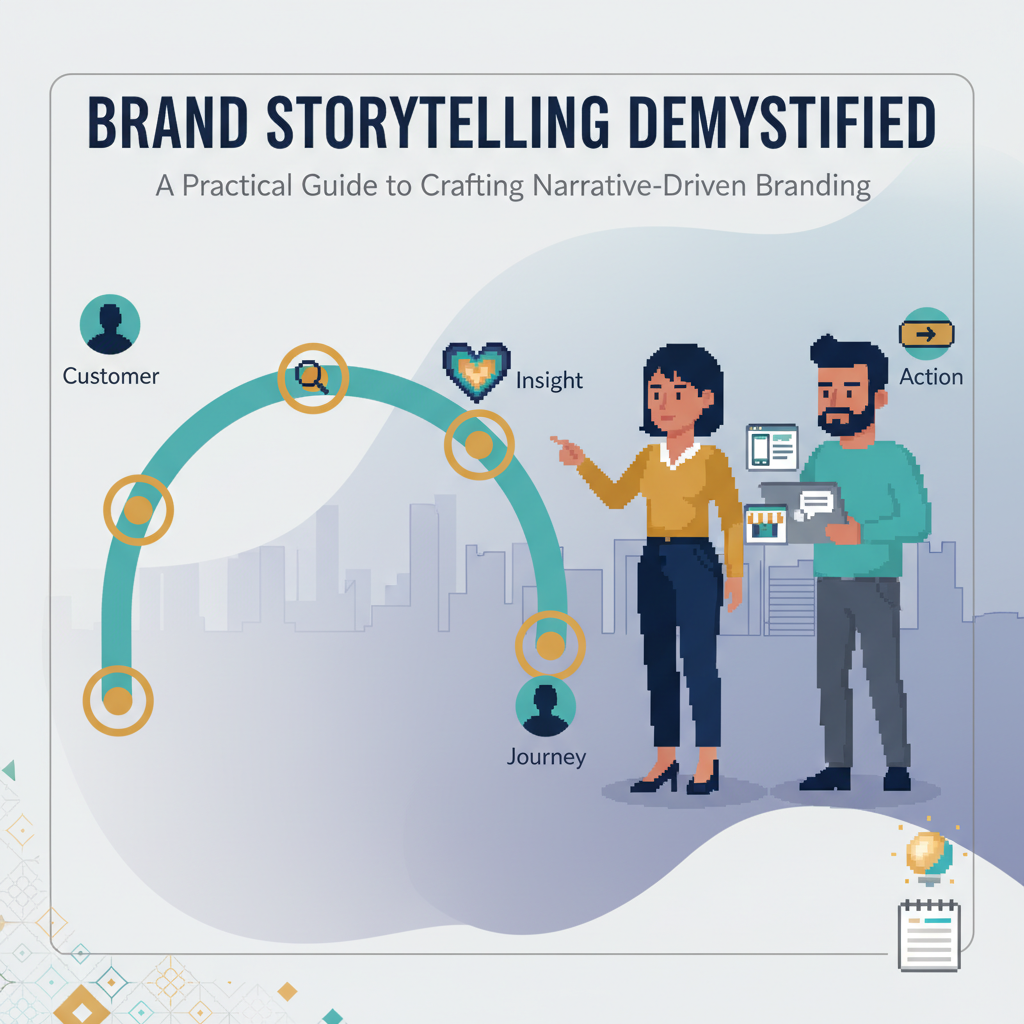
Brand storytelling is a customer-centered narrative used to clarify and convey a brand’s identity, values, and value proposition in a way that maps directly to the customer’s needs and journey. The StoryBrand framework formalizes this approach: the brand serves as guide, the customer is the hero who faces a problem, follows a simple plan, and takes action to achieve a desired outcome (StoryBrand official site).
Brand identity and emotional connection
Brand identity (values, mission, personality, positioning) is translated into an engaging narrative customers can feel and remember. Storytelling’s effectiveness as a structured form of communication that conveys experience and meaning has deep scholarly roots (Britannica: Storytelling).
Building a brand storytelling strategy
Goals, audience, and messaging
Link narrative work to business outcomes: awareness, consideration, conversion, and loyalty. Translate these into measurable milestones (engagement, landing-page conversion, lead quality, LTV). Ground your messaging with a clear customer-centered arc (problem, guide, plan, CTA) per StoryBrand and the broader narrative tradition highlighted by Britannica.
Singapore/SEA context
In Singapore and SEA, audiences are highly digital and mobile-first, often multilingual, and engaged with short-form video and social content. Build personas that reflect local languages and channel preferences (WhatsApp, TikTok, Instagram, Facebook). For regional growth trends and adoption data, consult the Google/Temasek e‑Conomy SEA report and Singapore digital profiles via DataReportal and We Are Social Singapore.
Practical steps
- Define 2–3 business outcomes storytelling should influence.
- Create SEA/Singapore personas with channel and format preferences.
- Build a messaging architecture anchored in customer needs (hero/problem/guide/plan/CTA).
- Set governance: brand guidelines, tone, and a storytelling playbook.
- Map story-to-channel with a publishing calendar across web, social, video, email, PR.
Additional reading: Harvard Business School Online: What Is a Brand Story? and Digital Marketing Institute: Brand storytelling in the digital age.
Narrative marketing and frameworks
Selecting and applying a storytelling framework
Two proven frameworks underpin modern narrative marketing:
- StoryBrand frames the brand as guide helping customers solve a problem through a simple plan and a clear call to action.
- The archetypal Hero’s Journey (Monomyth) maps transformation across stages; in marketing, the customer is the hero and the brand serves as mentor.
Blend both: use StoryBrand for clarity and cross-channel consistency; layer a Hero’s Journey into long-form video or editorial to deepen emotional resonance.
Omnichannel and visual storytelling
Channel alignment and consistency
Deliver a coherent brand experience across social, video, web, and offline touchpoints. Align messaging and a unified visual system (color, type, imagery, motion) across formats. For SEA, prioritize mobile-first, video-first content and social commerce informed by e‑Conomy SEA and DataReportal Singapore.
Explore approaches to visual storytelling across social channels that preserve your narrative arc.
- Short-form video: clear hook, conflict, resolution, and CTA.
- Web/landing: strong hero message; scannable problem/solution narrative.
- Social/ads: modular creative blocks that adapt per platform without losing the core story.
Further reading: Harvard Business Review on omnichannel, Salesforce: State of the Connected Customer.
AI-Powered storytelling
Prompts and templates; governance for voice and ethics
- Ideation: “Act as a senior content strategist… generate 12 topic ideas for [niche]…”
- Outlining: “Draft a detailed outline for [format] aimed at [persona]…”
- Drafting: “Write a 1,200–1,500 word post in [brand voice] optimized for [KW]…”
- Repurposing: “Summarize this piece into a 90-second script, a carousel, and a LinkedIn post…”
- Localization: “Adapt this core story for Singapore/SEA markets…”
Use guardrails: briefs, brand-voice rules, compliance checklists, and disclosures. Verify data and cite original sources. See McKinsey on AI in marketing, HubSpot on AI in content marketing, and Google AI Principles.
Case studies and examples
IKEA Singapore — “Shelf Help Guru”
Localized, humor-driven storytelling centered on customer needs extended across channels, boosting engagement in the SEA context. Sources: UNLV Oasis case discussion, Jessica Gioglio: Brand storytelling examples.
Singapore nation-brand narratives
Long-term, coherent narrative work illustrates how consistency compounds impact over time. Source: Precious Communications: Singapore nation branding case study.
Land Rover — customer-led storytelling
Authentic stories from real users reinforce emotional resonance; lessons transfer to SEA brands. Source: UNLV Oasis: The Land of Land Rovers case.
For more regional work, see our Singapore case studies in the Hamilton & Sherwind portfolio.
Conclusion: Key Takeaways
- Make the customer the hero. Use StoryBrand for clarity; layer the Hero’s Journey for emotional depth.
- Operationalize omnichannel consistency with a unified visual system and channel-aligned content calendar (see HBR, Salesforce).
- Use AI to accelerate ideation, drafting, and localization with brand-voice and ethics guardrails (McKinsey, HubSpot, Google AI Principles).
- Localize for Singapore/SEA: mobile-first, social-driven behaviors; validate plans using e‑Conomy SEA and DataReportal Singapore.
Ready to put this into practice? Hamilton & Sherwind can design a practical brand storytelling strategy tailored to Singapore and the broader SEA region.
Contact us to start the conversation.