

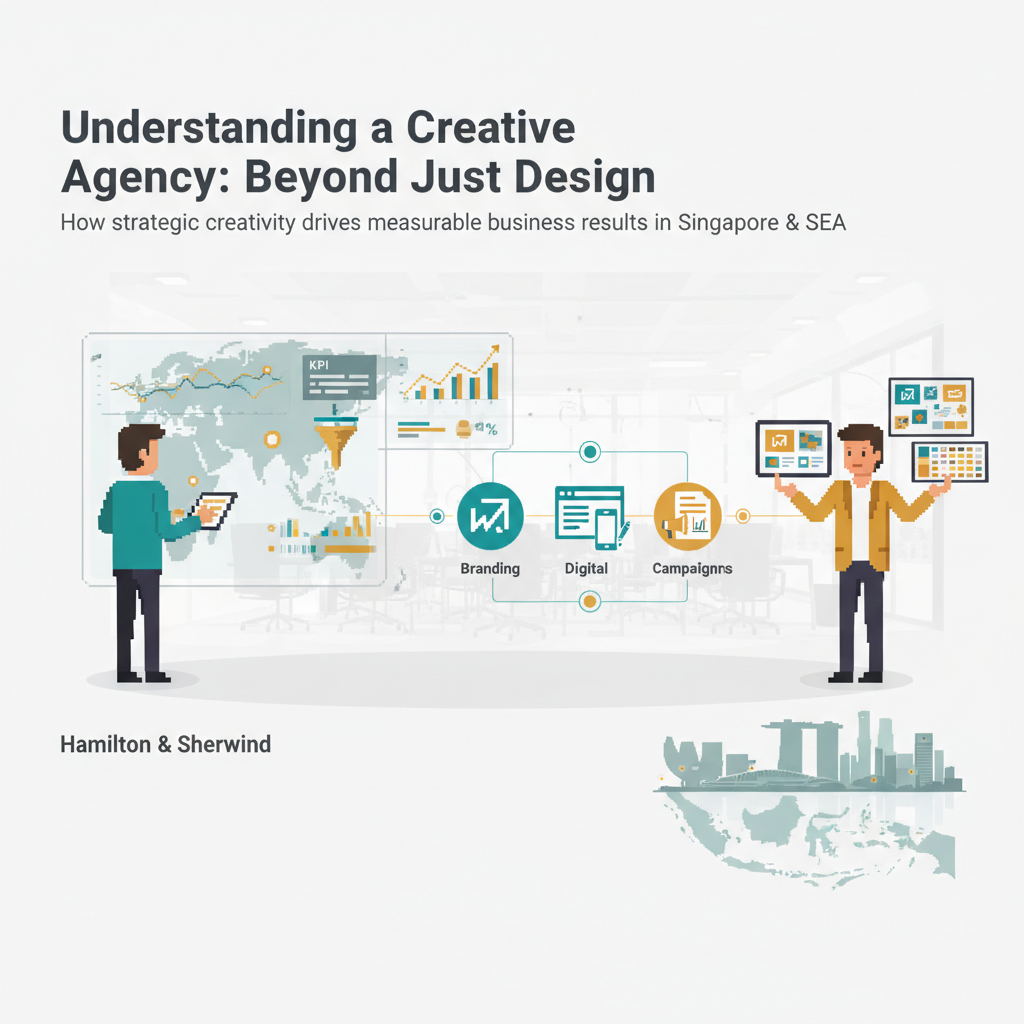
Understanding a creative agency: Beyond just design
In today’s fast-moving Southeast Asian market, the term “creative agency” often conjures images of designers sketching logos or copywriters brainstorming taglines. But the reality is far more sophisticated. A modern creative agency—particularly in Singapore and across ASEAN—is a strategic business partner that orchestrates everything from brand positioning and digital product design to multichannel campaigns and content production at scale. It’s the difference between having a design vendor and having a growth engine.
The shift is profound. Companies are no longer hiring creative agencies simply to make things look good. They’re hiring them to solve operational challenges: how to produce dozens of TikTok or Reels variants in a week, how to navigate cultural nuances across multiple markets, how to prove that creative work drives revenue, and how to compete in markets where content volume has exploded.
This guide walks you through what a creative agency actually does, how to choose the right partner for your goals, and how to measure success in an era where creative excellence and business impact are inseparable.
Why businesses turn to modern creative partners
The decision to hire a creative agency rarely happens in isolation. It’s typically triggered by several converging pressures that in-house teams alone cannot solve.
1. Efficient growth at scale
Marketing teams across Singapore and Southeast Asia are under pressure to deliver “efficient growth” rather than growth at all costs. Hiring an entire in-house creative department—designers, writers, producers, strategists—can be costly and difficult in a tight talent market.
A creative agency lets you tap into a complete team without the fixed overheads. Instead of adding five full-time staff, a company can partner with an agency that flexes capacity up or down based on campaign needs, product launches, or seasonal peaks.
2. Content velocity and volume
The sheer volume of content required to stay visible has become a production challenge, not a creative one. A D2C brand launching on Shopee, Lazada and TikTok Shop may need product photos, videos, social ads, email templates, influencer integrations and more—in multiple formats and aspect ratios.
Creative agencies build processes, templates and production pipelines (increasingly supported by AI tools) to turn around platform-ready variants quickly, without sacrificing quality or brand consistency.
3. Technology complexity and platform relationships
From shoppable live streams to AI-powered personalization, the marketing tech stack is increasingly complex. Many in-house teams don’t have the time or experience to stay current with every platform or emerging tool.
A modern creative agency often acts as a bridge between brand and technology by:
- Working closely with platform partners (Meta, Google, TikTok, Grab, etc.)
- Testing new formats and betas
- Integrating analytics and tracking into creative from day one
This combination of creative thinking plus technical know-how is hard to replicate internally at the same speed.
4. Multilingual and multicultural execution
A regional campaign for a Singapore HQ might need variants in English, Simplified Chinese, Bahasa Indonesia, Thai and Taglish—each with culturally appropriate imagery, humour and messaging. This isn’t just translation; it’s transcreation.
Creative agencies with teams or partners across ASEAN can handle:
- Local market insights and cultural checks
- Adapted scripts, visuals and offers for each country
- Local media, KOL and partner coordination
For brands expanding across Southeast Asia, this local nuance is critical to performance.
5. Talent arbitrage and de-risking
Senior creative and strategic talent in Singapore is scarce and expensive. Partnering with an agency gives you access to that calibre of thinking without the long-term commitment of full-time hires.
If the partnership isn’t working, you can change agencies more easily than restructuring an in-house team. In that sense, agencies de-risk your creative and marketing investment.
Core service pillars: Brand, Digital, Content, Campaigns
A full-service creative agency typically operates across four integrated pillars. Understanding how they connect—and how they feed data and assets into one another—is key to unlocking their value.
Branding & identity essentials
Branding is the strategic bedrock. It’s not just a logo; it’s the research-driven positioning, messaging and visual language that guides every downstream touchpoint.
A typical branding or branding agency engagement includes:
- Market and competitor analysis
- Customer and stakeholder interviews
- Brand positioning, mission, vision and values
- Messaging frameworks and tone of voice
- Visual identity (logo, colour, typography, image style, iconography)
- Brand guidelines and templates
The outcome is a clear, documented foundation that can be used consistently across campaigns, social media, websites, sales decks, events and more.
For a Singapore or regional brand, this consistency is especially important when different teams, countries or partners are executing your marketing.
Digital product & website design
Digital product and website design is where brand strategy meets user experience.
Here, a digital agency or creative agency will typically cover:
- UX research and user journeys
- Information architecture and wireframes
- UI design, component libraries and design systems
- Website or app development
- Conversion rate optimisation (CRO)
- Analytics set-up and tracking
The design system created for your website or app should pull directly from your brand identity so that users experience a seamless, recognisable interface whether they see you on social media, on your site or in an app.
Data from your digital properties—conversion paths, drop-off points, search queries—then feeds back into campaign creative, media targeting and content topics.
For Hamilton & Sherwind, this is tightly linked to our own digital marketing services and site experience.
Multichannel advertising & social campaigns
This is the most visible part of what many people associate with an advertising agency or social media marketing agency: the campaigns.
A campaign typically includes:
- Insight and strategy development
- Core creative idea and key visuals
- Channel strategy and media plan (search, social, display, OOH, video, etc.)
- Asset production across formats and languages
- Launch, optimisation and reporting
A strong creative agency will design campaigns that:
- Stay true to your brand positioning
- Adapt intelligently to each platform (TikTok vs LinkedIn vs OOH)
- Use testing to improve over time
- Connect upper-funnel storytelling with lower-funnel conversion tactics
This is also where creative agencies lean heavily on data—using audience insights, performance trends and testing frameworks to evolve the work, not just launch and leave.
You’ll often see this integrated into a broader offering, like Hamilton & Sherwind’s advertising campaigns and creative.
Content strategy & production
Content is the always-on fuel that keeps audiences engaged between major campaigns.
A content marketing agency or full-service creative agency will often provide:
- Content audits and strategy
- Editorial calendars mapped to the funnel and local events
- Social content (posts, carousels, Stories, Reels, TikToks)
- Articles, guides and landing pages
- Email and CRM content
- Video and animation production
The goal isn’t just to push out more posts, but to:
- Align content with search demand and social trends
- Support both brand-building and performance goals
- Reuse and repurpose cornerstone content into different formats
Hamilton & Sherwind’s own creative portfolio reflects how branding, campaigns and content work together.
Choosing the right agency model for your goals
Not every business needs the same type of creative partner. The right model depends on your maturity, budget, internal capabilities and growth plans.
Specialist vs full-service
A full-service creative agency typically offers:
- Brand strategy and identity
- Digital and UX/UI
- Social media and content
- Advertising and media support
- Production (design, video, events)
Advantages:
- One strategic partner from idea to execution
- Fewer hand-offs and misalignments
- Stronger brand consistency across touchpoints
- Often better suited for regional, multi-channel campaigns
Challenges:
- Larger retainers or project fees
- May be “good” at everything but not world-class in a very narrow niche
- Requires effort upfront to choose the right partner and build trust
Specialist creative agencies or boutiques, on the other hand, often focus on one area—say, branding, social, video, or UX—and go very deep in that niche.
Advantages:
- Expert-level knowledge in a specific discipline
- Often more agile and founder-led
- Good fit for solving a defined problem (e.g., rebranding, TikTok content, UX overhaul)
Challenges:
- More coordination across multiple vendors
- Increased risk of fragmented brand experience
- Measurement and data are harder to unify
How to choose
You’ll likely prefer a full-service creative agency if:
- You’re planning multi-channel, multi-market work
- You have a lean in-house team and need a partner to “own” execution
- You want one strategy and creative direction applied consistently
Specialists are more suitable if:
- You already have a strong marketing or brand team in-house
- You’re testing something specific (e.g., a new social platform or a product vertical)
- Your budget is limited and focused on one area
Hamilton & Sherwind sits in the full-service camp, with dedicated practices for branding, digital, social media and video—ideal when you want a single partner to orchestrate everything:
In-house collaboration processes
Once you select a creative agency, the way you work together is just as important as what you brief.
Common collaboration models include:
Embedded squad
- A cross-functional agency team (strategy, creative, design, content, performance) works closely with your marketing and product team.
- Shared Slack/Teams, project boards (Asana, Monday), and weekly WIP calls.
- Often used for always-on retainers and regional accounts.
Project-based pods
- A specific team is assembled per project (rebrand, website, campaign) and disbanded after.
- Communication is more milestone-based—briefing, concept presentation, production, launch.
- Efficient when projects are well-defined and time-bound.
Lead-agency with specialists
- One full-service creative agency acts as your lead partner.
- You may have separate SEO, media or PR specialists.
- The lead-agency is responsible for integrating work, ensuring brand consistency and reporting back in a unified way.
Regardless of the model, look for:
- Clear roles and responsibilities
- A single day-to-day contact on both sides
- Documented processes for approvals, revisions and handovers
- Transparent reporting and access to performance dashboards
Measuring success: KPIs and common benchmarks
In 2026, creative work must do more than win awards or Likes. It has to show impact.
Most brands and agencies track two sets of metrics:
Brand perception metrics
These focus on how people feel and think about your brand:
- Awareness – Are more of the right people aware you exist?
- Recall – Do they remember your campaign or key message?
- Consideration – Are they more open to buying or trialling after exposure?
- Sentiment – Is conversation becoming more positive?
- Preference – Do they start seeing you as “the” brand for your category?
Measurement methods include:
- Brand lift studies on platforms (Meta, TikTok, YouTube)
- Online panels and surveys in key markets
- Social listening across languages and platforms
For a Singapore-focused brand, a realistic ambition might be:
- +5–10 percentage-point increase in aided awareness for a hero campaign
- Stronger association with 1–2 core brand attributes (e.g., “innovative”, “trusted”)
Performance marketing KPIs
These are the hard numbers that tie directly to growth:
- ROAS (Return on Ad Spend) – Revenue generated per dollar spent
- CAC (Customer Acquisition Cost) – Spend per new customer
- CPA (Cost per Action) – Spend per key event (lead, trial, download, add-to-cart)
- Conversion Rate – Visitors who complete the desired action
- Revenue and LTV (Lifetime Value) – Particularly important for subscription and recurring models
A good creative agency should:
- Agree KPIs with you before work starts
- Set clear baselines and targets
- Build tests into campaigns (creative variants, offers, audiences)
- Optimise assets and budgets weekly or monthly
- Report results transparently, including what didn’t work
Hamilton & Sherwind’s approach to creative is built around this kind of data-driven iteration, not one-off launches.
Pricing structures and engagement options
Creative agency pricing is designed to match different levels of commitment and risk tolerance.
Project-based vs retainer vs hybrid
Project-based
Best for:
- One-off rebrands
- Website (re)designs and builds
- Single campaigns or content series
Pros:
- Defined scope and budget
- Clear timelines and deliverables
Cons:
- Less flexibility once the scope is locked
- Limited ongoing optimisation and learning
Retainers
Best for:
- Always-on content and social media
- Continuous campaign and performance management
- Long-term, multi-market relationships
Pros:
- Stable, predictable support
- Faster turnaround—an embedded team that knows your brand
- Easier to plan and forecast
Cons:
- Requires regular evaluation to ensure value
- Harder to compare on a “per item” basis if expectations are unclear
Hybrid and performance-based
These models combine a base fee with:
- A percentage of media or production budgets, or
- Performance incentives (e.g., bonus if CAC is reduced by X%, or ROAS exceeds Y)
Hybrid models are attractive if you want your agency to share some “skin in the game”, but they also require clear attribution and data access.
The key is to choose a model that:
- Aligns with your internal reporting and finance expectations
- Leaves enough room for test-and-learn experiments
- Encourages a partnership mindset rather than a vendor mentality
Frequently asked questions about working with a branding agency partner
How long does a typical branding or integrated-campaign project take?
For SMEs, a full branding project (strategy, identity, guidelines and key assets) usually takes 10–14 weeks, depending on stakeholder availability and research depth. A digital-first creative campaign can typically move from brief to launch in 4–8 weeks, with timelines stretching if there is live-action video production, multi-market localisation or complex approvals.
What deliverables will we receive from a branding engagement?
You should expect:
- A brand strategy or positioning deck
- Visual identity system and logo files in multiple formats
- Brand guidelines (design and tone of voice)
- Core messaging framework (taglines, value propositions, boilerplates)
- Starter asset pack (e.g., social templates, sales deck cover, stationery)
Good agencies will also run a handover session with your internal team.
Who will actually work on our account?
Ask agencies to show a proposed core team—account lead, strategy, creative, design, content, production—and clarify which people will be day-to-day contacts versus “pitch only”. Include expectations around the level of seniority and availability in your contract.
How many revision rounds are standard?
The norm is 2–3 major revision rounds for core brand or campaign concepts, followed by minor tweaks for adaptations. To avoid “scope creep”, define clearly what counts as a revision (e.g., refining the same direction) versus an entirely new direction.
How do you ensure our brand is consistent across markets and channels?
Consistency comes from:
- Strong guidelines and design systems
- Centralised asset libraries and templates
- Clear approval workflows
- A lead creative agency that acts as brand guardian
If you are working with multiple local partners, agree from the start who has final say on brand decisions.
Can a creative agency work with our existing in-house creatives?
Yes—and many do. The most effective relationships are collaborative, not competitive. An agency might act as a strategy and campaign engine, while your in-house creatives handle day-to-day adaptations and internal comms. Shared tools (Figma, shared drives, DAM platforms) make this easier.
What budget range should we plan for?
Budgets vary widely by scope and market, but as a rough guide for Singapore-based work:
- Branding projects: from lower tens of thousands upwards
- Mid-sized campaigns: similar or higher, depending on media and production
- Monthly retainers: typically a four- or five-figure amount depending on deliverables and complexity
Clarify up front whether media spend and production costs are included or separate.
How do we know if a creative agency is the right fit culturally?
Beyond credentials and case studies, pay attention to:
- How they ask questions during briefing
- Whether they challenge assumptions constructively
- How they talk about measuring impact, not just execution
- Chemistry with your team during workshops and WIPs
A small pilot project is often a good way to assess fit before committing to a long-term retainer.
Key takeaways for decision-makers
Choosing and working with a creative agency is one of the most impactful decisions a marketing leader can make. In summary:
- A creative agency should be a strategic partner, not just a production house.
- Full-service creative agencies provide integrated brand, digital, content and campaign support, ideal for ambitious growth and regional plays.
- Specialists are useful for deep, focused initiatives, but require more coordination.
- Measurement and optimisation are now non-negotiable; agree KPIs and dashboards early.
- Pricing models should align incentives, not obscure value.
- Cultural and linguistic nuance is a real competitive advantage in Southeast Asia.
If you’re evaluating creative agencies in Singapore or across ASEAN, use these points as your checklist—both for your own brief and for assessing prospective partners.
For additional perspectives and examples, you can explore Hamilton & Sherwind’s marketing insights blog to see how these principles play out in real campaigns.
Ready to partner with a creative agency that understands Singapore and Southeast Asia?
Whether you’re planning a rebrand, preparing for a regional launch, or trying to build a content engine that keeps up with your growth, the right creative partner can fundamentally change how your brand shows up in the market.
Hamilton & Sherwind is a Singapore-based creative marketing and branding agency that combines:
- Strategic brand and communications thinking
- Integrated digital, social and content capabilities
- Production craft across video, design and events
- A growing layer of AI-enabled tools to scale and personalise creative work
If you’d like to explore what this could look like for your brand, we’d be happy to discuss your challenges, your goals and potential pathways forward.
You can get in touch with us directly here: Contact Hamilton & Sherwind