

TikTok Ads Playbook 2025 for SMEs in Singapore: A Practical Growth Guide
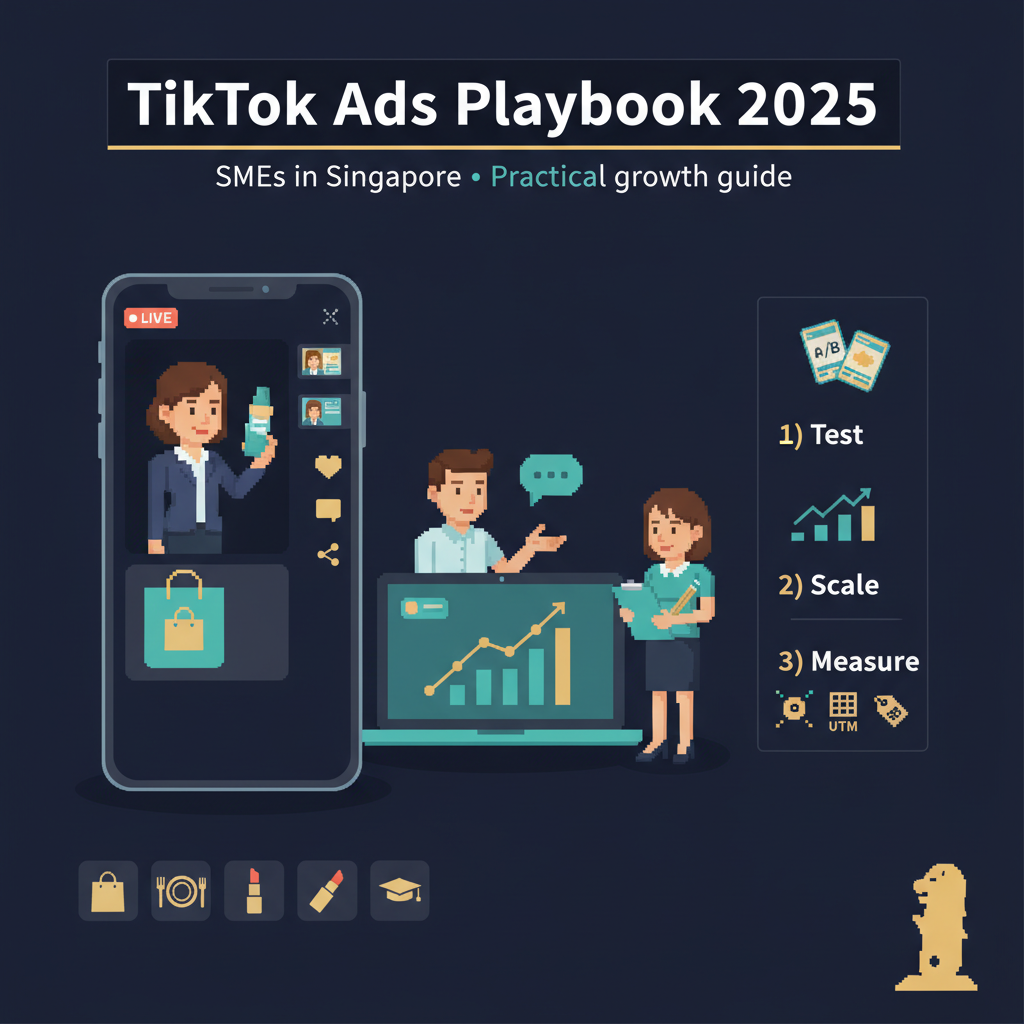
Introduction: Why SMEs in Singapore need a TikTok ads playbook in 2025
In 2025, TikTok is more than discovery — it is a commerce and engagement channel combining short-form video, in-app shopping, and live commerce. For SMEs in Singapore, the opportunity is practical: reach intent-rich audiences with native creative, convert through shoppable formats, and scale cost-effectively when creative and operations align. See TikTok for Business and the TikTok Ads Help Center for product and ad format capabilities.
What this guide covers
- Actionable playbook for Singapore SMEs: strategy, creative, budgeting, Shop integration, Live Shopping, measurement, and governance.
- Step-by-step setups and checklists you can implement in weeks.
- Examples across retail, F&B, beauty, and education with local execution tips.
- Measurement and governance guidance for efficient, brand-safe growth.
How to apply this playbook
- Use a staged plan: test → validate → scale.
- Prioritise pixel/catalog setup and a small creative test pack before higher budgets.
- Adapt sector templates to Singapore’s language and fulfillment expectations.
Section 1 – TikTok ads landscape for SMEs in 2025
Market overview
TikTok blends short-form content with integrated commerce features (catalogs, product tags, Video Shopping Ads, Live Shopping). The platform rewards native creative and creator authenticity. Refer to the TikTok Ads Help Center for supported formats and specs.
Key trends in Singapore 2025
- Shoppable content and live commerce are standard levers: shoppable clips paired with scheduled lives.
- Micro-creators provide cost-effective trust and localisation at niche scale.
- Measurement has matured: TikTok Pixel, product catalogs, and UTMs underpin attribution and ROAS analysis.
For broad TikTok usage trends, see aggregated industry references such as Hootsuite’s TikTok stats and Sprout Social’s TikTok stats.
Local context and practical implication
- Consumers expect clear product details, transparent delivery timelines, and local promos (e.g., same/next-day delivery, bundles).
- Align inventory and fulfillment before large promotions to protect ROAS.
- Authenticity and relevance outperform glossy production in crowded auctions.
Section 2 – TikTok advertising strategy for SMEs
Goals and KPIs
- Awareness: Reach, impressions, short video views, view-through rate.
- Consideration: Engagement, completion rate, CTR to shop/site, saves.
- Conversion: Purchases, add-to-cart rate, conversion rate, CPA, ROAS, AOV.
- Retention: Repeat purchase rate, LTV, loyalty sign-ups.
Step-by-step KPI alignment
- Define business outcome (weekly orders, enrollments, revenue).
- Map KPIs across the funnel.
- Set initial targets; refine from live data.
- Establish weekly dashboards and monthly reviews.
Audience and messaging
- Install TikTok Pixel; build custom audiences (visitors, engagers, add-to-cart).
- Start broad with interest-based audiences; discover creative resonance.
- Build lookalikes from purchasers/high-value users when events accrue.
- Layer language variants when targeting specific segments.
Messaging templates by sector
Retail: product-in-use, price clarity, fast delivery, bundles. Hooks: “3 ways to style this for SG weather.” CTA: “Shop now.”
F&B: freshness, taste, convenience, delivery ETA. Hooks: “Chef’s special — limited batch.” CTA: “Order now.”
Beauty: visible results, routine simplicity, ingredients. Hooks: “5-min morning glow.” CTA: “Shop bundle.”
Education: outcomes, preview lessons, limited seats. Hooks: “Boost your digital skills in 4 weeks.” CTA: “Enroll now.”
Execution checklist (first 4 weeks)
- Week 1: Pixel, catalog, 6 creatives, 2 interest audiences.
- Week 2: In-feed tests; build video viewer audiences (25/50/75%).
- Week 3: Retarget viewers/cart abandoners; pilot one Live.
- Week 4: Lock winners; scale budgets gradually.
Section 3 – Creative formats and best practices
Formats to use
- In-feed ads (primary workhorse)
- Spark Ads (amplify proven organic/creator content)
- Video Shopping Ads (tagged, direct purchase)
- Live Shopping (conversion-focused live events)
- TopView/Branded Effects (launches, participatory campaigns)
Creative guidelines
- Hook in the first 0–3 seconds; keep native, authentic visuals.
- Use 9:16; safe area for critical info; on-screen text overlays.
- Show product value early; include captions and clear CTAs.
Deepen creative tactics with our guide: Unlocking TikTok: Best Practices for Skyrocketing Engagement.
Testing & optimisation
- Develop 3–4 concepts per theme (hook, demo, social proof).
- Test 7–14 days with even budget splits.
- Track VCR, CTR, watch time, add-to-cart, purchases.
- Pause losers, scale winners, inject 1–2 new variants weekly.
Local examples
- Retail fashion: 3-outfit montage, price overlay, “Shop the look” tag (use Spark Ads to amplify UGC).
- F&B: 10–15s prep clip, delivery times callout, Live for weekend promos.
- Beauty: 30s routine tutorial, before/after, bundle VSA.
- Education: 45–60s course teaser plus Live Q&A.
Section 4 – Budgeting and ROI for 2025
Budgeting approach and pacing
- Test-to-scale: 25–40% test budget initially; 60–75% to winners.
- Scale budgets by 15–25% every 1–2 weeks when CPA/ROAS is stable.
8-week plan
- Weeks 1–2: setup & test — multiple creatives/audiences; Lowest Cost bidding.
- Weeks 3–4: learn & prune — pause underperformers; retargeting.
- Weeks 5–6: scale — 15–25% increases; consider Cost Cap.
- Weeks 7–8: seasonal/sustain — bundles, retention, retargeting.
Metrics & optimisation
- Core metrics: CTR, CPC, conversion rate, CPA, ROAS, AOV.
- Weekly: prune/shift budgets; bi-weekly: new hooks/formats; monthly: reset targets.
See our advertising campaigns portfolio for examples of creative and performance outcomes.
Section 5 – TikTok Shop ads and integration
Shop setup (step-by-step)
- Register TikTok Shop (SG) and connect your store.
- Sync/upload catalog; validate SKUs, images, prices, stock.
- Install Pixel; verify ViewContent, AddToCart, InitiateCheckout, Purchase events.
- Enable product tagging for in-feed, VSAs, and Live.
- Create Catalog Sales or product-tagged in-feed campaigns with UTMs.
Live commerce & creators
- Run 2–3 lives weekly (45–60 minutes); mix in-house hosts and micro-creators.
- Use clear scripts, benefits-first demos, timed bundles, and countdowns.
- Set creator terms (deliverables, usage rights, disclosure, measurement via UTMs).
For a deeper, Singapore-specific Shop runbook, see The Practical Playbook for Selling on TikTok Shop in Singapore.
Fulfilment alignment & measurement
- Confirm stock, delivery windows, and return policy before promotion.
- Track live KPIs: peak viewers, engagement, product clicks, orders, live-attributed ROAS.
- Post-live: thank-yous, confirm orders, retarget non-converters.
Section 6 – Measurement, analytics, and governance
Tracking & dashboards
- Pixel across key pages; verify standard events.
- Catalog sync and product tag mapping.
- Consistent UTMs; standard naming for joins in BI tools.
Consult the TikTok Ads Help Center for the latest on Pixel and measurement.
Recommended dashboards
- Executive ROI: Spend, Revenue, ROAS, CPA, AOV, New Customers.
- Funnel & attribution: ViewContent → AddToCart → Purchase conversion rates, time-to-purchase.
- Creative performance: VCR, watch time, CTR, ROAS per asset.
- Operational: by language, time-of-day, device, SKU.
Cadence & governance
- Daily: spend and anomaly alerts.
- Weekly: KPI reviews and creative pruning.
- Monthly: cohort/retention, budget reallocation.
Compliance & brand safety
- Follow platform ad policies and regional restrictions.
- Vetting creators; approvals workflow; #ad/#sponsored disclosures up-front.
- Comment moderation rules; escalation owners; incident logs.
- Creative approval flow with clear SLAs from brief to publish.
Conclusion – Ready-to-implement SME TikTok ads playbook for 2025
TikTok offers SMEs a commerce-ready channel when you pair native creative with operational readiness (catalog, pixel, fulfillment). Set funnel-based KPIs, test quickly, integrate Shop and Live, and measure with tidy dashboards and governance tailored to Singapore consumers.
Next steps (8–12 weeks)
- Week 0: Assign owners; define the primary objective.
- Weeks 1–2: Install Pixel, sync catalog, produce 6–8 creatives, set UTMs; build 2–3 audiences.
- Weeks 3–4: Launch in-feed tests; build retargeting; pilot one Live session.
- Weeks 5–8: Scale winners; add creators; shift to Cost Cap when CPA stable; codify dashboards and governance.
- Ongoing: Refresh creatives weekly; run recurring Lives; monitor ROAS/CPA for sustainable scaling.
If you’d like expert help implementing this playbook — from strategy and creative to live commerce and measurement — contact Hamilton & Sherwind.