

The Ultimate Guide to AI Marketing: Top Tools, Strategies, and Trends for 2025
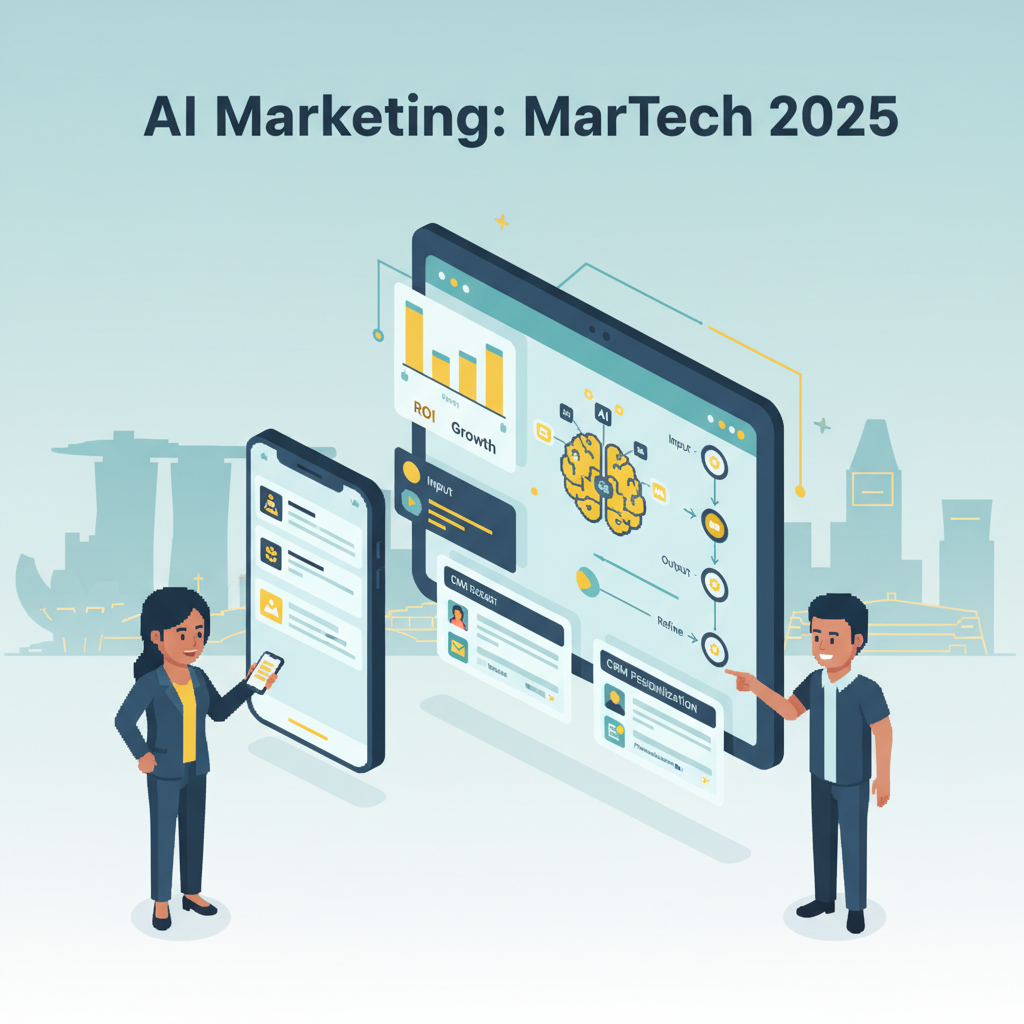
Introduction: Navigating the World of AI Marketing in 2025
Artificial intelligence has moved from the periphery of marketing strategy to its core. In 2025, AI is no longer a competitive advantage—it’s foundational infrastructure. For marketers in Singapore and Southeast Asia, this shift carries particular urgency. The region’s digital economy reached approximately US$263 billion in gross merchandise value in 2024, with e-commerce growing at mid-to-high-teens rates annually (Temasek/Google e‑Conomy SEA 2024 report). Across this rapidly expanding landscape, AI-powered tools are reshaping how brands discover customers, personalize experiences, optimize media spend, and scale content production.
What changed between 2024 and 2025 matters deeply. Large language models have become more capable, more affordable, and more accessible. Multimodal AI—systems that work seamlessly with text, images, video, and audio—is now standard. Agentic workflows are moving into pilots and scale. McKinsey’s State of AI 2025 notes 88% of organizations use AI in at least one business function, and 62% are experimenting with agents. The question is no longer “should we use AI?” but “how do we implement it responsibly and measure its impact?”
What is AI Marketing?
AI marketing uses machine learning, natural language processing, computer vision, and generative AI to automate, personalize, and optimize marketing activities across the customer journey. Core functions include automation, personalization, optimization, and insight generation.
Compared with traditional digital marketing, AI compresses cycles and scales relevance. For example, AI can generate and test dozens of email subject lines in real time and automatically send the best to each segment. In paid media, AI can autonomously optimize bids, budgets, and creative variants continuously, often outperforming manual management within weeks.
Essential AI Marketing Tools and Platforms
Below we organize the AI marketing landscape into four practical buckets and share selection criteria. For execution support across strategy, content, and media, Hamilton & Sherwind’s digital marketing services can help you evaluate and implement the right stack.
1) Automation & Workflow Orchestration
- Zapier: no-code automation across thousands of apps.
- ManyChat / Drift: conversational automation for capture and qualification.
- Reply.io / Salesloft: multichannel outreach orchestration.
- Conversica: autonomous AI assistants for lead follow-up (multilingual helpful for SEA).
2) Analytics & Experience Analytics
- Salesforce Marketing Cloud / Einstein: predictive analytics, journey orchestration.
- Improvado: unified marketing data ingestion and reporting.
- FullStory: behavioral analytics and AI-driven issue detection.
- Optimove: lifecycle orchestration and retention-focused CDP.
3) Generative Content Creation
Text & Copy: ChatGPT/Claude, Jasper/Copy.ai/Writer, Surfer SEO/Clearscope. Images: DALL·E 3, Canva, Adobe. Video/Audio: Synthesia, Runway, Descript, Lumen5, ElevenLabs.
To scale brand storytelling, consider our branding and video production in Singapore capabilities.
4) Marketing Operations & Ad Optimization
- Albert.ai / Adext AI: autonomous budget allocation and bid/target optimization.
- Pathmatics: competitor ad intelligence for media planning.
How to Choose the Right Platform
Define your biggest pain points, assess integrations, validate data lineage, evaluate usability, test scalability, confirm security/compliance, and pilot before committing. If you need help building a shortlist and pilot plan, explore our portfolio to see how we implement systems in practice.
Building an Effective AI Marketing Strategy
Key Steps
- Identify 2–4 measurable problems (e.g., content bottlenecks, slow MQL→SQL, ROAS stagnation, churn).
- Prioritize via a portfolio framework (ground game, roofshots, moonshots).
- Assess readiness across data, stack, skills, governance, measurement.
- Establish a steering group (CMO, Ops, Data, Legal, Creative) for pilot governance.
Integrating AI Content Automation
Adopt a “brief → generate → guardrails → edit → publish → repurpose → measure” workflow. Automate lower-stakes tasks first (summaries, captions, metadata), then scale to higher-stakes content. For multi-market SEA campaigns, ensure local language and cultural nuance during repurposing—our social media team can help.
Measuring Success: KPIs & Analytics
Track pipeline, velocity, CAC/LTV, ROAS, and operational KPIs (content velocity, edit time). Use randomized holdouts for causal measurement. Complement with algorithmic attribution models. Maintain consistent UTMs and identity mapping to power AI decisions.
Real-World AI Marketing Examples and Case Studies
- Unilever: supply chain and customer service AI—~30% planning effort reduction; social care augmentation (Unilever newsroom; context via Sprinklr: AI in Marketing).
- The Home Depot: “Magic Apron” generative AI concierge on product pages (Home Depot press release).
- Planet Fitness: AI-assisted social care to scale response quality and speed (Sprinklr: AI in Marketing).
- Entertainment brand: rapid A/B with AI analytics yields 29% CPS reduction and 19% CPP reduction (Sprinklr: AI in Marketing).
- Ferrero “Nutella Unica”: mass personalization with generative pipelines (Sprinklr: AI in Marketing).
Benefits and Challenges of AI Marketing Automation
Benefits
Speed & scale, personalization, cost efficiency, continuous optimization, and data-driven decision-making. Many companies report 20–30% productivity improvements from AI-enabled workflows (PwC 2025 AI Predictions).
Challenges and Remedies
- Data quality & governance: unify records in a CDP; define data dictionaries; audit regularly.
- Hallucinations: maintain human-in-the-loop; enforce brand and compliance guardrails.
- Change management: treat AI as augmentation; invest in training; celebrate early wins; secure exec sponsorship (McKinsey State of AI 2025).
- Explainability: require decision transparency and rollback controls.
- Privacy: adopt consent-based personalization and select vendors with robust assurances; design for privacy-safe targeting.
Future Trends: The Evolution of AI Marketing
Multimodal AI enables single-brief pipelines outputting images, copy, localized video, and audio. Agentic workflows orchestrate multi-step tasks; 62% of organizations are experimenting with agents (McKinsey State of AI 2025). Privacy-safe targeting and responsible AI (governance, explainability) become baseline (PwC 2025 AI Predictions).
What to Expect in Singapore & SEA
- Marketplace/social commerce optimization on Shopee, Lazada, TikTok Shop.
- Localization at scale across languages and cultural contexts.
- First-party data and clean-room strategies for privacy-safe growth.
Getting Started: Implementing AI Marketing
Phased Plan
Crawl (0–3 months): pick 1–2 pilots (content drafts, subject-line optimization); instrument minimal events; define KPIs; create RACI; run pilot.
Walk (3–6 months): scale successful pilots; add predictive signals; automate low-risk decisions; monitor models.
Run (6–12+ months): deploy agents with rollback/audit; implement incrementality testing; embed governance; continuous improvement loop. Browse our digital marketing portfolio and branding portfolio for relevant case examples.
Training & Resources
Leverage vendor certifications and community learning. Document playbooks and assign team “AI champions.” For brand and campaign alignment, explore our advertising services and ongoing insights on the Hamilton & Sherwind blog.
Conclusion & CTA
AI marketing is the new normal. Success in 2025 depends on moving from experimentation to systematic implementation—grounded in data, governance, and measurement.
Ready to build your AI marketing strategy? Hamilton & Sherwind helps organizations across Singapore and Southeast Asia design, implement, and scale AI marketing programs that deliver measurable impact—across strategy, tooling, pilots, and governance.
Contact us today to discuss your roadmap.