

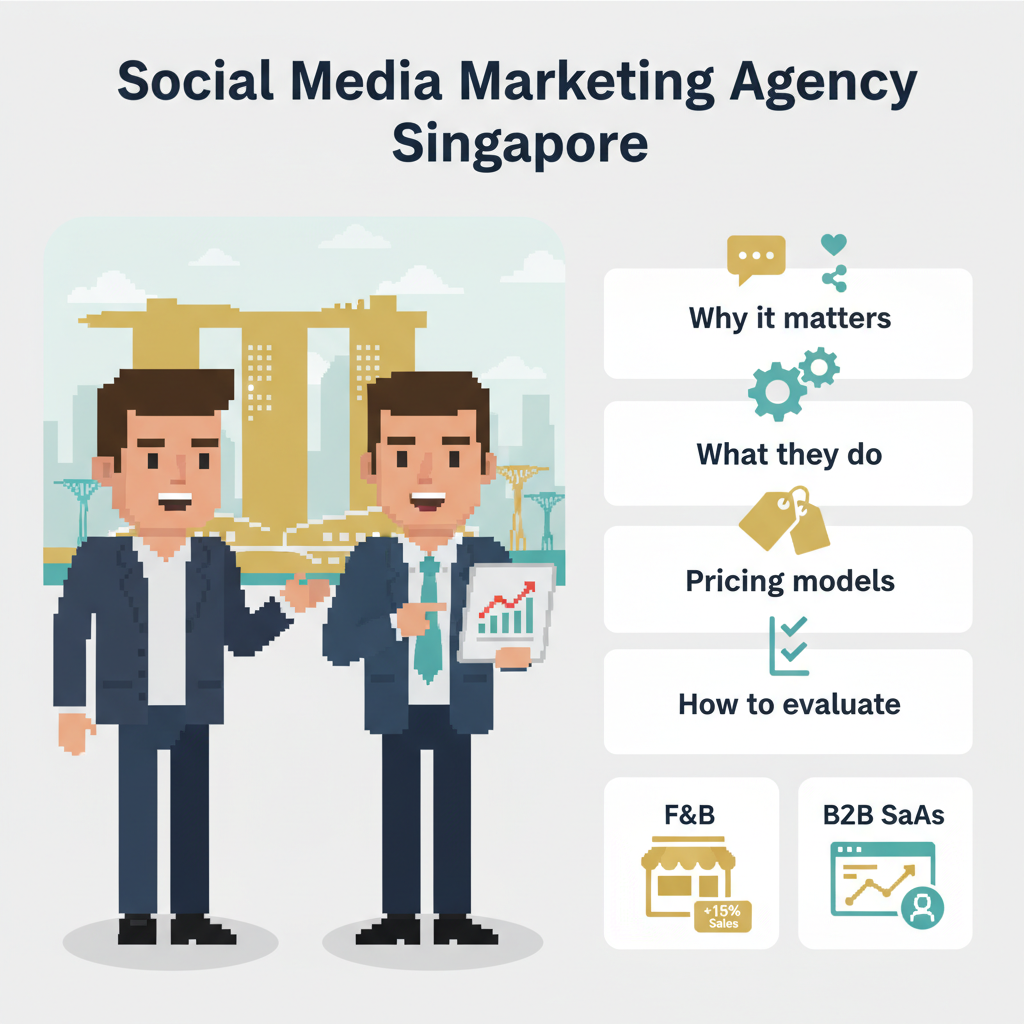
Your Comprehensive Guide to Hiring a Social Media Agency Singapore
Singapore’s digital landscape has reached a critical inflection point. With 95.8% internet penetration and 88.2% of the population active on social media, the market is saturated—but opportunity remains for brands that know how to navigate it strategically. According to DataReportal’s Digital 2025 report, the average Singaporean now uses 7.2 different social platforms monthly, yet spends just 2 hours and 2 minutes per day on social media overall. This fragmentation means that choosing the right social media marketing agency Singapore becomes not just a nice-to-have, but essential for SMEs competing for attention.
If you’re a marketing manager, founder, or business leader in Singapore wondering whether to hire a social media agency—and if so, how to pick the right one—this guide will walk you through the decision-making process with clarity and confidence.
Why Social Media Marketing Matters for Local Businesses
Snapshot of Singapore’s Digital Landscape
Singapore stands apart in Southeast Asia as a hyper-connected market. The nation boasts millions of internet users with almost all accessing the web via 3G, 4G, or 5G connections. Mobile speeds are among the fastest globally, making Singapore a highly attractive testbed for new social formats and ad products.
But raw connectivity is only part of the story. The real insight lies in where Singaporeans spend their time:
- TikTok dominates with dozens of hours per user per month and has grown strongly year-on-year among adults 18+
- YouTube captures nearly the entire online population, reaching well over 80% of users
- Facebook remains relevant with strong penetration, particularly among older demographics
- Instagram is entrenched with more than half the population, especially younger and affluent users
- LinkedIn has millions of registered members, making it critical for B2B and professional services
What’s striking is that despite shorter overall daily time budgets, Singaporeans are platform-hopping more than ever. This means a one-platform strategy is no longer viable. Brands need omnichannel presence, and that’s where professional agencies add immediate value.
Organic vs. Paid Social: Where the ROI Lies
The distinction between organic and paid social has become increasingly blurred—and increasingly important. According to global projections in Statista’s Digital Advertising Outlook, social media advertising continues to claim a growing share of digital ad budgets, and Singapore follows that trajectory closely.
Here’s the reality: organic reach on most platforms has contracted significantly. Facebook’s organic reach for brand pages commonly sits in the low single digits without paid promotion. Instagram’s algorithm similarly deprioritizes brand content in favor of peer-to-peer interactions. TikTok is the exception—the platform still rewards authentic, creative content with substantial organic reach—but even TikTok’s algorithm increasingly favors accounts with consistent, high-quality output and often benefits from paid amplification.
For SMEs, this creates a dilemma: you need both organic content (to build community and trust) and paid campaigns (to reach new audiences and drive conversions). A competent social media marketing agency Singapore will balance these, using organic content to build brand narrative and paid ads to accelerate growth.
Industry data also shows that influencer and creator spending has grown quickly across Asia, indicating that brands are investing in authentic voices—both in paid partnerships and organic community building. The net effect: without a strategic blend of organic, paid, and creator-led content, brands risk being invisible.
What an Agency Actually Does for You
Before evaluating specific agencies, it’s worth understanding the full scope of services a professional outfit should provide. Many SMEs underestimate the breadth of work involved in managing social media effectively, especially in a competitive market like Singapore.
Strategy & Audience Research
This is where the best agencies differentiate themselves. Strategy work includes:
- Competitive analysis: Auditing 5–10 direct competitors’ social presence, identifying content gaps, engagement patterns, and audience sentiment
- Audience research: Building detailed personas of your ideal customers—their pain points, content preferences, platform behavior, and purchase triggers
- Platform selection: Recommending which platforms align with your audience and business goals (not all platforms suit all businesses)
- Content pillars: Defining 3–5 core themes your brand will communicate (e.g., product education, behind-the-scenes, customer stories, industry insights)
- Posting cadence: Determining optimal frequency and timing for each platform based on audience behavior data
This foundational work typically takes 2–4 weeks and should result in a documented social media strategy that guides all subsequent work. A strong social media agency Singapore will also localise the strategy for this market—whether it’s tailoring messaging for Singaporean English, understanding local holidays like National Day and 11.11, or respecting cultural nuances across different ethnic groups.
Content Creation, Scheduling & Community Management
Once strategy is locked, execution begins. This includes:
- Content creation: Writing captions, designing graphics, shooting or sourcing video content, and producing any original assets
- Content calendar management: Planning and scheduling posts across platforms, typically 2–4 weeks in advance
- Community management: Responding to comments, messages, and mentions within agreed SLAs (typically 24–48 hours)
- Engagement: Proactively engaging with relevant accounts, industry conversations, and user-generated content
- Crisis monitoring: Flagging negative sentiment or potential PR issues early
For most SMEs, this is the most visible and time-consuming component of agency work. Quality agencies will use social media management tools to streamline scheduling and reporting, while still customising content to feel on-brand rather than templated.
Paid Social, Influencer Outreach & Reporting
The final pillar includes:
- Paid campaign management: Setting up, optimizing, and scaling ads across Facebook, Instagram, TikTok, LinkedIn, and other platforms
- A/B testing: Running creative and audience tests to identify highest-performing variations
- Budget allocation: Distributing ad spend across platforms and campaigns based on performance data
- Influencer partnerships: Identifying, vetting, and negotiating with micro and macro influencers aligned with your brand
- Monthly reporting: Delivering dashboards and insights on reach, engagement, conversions, ROI, and recommendations for optimization
This is where agencies justify their fees. A skilled paid social manager can often generate significantly better ROI on ad spend through audience targeting, creative optimization, and continuous testing than a generalist trying to manage everything in-house.
Signs Your Brand Is Ready to Partner with Professionals
Not every business needs an agency immediately. Here are the clearest indicators that it’s time to hire.
Growth Plateaus & Resource Constraints
If your organic social media growth has stalled despite consistent posting, an agency can inject fresh strategy and creative approaches. Similarly, if your in-house team is stretched thin—managing social media as a side responsibility rather than a core focus—professional help will free up bandwidth for other priorities.
Many SMEs reach a point where they’re posting regularly but seeing minimal engagement or follower growth. This often signals that strategy, not effort, is the bottleneck. An agency can diagnose the issue and course-correct, whether that means refining your content pillars or repositioning your brand voice for Singaporean audiences.
Scaling Campaigns Across Platforms
If you’ve had success on one platform (say, Instagram) but struggle to replicate it on others, an agency’s multi-platform expertise becomes invaluable. Similarly, if you’re running paid campaigns but not seeing consistent ROI, a professional team can audit your setup and optimize.
A practical threshold:
- You’re spending more than SGD 2,000–3,000 monthly on ads without clear attribution, or
- You’re posting three or more times weekly but seeing engagement rates below 1–2%
At that point, staying “DIY” can cost more in missed opportunities than a professional retainer.
Core Service Packages & Typical Pricing Models in Singapore
Fixed Retainers vs. Performance-Based Fees
Singapore’s social media agencies typically offer three pricing models.
Fixed Monthly Retainer (most common for SMEs)
- Ranges from roughly SGD 2,000–8,000+ monthly depending on scope
- Includes a defined number of posts, community management hours, and reporting
- Predictable budgeting; good for businesses with consistent needs
- Risk: you pay the same whether results are strong or weak
Performance-Based Pricing
- Agency takes a percentage of ad spend (often 10–20%) or a commission on sales/leads generated
- Aligns agency incentives with your results
- Risk: agencies may become conservative with testing or focus only on short-term wins
- Less common in Singapore but growing among performance-focused social media marketing agencies
Hybrid Model (increasingly popular)
- Base retainer covers strategy, content creation, and community management
- Additional fees for paid ad management (typically 10–15% of ad spend)
- Combines predictability with performance alignment
For a typical SME in Singapore, expect approximately:
- Starter package (SGD 2,500–4,000/month)
- 8–12 posts monthly
- Basic community management
- Monthly reporting
- Growth package (SGD 4,500–7,000/month)
- 16–20 posts monthly
- Daily community management
- Paid ad management (with SGD 2,000–5,000 ad budget)
- Bi-weekly reporting
- Premium package (SGD 7,500–12,000+/month)
- 20+ posts monthly across platforms
- Influencer partnerships
- Advanced analytics and testing
- Weekly strategy calls
Hidden Costs to Watch For
When evaluating proposals from any social media agency Singapore, clarify what’s not included:
- Ad spend: Most retainers cover management only; your actual media budget is separate
- Content production: Video production, professional photography, or advanced motion graphics often incur extra fees
- Rush fees: Expedited content or urgent campaign setup may carry surcharges
- Revision limits: Clarify how many rounds of revisions are included before extra charges apply
- Tool subscriptions: Some agencies pass through costs for premium social management or analytics tools
- Influencer fees: Influencer payments are typically separate from the agency retainer
- Contract minimums: Many agencies require 3–6 month minimum terms with early termination penalties
Always request a detailed scope of work, line-item pricing, and a clear list of assumptions so there are no surprises later.
How to Evaluate and Compare Shortlisted Agencies
Portfolio Depth & Industry Fit
Request case studies and portfolios from at least 3–5 agencies. Look for:
- Industry experience: Have they worked with brands similar to yours (F&B, SaaS, e-commerce, education, financial services, etc.)—especially in Singapore or SEA?
- Platform expertise: Is there strong work on the specific platforms you care about (e.g., TikTok and Instagram for retail; LinkedIn for B2B)?
- Growth metrics: Do they show follower growth, engagement improvements, conversion rate increases, or ROI?
- Creative quality: Does the content feel authentic and on-brand, or generic and templated?
- Longevity: How long did they work with each client? Longer relationships often signal trust and results.
Red flags include:
- Vague case studies without specific metrics
- Portfolios dominated by one platform when you need multi-channel support
- Inability to provide client references or anonymised performance data
- Recycled visuals and captions across different brands
Tech Stack, Reporting Cadence & KPIs
Ask each agency:
- What tools do you use? Look for robust stacks—Meta Business Suite, TikTok Ads Manager, Google Analytics, data visualisation tools, etc.
- How often do you report? Monthly is standard; bi-weekly or weekly is premium.
- What metrics do you track? Go beyond vanity metrics (likes, followers) to engagement rate, click-through rate, cost per result, and actual leads or sales.
- How do you attribute conversions? Do they use UTM parameters, pixel tracking, and CRM integration to connect social activity to revenue?
- What’s your optimisation process? Ask how often they test new creatives, audiences, and offers, and how they decide what to scale or cut.
The best social media marketing agencies in Singapore will provide a clear reporting template from day one, with sample dashboards so you know exactly what to expect.
Essential Questions to Ask Before Signing the Contract
Timeline Expectations & SLA Commitments
Before committing, clarify:
- When will we see results? Realistic agencies will say 4–8 weeks for organic traction and 2–4 weeks to stabilise paid campaigns.
- What are your response times? For community management, 24–48 hours on weekdays is typical; ask how they handle weekends and public holidays in Singapore.
- What happens if we’re unhappy? Is there a formal review at 30/60/90 days, and what does “success” look like?
- How do we communicate? Weekly calls, WhatsApp group, Slack, or email updates—choose what works for your team.
- What’s the exit process? Notice period, handing over of assets, and cooperation with any new agency or in-house team.
Ownership of Creative Assets & Data
This is critical and often overlooked:
- Who owns the content created? You should own all final assets (posts, graphics, videos) once paid for.
- Who owns the social accounts? Your business must own the Facebook, Instagram, TikTok, and LinkedIn accounts—not the agency.
- Who owns the data? You should have admin or at least full reporting access to all ad accounts and analytics.
- What happens if we part ways? Ensure there is a clear handover plan, including passwords (via secure password tools), audiences, and historical reports.
Insist that all key accounts (Meta Business Manager, TikTok Business Center, Google Analytics) are created under your company’s primary domain email and that you retain admin access throughout.
Local Success Stories: Mini Case Studies
F&B Brand Tripled Bookings via TikTok Ads
A mid-range restaurant group in Singapore’s CBD was struggling to fill tables during off-peak hours. Their Instagram presence was strong (around 12,000 followers) but engagement was declining, and they weren’t converting followers into diners.
A local social media agency audited their strategy and identified an opportunity: TikTok. While the restaurant had no TikTok presence, their target demographic (professionals aged 25–40) was increasingly discovering dining spots via TikTok’s “For You” page.
The agency created a content series featuring:
- 15-second clips of signature dishes being plated
- Behind-the-scenes kitchen footage
- Staff recommendations and personality-driven content
- Curated user-generated content from diners
Within eight weeks, the restaurant amassed tens of thousands of TikTok followers. More importantly, they tracked bookings via a unique promo code shared only in TikTok videos. In the first three months, TikTok-attributed bookings grew from zero to over 180 monthly reservations, effectively tripling their off-peak table fills.
The approach combined organic TikTok growth with modest paid amplification (around SGD 1,500/month) to accelerate reach. The key insight: for F&B in Singapore, the right platform plus authentic, fast-paced content can dramatically shift footfall.
B2B SaaS Grew Leads 4× Through LinkedIn
A Singapore-based HR tech startup was generating around 5–10 qualified leads monthly through LinkedIn, but growth had plateaued. Their social strategy was reactive—occasional company updates and employee re-shares—rather than strategic.
An agency conducted a LinkedIn audit and found:
- The founder’s personal profile had a small but relevant following with minimal engagement
- Company content was infrequent and generic
- No clear thought leadership positioning
- Underutilised employee networks
The agency implemented a six-month strategy:
- Founder positioning: Built a content calendar for the founder’s personal profile focusing on HR trends, talent challenges in Singapore, and candid culture posts.
- Employee advocacy: Trained a pilot group of eight team members to share company content and their own perspectives within LinkedIn’s professional norms.
- Paid campaigns: Ran targeted LinkedIn lead-gen ads to HR decision-makers in Singapore, promoting webinars and case studies.
- Content pillars: Established four core themes—product education, customer success stories, hiring/culture, and industry insights.
Results after six months:
- Founder’s followers grew several-fold
- Monthly qualified leads increased about 4×
- Cost per lead fell by more than a third
- Employee posts generated roughly 3× more engagement than company page posts
For B2B brands in Singapore, this demonstrates that a multi-layered LinkedIn approach—company, founder, and employees—beats a company-only broadcast strategy.
Moving Forward with Confidence: Your Action Checklist
Ready to hire a social media marketing agency Singapore? Use this checklist to guide your decision.
Phase 1: Preparation (Week 1–2)
- Define your social media goals (brand awareness, lead generation, sales, community building, recruitment, or a mix)
- Audit your current social presence (followers, engagement rates, posting frequency, content mix)
- Identify your target audience segments and which platforms they use most in Singapore/SEA
- Set a realistic budget for the next 6–12 months (retainer + ad spend)
- Compile a longlist of 5–10 agencies with relevant experience
Phase 2: Evaluation (Week 3–4)
- Request proposals and case studies from shortlisted agencies
- Schedule discovery calls with your top three
- Ask the essential questions on timelines, SLAs, and ownership
- Speak to at least one existing or past client reference for each finalist
- Compare pricing, scope, and team seniority—not just headline cost
Phase 3: Decision (Week 5)
- Negotiate contract terms (especially around account and data ownership)
- Agree on KPIs: e.g., engagement rate, cost per lead, ROAS, content output
- Set a 90-day pilot period with a structured review at the end
- Ensure all social and ad accounts are owned by your company from day one
- Schedule a kickoff workshop to align on brand, audience, and content pillars
Phase 4: Onboarding (Week 6–8)
- Provide the agency with brand guidelines, product information, and past campaign data
- Collaborate on the social media strategy document and approve it
- Review and approve the first month’s content calendar
- Set up analytics tracking, pixels, and UTM conventions for all campaigns
- Confirm communication cadence and escalation paths for urgent issues
Choosing the right social media marketing agency Singapore is a high-leverage decision. With almost nine in ten Singaporeans on social media and digital ad budgets shifting heavily into social channels, a strategic agency partner can help you cut through the noise, turn attention into action, and build a brand that genuinely resonates in this market.
To see what this could look like in practice, explore how integrated social media marketing campaigns and broader digital marketing services can work together to drive performance.
When you’re ready to take the next step, contact us and our team will help you map out a social media roadmap tailored to your Singapore or regional goals.
Content Finalized