

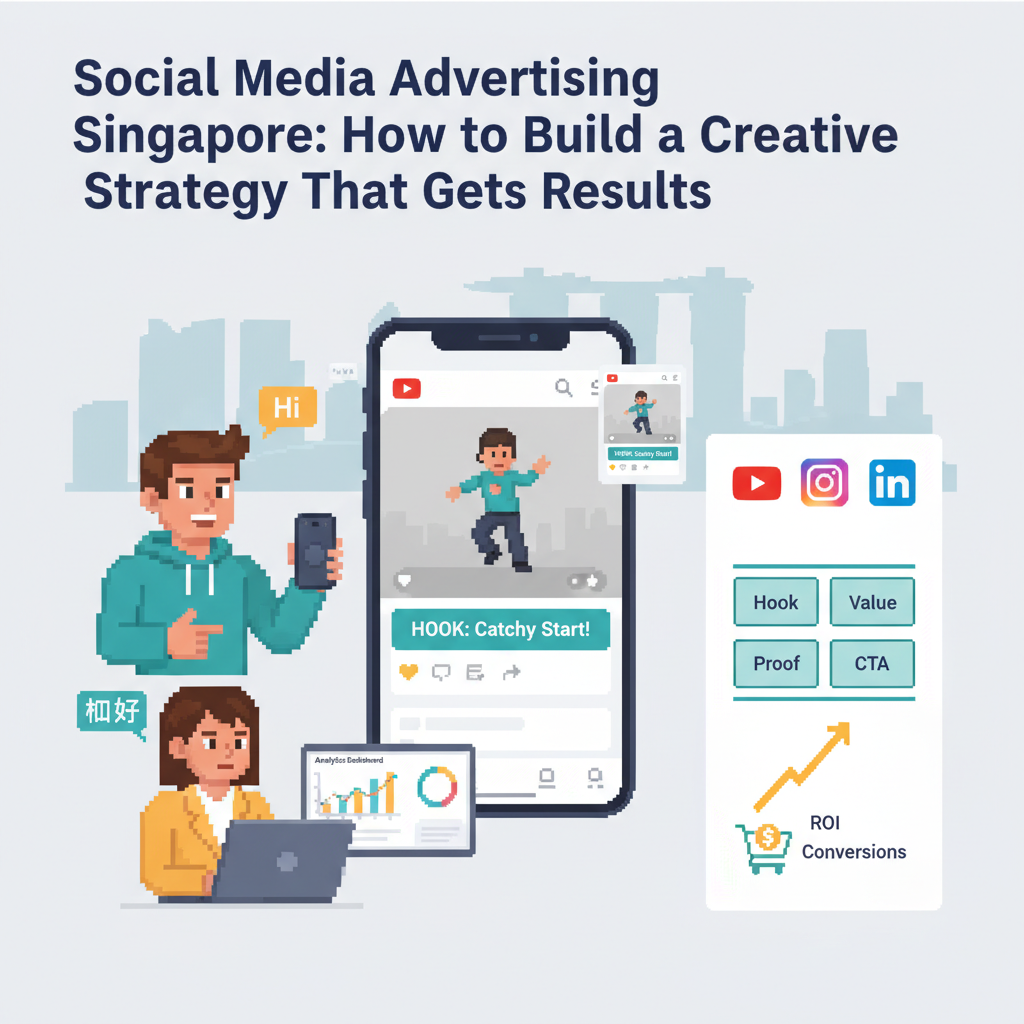
Social Media Advertising Singapore: How to Build a Creative Strategy That Gets Results
Introduction: Why Creative Strategy Matters for Social Media Advertising Singapore
In Singapore’s hyper-connected digital landscape, where social media penetration reaches exceptionally high levels across the population, standing out requires more than just posting content—it demands a strategic creative approach that resonates with local audiences while driving measurable business results.
Singapore’s unique market characteristics present both opportunities and challenges for social media advertising. With users spending substantial time daily across multiple different platforms, attention is fragmented yet highly engaged. The market’s pragmatic nature means audiences value authenticity, convenience, and clear value propositions over flashy campaigns that lack substance.
A well-crafted creative strategy for social media advertising Singapore goes beyond beautiful visuals or clever copy. It requires understanding the nuanced preferences of Singaporean consumers, from their preference for mobile-first experiences to their appreciation for local cultural references. Whether you’re targeting the urban food explorer discovering new hawker gems or the busy professional seeking time-saving solutions, your creative approach must speak directly to their motivations and behaviors.
The stakes are high in this competitive market. With digital advertising spend reaching substantial levels annually and social media commanding a significant portion of that investment, brands cannot afford to rely on generic, one-size-fits-all creative approaches. Success demands a strategic framework that balances global brand consistency with local relevance, leverages the right platforms for your audience, and continuously optimizes based on performance data.
This comprehensive guide will equip you with the strategic insights, practical frameworks, and actionable tactics needed to build a creative strategy that not only captures attention in Singapore’s crowded social media landscape but also drives meaningful business outcomes. From understanding platform-specific audience behaviors to crafting culturally sensitive content that converts, we’ll explore every aspect of creating social media advertising campaigns that truly resonate with Singaporean audiences.
Understanding the Singapore Social Media Landscape
Key platforms and audience behaviors in Social Media Marketing Singapore
Singapore’s social media ecosystem is characterized by high engagement across multiple platforms, with users demonstrating sophisticated multi-platform behaviors that marketers must understand to succeed. The landscape is dominated by messaging apps, short-form video platforms, and established social networks, each serving distinct roles in the consumer journey.
WhatsApp leads the charge with exceptionally high monthly reach, serving as the primary communication hub for both personal and business interactions. This messaging-first preference extends to community building, with WhatsApp groups playing crucial roles in local recommendations, event coordination, and word-of-mouth marketing. For brands, this presents opportunities for conversational commerce and community-driven marketing strategies.
TikTok has emerged as the time-consumption leader, with users spending considerable time monthly on the platform. This represents a significant shift toward short-form video content consumption, making it essential for brands to develop video-first creative strategies. The platform’s algorithm-driven discovery mechanism offers substantial organic reach potential, particularly for content that taps into local trends and cultural moments.
YouTube maintains strong engagement with substantial monthly usage per user, serving dual purposes as both an entertainment and educational platform. Singaporean users frequently turn to YouTube for product research, tutorials, and reviews, making it valuable for consideration-stage marketing and longer-form storytelling.
Meta’s platforms—Facebook and Instagram—continue to play important roles, with Facebook reaching a significant majority of internet users and Instagram maintaining strong reach. Facebook excels in community building, event promotion, and reaching older demographics, while Instagram dominates visual storytelling and aspirational lifestyle content, particularly among younger professionals and lifestyle-conscious consumers.
The behavioral patterns reveal a pragmatic approach to social media consumption. Users primarily engage to stay connected with family and friends, fill spare time, and consume news. This practical orientation means content must provide clear value—whether entertainment, information, or utility—to capture and maintain attention.
Local trends shaping Social Media Content Singapore
Several key trends are reshaping how brands approach social media content in Singapore, driven by cultural preferences, technological adoption, and changing consumer expectations.
The rise of micro-communities represents a significant shift from broadcast-style social media to more intimate, interest-based groups. These communities, often organized around neighborhoods, hobbies, or professional interests, offer brands opportunities for more targeted, relevant engagement. Successful brands are learning to participate authentically in these communities rather than simply advertising to them.
Food culture continues to dominate social media conversations, with F&B content consistently ranking among the most engaging categories. This extends beyond restaurants to include home cooking, hawker culture, and food delivery experiences. Brands across industries are finding ways to connect their products and services to Singapore’s vibrant food scene, whether through partnerships, content collaborations, or cultural references.
The integration of e-commerce with social media has accelerated, with platforms introducing shopping features and brands developing seamless purchase journeys. Singaporean consumers increasingly expect to discover, research, and purchase products without leaving their preferred social platforms. This trend demands creative strategies that balance entertainment value with commercial objectives.
Sustainability and social responsibility themes are gaining traction, particularly among younger demographics. Brands that authentically incorporate environmental consciousness and community impact into their social media strategies are seeing increased engagement and brand affinity.
The bilingual and multicultural nature of Singapore is creating opportunities for brands to develop more inclusive content strategies. Successful campaigns often incorporate multiple languages naturally, reflect the city-state’s ethnic diversity, and reference shared cultural experiences that resonate across different communities.
Live streaming and real-time content are becoming more important, driven by the desire for authentic, unfiltered brand interactions. This trend is particularly strong in the F&B and retail sectors, where live product demonstrations, behind-the-scenes content, and real-time customer service are proving effective.
Defining Your Objectives and Target Audience
Setting measurable goals for Social Media Advertising Strategy
Establishing clear, measurable objectives forms the foundation of any successful social media advertising strategy in Singapore. The key lies in aligning marketing goals with business outcomes while accounting for the unique characteristics of the local market.
Framework for Goal Setting
Start with business-aligned objectives and translate them into specific, time-bound marketing targets. For brand awareness campaigns, focus on reach and frequency metrics that matter to your business. A typical awareness goal might target reaching a substantial portion of your core demographic with multiple ad exposures over defined timeframes, establishing cost benchmarks through initial testing phases.
Demand generation objectives should emphasize qualified traffic and engagement metrics. Set targets like generating significant unique website sessions from social channels within specific periods, with click-through rates that exceed baseline performance by meaningful margins.
Lead generation campaigns require careful attention to both quantity and quality metrics. Aim for specific numbers of marketing-qualified leads within defined timeframes while maintaining cost-per-acquisition targets that align with your customer lifetime value calculations.
For direct response and e-commerce objectives, establish clear return on ad spend targets based on your business economics. Minimum return ratios should reflect your profit margins, customer acquisition costs, and competitive landscape requirements.
KPI Selection by Funnel Stage
Awareness stage metrics should focus on reach, impressions, cost efficiency, and video view rates. Track unique reach to avoid inflated impression counts and monitor frequency to prevent ad fatigue. Video play rates at early intervals provide indicators of creative effectiveness.
Consideration stage KPIs emphasize engagement and intent signals. Monitor click-through rates, cost-per-click, video view-through rates at meaningful intervals, and time spent on landing pages. These metrics indicate whether your creative successfully moves audiences from awareness to active interest.
Conversion metrics include conversion rates, cost per acquisition, return on ad spend, and revenue attribution. Secondary metrics like add-to-cart rates and checkout completion rates help identify funnel bottlenecks and optimization opportunities.
Retention and lifetime value tracking becomes crucial for long-term success. Monitor repeat purchase rates, customer lifetime value, and the cost to acquire repeat buyers. These metrics help evaluate the true profitability of your social media advertising investments.
Budget Allocation Strategy
Implement a test-and-scale approach, allocating a meaningful portion of your planned spend to initial learning phases. This allows you to validate creative concepts and audience segments before committing larger budgets.
For brand-focused campaigns, consider allocating the majority to awareness activities, with substantial portions for consideration and smaller amounts for conversion. Direct-response campaigns typically perform better with more balanced allocation across consideration and conversion activities.
Always reserve a significant portion of your budget for measurement experiments, including incrementality tests, creative variations, and audience explorations. This investment in learning pays dividends through improved campaign performance over time.
Identifying and segmenting your Singaporean audience
Effective audience segmentation in Singapore requires understanding the intersection of demographics, psychographics, and behavioral patterns unique to this diverse, urban market.
Core Segmentation Layers
Demographic segmentation should consider distinct age bands, but avoid overly broad ranges that mask important behavioral differences. Gender targeting should only be specified when product-relevant, as mixed-gender campaigns often reveal unexpected insights.
Geographic segmentation can be highly effective in Singapore’s compact geography. Consider neighborhood-level targeting for location-specific services, with areas like the Central Business District for office services, or eastern and western clusters for family-oriented promotions.
Life-stage segmentation proves particularly valuable, distinguishing between students, early-career professionals, parents, homeowners, and retirees. Each group demonstrates distinct social media behaviors and content preferences.
Behavioral Targeting Strategies
First-party audience data provides the most valuable targeting signals. Segment website visitors by page engagement, product viewers, cart abandoners, and past purchasers. Email subscribers and app users represent high-intent audiences worth targeting with specialized content.
Engagement-based audiences from social platforms offer powerful retargeting opportunities. Video viewers at various completion rates indicate different levels of interest and should receive tailored messaging approaches.
Purchase behavior segmentation using recency, frequency, and monetary analysis helps identify high-value customers for lookalike audience creation and VIP treatment in campaigns.
Practical Audience Personas
Maya, the Urban Food Explorer
A young marketing professional living centrally, dining out frequently, following food influencers, and sharing experiences with friends. Active on TikTok, Instagram, and WhatsApp groups. Responds to visually rich content featuring new restaurants, location tags, and group booking promotions. Target with food and dining interests, recent restaurant searches, and video engagement behaviors.
Aaron, the Busy Professional
A finance manager who values efficiency and reliability, shops online for electronics and workwear, uses LinkedIn professionally. Engages with product reviews and comparison content. Target with tech interests, high mobile spending behaviors, and professional content engagement patterns.
Siti, the Value-Conscious Parent
A mother of two who is budget-oriented, shops for family necessities online, follows parenting groups and supermarket pages. Active on Facebook and WhatsApp groups. Responds to promotions, bundle deals, and practical content. Target with parenting interests, frequent e-commerce behaviors, and coupon-seeking patterns.
David, the Expat Professional
An international executive interested in premium services, dining, and community events. Uses multiple platforms for both professional and social purposes. Responds to convenience-focused messaging and expat community content. Target with expat group interests, international brand preferences, and premium service categories.
Testing and Refinement Approach
Start with multiple test segments per campaign, combining broad interests, in-market intent signals, remarketing audiences, and lookalike audiences based on your best customers. Measure cost-per-acquisition and lifetime value across segments to identify the most profitable audiences for scaling.
Use progressive refinement, beginning with broader audiences to gather performance signals, then narrowing to high-value segments based on actual conversion data rather than assumptions.
Crafting a Creative Strategy for Social Media Success
Elements of a winning creative approach in Creative Agency Singapore
Developing winning creative for Singapore’s social media landscape requires understanding both universal engagement principles and local market nuances. The most successful campaigns combine proven creative frameworks with authentic local relevance.
The HVPC Framework
The Hook-Value-Proof-CTA framework provides a reliable structure for social media creative. Your hook must capture attention within the first moments, using movement, contrast, surprising visuals, or compelling questions. In Singapore’s mobile-first environment, this means designing for vertical viewing with impactful first frames that work even without sound.
The value proposition should clearly communicate what’s in it for the viewer within the opening seconds. Singaporean audiences appreciate directness and practical benefits, so lead with convenience, savings, or problem-solving rather than abstract brand messaging.
Proof elements build credibility through demonstrations, user reviews, or quick data points. Singapore’s pragmatic consumer base responds well to evidence-based claims, making social proof and product demonstrations particularly effective.
Your call-to-action should provide a single, obvious next step that aligns with your campaign objective. Whether it’s “Shop Now,” “Learn More,” or promotional offers, the CTA should feel natural and valuable rather than pushy.
Visual Design Principles
Mobile-first design is non-negotiable, with vertical aspect ratios as your primary format. Ensure all crucial information—text, logos, and focal points—remains visible within the safe zone to avoid platform interface overlays.
High contrast and legible typography improve performance across all platforms. Use bold, sans-serif fonts with appropriate sizes for mobile viewing, and maintain proper line height for subtitle readability.
Color choices should maintain brand consistency while considering cultural sensitivities. During festival periods, appropriate color palettes can increase relevance, but avoid accidental cultural missteps or inappropriate use of religious symbols.
Storytelling Techniques That Resonate
Local microstories perform exceptionally well in Singapore. These brief vignettes showing everyday moments—queuing at a kopitiam, rush-hour commutes, family meals—create immediate relatability when resolved with your brand solution.
The “Hero + Ritual” approach positions your product as an enhancer of existing local rituals. For example, showing how your service improves the Sunday hawker center experience or makes weekday lunch ordering more convenient.
Social proof as narrative works particularly well with Singapore’s community-oriented culture. Quick montages of local customers with authentic testimonials create trust and encourage trial.
Platform-Specific Adaptations
TikTok and Instagram Reels demand native-feeling content with strong hooks, trending audio, and authentic creator involvement. Avoid overly polished content that feels like traditional advertising.
Instagram Feed and Stories allow for higher production values and aspirational lifestyle imagery, particularly effective for premium brands and lifestyle products.
Facebook excels with community-focused content, longer captions, and event-driven campaigns that encourage group participation.
YouTube supports both short-form discovery content and longer explanatory videos, ideal for product demonstrations and educational content that builds consideration.
Balancing brand voice with local relevance
Successfully balancing global brand consistency with local relevance requires a strategic approach that maintains core brand elements while allowing for cultural adaptation.
Establishing Brand Guardrails
Define non-negotiable brand elements including core messaging pillars, visual identity standards, and tone of voice fundamentals. These elements should remain consistent across all markets and campaigns.
Create a localization layer that can flex within these guardrails. This includes approved local terminology, cultural references, and tone adjustments that feel authentic to Singaporean audiences without compromising brand integrity.
Develop a comprehensive localization playbook covering approved local terms, cultural do’s and don’ts, festival guidelines, and sensitivity considerations. This resource should be accessible to all team members creating content for the Singapore market.
Cultural Integration Strategies
Use modular creative assets that combine global brand elements with interchangeable local components. This might include central hero creative with local text overlays, neighborhood references, or culturally relevant offers.
Incorporate subtle local visual cues—HDB blocks, hawker stalls, MRT signage, or local landmarks—that increase relevance without overwhelming the brand message. These elements should feel natural rather than forced.
Language adaptation should prioritize authenticity over cleverness. Use Singlish sparingly and only when it genuinely fits your brand voice and target audience. Misused local language can appear inauthentic and damage brand credibility.
Testing and Validation
Implement local review processes for all culturally adapted content. Include team members or consultants familiar with Singapore’s cultural nuances to catch potential issues before publication.
Test localized content against global versions to measure the impact of cultural adaptation on engagement and conversion metrics. This data helps refine your localization strategy over time.
Monitor social listening and community feedback to understand how your localized content is received. Adjust your approach based on authentic audience responses rather than assumptions.
Seasonal and Cultural Moments
Plan content calendars around major Singapore festivals and events including Chinese New Year, Hari Raya, Deepavali, National Day, and the Great Singapore Sale. Each presents opportunities for relevant, timely content that demonstrates cultural awareness.
Approach cultural moments with respect and authenticity. Collaborate with local cultural consultants when creating festival-specific content to ensure accuracy and appropriateness.
Consider the multicultural nature of Singapore’s population when planning cultural content. Inclusive approaches that acknowledge the city-state’s diversity often perform better than content targeting single ethnic groups.
Content Creation: What Works in Singapore
Types of content that engage Singaporean users
Understanding content preferences in Singapore requires recognizing the intersection of cultural values, lifestyle patterns, and digital consumption habits that shape audience engagement.
Short-Form Video Dominance
Short-form video content drives the highest engagement rates across Singapore’s social media landscape. These videos must deliver immediate value through clear hooks, local settings, and single, focused benefits. Successful formats include quick tutorials, product demonstrations, and behind-the-scenes glimpses that satisfy the audience’s desire for authentic, useful content.
The key to short-form success lies in the opening moments. Use movement, surprising visuals, or compelling questions to stop the scroll. Local settings—hawker centers, HDB corridors, MRT stations—immediately signal relevance to Singaporean viewers and increase engagement rates.
Utility and How-To Content
Singaporean audiences highly value practical, time-saving content that solves real problems. How-to videos, quick tips, and local hacks consistently outperform purely promotional content. Examples include commuting shortcuts, hawker ordering strategies, or quick recipe adaptations using local ingredients.
This preference for utility extends to product demonstrations and comparison content. Clear explanations of functionality, price comparisons, and feature breakdowns help pragmatic consumers make informed decisions. Include trust indicators like warranties, return policies, and user reviews to address the local preference for evidence-based purchasing.
Food and F&B Content Excellence
Food culture dominates Singapore’s social media conversations, making F&B content a powerful engagement driver across industries. Even non-food brands can leverage this interest through office lunch content, team dining experiences, or product usage in food-related contexts.
Successful food content focuses on close-up visuals, authentic reactions, and practical information like location details, pricing, and ordering tips. User-generated content featuring real customers enjoying meals often outperforms polished brand photography.
Community and Social Proof
Content that facilitates community building and showcases social proof resonates strongly with Singapore’s relationship-oriented culture. This includes customer testimonials, user-generated content, and behind-the-scenes glimpss that humanize your brand.
Community-focused content should encourage sharing and discussion. Ask questions, create polls, and design content specifically for WhatsApp group sharing. Include shareable elements like discount codes, event invitations, or useful tips that provide value to both the sharer and recipient.
Live and Real-Time Content
Live streaming and real-time content creation are gaining importance as audiences seek authentic, unfiltered brand interactions. This trend is particularly strong in retail and F&B sectors, where live product demonstrations, cooking shows, and real-time customer service prove highly effective.
The key to successful live content is preparation combined with authenticity. Plan your key messages and have backup content ready, but allow for spontaneous interactions and genuine responses to audience questions and comments.
Visual storytelling and copywriting tips for Content Marketing Singapore
Effective visual storytelling in Singapore requires understanding mobile-first consumption patterns, cultural preferences, and the practical nature of local audiences.
Mobile-First Visual Design
Design all visual content for vertical viewing, with appropriate aspect ratios as your primary format. Ensure critical information—faces, products, text overlays—remains visible within the center portion of the frame to avoid platform interface overlays.
Use high contrast and bold visual elements that remain clear on small screens. Avoid cluttered backgrounds that compete with your main subject, and ensure text overlays use sufficient contrast for easy reading in various lighting conditions.
Cultural Visual Cues
Incorporate subtle local visual elements that increase relevance without overwhelming your brand message. This might include recognizable Singapore landmarks, local architecture like HDB blocks, or cultural symbols used respectfully and appropriately.
Represent Singapore’s multicultural population authentically in your visual content. Include diverse ethnicities naturally rather than tokenistically, and ensure your visual choices reflect the real diversity of your target audience.
Copywriting for Singapore Audiences
Lead with clear benefits and practical value in your copy. Singaporean audiences appreciate directness, so front-load your most compelling value proposition rather than building up to it gradually.
Keep sentences short and mobile-friendly, using concise lines and aiming for optimal word counts per line in text overlays. This improves readability on small screens and accommodates quick consumption patterns.
Language and Tone Considerations
English serves as the primary language for most social media content, but tone should vary by target audience. Use playful, trend-aware language for younger demographics while maintaining professional, concise communication for business audiences.
Use local terminology and references when they feel natural to your brand voice. Mention specific neighborhoods, local food terms, or cultural references that resonate with your audience, but ensure authenticity through local review processes.
Hashtag and Discovery Optimization
Combine local hashtags with campaign-specific and niche tags. Avoid overloading posts with too many broad hashtags, focusing instead on relevant, targeted tags that reach your intended audience.
Research trending local hashtags and participate in relevant conversations, but ensure your participation adds value rather than appearing opportunistic.
Call-to-Action Optimization
Match your calls-to-action to the appropriate funnel stage and platform context. Use discovery-focused CTAs for awareness content, exploration prompts for consideration, and specific action requests for conversion-focused content.
Make CTAs feel natural and valuable rather than pushy. Frame them as opportunities or solutions rather than demands, and ensure the promised experience matches what users encounter after clicking.
Testing and Iteration
Continuously test different visual and copy approaches to understand what resonates with your specific audience segments. Test headlines, opening hooks, visual styles, and CTA language to optimize performance over time.
Document successful approaches in a brand playbook that can guide future content creation while allowing for creative evolution and seasonal adaptations.
Choosing the Right Platforms and Ad Formats
Comparing options: Facebook, Instagram, LinkedIn, TikTok, and more
Selecting the optimal platform mix for your social media advertising strategy requires understanding each platform’s unique strengths, audience characteristics, and role in the customer journey.
Facebook: Community and Conversion Hub
Facebook maintains broad reach across Singapore with strong monthly usage among internet users, making it particularly valuable for reaching mainstream adults and family-oriented demographics. The platform excels in community building through Groups, event promotion, and Marketplace integration.
Facebook’s strength lies in its sophisticated targeting capabilities and robust conversion tracking. Dynamic Product Ads perform exceptionally well for e-commerce brands, while Lead Ads provide seamless lead capture experiences. The platform’s integration with WhatsApp Business creates powerful conversational commerce opportunities.
Use Facebook when you need scale among mature adults, community activation around events or causes, or multi-format campaigns that combine awareness, consideration, and conversion objectives. The platform’s cost efficiency compared to other channels makes it ideal for budget-conscious campaigns requiring broad reach.
Instagram: Visual Storytelling and Lifestyle Engagement
Instagram’s substantial monthly reach in Singapore skews younger than Facebook, with strongest adoption among young professionals. The platform dominates visual storytelling, aspirational lifestyle content, and influencer-driven commerce.
Instagram Reels has become crucial for discovery, competing directly with TikTok for short-form video attention. Stories provide ephemeral content opportunities, while Shopping features create seamless browse-to-buy experiences. The platform’s creator ecosystem offers authentic partnership opportunities.
Choose Instagram for brands requiring strong visual creative, shoppable experiences, influencer partnerships, and Reels-based discovery campaigns. Fashion, lifestyle, F&B, and premium brands typically see strong performance on Instagram.
TikTok: Discovery and Viral Engagement
TikTok leads in time-on-app with substantial monthly usage per user in Singapore, making it the primary platform for short-form video discovery. The platform’s algorithm provides significant organic reach potential, particularly for content that taps into trends and cultural moments.
TikTok’s ad formats include In-Feed Ads, TopView takeovers, Branded Hashtag Challenges, and Spark Ads that amplify creator content. The platform excels at driving rapid awareness and cultural conversation around brands.
Use TikTok for rapid awareness building, trend-driven campaigns, UGC amplification, and reaching younger demographics. The platform works particularly well for brands that can create entertaining, native-feeling content that doesn’t feel overly commercial.
YouTube: Education and Consideration
YouTube maintains strong engagement across age groups in Singapore, serving dual purposes as entertainment and educational platform. Users frequently turn to YouTube for product research, tutorials, and reviews, making it valuable for consideration-stage marketing.
YouTube’s ad formats range from brief bumpers to longer TrueView ads, plus YouTube Shorts for short-form discovery. The platform’s integration with Google’s advertising ecosystem provides robust measurement and attribution capabilities.
Choose YouTube when you need considered attention for product demonstrations, educational content, or longer-form storytelling. The platform works well for complex products requiring explanation or brands building thought leadership.
LinkedIn: Professional and B2B Focus
LinkedIn serves Singapore’s professional community with strong adoption among decision-makers and higher-income segments. The platform excels for B2B lead generation, recruitment, thought leadership, and account-based marketing.
LinkedIn’s Sponsored Content, Message Ads, and Lead Gen Forms provide direct paths to professional audiences. The platform’s job title and company targeting capabilities enable precise B2B audience selection.
Use LinkedIn for targeting professional audiences, promoting webinars and case studies, recruiting talent, or reaching enterprise decision-makers. The platform typically commands higher costs but delivers higher-quality leads for B2B campaigns.
Matching ad formats to campaign goals in Social Media Campaign Singapore
Aligning ad formats with campaign objectives ensures optimal performance and efficient budget utilization across Singapore’s diverse social media landscape.
Awareness and Reach Objectives
For maximum awareness impact, combine TikTok TopView or In-Feed ads with YouTube Masthead placements and Instagram/Facebook reach campaigns. These formats provide high-impact, broad exposure to introduce your brand to new audiences.
Video formats work best for awareness, with brief clips optimized for mobile viewing. Focus on strong visual hooks and brand recall elements rather than direct response calls-to-action.
Consideration and Engagement Goals
Instagram Reels, TikTok In-Feed, and YouTube TrueView ads excel at driving consideration through engaging, informative content. These formats allow for longer storytelling while maintaining high engagement rates.
Carousel ads on Facebook and Instagram work well for showcasing multiple products or explaining step-by-step processes. Collection ads create immersive browsing experiences that bridge awareness and purchase intent.
Conversion and Direct Response
Facebook and Instagram Dynamic Product Ads provide personalized, relevant ad experiences that drive conversions. These formats automatically show users products they’ve viewed or similar items based on their behavior.
YouTube Video Action campaigns optimize specifically for conversions, combining video engagement with direct response elements. LinkedIn Lead Gen Forms capture professional leads without requiring users to leave the platform.
Retargeting and Nurturing
Sequential messaging campaigns work well across Meta platforms, showing different creative to users based on their previous interactions. Start with problem-focused content, progress to solution demonstrations, and conclude with specific offers.
WhatsApp Business integration allows for conversational retargeting, moving interested prospects into direct messaging flows for personalized assistance and conversion.
Platform-Specific Format Optimization
Each platform requires format-specific optimization for maximum effectiveness. TikTok content should feel native and trend-aware, while LinkedIn content should maintain professional tone and provide clear business value.
Instagram Stories and Facebook Stories work well for time-sensitive offers and behind-the-scenes content that creates urgency and authenticity. These ephemeral formats encourage immediate action.
Creative Asset Planning
Develop modular creative assets that can be adapted across multiple platforms and formats. Create hero video content in multiple aspect ratios to maximize placement opportunities.
Plan creative variations for different funnel stages and platform contexts. The same core message might require different hooks, lengths, and calls-to-action depending on the platform and audience segment.
Budget Allocation Strategy
Allocate budget based on platform strengths and campaign objectives. A typical full-funnel approach might dedicate substantial portions to TikTok and YouTube for upper-funnel awareness, significant allocation to Meta platforms for mid-to-lower funnel conversion, and meaningful investment in programmatic and search for intent capture.
Start with learning budgets across multiple platforms to identify top performers, then scale successful combinations while maintaining diversified reach.
Measuring Success and Optimizing Your Campaigns
Key metrics for Digital Marketing Agency Singapore clients
Establishing comprehensive measurement frameworks enables data-driven optimization and demonstrates clear ROI to stakeholders in Singapore’s competitive digital landscape.
Funnel-Based Metric Framework
Structure your measurement approach around the customer journey, with primary and secondary metrics for each stage. Awareness campaigns should focus on reach, unique reach, impressions, and cost efficiency as primary metrics, with video view rates and ad recall lift as secondary indicators.
Consideration stage metrics emphasize engagement quality over quantity. Track click-through rates, cost-per-click, video view-through rates at meaningful intervals, and time spent on landing pages. These metrics indicate whether your creative successfully moves audiences from awareness to active interest.
Conversion metrics include conversion rates, cost per acquisition, return on ad spend, and attributed revenue. Monitor secondary metrics like add-to-cart rates and checkout completion rates to identify funnel bottlenecks and optimization opportunities.
Platform-Specific KPIs
Each platform provides unique metrics that offer insights into performance and optimization opportunities. TikTok’s engagement rate, view-through rates, and trending performance indicators help assess content resonance and viral potential.
YouTube’s quartile completion rates, view-through conversions, and subscriber growth metrics indicate content quality and long-term audience building success. Meta platforms provide detailed conversion tracking, dynamic ad performance, and cross-device attribution insights.
LinkedIn’s lead form completion rates, content engagement metrics, and account-based marketing indicators help evaluate B2B campaign effectiveness and professional audience engagement.
Attribution and Measurement Setup
Implement comprehensive tracking infrastructure including platform pixels, server-side event APIs, and Google Analytics with proper e-commerce tracking. This multi-layered approach provides resilience against privacy changes and browser restrictions.
Use consistent UTM parameter structures across all campaigns to enable accurate channel attribution and performance comparison. Establish naming conventions that allow for easy filtering and analysis across platforms and campaign types.
Set up conversion deduplication to avoid inflated conversion counts when users interact with multiple touchpoints. Define clear conversion windows that align with your typical customer journey length.
ROI and Business Impact Measurement
Connect advertising metrics to business outcomes through customer acquisition cost, lifetime value, and payback period calculations. Establish target return ratios based on your business economics rather than arbitrary benchmarks.
Track cohort performance over multiple time periods to understand the true profitability of different channels and creative approaches. This long-term view helps optimize for sustainable growth rather than short-term conversions.
Monitor contribution margin per customer acquired through each channel, accounting for variable costs and fulfillment expenses. This provides a more accurate picture of campaign profitability than revenue-based returns alone.
Iterating creative and targeting for better ROI
Continuous optimization through systematic testing and iteration drives long-term campaign success and improved return on investment.
Creative Testing Framework
Implement structured testing for creative elements, focusing on one variable at a time to isolate impact. Test hooks, thumbnails, video length, calls-to-action, and creator versus brand talent to identify winning combinations.
Maintain a creative testing calendar that introduces new variants regularly while allowing sufficient time for statistical significance. Run tests for adequate durations covering business cycles that affect traffic.
Document successful creative elements in a brand playbook that guides future content creation. Include winning hooks, effective thumbnails, high-performing CTAs, and audience-specific messaging approaches.
Audience Optimization Strategy
Start with broad audience testing to gather performance signals, then narrow to high-value segments based on actual conversion data. Use progressive refinement rather than starting with overly specific targeting that limits learning opportunities.
Build custom audiences from high-value actions like video views, website visits, and email engagement. Create lookalike audiences from your best customers, using value-based lookalikes when possible to find similar high-value prospects.
Implement sequential messaging strategies that show different creative to users based on their previous interactions. Progress from problem-focused content to solution demonstrations to specific offers based on engagement levels.
Automated Optimization Rules
Set up automated rules to pause underperforming creative or audiences based on predetermined thresholds. This might include pausing ads with low click-through rates or high cost-per-acquisitions above target levels.
Use platform automation features to leverage machine learning for optimization. Monitor these automated systems closely and maintain manual control over strategic decisions.
Implement spend alerts and performance notifications to catch issues quickly. Daily monitoring of key metrics prevents small problems from becoming expensive mistakes.
Performance Analysis and Insights
Conduct weekly performance reviews focusing on actionable insights rather than just reporting numbers. Identify patterns in high-performing creative, successful audience segments, and optimal timing for different campaign types.
Analyze performance by demographic segments, geographic areas, and device types to uncover optimization opportunities. Singapore’s diverse population may respond differently to various creative approaches and messaging strategies.
Use cohort analysis to understand how different acquisition sources perform over time. This helps identify channels that drive immediate conversions versus those that build long-term customer value.
Scaling Successful Elements
Scale winning creative and audience combinations gradually, increasing budgets incrementally while monitoring performance stability. Avoid dramatic budget increases that can disrupt algorithm optimization.
Expand successful campaigns to similar audiences and platforms while maintaining the core elements that drove initial success. Test variations of winning creative to extend their effective lifespan and reach new audience segments.
Create systematic processes for identifying, testing, and scaling successful elements across your entire campaign portfolio. This ensures learnings from one campaign benefit your overall advertising strategy.
Conclusion: Elevating Your Brand with a Creative Social Media Advertising Strategy in Singapore
Success in Singapore’s dynamic social media advertising landscape requires more than just following best practices—it demands a deep understanding of local culture, consumer behavior, and platform dynamics combined with rigorous strategic thinking and continuous optimization.
The most successful brands in Singapore’s social media ecosystem share common characteristics: they balance global brand consistency with authentic local relevance, they prioritize mobile-first experiences that respect users’ time and attention, and they build genuine connections with communities rather than simply broadcasting messages.
Your creative strategy must evolve continuously, adapting to changing platform algorithms, emerging trends, and shifting consumer preferences while maintaining the core elements that make your brand distinctive and valuable. This requires investment in both creative excellence and measurement infrastructure that provides actionable insights for optimization.
The opportunity in Singapore’s social media advertising market is substantial, but so is the competition. Brands that commit to understanding their audiences deeply, creating genuinely valuable content, and optimizing based on performance data will find significant rewards in this sophisticated, engaged market.
Remember that social media advertising success is not just about immediate conversions—it’s about building lasting relationships with customers who become advocates for your brand. In Singapore’s relationship-oriented culture, this long-term perspective often proves more valuable than short-term performance metrics.
The frameworks, strategies, and tactics outlined in this guide provide a foundation for success, but your specific implementation should reflect your unique brand positioning, target audience, and business objectives. Test, learn, and iterate continuously while maintaining focus on delivering genuine value to your audience.
As Singapore’s social media landscape continues to evolve with new platforms, features, and user behaviors, the brands that succeed will be those that remain agile, authentic, and audience-focused while maintaining strategic discipline in their approach to creative development and campaign optimization.
Recommended Internal Resources
- Social Media Services by Hamilton & Sherwind
- Digital Marketing Services
- Branding Services
- Video Production in Singapore
- Social Media Portfolio
- Digital Marketing Portfolio
- Branding Portfolio
- Video Portfolio
- Hamilton & Sherwind Blog
- Who We Are
Speak with Hamilton & Sherwind
Ready to transform your social media advertising strategy and achieve breakthrough results in Singapore? Contact Hamilton & Sherwind to get started.