

Singapore Social Commerce Playbook 2025: TikTok Shop, Live Selling, and WhatsApp Business
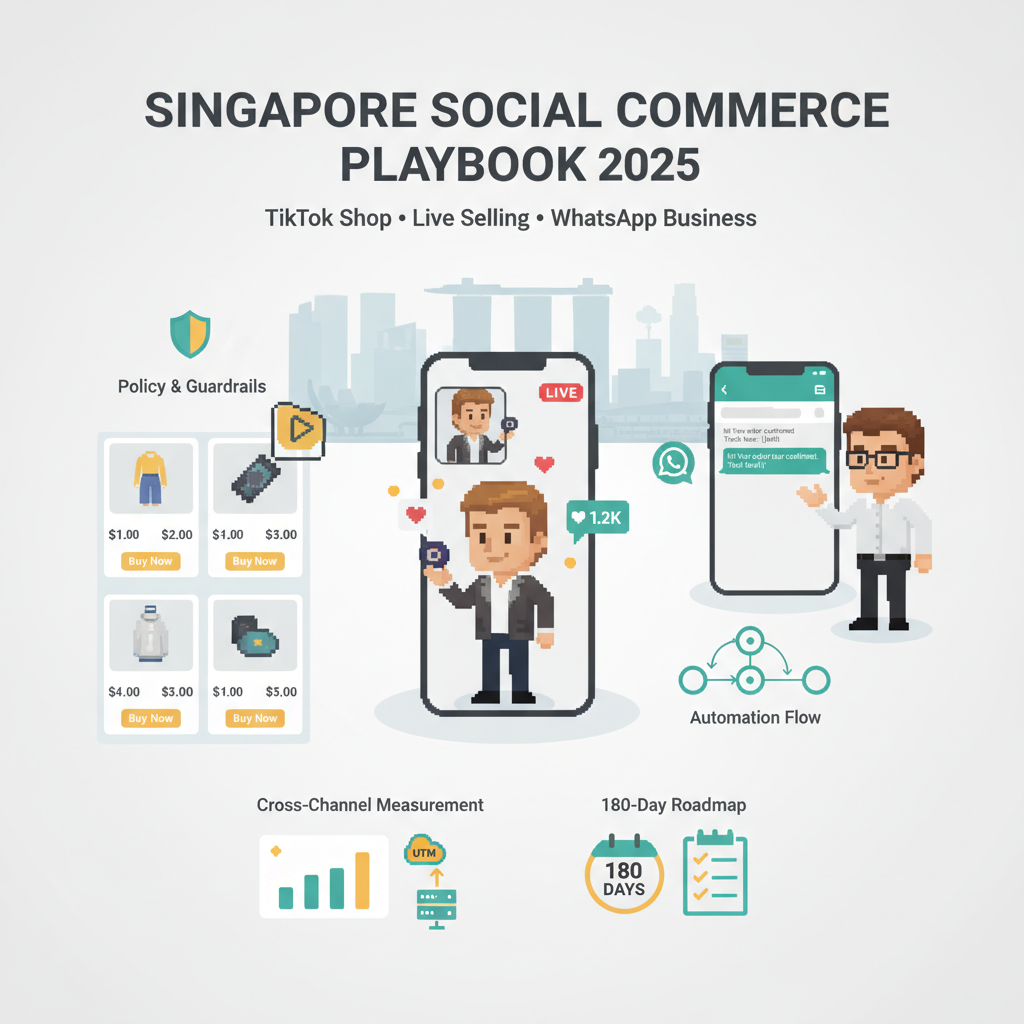
2025 is the tipping point for social commerce in Singapore and Southeast Asia. Platforms and formats that were experimental two years ago—TikTok Shop commerce features, creator-led live selling, and messaging-first commerce via WhatsApp—have matured into reliable customer acquisition and conversion channels. This playbook is for marketing leaders and e‑commerce owners across SMBs and enterprise teams who need a practical, Singapore-focused blueprint to launch, measure, and scale social commerce across TikTok Shop, live formats, and WhatsApp Business.
Key signals that make 2025 different:
- Social commerce GMV and live-commerce activity are now mainstream in Singapore, with strong 2024–2025 growth signals from local market analyses (DBS: Live Commerce — Retail’s Next Chapter (Singapore)).
- Short-form video and live formats now come with native commerce tools (shoppable overlays, product pins, creator affiliate flows), enabling one-click discovery-to-purchase journeys (TikTok Shop Seller Center: Getting Started).
- Messaging platforms are commerce-ready: WhatsApp Business supports catalogs, templates and programmatic flows that enable remarketing and fulfilment conversations at scale (WhatsApp Cloud API overview).
Table of Contents
- Understanding the Singapore social commerce landscape
- TikTok Shop Singapore: setup, features, and best practices
- Live selling in Singapore: formats, engagement, and measurement
- WhatsApp Business for ecommerce in Singapore: strategy and integration
- Cross-channel playbook: syncing TikTok Shop, live selling, and WhatsApp
- Implementation roadmap for 2025: timeline, resources, risks, and metrics
- Conclusion: Key takeaways and next steps
1: Understanding the Singapore social commerce landscape
Market overview and growth signals
Singapore’s social commerce market has moved from pilot to scale. Multiple market trackers converge on a strong 2024–2025 jump in social/live commerce share and GMV. Local analyses and trackers highlight continued growth momentum (DBS live commerce outlook (Singapore); Statista: Social commerce in Singapore). For brands, social channels are now a primary discover-to-purchase path, not a peripheral marketing channel.
Consumer behavior and timing for adoption
- Mobile-first and video-first: Singapore shoppers discover and transact on mobile; short-form video drives intent and impulse purchases. Platforms’ native shopping features reduce friction from discovery to checkout (Statista topic page).
- Cohort drivers: Gen Z and younger millennials are disproportionately engaging with short-form and live video commerce, favoring interactive formats and creator recommendations (TikTok Creator Marketplace).
- Timing: If you’re targeting consumers aged 18–35 in SG/SEA, 2025 is the time to embed social commerce into your core marketing mix—test live formats, onboard creators, and integrate messaging for post-purchase care.
Regulatory, payments, and platform context in Singapore
- Platform rules matter: Each marketplace has seller eligibility, prohibited product lists, and shipping/returns obligations that sellers must follow on TikTok Shop (TikTok Shop SG: Seller eligibility; TikTok Shop SG: Prohibited products).
- Payments and consumer protection: Payments in Singapore operate under MAS‑governed frameworks that affect settlement, refunds and PSP selection for merchants (MAS e-payments user protection guidelines; MAS payments regulation hub).
- Advertising and content codes: IMDA guidance and media codes shape what can be broadcast or promoted in live sessions and video ads; confirm compliance for regulated categories (IMDA Online Safety Code; IMDA media codes).
2: TikTok Shop Singapore: setup, features, and best practices
Account setup and eligibility
- Create a Seller Center account (choose Singapore region) and complete KYC and business documents. Follow the step-by-step guide in TikTok’s Seller Center (TikTok Shop: Getting started).
- Confirm eligibility for the product categories you intend to list (Seller eligibility; Prohibited products).
- Set up storefront, shipping templates and return policies according to Singapore rules—use the SG shipping and returns guides to set realistic SLAs and refund terms (Shipping guidelines (SG); Returns & refunds (SG)).
For a comprehensive, always-on channel strategy to support TikTok Shop launches and live selling, explore our social media services.
Creator-led content, live formats, and shoppable content
- Feature set: TikTok Shop supports shoppable product pins, live product showcases and creator affiliate links (TikTok Shop features; TikTok live shopping tips).
- Creator programs: Identify creators via Creator Marketplace and run affiliate models where creators earn commission on tracked sales (Creator Marketplace; Affiliates).
- Best practice: Pair short-form product videos (15–30s) with scheduled live sessions; use product pins during live shows and enable limited-time promo codes to convert live viewers into buyers.
Compliance, policies, and brand safety considerations
- Prohibited products and content: Adhere strictly to the prohibited products list and content rules to avoid delisting (TikTok Shop SG: Prohibited products).
- Returns, shipping and consumer expectations: Set shipping options and return windows that match local expectations; late shipments and poor returns handling can lead to penalties under TikTok’s seller policies (Shipping (SG); Returns (SG)).
- Brand safety: Vet creators’ past content, require scripts/approvals for regulated-product mentions, and embed pre-approved messaging for any health/regulated claims.
3: Live selling in Singapore: formats, engagement, and measurement
Live formats (product demos, flash drops)
- Product demo + how-to: 10–25 minute sessions focused on one hero SKU.
- Flash drop/limited bundles: short (5–10 minute) promotions with inventory-limited bundles to drive FOMO.
- Themed shows: multi-SKU lifestyle shows (20–45 minutes) with segments (demo → Q&A → bundle).
Run-of-show template (30-minute demo):
- Pre-show countdown and intro (0–3 min)
- Product feature demo and social proof (3–12 min)
- Creator testimonial + live Q&A (12–20 min)
- Offer reveal + checkout walkthrough (20–27 min)
- Final CTA and bundle close (27–30 min)
Calendar cadence: Run a pilot weekly for four weeks, then increase to bi-weekly or multiple shows per week based on demand signals.
Need help planning and producing live-ready assets? Review our video portfolio and video production services.
Engagement tactics and chat/interaction flows
- Scripts and prompts: “Type 1 for quick demo, 2 for bundle details, 3 for discount.” Midstream CTA: “Comment ‘BUY’ to reserve; we’ll pin the checkout link.”
- Tactics: giveaways for the first 50 comments, live-only bundles, pinned product cards, and comment-to-buy flows where supported.
- Moderation and chat flow: Assign a producer for pinned links and moderation, and a community manager to route customer messages to WhatsApp for fulfilment follow-up.
KPIs, attribution, and optimization loops
- Peak concurrent viewers and average view duration
- View-through rate and viewer retention at 5/10/20 minutes
- Add-to-cart rate during live sessions
- Conversion rate (viewers → buyers) and revenue per hour
- Refund/return rate for live orders
Optimization cadence: 48-hour debriefs, weekly A/B tests on show formats and offers, and monthly analysis to fine-tune creators, time slots, and bundles.
4: WhatsApp Business for ecommerce in Singapore: strategy and integration
WhatsApp Business features and automation
- App features: The WhatsApp Business app supports catalogs, quick replies, greeting messages and labels for small teams (WhatsApp Business features; Catalog how-to).
- Business Platform/Cloud API: For scale and automation, use Cloud API to deliver templated messages, flows, and programmatic updates (Cloud API overview).
- Templates and flows: Outbound updates require approved templates; manage templates and flows via the Cloud API (Message templates; Flows endpoints).
Customer journey funnels and messaging best practices
- TikTok live attendee clicks “Ask via WhatsApp” or a link in post-live follow-up.
- Customer opts in and receives an automated welcome and catalog entry.
- Agents handle pre-sale questions; post-order, automated templates deliver confirmations and shipping updates.
- Post-delivery: request feedback and present cross-sell bundles via catalog messages.
- Best practices: Obtain explicit opt‑in before sending marketing messages (WhatsApp opt-in guidance). Keep SLAs tight (aim for <1 hour responses during business hours). Use templates only for transactional/approved outbound notifications (Template guidelines).
Privacy, data handling, and Singapore-specific compliance
WhatsApp provides encryption and data controls for Cloud API messages—ensure data minimization and secure webhook handling (Cloud API: Data privacy & security). Treat WhatsApp as a customer data channel—persist conversation IDs and minimal purchase metadata to support fulfilment, returns and measurement while limiting unnecessary personal data capture.
5: Cross-channel playbook: syncing TikTok Shop, live selling, and WhatsApp
Content strategy and calendar alignment
90-day calendar blueprint:
- Weeks 0–4 (launch): 2–3 short-form product videos + 1 live pilot per week; promo cadence: teaser → live → recap with catalog CTA. For strategic support, see our social media services.
- Weeks 5–12 (scale): 2 weekly lives (one product-centric, one lifestyle/collection), daily short-form creative, and mid-week creator posts. Reuse assets: 15s clips, 60s demos, product pins.
Creative pillars: Education (how-to), Desire (UGC/creator testimonials), Urgency (limited bundles), Support (aftercare via WhatsApp).
Data integration, measurement, and attribution across channels
- Tracking fundamentals: Add UTM parameters to every external link and maintain consistent campaign naming (GA4 UTM guidance). Where possible, use server-side conversions (Meta Conversions API).
- Reconciling TikTok Shop: Reconcile TikTok Shop order reports with tracked UTM sessions; use TikTok’s guidance for UTMs on ad links (TikTok UTM parameters).
- Attribution: Use GA4’s data-driven attribution and reconcile with platform-reported conversions for optimization (GA4 attribution).
Explore our campaign results in the digital marketing portfolio and our broader portfolio. For end-to-end support, see digital marketing services.
Cross-channel promotion sequences and workflows
- Pre-live: Teaser short-form videos and creator posts; collect sign-ups/opt-ins via a pre-live microsite with UTM tags.
- Live: Pin product links and a WhatsApp call-to-action for concierge checkout.
- Post-live: Send order links and abandoned-cart reminders via WhatsApp templates; retarget non‑buyers on TikTok and feed with segmented creative.
Workflow roles: Producer (run the live tech and pin product cards), Community manager (triage chat and send WhatsApp opt-in links), Fulfilment coordinator (confirm orders and SLAs; manage returns per TikTok returns policy (SG)).
6: Implementation roadmap for 2025: timeline, resources, risks, and metrics
Phased rollout plan and milestones
- 0–30 days: pilot
- Register TikTok Shop, set up catalog and shipping profiles (Getting started).
- Run 1–2 pilot lives with a creator and basic WhatsApp post-sale messaging.
- Track foundational KPIs (viewers, add-to-cart, conversions).
- 31–90 days: scale
- Increase live cadence; add 2–3 creators and introduce live-only bundles.
- Implement Cloud API templates for confirmations and shipping updates (Cloud API templates).
- Integrate UTMs and server-side conversions for cross-channel attribution (Meta CAPI; GA4 UTM guidance).
- 90–180 days: optimize
- A/B test show formats, timeslots and creators; refine product assortments.
- Automate recurring flows (cart recovery via WhatsApp templates, retargeting lists).
- 180+ days: automation and AI augmentation
- Use AI for creative variants and chat summarization; build predictive replenishment for live bundle inventory.
- Formalize analytics cadence and ROI modelling.
Resource planning, team roles, and budgeting
- Lightweight squad model: Head of Social Commerce, Live producer, Creator manager, Community manager, Fulfilment liaison.
- Indicative budgets (SG/SEA): Pilot 0–30 days: SGD 5–15k; Scale 31–90 days: SGD 20–60k/month; Optimization/automation: incremental tooling (Cloud API fees, analytics integrations).
- ROI modelling: Target payback within 90 days for high-margin SKUs; measure CAC by channel and revenue per live hour to determine show profitability.
Risk management, governance, and success metrics
- Platform policy risk: Maintain a policy tracker and pre-clear regulated claims (TikTok Seller policies (SG)).
- Live show fatigue: Space shows and rotate creatives to avoid audience saturation; monitor view-to-conversion ratios.
- Fulfilment risk: Define clear SLAs and integrate local PSPs to minimize disputes (MAS e-payments guidelines).
- Success metrics (sample): Activation (time-to-first-live), Engagement (avg. view time, add-to-cart rate), Conversion (live conversion rate, revenue/hour), Operability (% messages within SLA, fulfilment success rate).
Conclusion: Key takeaways and next steps
- From pilot to core: TikTok Shop + live formats + WhatsApp are mature enough to deliver reliable revenue (DBS live commerce outlook).
- Operational readiness: Policies, shipping SLAs, and messaging opt-ins create the guardrails for trust and scale (TikTok Seller policies; WhatsApp opt-in rules).
- Measurement and integration: Use UTMs, server-side conversion APIs and reconciled platform order data to derive accurate ROIs (GA4 UTMs; Meta Conversions API).
See more insights on our blog. If you’d like a tailored social commerce launch plan for your brand—complete with a 90-day calendar, creator sourcing list, and measurement architecture—reach out to our team.