

Singapore Content Strategy: A Local Guide to Content Marketing and SEO
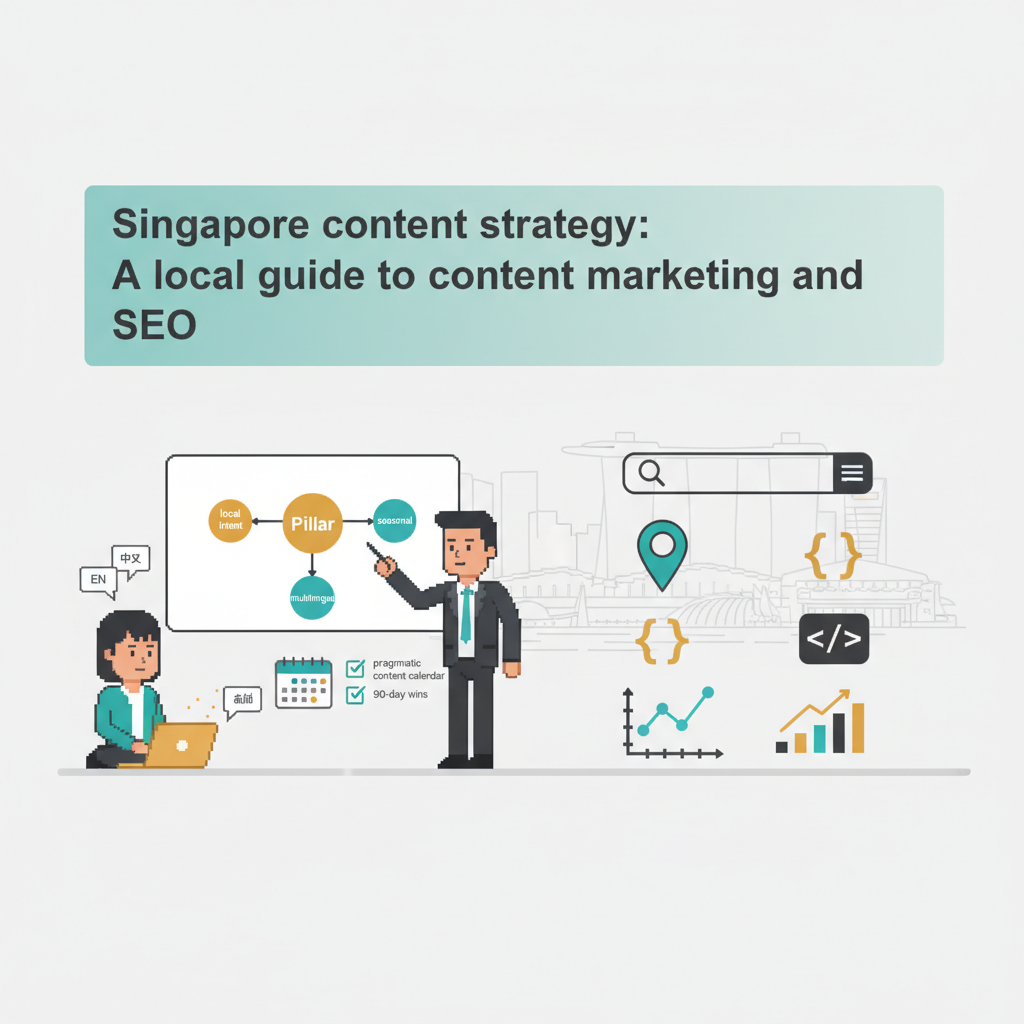
Introduction: Setting the stage for Singapore-focused content strategy
Singapore content strategy
Singapore’s digital landscape is compact, highly mobile, and intensely competitive. For marketing leaders, SEO managers, and startup founders, this means content strategies work differently here than in larger, monolingual markets. You face dense local intent (district-level searches, neighbourhood dining, regulatory queries for fintech, school-term timing for education), a multilingual audience, and seasonality driven by public holidays and commerce events (Chinese New Year, Great Singapore Sale, 11.11, and school terms). Use content to own intent at every stage of the buyer journey — from discovery (search, social) to conversion (local landing pages, bookings, contact forms) — while proving credibility through local signals, author expertise and high-quality pages.
Singapore content marketing
Content marketing in Singapore succeeds when it combines:
- Local relevance: district-level guides, Singapore-specific data, local partners and testimonials.
- Multilingual reach: English-first, then selectively Mandarin, Malay, Tamil where the target audience justifies it.
- Practical distribution: short-form video for TikTok/Instagram, search-optimized blog posts, and Google Business Profile optimisation for local visibility.
Local publishers show how combining long-form thought leadership with short-form social content builds trust and conversions in Singapore’s tightly networked market. For help executing this mix end-to-end, explore our digital marketing services and branding services.
Content calendar Singapore template
Your calendar is your north star. It must layer:
- Annual anchors (CNY, GSS, 11.11, year-end)
- MOE school-term dates for family and education content
- Language tracks (EN, ZH, MS, TA)
- Channel pairings (blog + YouTube + email + Google Business Profile posts)
Pair each content item with a distribution plan across social media marketing and search, and consider adding video assets via our video production in Singapore team.
Singapore SEO content
- Local schema (LocalBusiness), consistent NAP, and Google Business Profile optimization.
- Mobile-first performance and fast Core Web Vitals for Singapore’s mobile-first users.
- Hreflang or language subfolders to serve multilingual audiences and signal intent to Google.
Ground your approach in Google Search Essentials and creating helpful, reliable, people‑first content to align with E‑E‑A‑T expectations.
Singapore hyperlocal SEO
- City- and district-specific landing pages (e.g., “F&B catering Bukit Timah”).
- Local content clusters: neighborhood dining guides, MRT-access articles, property micro-guides.
- Local citations and review acquisition (GrabFood, Google reviews, Singapore directories).
Support hyperlocal pages with structured schema, Google Business Profile posts, and internal links from pillar pages to reinforce relevance. See our portfolio for examples of integrated campaigns.
Singapore blog strategy, blog content strategy Singapore
A Singapore blog strategy should be a mix of:
- Pillar content (e.g., “Digital marketing in Singapore” hub page)
- Cluster posts that address micro-intent (local SEO, GSS campaign guides, CNY content)
- Case studies featuring local clients (F&B outlets, fintech startups)
- Multilingual FAQs and resource pages for non-English speakers
This structure drives topical authority and supports paid/social campaigns. Related reading: Mastering SEO Content Operations: A Guide for Singapore Brands.
A step-by-step local content framework (how to plan and execute)
Step 1 — Research & intent mapping
- Start with local keyword research:
- Use Google Trends (Singapore) and Think with Google APAC to spot seasonal spikes.
- Prioritise queries containing location signals and commerce events (e.g., “GSS 2025 deals Singapore”, “CNY restaurant reservations Singapore”).
- Segment intent:
- Informational: “what is local SEO singapore”
- Navigational: “Hamilton & Sherwind portfolio”
- Commercial: “best fintech marketing agency singapore”
- Multilingual check:
- Translate and validate top keywords in Mandarin/Malay/Tamil for defined audience segments.
Step 2 — Define pillars and topic clusters
Choose 1–2 pillar topics that match your business + demand (e.g., “Content marketing in Singapore”, “Local SEO Singapore”). Map 6–10 cluster topics per pillar (neighbourhood guides, how-to SEO, seasonal campaign playbooks). Produce 3–5 cluster pieces, with one local case study and one video per cluster.
Linking rule: pillar page links to all clusters; each cluster links back to pillar and related clusters. Strengthen UX and authority with strategic internal links to digital marketing services, brand strategy, and our blog.
Step 3 — Content calendar and production process (template)
Quarterly planning columns: publish window, campaign anchor (CNY/GSS/11.11/evergreen), language track (EN/ZH/MS/TA), title + intent, format (blog/video/infographic/GBP post), owner, SEO checkpoints (keywords, internal links, schema), distribution plan, KPI. Production steps: Brief → Research → Draft → Localisation → SEO review → Publish & promote → Measure & iterate.
Step 4 — On-page checklist (Singapore-specific)
- Mobile-first, pass Core Web Vitals.
- LocalBusiness or Organization schema with Singapore address/phone.
- Hreflang or subfolder strategy (/en/, /zh/, /ms/, /ta/) and correct canonicals.
- Clear H1/H2 hierarchy with local keywords where relevant.
- Author byline + author page with credentials to demonstrate E‑E‑A‑T (see people‑first content guidance).
- Local examples, territory-specific stats, and customer stories.
- FAQ with Singapore-specific Q&A to target featured snippets.
Compliance: avoid thin/doorway pages; see Google’s March 2024 core update and spam policies for what to avoid.
Step 5 — Distribution and amplification
- Organic: prioritize pillar/cluster pages and internal links; maintain Google Business Profile posts.
- Social: short-form video for F&B and retail; long-form for fintech/education. Explore our social media strategy and video production services.
- Partnerships: local media, industry bodies, and influencers aligned to cultural moments (CNY, Hari Raya, Deepavali).
- Paid: boost pillar or seasonal content with GA4-tracked campaigns to capture bottom-of-funnel intent.
Step 6 — Measurement & iteration (KPI framework)
Track Awareness (impressions, branded search), Engagement (time-on-page, scroll depth), Conversion (MQLs, bookings, downloads), and Local ROI (CPL, revenue attributed to Singapore content). Review weekly (snapshot), monthly (channel attribution), and quarterly (language strategy and gaps). Use GA4 and Search Console with Singapore filters and consistent UTM tracking.
Practical checklists and ready-to-use templates
Content calendar checklist (Singapore edition)
- Columns: campaign anchor, publish window, language, title, intent, format, owner, SEO keywords, internal links, GBP action, KPI.
- Pre-fill anchors: CNY, GSS, 11.11, year-end, MOE term dates.
- Reserve flexible slots for trending content (Google Trends “Year in Search” Singapore).
- Tag priority (H/M/L) and objective (awareness/leads/revenue).
Topic cluster checklist
- One pillar page per main service vertical or market need.
- 6–10 cluster pages mapped to long-tail local queries.
- At least one local case study per cluster (F&B, fintech, education, healthcare, real estate).
- Internal links: pillar → clusters; clusters ↔ clusters; add context links to case studies.
- Translate pillar and top clusters into language tracks where justified.
On-page SEO checklist (compact)
- Title tags include local intent terms where applicable.
- Meta descriptions mention Singapore or district if relevant.
- Hreflang or subfolder language strategy implemented.
- LocalBusiness schema with Singapore address/phone.
- Author credentials, date, and original quotes; align to Google Search Essentials.
- FAQ section addressing Singapore-specific questions.
Measurement checklist
- GA4: Singapore-only segments created and tested.
- Search Console: filter for Singapore queries and pages.
- Conversion funnels instrumented with UTM source/medium and geo tagging.
- Monthly content QA: page freshness, canonical correctness, and localization errors.
Local examples and micro-case ideas
F&B: neighbourhood-first content wins
– Example tactic: a rotating “Best hawker stalls near [MRT station]” series that links to map embeds and local GBP entries. Short videos for Reels/YouTube Shorts showing the dish + link to reservation/contact.
– KPI: GBP calls + online order links tracked.
Fintech: trust and education
– Example tactic: long-form explainers on local regulatory issues (MAS guidance) + short explainer videos. Use author bios from founders or product leads to satisfy E‑E‑A‑T.
– KPI: demo signups and high-quality leads.
Education: seasonally-aligned content
– Example tactic: “Back-to-school tuition guide Singapore (by level)” timed to school-term calendar. Multilingual summary pages for local parent segments.
– KPI: enrolment inquiries, webinar signups.
Healthcare: patient education and local clinics
– Example tactic: condition-focused pages with local resources (clinic addresses, appointment booking), translated FAQs, and patient testimonials. Local schema + GBP optimisation.
– KPI: appointment bookings and referral traffic.
Real estate: neighbourhood guides
– Example tactic: “Living in Pasir Ris — schools, commute, food” combining market data, commute times, and local amenities. Use local datasets and property portals to support claims.
– KPI: contact forms and valuation requests.
Quick wins checklist (first 90 days for an SME/startup in Singapore)
Week 1–2
- Audit existing site for mobile speed and Core Web Vitals.
- Ensure GBP is claimed and optimised (photos, services, posts).
- Create 1 Singapore pillar page and 2 hyperlocal cluster pages.
Week 3–6
- Translate the pillar into Mandarin if the audience supports it.
- Add LocalBusiness schema and NAP consistency checks.
- Publish one local case study (F&B/fintech/education example).
Week 7–12
- Launch a seasonal campaign tied to the next major event (CNY/GSS/11.11).
- Run a short paid search/social test to amplify the pillar page and track local conversions.
- Review KPIs and adjust content calendar for the next quarter.
FAQ
What is the single most important change to content strategy for Singapore?
The most impactful change is localising both intent and format: build district-level content, optimise GBP, and create short-form video aligned to Singapore cultural moments (CNY, GSS) while keeping an English-first multilingual approach.
How should I prioritise English vs Mandarin vs Malay vs Tamil content?
Start with English for broad reach. Prioritise Mandarin for FMCG/F&B and certain community segments, Malay for community and family-focused campaigns, and Tamil where community signals justify it. Use analytics and small tests to validate demand before scaling.
How do I measure the ROI of local content efforts?
Track Singapore-specific sessions and conversions in GA4, measure local lead quality (MQLs/SQLs), attribute revenue to content via UTM tracking, and compare CPL and ROAS for local campaigns.
What does E‑E‑A‑T mean for SMEs in practice?
Show real experience (case studies), expertise (author bios), authoritativeness (local partnerships and media), and trust (contact info, clear terms). Use credentials for authors and cite local data where possible.
Do I need separate pages for each district in Singapore?
Only if there is user demand and distinct intent (e.g., “bakery near Tiong Bahru” vs “bakery near Jurong”). Consolidate similar pages and avoid thin doorway pages; consider a neighbourhood hub with sub-pages where warranted.
Conclusion: Key takeaways for implementing in Singapore
Singapore demands a content strategy that is local-first, multilingual-aware, and seasonally aligned. Build a pillar+cluster architecture, prioritise hyperlocal landing pages and Google Business Profile optimisation, and demonstrate E‑E‑A‑T with author credentials and Singapore case studies. Use the checklists above to operationalise a repeatable process: research and intent mapping, topic clustering, multilingual production, local schema and GBP, promotion, and measurement with GA4 and Search Console.
Explore how we can help: our services, digital marketing services, brand strategy, social media marketing, video production, and recent case studies. For more insights, visit the Hamilton & Sherwind blog.
Contact us to build your Singapore content strategy.