

SEO Content Strategy for Singapore: A Practical Roadmap to Rank and Engage in SEA
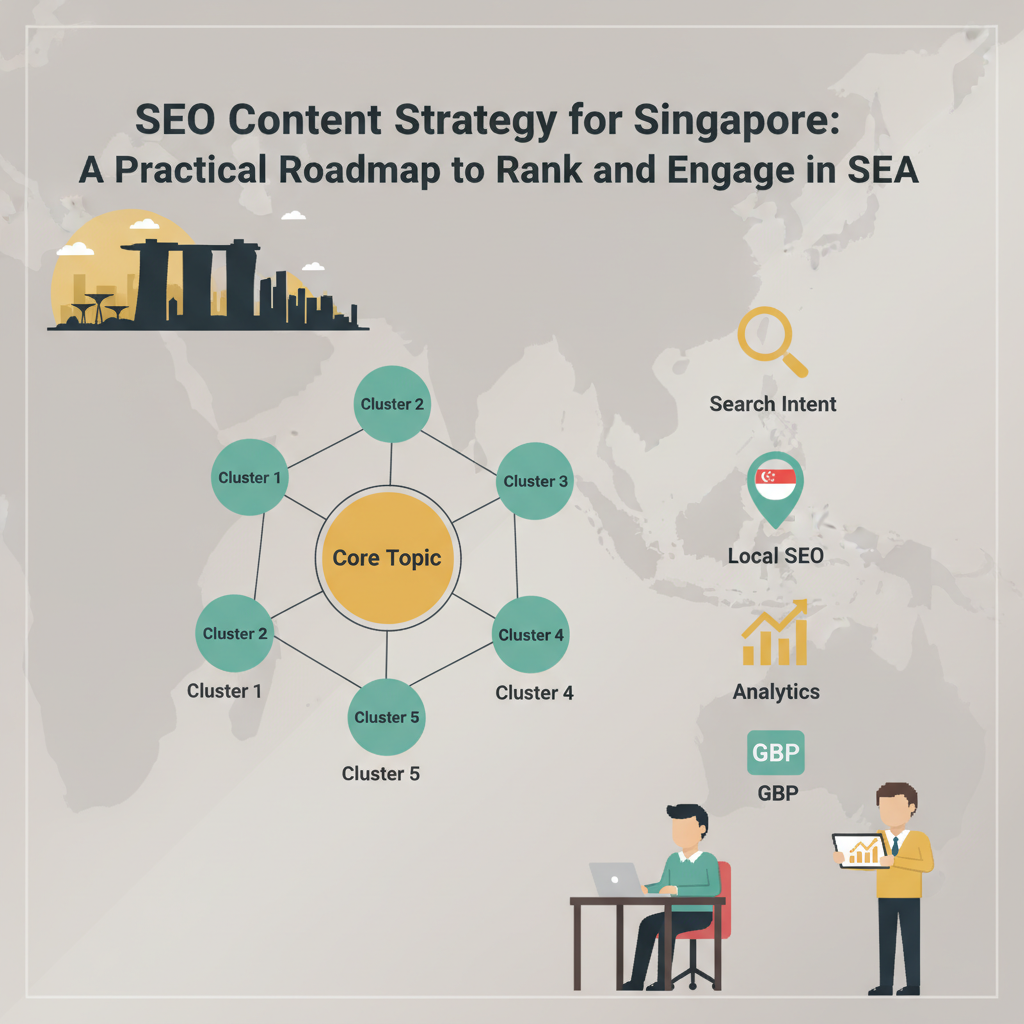
SEO content strategy is the operational plan that turns keywords, content and on-site signals into measurable business outcomes. For marketers in Singapore and Southeast Asia, the technical and creative elements are the same as global best practice—but local signals, language variants, platform preferences and regulatory context change priorities and execution. This guide gives a step-by-step, practical roadmap for building a content SEO program that aligns to business goals, serves search intent across the funnel, and scales through topic clusters, AI-assisted workflows (with human editorial review), content governance and measurement.
Read this if you lead content, SEO or digital marketing in Singapore/SEA and need a playbook that balances strategy and execution: an actionable framework, sector examples (finance, property, F&B, tech), checklists for on-page SEO Singapore, and a starter SEO content calendar you can adapt.
Foundations of SEO Content Strategy in Singapore
What is SEO content strategy? Core components and purpose
- Definition and purpose: An SEO content strategy combines keyword research, search intent mapping, topic clusters, on-page optimization, and a publishing/maintenance cadence to attract qualified organic traffic and convert it into business outcomes.
- Core components:
- Topic clusters and pillar pages (establish topical authority)
- Search intent mapping (informational → transactional)
- On-page SEO (titles, H tags, schema, local markup)
- Content production & editorial governance (roles, AI-assisted drafts, human review)
- Measurement and optimization cycles (audits, dashboards, ROI)
- Why it matters in Singapore: small geography but high competition, mobile-first users, multilingual segments (en‑SG, zh-Hans-SG, ms-SG, ta-SG), and strong local signals (Google Business Profile, local citations).
Linking strategy to business goals and customer journeys
- Map content to business goals: awareness, consideration, conversion, retention.
- Search intent framework: Informational → pillar and cluster posts (how, why, definitions); Commercial investigation → comparison, buyer’s guides, case studies; Transactional → product/service pages and optimized CTAs; Local transactional → local landing pages, GBP-anchored pages
- Topic cluster approach (step-by-step): 1. Topic selection: choose 2–3 pillar topics most aligned to revenue (e.g., “SaaS SEO for Singapore SMBs”). 2. Cluster ideation: list 8–12 cluster topics that answer long-tail questions (use keyword research Singapore tools). 3. Internal linking: link every cluster back to the pillar and cross-link within the cluster. 4. Measurement: track topic visibility and conversions at pillar and cluster levels.
Team roles and workflows for execution
- Essential roles:
- SEO/content strategist — defines pillars, search intent maps, KPIs (SEO strategy Singapore).
- Content producers — write drafts aligned to SEO writing guidelines.
- Editors/localization specialists — verify tone, language variants, local facts.
- Technical SEO/developers — implement schema, hreflang, and page speed fixes (on-page SEO Singapore).
- Data analyst — builds GA4/Search Console dashboards and measures ROI.
- SMEs and compliance/legal — sign off on regulated sector content (finance, health).
- AI-assisted workflow (human-in-the-loop): 1. Ideation: AI generates topic ideas and meta suggestions; strategist refines against topic clusters. 2. Briefing: create a structured brief (keywords, intent, CTAs, E‑E‑A‑T notes). 3. First draft: AI-assisted draft produced with source prompts; writer edits for accuracy and tone. 4. Editorial review: editor checks facts, compliance, localization, and E‑E‑A‑T signals. 5. Final QA & publish: technical checks, schema/hreflang verification, GBP update if applicable. 6. Post-publish optimization: monthly or quarterly refreshes, with AI-assisted suggestions and human approval.
- Governance essentials: define allowed AI uses, maintain versioning, retain audit logs, and require SME verification for sensitive topics.
Need hands-on help executing this roadmap? Explore our Digital Marketing services to accelerate implementation.
Singapore-specific Considerations and Best Practices
Local SEO signals and on-page optimization for Singapore
- Language and hreflang: default to en‑SG; add zh‑Hans‑SG, ms‑SG, ta‑SG where justified. Implement hreflang correctly.
- LocalBusiness and structured data: LocalBusiness/Organization schema with Singapore address, SGD currency where relevant, phone numbers in local format, and opening hours. Use FAQ/Product/Article schema where applicable for rich results.
- Google Business Profile (GBP): claim and verify your GBP; keep NAP consistent across site and directory listings (local SEO Singapore). Populate services, use posts and offers, and respond to reviews to improve local signals.
- On-page SEO Singapore checklist:
- Title/meta: include local modifiers (e.g., “in Singapore”, neighborhood names).
- Headers: map to search intent and use conversational SG phrases.
- Local imagery and examples: use footage, examples and case studies from Singapore.
- Speed & UX: mobile-first optimization; use a Singapore CDN or regional hosting for lower latency.
- Currency & contact: display SGD pricing/options and Singapore contact methods (WhatsApp, local hotline).
Content formats and channels for SEA audiences
- Prioritize formats per intent and audience:
- Awareness: long-form guides, explainer videos, thought leadership on LinkedIn and YouTube.
- Local discovery: GBP posts, local landing pages, short-form video (TikTok/IG Reels).
- Consideration: calculators, comparison pages, webinars/case studies.
- Decision: landing pages, pricing tables, localized contact flows (WhatsApp Business).
Example: a property agency in Singapore pairs a pillar “Guide to Buying Property in Singapore” with neighborhood video tours on YouTube and GBP neighborhood posts to drive local discovery and leads.
Content planning, calendars, governance, and cross-team collaboration
- Content calendar structure: Columns: publish date, asset type, market (en‑SG/zh‑SG), primary keyword, search intent, owner, status, promotion channels, target KPI.
- Cadence: publish 1 pillar + 2–4 clusters per quarter per pillar; weekly GBP posts and 1–2 short videos/month for local engagement.
- Governance and SOPs: Editorial style guide; AI usage policy; RACI matrix; quarterly SEO content audit.
- Cross-team rituals: Weekly pipeline sync (content + SEO + product); Bi-weekly measurement review; Quarterly governance review for AI and regulatory changes.
Implementing the SEO Content Strategy in Singapore/SEA
Step-by-step framework to get started (6 steps)
- Baseline audit (Week 1–2): Inventory SG-facing content, GBP entries, language variants, and technical health. Tag pages by topic cluster and funnel stage (SEO content audit).
- Define goals and KPIs (Week 1–2): Set market-specific KPIs: organic sessions from SG, SG keyword rankings, GBP interactions, and conversion metrics (forms, calls, bookings).
- Pillar and cluster planning (Weeks 3–6): Choose 1–2 revenue-aligned pillar topics and 6–12 cluster pages. Create briefs emphasizing search intent and E‑E‑A‑T (author bios, case studies).
- Publish with governance (Weeks 3–12): Use AI to accelerate drafting but enforce editorial gates: fact-checking, SME review, and localization. Implement on-page SEO Singapore items before publish (schema, hreflang, meta).
- Measure and iterate (Ongoing): Build GA4 + Search Console dashboards and link to CRM events for attribution. Run monthly checks for CTR, impressions, and local conversions; quarterly content audits to prune and refresh.
- Scale with control (Quarterly+): Expand pillar clusters, add language variants based on ROI, and refine AI governance using audit trails and quality KPIs (content pass rate after editorial review).
SEO writing guidelines (short)
- Start with intent: craft an opening that answers the searcher’s question within the first 100–150 words.
- Use en‑SG phrasing and local examples when targeting Singapore queries.
- Add local proof points: Singapore client names (if permitted), case studies, data points, and testimonials.
- Keep paragraphs short, use descriptive H2/H3s, and include schema-ready FAQ sections for common queries.
- Always include a clear local CTA (phone/WhatsApp/local form).
Measurement and reporting essentials
- Minimum measurement stack: GA4 (behaviour & conversions), Google Search Console (query-level insights), Looker Studio (dashboards), GBP analytics for local signals.
- Key KPIs: organic sessions from SG, SG keyword rankings, GBP interactions, content-assisted leads, and content ROI.
- Attribution approach: begin with a position-based or time-decay model, move to data-driven attribution when volume allows; always validate with experiments.
Practical examples and quick wins
SME quick wins: Claim and optimize GBP; build or update local landing pages with SGD pricing and local CTAs; run short-form video experiments to bring traffic to local content.
Enterprise quick wins: Launch a Singapore pillar with linked clusters and multilingual hreflang implementation; formalize AI governance and content review SOPs; build SG-specific dashboards and report ROI to leadership quarterly.
Final note on trust, E‑E‑A‑T and privacy – E‑E‑A‑T matters: include visible author experience, local case studies, partnership logos, and transparent updates. That combination builds credibility in Singapore’s informed market. AI helps scale but cannot replace local expertise. Maintain strict editorial review and SME approval, especially in finance, property and regulated verticals. Maintain a simple, clear privacy posture and consent controls for forms and messaging—keep privacy mentions generic in public content while following regional requirements internally.
Strong internal CTA Ready to accelerate your SEO content strategy in Singapore? For a tailored 8–12 week rollout (content calendar, pillar + cluster topics, and measurement dashboards) contact Hamilton & Sherwind — we help Singapore and SEA teams turn SEO strategy into measurable growth. Contact Hamilton & Sherwind to start the conversation and request a custom plan.
Content Finalized
[Note: The content above has been prepared for publication on Hamilton & Sherwind’s website.]
References
Talk to Hamilton & Sherwind
Want an 8–12 week rollout with a content calendar, pillar + cluster plans, and dashboards for Singapore? Contact us and we’ll design a plan that maps directly to your metrics.