

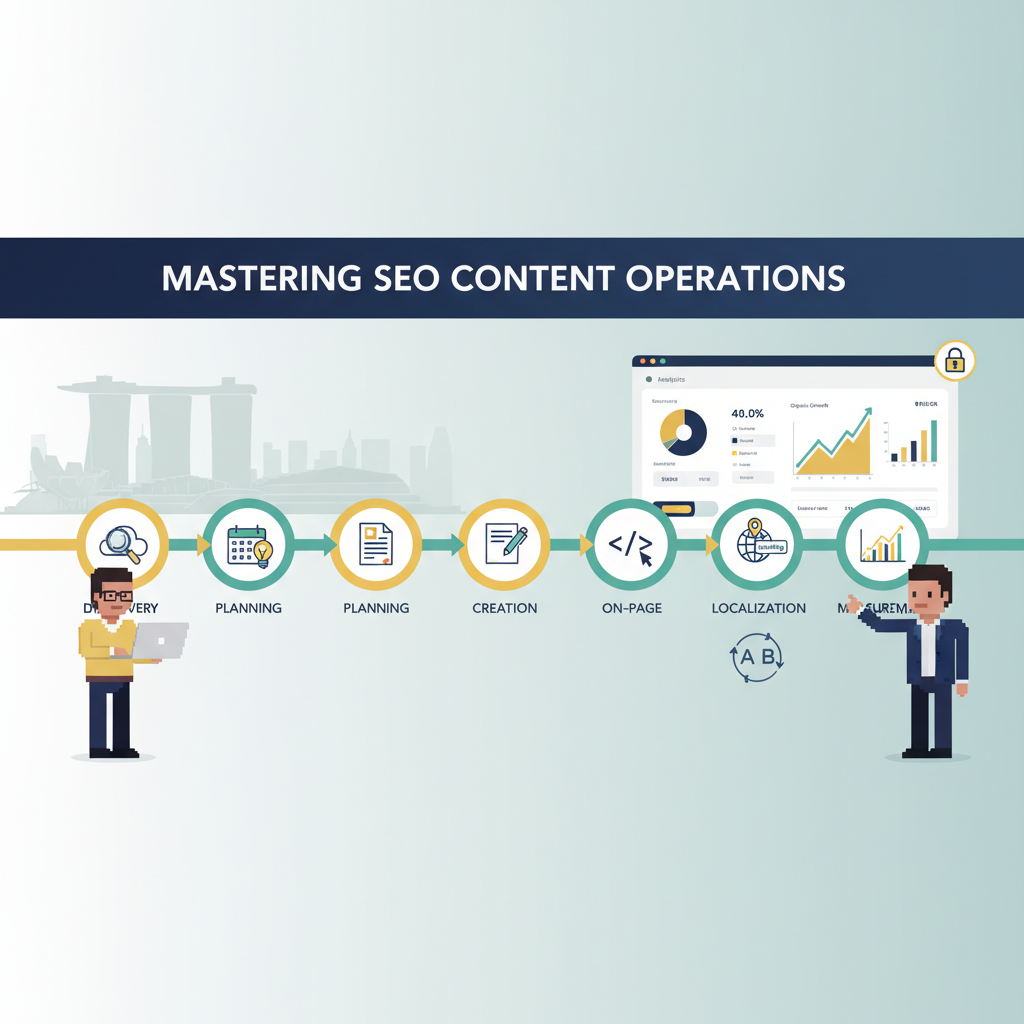
Mastering SEO Content Operations for Singapore Brands: A Practical Guide
Executive summary
Mastering SEO content operations is about turning editorial discipline, technical SEO, and measurable experimentation into predictable growth in organic search—especially for Singapore and the broader Southeast Asia region. This practical guide translates global best practices into SEA-ready playbooks, with local insights on language, culture, regulatory considerations, and regional platforms. The aim is to help marketing leaders, content leads, and founders scale organic traffic and content production while maintaining quality controls and a clear ROI.
- Build a centralized, cross-functional Content Operations model that tightly couples discovery, creation, optimization, publishing, and measurement.
- Localize thoughtfully for Singapore and SEA: multilingual considerations, cultural nuances, and region-specific search behavior matter as much as core SEO.
- Start with a data-informed discovery, maintain a robust editorial calendar, and embed SEO into briefs from day one.
- Use a controlled experimentation loop to drive continuous improvement while aligning with local advertising norms and privacy requirements.
- Leverage trusted sources like Google Search Central for fundamentals and practical SEA tactics from Ahrefs and Semrush. Ground localization and governance in credible government datasets and local guidelines.
Introduction: Mastering SEO content operations in Singapore
Singapore’s digital market is sophisticated, mobile-centric, and highly results-driven. For marketing leaders and founders, SEO content operations (SSEO) is the systematic practice that translates editorial creativity into measurable organic growth. The field blends content strategy, editorial discipline, technical SEO, data science, and cross-functional collaboration to deliver scalable, high-quality content that ranks well, engages readers, and drives business outcomes.
Singapore-specific context matters: English remains the dominant language for search, but a sizable segment consumes content in Mandarin, Malay, and Tamil. Singapore’s multilingual landscape adds nuance to keyword strategy and localization. Local search features—maps, local packs, and Google Business Profile (GBP) presence—play a meaningful role in visibility for nearby brands. Aligning content operations with privacy norms and local advertising practices ensures you can scale without friction. In short, SEA leaders should treat SEO content operations as a repeatable system with governance, localization, and clear ROI.
Checklist
- Cross-functional Content Ops team with defined roles
- Discovery brief and keyword map linked to a prioritized editorial calendar
- SEA-specific KPIs and a lightweight measurement dashboard
- Localization plan: glossaries, QA, hreflang, cultural adaptation
- Privacy-aware analytics and data governance
What is SEO content operations and why it matters in Singapore
SEO content operations is the end-to-end system that aligns content planning, creation, optimization, distribution, and measurement to deliver sustainable search visibility and business outcomes. In Singapore and the broader SEA region, rapid digital adoption, strong mobile usage, and a competitive multilingual market make a well-governed Content Operations approach especially valuable. The goal is to fuse editorial discipline with technical SEO, data-driven decision making, and cross-functional collaboration so that every piece of content serves both user intent and business metrics.
The role of content teams and SEO in the Singapore market
- Editorial creates value and relevance; SEO ensures discoverability and structural alignment. In Singapore, this collaboration must consider multilingual needs, precise local intent, and the integration of map packs into visibility strategies. See Google Search Central guidance on creating helpful content.
- Cross-functional alignment is essential. Editorial calendars, keyword plans, and localization standards need to be codified so new team members can contribute quickly. In SEA markets, the speed of localization and the ability to adapt to local events (festivals, regulatory updates) matter as much as base SEO mechanics.
Common challenges and how to address them
- Siloed teams: Break down silos with shared briefs, templates, and joint review cycles. Establish SLAs between content, SEO, analytics, and product teams.
- Localization complexity: Build a localization pipeline with glossaries, translation QA, and hreflang best practices. Treat localization as a first-class citizen in planning.
- Governance at scale: Create reusable templates (briefs, QA checklists, style guides) and a centralized content calendar to maintain consistency across markets and languages.
- Privacy and compliance: Ensure transparency around data usage and consent. Reference PDPA data protection obligations for analytics and personalization guardrails.
- Local search dynamics: Optimize GBP and local pages for visibility in Singapore. See What is a Google Business Profile? and Local pack ranking factors.
Singapore-centric benchmarking and planning can be grounded in credible sources like Data.gov.sg for market context.
Checklist
- Shared editorial and SEO templates and SLAs
- Localization pipeline and QA including hreflang mapping
- Privacy-aware analytics and consent management
- GBP optimization plan for local discovery
- Use local datasets (e.g., Data.gov.sg) to inform content and localization
Key steps in the SEO content operations workflow
Discovery and research
- Define business outcomes (e.g., qualified leads, revenue impact) and translate into content KPIs.
- Map primary and secondary keywords to user intents across Singapore audiences.
- Benchmark competitors and identify content gaps. See Google’s guidance on helpful content and practical keyword research via Ahrefs: How to use keywords for SEO.
- Outputs: discovery brief, keyword/topic map, prioritized topic list with localization notes.
Editorial calendar and content pipeline
- Calendar spine covers campaigns, holidays, and SEA events; integrate localization milestones.
- Pipeline: briefs → outlines → drafts → reviews → SEO checks → publishing → distribution → post-publish optimization.
- Governance: templates for briefs, QA, localization, and SEO checklists to ensure consistency and speed.
- Connect plans to a measurement blueprint and feedback loop.
Checklist
- Editorial calendar with SEA seasonality
- Documented production workflow and owners
- Localization QA and hreflang included
- Measurement blueprint aligned to goals
- Post-publish playbook for updates and internal linking
From planning to performance: Crafting an effective SEO content strategy
Aligning goals with business metrics
- Translate growth goals into content KPIs (organic sessions → qualified leads → revenue).
- Create a measurement model from inputs and activities to outputs and outcomes.
- Use OKRs to tie content to business value and conversion outcomes.
- Map content to the funnel: discovery, engagement, conversion, revenue.
Integrating with teams and tech stack
- Define cross-functional roles and SLAs across Strategy, Editorial, SEO, Analytics, Localization, and Design.
- Embed keyword targets, intent, and internal linking plans into briefs and outlines.
- Adopt a stack that scales in SEA: CMS with localization, keyword tools, GA4, GSC, and collaboration systems.
- Build multilingual capabilities with localization QA and hreflang workflows.
Explore how our team supports the full journey from strategy to production and measurement via Digital Marketing services and review outcomes in our portfolio. Learn more about Hamilton & Sherwind.
Checklist
- Documented roles, SLAs, and cadence
- Brief templates with SEO inputs and internal linking plan
- SEA-ready stack (CMS, GA4, GSC, Ahrefs/Semrush, dashboards)
- Localization QA and hreflang configured
- Experiment log and governance
Content creation and copywriting best practices
Editorial guidelines
- Define personas, voice/tone, and standard content formats.
- Maintain a quality checklist for factual accuracy, usefulness, originality, and credible sourcing.
- Ensure accessibility (clear structure, alt text, captions) and mobile-first readability.
- Plan Singapore/SEA language conventions; use Singlish sparingly and appropriately for audience fit.
On-page optimization and keyword usage
- Place the primary keyword in title, first 100 words, at least one subheading, and naturally in body copy.
- Use semantic keyword families to strengthen topical authority; avoid stuffing.
- Use descriptive anchor text for internal linking and build hub-and-spoke structures.
- Optimize images and media with concise alt text and filenames; ensure Core Web Vitals are healthy.
- For multilingual content, tailor keywords per language and apply correct hreflang signals.
Checklist
- Keyword placement and semantic coverage
- Internal link plan executed
- Media optimized (alt, filenames, compression)
- Core Web Vitals monitored
- Language-specific keywords and hreflang
Measurement, KPIs, and optimization
Metrics to track and reporting cadence
- Awareness: impressions, clicks, CTR, SERP feature presence.
- Engagement: time on page, pages/session, bounce, scroll depth.
- Conversion: form fills, trials, purchases; content-influenced revenue.
- Technical: Core Web Vitals, mobile performance, indexing, crawl health.
- Governance: transparent analytics and consent management.
Use Google guidelines as north star and augment with practical measurement guidance from Semrush on keyword mapping and Ahrefs.
Experimentation and iteration
- Adopt a PDSA loop: Plan, Do, Study, Act; maintain an Experiment Log.
- Test on-page elements, content formats, UX, localized landing pages, and technical improvements.
- Time tests around SEA seasonality (festivals, holidays, term-time shifts).
Checklist
- Hypothesis and success metrics defined
- Control/test groups and timelines
- Significance checks and qualitative feedback
- Rollout or iterate based on results
- Document learnings
Localization and technical considerations for Singapore
Localization strategies and cultural considerations
- Use hreflang for language/region variants (e.g., en-SG, ms-SG, ta-SG) with cross-references and x-default.
- Localize content purposefully; adapt examples and norms to improve resonance.
- Create glossaries and translation memories; bake localization QA into editorial workflow.
- Use Singapore-centric examples and inclusive visuals; avoid stereotypes.
- Ensure accessibility across languages (alt text, clear formatting).
Technical content optimization for local search
- Localize titles, metas, headings, and copy for Singapore relevance while maintaining readability.
- Implement hreflang clusters correctly and set canonical relationships to avoid duplication.
- Use appropriate schema (LocalBusiness, FAQPage, HowTo) and maintain accurate GBP details.
- Optimize hosting, speed, and latency for Singapore; consider edge caching.
- Ground localization decisions in credible local data (e.g., Data.gov.sg).
Checklist
- Hreflang map and QA validated
- Localized schema and GBP readiness
- Fast, mobile-first experience
- Local datasets inform content
- Consistent NAP and local pages
Conclusion: Taking action—next steps for implementing SEO content operations in Singapore
To translate this framework into results, start with a clean, SEA-focused playbook: establish a cross-functional Content Ops team, codify discovery and editorial processes, and implement a localization and measurement framework that reflects Singapore’s realities. Tie business goals to content outcomes with a transparent KPI hierarchy, then embed an experimentation loop to drive continuous improvement. Ground localization decisions in credible data and official guidance, combining Google Search Central principles with Singapore’s open data and PDPA guidelines. This approach enables scalable growth in organic traffic and meaningful ROI for Singapore brands.
References and further reading
- Creating helpful content (Google Search Central)
- Helpful Content Update (Google)
- Managing multi-regional sites with hreflang
- What is a Google Business Profile?
- Local Pack ranking factors
- PDPA data protection obligations
- Data.gov.sg — Singapore’s open data platform
- Guide to data.gov.sg
- Ahrefs: How to use keywords for SEO
- Ahrefs: Keyword Research
- Semrush: Keyword Research
- Semrush: Keyword Mapping