

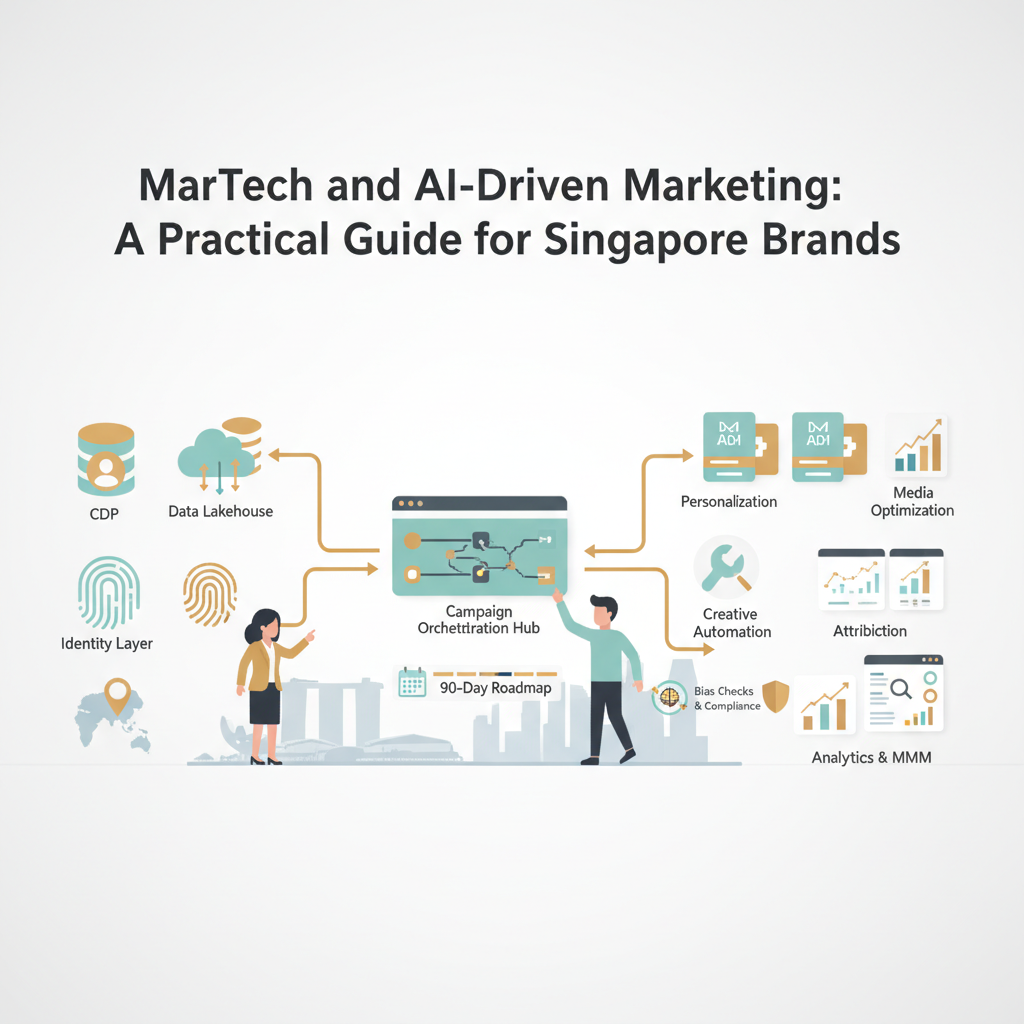
MarTech and AI-Driven Marketing: A Practical Guide for Singapore Brands
MarTech—the confluence of marketing, technology, and data—has moved from a niche capability to a core growth driver for brands in Singapore and across Southeast Asia. Marketers are shifting from siloed channels to integrated platforms that unify data, automate campaigns, and derive measurable insights at scale. The outcome is faster decision-making, more personalized customer experiences, and clearer proof of marketing’s impact on growth.
For help activating these capabilities, explore our digital marketing services and broader view of our services.
What is MarTech and why it matters for Singapore marketers
Definition and scope
MarTech stands for marketing technology—the tools, platforms, data, and processes that enable modern marketing. It spans data foundations, activation technologies, and operating models. In Singapore and the broader SEA ecosystem, MarTech is increasingly a company-wide capability that aligns customer insight with business outcomes, enabling faster experimentation and more consistent customer journeys.
Evidence shows personalized, data-driven experiences are central to growth, as noted in McKinsey’s analysis on personalization.
MarTech stack components
Data integration and data platforms (CDP, lakehouse, identity)
- Customer data platform (CDP): Builds unified profiles from first-party data for real-time segmentation and activation. See Segment’s primer on CDPs.
- Data lakehouse: Combines lake scale with warehouse governance for reliable analytics and experimentation. See Databricks’ overview of the lakehouse.
- Identity resolution: Reconciles cookies, device IDs, loyalty IDs, and emails to maintain a single view of the customer.
Practical next step: map primary data sources, define canonical IDs, and pilot a CDP use-case. Tie content to your stack via branding services and content pipelines managed through your CMS/DAM.
Campaign orchestration and automation (MAP, journeys, CMS, DAM)
Orchestration tools coordinate experiences across channels:
- Marketing automation platforms (MAPs) for email, push, SMS, and in-app.
- Journey orchestration with real-time decisioning.
- Content management (CMS) and digital asset management (DAM) for consistent asset reuse.
For channel execution support, see our advertising capabilities and social media marketing. For video-rich campaigns, explore video production in Singapore. Industry commentary from Think with Google on AI in marketing and IPA’s marketing technology stack guide offers additional context.
Measurement and attribution (analytics, MMP, MMM)
- Marketing analytics: Descriptive and diagnostic insights across channels.
- Mobile measurement partners (MMPs): Mobile attribution and in-app behavior measurement.
- Marketing mix modeling (MMM): Budget planning across channels with macro-level attribution.
Analytics-led decisioning and model-driven optimization are essential, as highlighted in McKinsey’s guidance on analytics-driven growth and Think with Google’s AI marketing insights.
AI-powered marketing capabilities
Personalisation at scale (recommendation, propensity, next-best-action)
- Content and product recommendations based on behavior and context.
- Propensity scoring for conversion, churn, and upgrades.
- Next-best-action engines that choose message, offer, and channel.
See the business case in McKinsey’s promise of personalization. For applied AI content workflows, read our Ultimate ChatGPT Marketing Guide.
Creative and content automation (genAI, content ops)
Use genAI to accelerate copy, variants, and localization with human-in-the-loop guardrails. Orchestrate workflows through content ops to scale across SEA markets. For content strategy thought-starters, explore content marketing beyond creation.
Media optimisation (bid strategies, mix modelling, incrementality)
Combine automated bidding with incrementality testing and MMM-informed budget shifts. Benchmark against analytics-led planning frameworks like McKinsey’s analytics playbooks.
Measuring success with marketing analytics
North-star metrics and leading indicators
- Revenue per user (RPU) and incremental revenue from personalization.
- LTV:CAC ratio, purchase frequency, and AOV uplift.
- Data quality (ingestion latency, completeness) and model performance (precision/recall).
Practical KPI tree for AI initiatives
- Business outcomes: revenue, margin, share
- Marketing outcomes: incremental sales, repeat purchase, AOV
- AI/ML outcomes: accuracy, calibration, uplift from AI campaigns
- Operational: pipeline reliability, retraining cadence, cycle time
- Quality and risk: guardrail adherence, bias checks, override rates
Example 90-day roadmap for a mid-market Singapore brand
- Days 1–14: Audit data sources and quality; define governance; select North-star plus leading indicators.
- Days 15–45: Implement/optimize CDP; launch a focused propensity model and control/test experiment; deploy NBA for a priority segment.
- Days 46–90: Scale personalization to more lines/markets; run incrementality tests; pilot MMM-informed budget shifts; add weekly dashboards.
Deep-dive perspectives: analytics to drive growth and Think with Google on AI marketing. For structured SEO/content workflows, see our SEO content operations guide.
Implementation playbook (Singapore/SEA context)
Build vs buy: choosing platforms and partners
Most brands adopt a hybrid approach: build core data and orchestration with a systems integrator while selecting best-in-class modules for CDP, MAP, and analytics. Consider platform flexibility, time-to-value, regional support, and total cost of ownership. Reference: IPA on the marketing technology stack. Review our portfolio and digital marketing portfolio for outcomes.
Data foundation first: consented first-party data, taxonomy, governance (non-legal)
Prioritize consented first-party data, a shared taxonomy, robust identity resolution, and governance. See the lakehouse primer and what is a CDP for foundational patterns.
Team & process: roles, skills, agile cadence, vendor management
Build cross-functional squads: MarTech lead, data engineering, analytics, marketing ops, creative/content ops, and media. Run 2–3 week sprints with demos and health checks. Learn more about Hamilton & Sherwind and how we partner across SEA.
Risks and safeguards (non-legal)
Data quality, model drift, hallucinations, bias
Mitigate with automated quality checks, model monitoring, and retraining schedules.
Human-in-the-loop reviews and A/B guardrails
Use human reviews for creative and high-stakes decisions; validate changes with controlled experiments and clear rollback plans. For execution at scale, align with paid media operations and social amplification.
Conclusion: Key takeaways for Singapore brands
- Invest in the data foundation and identity to unlock reliable analytics and activation.
- Start with a focused AI pilot, keep human-in-the-loop guardrails, and scale via experimentation.
- Measure with a KPI tree, incrementality tests, and MMM to guide budgets.
Explore more insights from our blog and our branding services that strengthen AI-driven experiences.
Ready to build your AI-powered MarTech roadmap? Talk to us.