

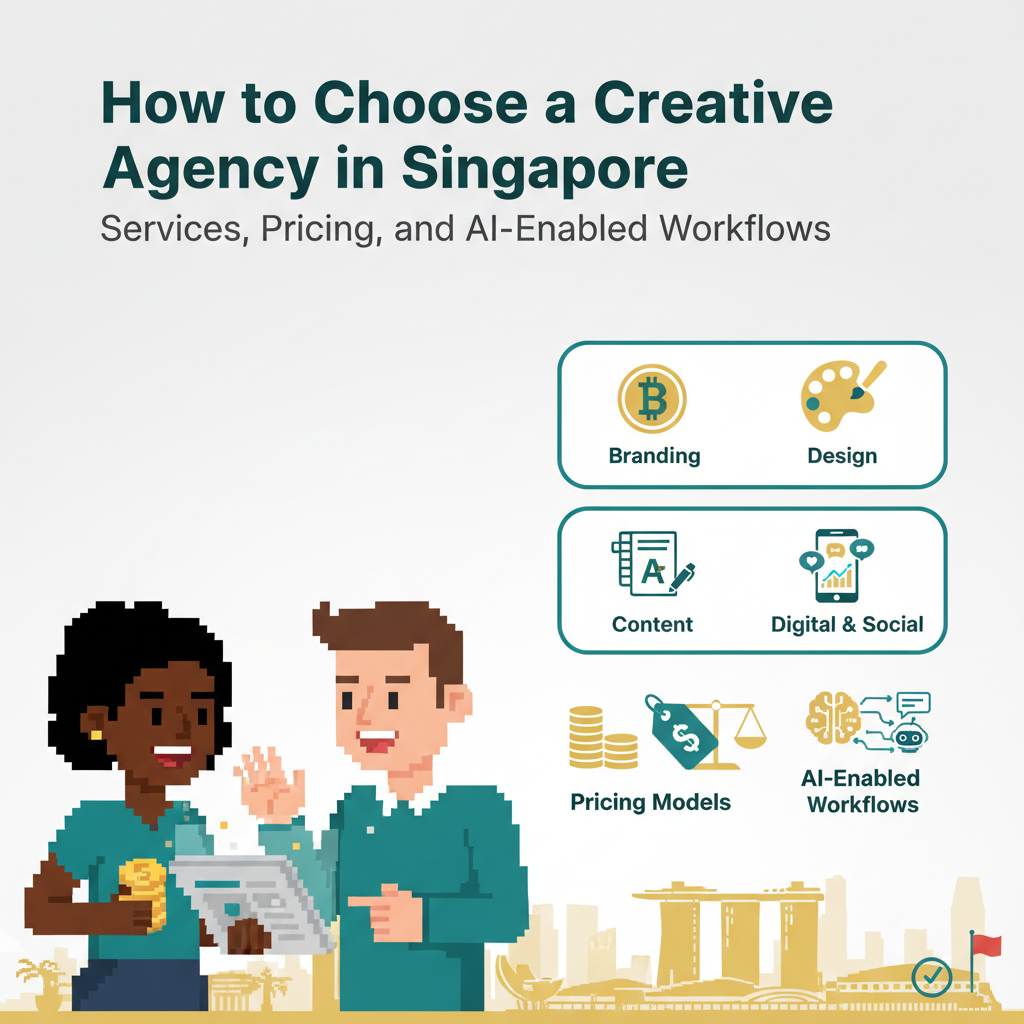
How to Choose a Creative Agency in Singapore: Services, Pricing, and AI-Enabled Workflows
The creative industry in Singapore has evolved into a sophisticated, multi-billion-dollar ecosystem that attracts regional and global talent. Whether you’re a startup looking to establish your brand identity or an established enterprise seeking to refresh your market presence, choosing the right creative agency can be the difference between a campaign that resonates and one that falls flat. This guide walks you through the landscape, helping you understand what creative agencies do, how to evaluate them, what they cost, and how to work with them effectively.
Understanding the Role of a Creative Agency in Singapore
What Defines a Creative Agency in Singapore?
A creative agency is fundamentally a design-led professional services firm that helps organizations shape how they look, sound and feel to their customers. Unlike firms that focus primarily on channel execution or paid media buying, creative agencies centre on brand storytelling, identity, visual communication and experience design.
The core value proposition of a creative agency lies in its ability to translate business objectives into distinctive, memorable brand expressions. This might involve developing a new visual identity system, crafting a brand narrative that resonates with your target audience, designing user experiences for digital products, or producing compelling video and motion content that tells your story across multiple platforms.
Singapore’s creative agencies operate within a thriving ecosystem supported by government bodies including the DesignSingapore Council, the Infocomm Media Development Authority (IMDA), and the National Arts Council. These institutions have positioned Singapore as a regional creative hub, attracting both local talent and international agencies seeking to establish Asia-Pacific operations. The city-state’s multicultural population, strong IP protection framework, and connectivity to regional markets make it an ideal base for creative work serving both local and pan-Asian audiences.
Key Differences Between Creative Agencies and Other Marketing Firms
The distinction between creative agencies and other marketing firms is crucial to understand before you begin your search. While the terms are sometimes used interchangeably, they serve fundamentally different purposes.
Creative agencies prioritize brand expression, ideas and aesthetics to shape long-term perception. Their deliverables include brand assets, creative concepts, visual systems and experience designs. Success metrics are often qualitative—brand recall, distinctiveness, engagement quality—and measured over longer timeframes.
Performance or digital marketing agencies, by contrast, prioritize acquisition, channel optimization and measurable short-term outcomes like leads, return on ad spend (ROAS), and conversions. Their teams typically include media buyers, performance marketers, SEO specialists and analytics experts. They deliver campaign plans, media buys, performance reports and conversion metrics.
The team composition reflects these different focuses. Creative agencies staff brand strategists, creative directors, art directors, designers, copywriters and producers. Marketing agencies employ media buyers, performance marketers, SEM specialists, campaign managers and analytics teams. Hybrid agencies exist that combine both capabilities, but their core competence typically leans one direction or the other.
In practice, many successful campaigns require both disciplines. A tech startup might engage a creative agency to develop a distinctive brand identity and positioning, then partner with a performance marketing firm to drive user acquisition through paid channels. Alternatively, a full-service agency might provide integrated services across both domains.
Core Creative Agency Services Offered in Singapore
Branding, Design, and Content Creation
Branding work sets the long-term strategic platform for how a company is perceived. Singapore creative agencies typically conduct stakeholder interviews, competitor analysis and audience research to define positioning and brand promise. They then design visual identity systems—logo families, typography rules, colour systems and modular asset libraries—that ensure consistency across all communications and products.
The branding process typically unfolds in phases. Discovery involves understanding your business, competitive landscape and target audiences. Strategy development produces positioning statements, brand pillars and messaging frameworks. Identity design translates strategy into visual form through logos, colour palettes, typography and imagery guidelines. Finally, brand launch combines creative concepts, launch campaigns and PR/social rollouts to introduce the new brand to audiences.
Design services extend beyond branding to encompass graphic design, packaging, UX/UI design and environmental design for retail and events. Larger agencies often include dedicated UX and front-end teams that produce wireframes, user flows and high-fidelity prototypes for websites and apps. Packaging design includes dielines, mockups and production specifications. Environmental design covers wayfinding, retail graphics and installation renderings.
Content creation—video, motion graphics, photography and long-form editorial—brings brand stories to life. Many Singapore agencies operate in-house production studios that plan, shoot and edit social-first video, long-form films and motion graphics. Content roadmaps typically span 3–12 months, with assets produced in sprints to maintain “always-on” channel presence. Some agencies also manage creator and influencer partnerships, coordinating production and ensuring brand alignment.
Digital Marketing and Social Media Marketing Singapore
Digital marketing services encompass SEO, SEM/paid search, email marketing and web analytics—all designed to drive measurable business outcomes. Singapore agencies typically employ a data-first strategy, designing conversion funnels and running 90-day optimization sprints or continuous improvement cycles.
Search and paid advertising work includes setting up and managing Google Ads and paid social campaigns, running A/B tests for landing pages, and optimizing for cost per acquisition (CPA) or ROAS. SEO specialists coordinate with content teams to produce search-optimized content and implement technical site fixes. Email marketing involves building nurture flows and campaign templates that guide prospects through the customer journey.
Social media marketing encompasses organic content programs, community management, paid social campaigns and influencer partnerships tailored to platform culture. Agencies plan platform-specific content—TikTok, Instagram Reels, LinkedIn—and produce short-form assets suited to each platform’s unique behaviors and audience expectations. Community management teams handle interactions, response protocols and social listening to inform content strategy and crisis responses. Influencer programs involve identifying creators, negotiating terms and providing creative direction to ensure brand alignment.
AI-Driven Campaigns and Automation
The integration of artificial intelligence into creative workflows is accelerating rapidly in Singapore. Agencies increasingly use AI tools to accelerate ideation, generate creative assets, personalize outreach at scale and optimize media targeting. The focus is on blending human creative judgment with AI capabilities rather than replacing either.
AI-enabled services include influencer discovery and matching, generative copy and creative variants, media optimization and dynamic creative optimization. Many agencies also pilot emerging technologies such as generative AI, AR/VR and interactive formats to keep clients ahead.
How to Evaluate and Choose the Right Creative Agency
Essential Criteria for Selection
- Strategic fit: Can the agency’s approach advance your objectives?
- Creative quality: Original, on-brand, audience-appropriate work.
- Proven results: Case studies with measurable impact.
- Delivery capability: Clear process, timelines, resourcing.
- Team expertise: Named senior talent with relevant experience.
- Local knowledge: Multicultural fluency and regulatory awareness.
- Commercial transparency: Clear fees, scope, and terms.
- Data and tech: Measurement, analytics, martech integration.
- Legal/IP clarity: Ownership, creator rights, data handling.
- Chemistry and responsiveness: Communication and pragmatism.
Questions to Ask During the Vetting Process
- Discovery and strategy approach, inputs, timelines, and examples of impact.
- Walkthrough of relevant case studies with metrics and role clarity.
- Team structure, named personnel, and project management process/tools.
- Integration of organic/paid social, analytics stack and ROI proof.
- Use of AI tools, quality control, IP management, and compliance practices.
Red Flags and Common Pitfalls
- Unclear staffing or unwillingness to present the actual delivery team.
- Portfolios without strategic context or measurable outcomes.
- Vague measurement answers; reliance on awards/buzzwords over results.
- Unrealistic promises (e.g., “guaranteed virality”) or suspiciously low pricing.
- High turnover, slow responses, sloppy proposals, unclear IP ownership.
- Picking purely on price, skipping pilots, or writing vague briefs without KPIs.
- Weak governance/change control; ignoring local nuances and compliance.
Decoding Creative Agency Pricing Models in Singapore
Common Pricing Structures
Project-based: Defined deliverables for a fixed fee. Good for identity, websites, campaign launches.
Retainer: Ongoing monthly fee for services and team allocation. Good for always-on programs.
Hourly/T&M: Flexible for audits/workshops/ad-hoc work.
Performance-based: Compensation tied to outcomes; harder to structure fairly but used in lead-gen contexts.
Hybrid: Combinations (e.g., base retainer + performance bonus).
Factors Influencing Cost
Scope/complexity, production value, agency reputation, team seniority, speed, media management fees, measurement/integrations, localization/compliance, third-party costs, and pilot pricing.
How to Compare Quotes Transparently
- Normalize scope via a standardized deliverables/frequency/role sheet.
- Request itemized breakdowns, assumptions, and exclusions.
- Compare effective resource cost, not just totals.
- Focus on outcomes/KPIs; check comparable case studies with metrics.
- Review SLAs, governance, IP/usage rights, and pilot options.
Indicative Singapore ranges: Basic social mgmt: ~SGD 500–1,500/month; full social retainers: ~SGD 3,000–20,000+/month; SEO: ~SGD 750–12,000/month; PPC mgmt: ~SGD 1,000–5,000+ plus 10–30% ad spend; content marketing retainers: ~SGD 5,000–30,000+; video production: ~SGD 3,000–50,000+; branding projects: ~SGD 3,000–150,000+ (scope-dependent).
The Rise of AI Marketing Agency Singapore and Workflow Automation
How AI is Transforming Creative Workflows
AI accelerates research and ideation, automates production (e.g., cutdowns, subtitles), enables personalization at scale, improves media optimization and supports predictive measurement—all while keeping humans in the loop for strategy and quality control.
Examples of AI-Enabled Services in Singapore Agencies
Influencer discovery/matching, generative copy/design variants, production automation, AI video/voice, personalization/DCO, chatbots/conversational marketing, AI SEO and predictive analytics/media optimization.
Benefits and Limitations
Benefits: Speed, scale, cost efficiency, personalization, data-driven decisions.
Limitations: Brand voice/quality needs human editing; risk of hallucinations; IP/provenance; creator authenticity; privacy/compliance; bias; homogenization; attribution complexity.
Case Studies: Successful AI-Enabled Campaigns by Singapore Agencies
Real-World Examples and Outcomes
AI-powered influencer matching for a major QSR campaign (high demand surges), airline creator collaborations optimized in real-time, and virtual influencer programs with strong engagement—all pointing to the power of AI + human oversight.
Lessons Learned and Best Practices
- Combine AI with human review for nuance and brand safety.
- Run pilots and control groups to prove incremental lift.
- Prepare ops (site, inventory) for viral surges.
- Be transparent with AI/creator disclosures; ensure compliance.
- Vet creators algorithmically and manually; measure business outcomes.
- Plan IP/licensing for AI outputs.
Expert Tips for Working with a Creative Agency in Singapore
Setting Clear Goals and Expectations
Define SMART objectives and KPIs; set scope, revisions, languages, platforms and acceptance criteria; align on milestones and governance.
Building a Collaborative Relationship
Run discovery workshops; require named core team; set weekly/monthly/quarterly rituals; provide business context; integrate the agency into relevant product/strategy sessions.
Measuring Success and ROI
Establish baselines; choose a balanced scorecard; set tracking and attribution; run controlled tests; use dashboards and QBRs; define RACI and change control; standardize feedback frameworks.
Conclusion: Making an Informed Choice for Your Business Needs
Singapore’s creative agency landscape is mature and innovation-led. The best partnerships are built on clarity, accountability, and collaboration—combining human creativity with AI-enabled efficiency to deliver measurable outcomes. Evaluate rigorously, pilot smartly, and invest in governance to maximize ROI.
Further Reading and Internal Links
- Our services for branding, social media, advertising, and content marketing
- Branding portfolio
- Video production portfolio
External References
- DesignSingapore Council
- Infocomm Media Development Authority (IMDA)
- Personal Data Protection Commission (PDPC)
Ready to discuss your brief? Contact us and we’ll help you navigate the selection process or deliver the creative solutions your business needs.