

Brand Storytelling for Singapore Brands: Frameworks, Local Narratives, and Practical Templates
Brand Storytelling in Singapore: A Practical Guide
What BRAND STORYTELLING is and why it matters in Singapore
Brand storytelling is the strategic use of narratives to convey a brand’s identity, values, and promise to customers. It goes beyond listing product features to articulate why a brand exists and how it partners with people’s lives. A robust definition aligns with Harvard Business School/Harvard Business Review thinking that storytelling is a strategic tool for communicating brand identity, values, and actions in a way that creates meaning, trust, and memory for audiences. Harvard Business School Online’s practical overview frames brand storytelling as a disciplined approach to shaping what customers understand and remember about a brand over time. HBS Online: What Is a Brand Story?; Harvard Business Review: Storytelling as a strategic tool
In business terms, stories capture attention, evoke emotion, and translate abstract values into observable actions—driving engagement and behavior. Harvard Business Review emphasizes the potential to cut through clutter and align organizational action behind a credible narrative.
Singapore-specific considerations
- Market context: Singapore is highly digital and globally oriented, with a densely connected consumer base. Local datasets like data.gov.sg support localization, segmentation, and measurement.
- Privacy and compliance: Integrate clear privacy practices and transparent data usage messaging to maintain trust in digital storytelling.
Practical framing for trust, differentiation, and lifecycle
- Build trust and credibility using customer-centric narratives grounded in values (see HBS Online, HBR).
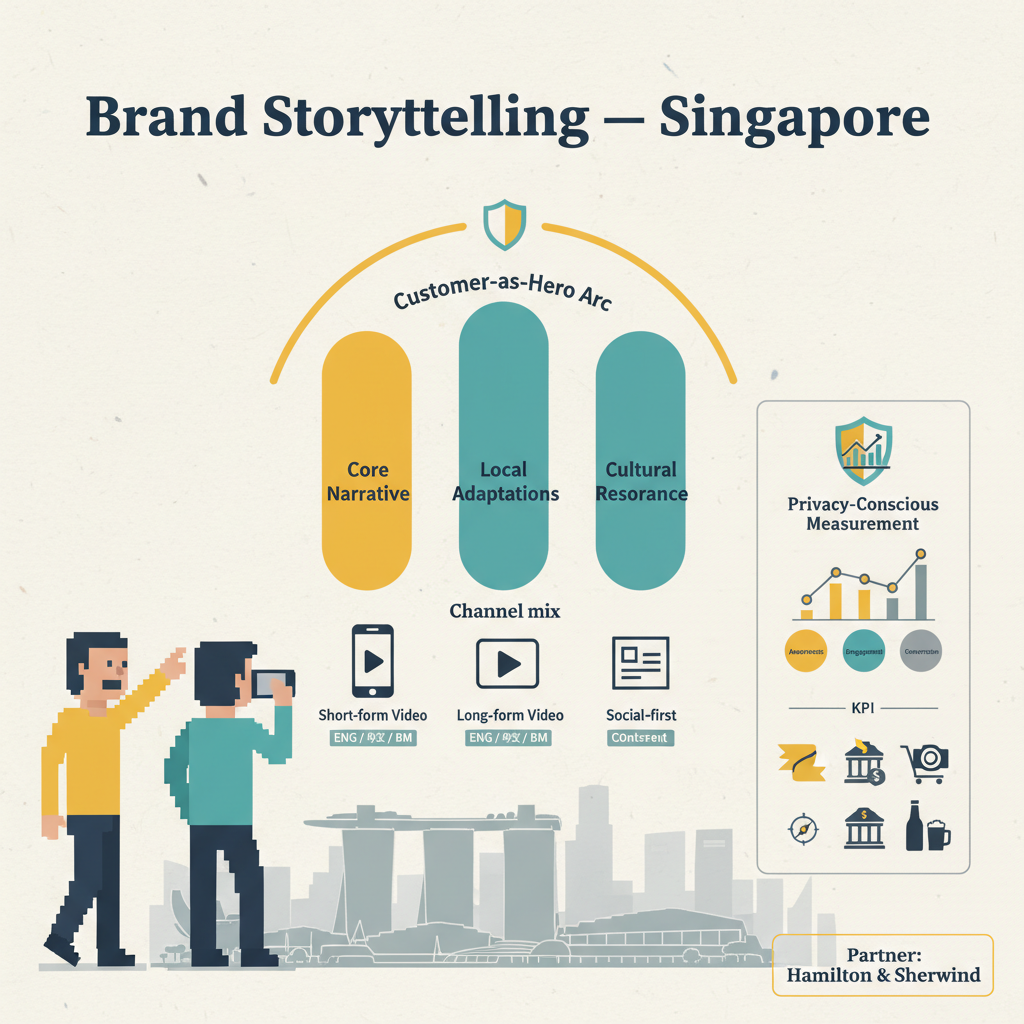
- Differentiate with a clear arc: conflict, hero (customer), plot, moral.
- Map stories to lifecycle stages to guide prospects from awareness to advocacy; ground in local data signals from data.gov.sg.
Explore our in-depth brand storytelling frameworks for implementation support.
The BRAND STORY FRAMEWORK you can apply
A repeatable framework translates your core narrative into actions across teams, channels, and customer moments. This approach blends classic narrative structure with modern branding practice for Singapore’s multilingual market.
Core narrative structures
- Three-act structure: Britannica overview
- Customer-as-hero with brand-as-guide: HBR insight
- StoryBrand framework: Seven-part messaging structure
- Hero’s journey in marketing: HubSpot guide
Narrative pillars and governance
- Purpose, Problem, Plan, Proof, Moral/Promise
- Codify in a Brand Story Bible; align marketing, product, and CX (see HBR).
Lifecycle mapping
- Awareness: short, emotional hooks (short-form video, social-first).
- Consideration: mini-episodes proving local relevance.
- Conversion: narrative that reduces friction and clarifies value.
- Retention/Advocacy: customer stories, UGC, and outcomes.
Templates and measurement
- Narrative Pillars Worksheet; Hero’s Journey Canvas; Content Format Matrix.
- Track engagement, behavior, and brand metrics; use local signals; keep privacy best practices in mind.
Localized storytelling: multicultural audiences and languages
Start with English as baseline, then assign variants for Mandarin, Malay, and Tamil when audience size and objectives justify. This aligns with Singapore’s bilingual policy (see MOE, NLB).
- Preserve intent, tone, and cultural cues when translating or transcreating.
- Use authentic local cues (e.g., hawker culture) respectfully.
- Test dialect flavor (e.g., Singlish) with panels to avoid misinterpretation.
Channel strategy and formats for Singapore’s audiences
Singapore’s digital landscape supports mobile-first, video-centric storytelling. DataReportal’s Digital 2024: Singapore notes ~5.79M internet users and ~96% penetration.
- Short-form video: 15–60s, English baseline + localized subtitles.
- Long-form video: 3–8m explainers and journeys.
- Live and interactive: Q&As, demos, carousels, polls, shoppable video.
- Platform mix: YouTube, TikTok, Instagram, Facebook, LinkedIn, X.
Regional case studies and templates
Here are SEA/Singapore-focused brand storytelling case studies across F&B, fintech, e-commerce, tourism, and education, with publicly reported campaigns and inline sources. Each case demonstrates a strategic arc, channel mix, and practical ROIs you can translate into local playbooks for Singapore brands.
Tourism: STB — Made in Singapore (MIS)
Global storytelling to position distinctive Singapore experiences. Sources: STB MIS launch; Campaign Brief Asia; TikTok MIS case.
Fintech: DBS Bank — Live More, Bank Less
DBS repositioned around lifestyle storytelling to connect banking with everyday life and outcomes, supported by cross-channel consistency and experimentation. Inline sources: DBS official materials; Think with Google case studies. DBS Live More Think with Google
E-commerce: Shopee — creator-led storytelling across SEA
Creator ecosystem to localize narratives across SEA. Sources: Shopee Premium; Campaign Asia.
F&B: Tiger Beer — You Never Roar Alone
Community-centric regional storytelling. Sources: Campaign Asia; Heineken Company.
See our Singapore video storytelling case studies for real-world execution.
Practical templates, exercises, and playbooks
- Narrative Pillars Worksheet
- Hero’s Journey Canvas
- Content Format Matrix (by lifecycle x language)
- KPI and Measurement Template
- Localization Brief Template
Conclusion: Final Reflections on BRAND STORYTELLING in Singapore
Brand storytelling in Singapore links business outcomes with cultural nuance, operational governance, and lifecycle design. Use the frameworks and templates above to create a coherent, localized, and measurable narrative program. For expert support across strategy, production, and measurement, partner with Hamilton & Sherwind.
FAQ
What is the primary keyword this article targets?
The primary keyword is “brand storytelling.” It is integrated throughout the content, including frameworks, localization, and channel strategy.
Do you include Singapore-specific data?
Yes. The article references language policy (English + Mother Tongue) and local open-data resources to ground localization and measurement. See MOE and NLB sources.
How should brands measure the ROI of storytelling?
Blend engagement and business metrics across lifecycle (awareness, consideration, conversion, retention), with benchmarks from sources like DataReportal and data.gov.sg where relevant.
Are templates provided?
Yes. Use the narrative pillars worksheet, hero’s journey canvas, content format matrix, localization briefs, and KPI dashboards.
Can this be tailored to my brand?
Absolutely. We can customize the playbook with your voice, audience segments, regional priorities, and channels.
Who should own the brand storytelling program?
A cross-functional governance team spanning brand/marketing leadership, product, CX, and data/privacy owners.
Further reading and sources:
HBS Online,
Harvard Business Review,
Britannica,
DataReportal,
data.gov.sg,
MOE,
NLB,
STB,
Think with Google,
Campaign Asia,
Heineken Company.