

AI Video Generators for Social Media: A Practical Guide to Faster, Creative Short-Form Videos (Singapore/SEA 2025)
Intro: Why AI video generators are a game changer for social media
The rise of short-form video has rewritten the tempo of social media content. Across platforms such as TikTok, Instagram Reels, and YouTube Shorts, snackable clips have become the lingua franca of scrolling feeds, prized for their immediacy, entertainment value, and shareability. This shift is driven by mobile-first consumption and the need to publish at velocity. Industry data shows marketers continue to prioritize video and see strong returns from the format (Wyzowl: State of Video Marketing 2024).
Brands are moving from episodic, long-form productions to rapid, repeatable formats that can be tested, iterated, and repurposed across channels in days rather than weeks. Many teams now produce multiple short-form videos weekly, and a growing share report using AI or automation to help with scripting, editing, captioning, and distribution (Wyzowl 2024). In Southeast Asia (SEA), high social penetration and mobile engagement further amplify the opportunity for vertical video (DataReportal: Digital 2025 Southeast Asia).
For Singapore specifically, digital adoption and social media usage are consistently high, supporting rapid testing and scaling of vertical video content (DataReportal: Digital 2025 Singapore). AI video generators help teams move faster by assisting with ideation, scripting, motion graphics, captions, resizing, voiceover, and localization—so you can go from concept to social-ready clips in days. If you’re exploring a partner to operationalise this shift, see our social media services and video production in Singapore.
What is an AI video generator?
An AI video generator is a software tool that uses artificial intelligence models to produce video content from inputs such as text prompts, scripts, URLs, or media assets. These tools can automatically generate visuals, narration or avatars, and on-screen text, then assemble them into a finished video. In practice, users can start from text, a prompt, or media and have the platform draft, render, and often translate or localize the result with minimal on-camera production.
- Text-to-video (T2V): The most common mode, where the input is text and the model generates visuals and narration to match the prompt (e.g., Synthesia: AI video generator; InVideo: AI video generator).
- Image-to-video (I2V): The model uses supplied images or media to animate or turn static visuals into video sequences (e.g., VEED: AI video).
- Template-driven editing: Many AI video generators pair AI generation with templates and editors to customize scenes, add captions, branding, and post-production polish.
Use AI video generators as a starting point to rapidly storyboard and script, then apply human review to ensure alignment with brand voice, regulatory requirements, and market nuance. For hybrid teams in Singapore, our digital marketing services and branding practice can support end-to-end execution.
Core features to evaluate in AI video generators
- Templates and presets: Broad coverage for awareness, education, and product demos; easy customization for branding.
- Brand kits and governance: Central management of logos, fonts, colors, and templates; role-based permissions and audit trails.
- Stock libraries: Royalty-free video, images, and audio with licensing clarity.
- Captions and accessibility: Automatic captions in multiple languages, easy editing, and accurate synchronization with narration.
- Voice options and translation: Variety of AI voices, language coverage, and localizable dubbing; translated captions.
- Integrations and collaboration: APIs, CMS/LMS integrations, shared workspaces for distributed teams.
- Export formats and aspect ratios: Platform-ready outputs (9:16, 1:1, 16:9). For specs, see YouTube Shorts specs, TikTok in-feed specs, and Instagram Reels guidance.
Workflow: from prompts to social videos
Prompting patterns for marketing outcomes
Use outcome-driven prompts to steer the AI toward awareness, education, consideration, conversion, or retention goals. Craft hooks, value demonstrations, and CTAs tailored for each channel.
Storyboard framework (Hook–Value–CTA)
- Hook (0–3s): Grab attention with a bold question or value proposition.
- Value (3–20s): Demonstrate key benefits or a quick demo.
- CTA (20–30s): Direct viewers to a next step with a clear action (e.g., Try, Learn more).
Example (25s): Hook: “What if you could cut task time in half?” Value: product demo and one KPI overlay; CTA: “Try it free for 7 days.”
Turning prompts into scripts, scenes, and captions
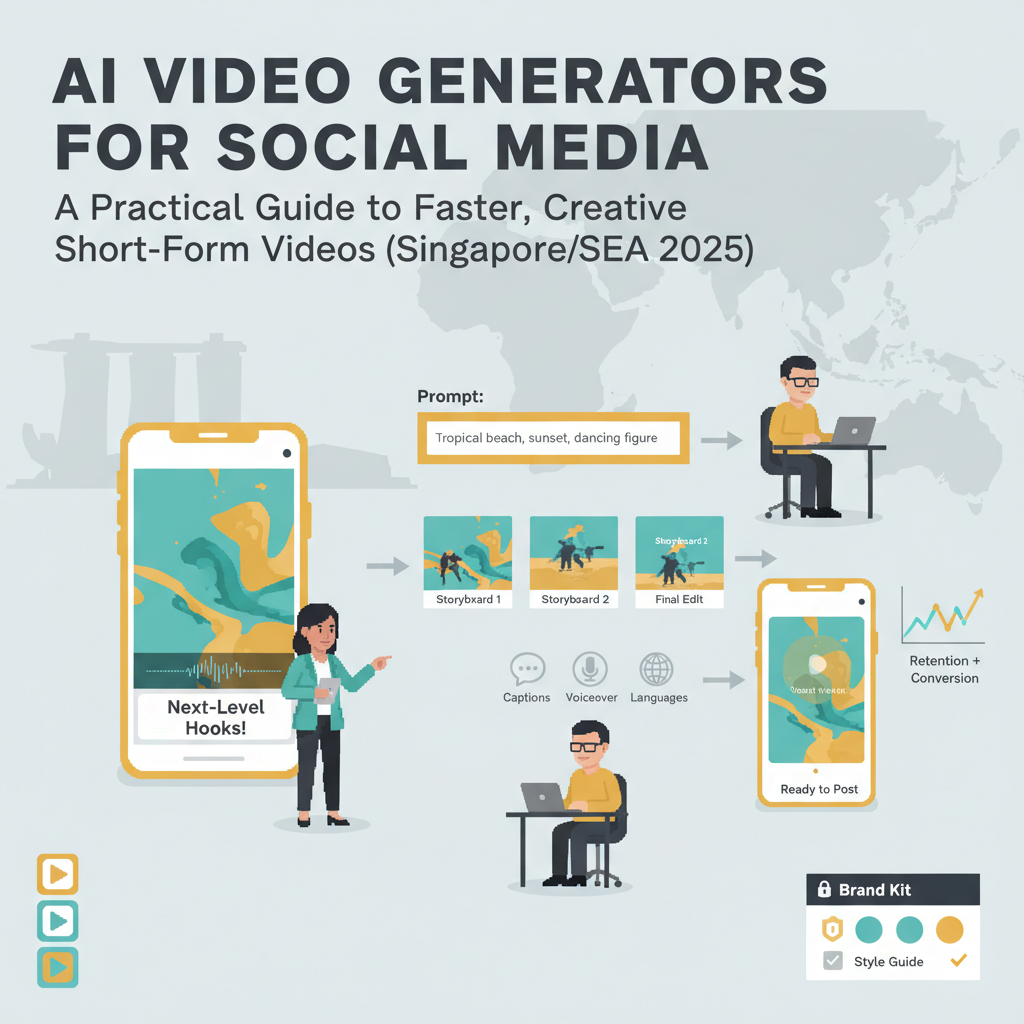
Convert prompts into a compact script, map lines to visuals, and generate captions aligned to narration. Include on-screen text for key points and ensure captions reflect the spoken content.
Batch production and quality control
Build a prompt bank for campaigns; generate several clips in parallel; implement a QA checklist—format, pacing, caption sync, and branding—before publishing.
Using text-to-video AI for personalization at scale
Personalize by region, language, or product variant using templated prompts and dynamic fields; maintain governance to prevent data leakage or misrepresentation.
Quality control checklist
- Framing and aspect ratio aligned to platform
- Hook effectiveness within first 3 seconds
- Clear value proposition and proof visuals
- Caption accuracy and legibility
- Lip-sync alignment (if avatars/VO used)
- Branding consistency across assets
- Localization quality and cultural appropriateness
- Audio balance, licensing, and sound mix
- Proper exports and metadata
Singapore context and regional considerations
Singapore shows strong online and social media engagement with a high propensity for mobile-first video consumption, creating fertile ground for short-form formats (DataReportal: Digital 2025 Singapore). TikTok and YouTube lead for short-form, with Instagram Reels gaining traction as a discovery and engagement channel.
Singapore’s multilingual mix (English, Mandarin, Malay, Tamil) suggests bilingual captions and localized voiceovers when relevant. AI tools with multi-language dubbing and captions can help scale localized campaigns efficiently. For SMEs, lean in-house production supported by targeted external localization often yields strong ROI. Hybrid models—combining in-house production with agency localization—work well in Singapore’s ecosystem; governance and collaboration features are critical to maintain consistency. See our services overview and portfolio for examples.
Playbook idea: A 20–25s vertical video introducing a regional product feature with English audio plus Mandarin and Malay subtitles; CTA to a regional landing page. Steps: single prompt-to-video pipeline; apply Brand Kit; generate translated captions; publish to TikTok and YouTube Shorts simultaneously. Measure view-through rates and CTA clicks by language and platform.
Practical compare: pricing, trials, and rollout
Evaluation framework
Create a lightweight evaluation matrix (1–5 scale) across pricing, trials, core features, integrations, governance, export formats, localization, and support. Weight criteria by your organization’s priorities (e.g., features, governance, and localization are typically high for Singapore/SEA).
Pilot plan (4 weeks)
- Week 0–1: Scope, set up Brand Kit and starter prompts; select 2–3 tools for a side-by-side pilot and a simple localization test.
- Week 2: Run identical prompts across tools; track time-to-first-render, edits required, and caption accuracy.
- Week 3: Governance and localization checks; generate one-language variant and one bilingual variant for comparison.
- Week 4: Evaluate against the matrix with stakeholder feedback and decide next steps.
Procurement and governance
Request DPAs, clarify data residency, confirm licensing rights for generated videos, and align SLAs to IT policies. For governance frameworks, see NIST AI RMF overview and NIST AI RMF (PDF).
Pricing and trials
- InVideo pricing, Synthesia pricing, VEED pricing, Canva pricing.
- For broader comparisons, see AIMultiple: AI video pricing.
Upskill teams on prompt design, localization workflows, and basic editing; assign a Brand Champion to maintain consistency. Our team can help you plan and execute a pilot—explore digital marketing case work and social media portfolio.
Best practices for localization, accessibility, and quality
Captions and subtitles
Captions are essential for accessibility and reach; YouTube and Instagram support subtitles and translations. See YouTube: Add subtitles & captions and YouTube: Translated subtitles. For Instagram performance and measurement, see Instagram Insights.
Sound design and mix
Ensure clear dialogue, balanced audio, and licensing-compliant music. Apply volume normalization and ducking where needed.
Brand consistency
Maintain consistency with a central Brand Kit and templates across languages to reduce rework.
Versioning and A/B testing
Name and track versions for scripts, captions, and assets. Test different hooks, caption lengths, and CTAs by language and platform.
Analytics
Track watch time, retention, completion rate, and CTA clicks. See YouTube Analytics and Instagram Insights.
For hands-on execution support, our digital marketing services and advertising teams can help you operationalise and scale.
Conclusion: Future-proofing your social video strategy with AI
AI video generators are rapidly shifting from experimental tools to core production engines for social video in Singapore and across SEA. The combination of speed, scalability, and localization enables teams to test concepts quickly, publish at scale, and optimize campaigns based on robust data. As platforms evolve and user expectations shift toward more personalized, multilingual content, AI-assisted video production becomes a strategic capability.
Ready to accelerate your AI-driven video program? Talk to Hamilton & Sherwind about a Singapore-ready rollout.
FAQ
What is an AI video generator, and do I still need a creative team?
An AI video generator creates videos from prompts, scripts, or media assets using AI-driven visuals and narration. It can accelerate ideation and production, but many marketers still rely on human editors for copy accuracy, brand voice, and localization nuance.
Which platforms should I optimize for first with AI video?
For Singapore and SEA, start with TikTok, YouTube Shorts, and Instagram Reels, as these are the leading short-form formats. Ensure your exports fit 9:16 vertical aspect ratio for these platforms (see YouTube Shorts specs, TikTok in-feed specs, and Instagram Reels guidance).
How do I measure success when piloting AI video tools?
Use a simple evaluation matrix (pricing, trials, features, governance, localization, analytics) and run a 4-week pilot with 2–3 tools; track time-to-publish, caption accuracy, and engagement metrics by language and platform.
What about localization and language variants?
Use AI to generate translated captions and voiceovers where appropriate, and test regional language variants to determine which combinations perform best on each platform.
How can I ensure brand consistency across teams and markets?
Build and enforce a central Brand Kit with approved logos, colors, fonts, and templates; use collaborative tools with governance features to maintain consistency across in-house and agency teams.
Are captions essential for SEA audiences?
Yes—captions improve accessibility and can boost comprehension and engagement for multilingual audiences in SEA, where many viewers prefer captions in local languages (see YouTube captions and Instagram Insights).
What is the typical ROI when using AI video for social?
Global research shows video generally delivers strong ROI in marketing; AI-enabled short-form video can amplify reach and lift efficiency by enabling rapid testing and scale (Wyzowl: State of Video Marketing 2024).