

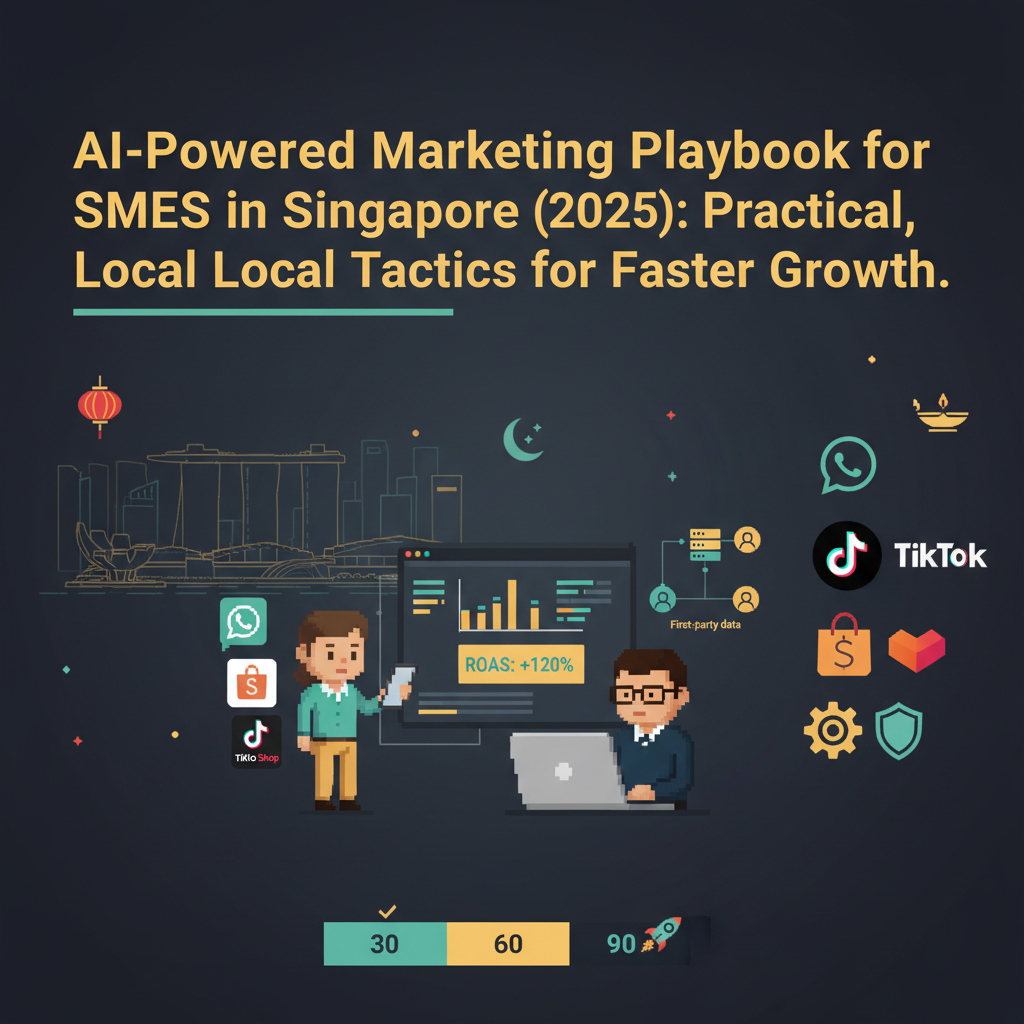
AI-powered marketing playbook for SMEs in Singapore (2025)
Introduction: Why AI marketing matters for Singapore SMEs in 2025
In 2025, AI-powered marketing is no longer a nice-to-have — it’s a performance accelerator for Singapore’s small and medium enterprises (SMEs). With tighter budgets, a crowded digital marketplace, and rising expectations for personalized customer experiences, smart automation and data-driven decision-making are essential to compete at scale. This playbook is designed to give Singapore-based SMEs practical, actionable guidance: templates you can copy, checklists to follow, and a concrete 30–60–90 day plan to start delivering measurable results.
What you’ll get from this playbook
- Ready-to-use templates you can paste into your team workflows (content calendars, prompt libraries, KPI tables).
- Step-by-step checklists for setup, data collection, and campaign execution.
- A practical 30–60–90 day plan that scales from quick wins to governance handoffs.
- Localized examples across Singapore/SEA contexts (TikTok Shop, Shopee, Lazada, WhatsApp Business, Grab, PayNow) and festival season moments to help you connect with local customers.
The SG-specific context: data privacy, vendor landscape, and budget realities
- Data privacy: In Singapore, the PDPA governs personal data practices. For AI-enabled marketing, focus on consent-based data use and transparent disclosures built around first-party data. See the PDPC’s overview of the PDPA.
- Vendor landscape: Most SMEs combine global ad platforms (Google, Meta, TikTok) with automation/CRM and conversational commerce via WhatsApp Business, plus marketplace presence on Lazada and Shopee, and eCommerce through TikTok Shop.
- Budget realities: Singapore grants can reduce adoption costs for eligible projects. Explore the Productivity Solutions Grant (PSG), Enterprise Development Grant (EDG), and IMDA’s SMEs Go Digital programme.
Need a partner to operationalise this? See our digital marketing services and recent portfolio.
Section 1: Strategic foundations for AI marketing in Singapore SMEs
Defining goals, budgets, and success metrics tailored to SG
Start with three core marketing objectives: awareness, consideration, and acquisition. Map each objective to two or three KPI targets with a budget envelope:
- Awareness: Reach, video views, first-party audience growth; bias budget toward short-form video and social.
- Consideration: Engagement rate, time-on-site, pages/session, first-party data capture rate; allocate for retargeting and content personalisation.
- Acquisition: CPA, ROAS, conversion rate from key channels (e.g., WhatsApp conversations to orders, marketplace conversions, direct site purchases).
Favour first-party data and automation with a 3–6 month runway before scaling. For conversational commerce, WhatsApp Business can be high-ROI; for social commerce consider TikTok Shop. For payment convenience, consider PayNow and GrabPay.
Aligning AI investments with core marketing objectives
- Awareness: AI-assisted creative testing and cross-platform distribution to accelerate content velocity and reach.
- Consideration: AI-powered content personalisation and sequencing (e.g., retargeting via WhatsApp or social ads) based on first-party signals.
- Acquisition: Lead capture, journey orchestration, and conversion-rate optimisation with marketplace integration and local payment options.
Governance tip: set brand safety guardrails and review automated outputs for quality and PDPA alignment. Refer to PDPC’s Advisory Guidelines on Key Concepts.
Section 2: Audience, data, and privacy considerations for SG businesses
Building Singapore-centric audience personas and segmentation
Start with 3–4 core personas reflecting SG consumer segments (e.g., urban professionals, family shoppers in heartlands, value-seekers on marketplaces). Build segments around first-party signals: purchase history, site/app interactions, and opt-in preferences.
- Demographic: Age, location, income band (if consented).
- Behavioural: Site/app engagement, channel preference (WhatsApp vs email vs social), marketplace activity (Shopee/Lazada/TikTok Shop).
- Intent: Wishlist activity, cart abandonment, content engagement.
Channel pairings: direct conversations via WhatsApp Business; discovery-to-purchase via TikTok Shop; sustained presence on Shopee and Lazada.
Data privacy, consent, and compliance (high-level)
- Consent: Obtain explicit consent for data collection and explain AI-driven personalisation clearly. See PDPC’s overview of consent and purpose limitation in the PDPA.
- Purpose limitation: Use data only for stated purposes.
- Opt-out: Provide easy paths and honour withdrawals.
- Transparency: Communicate data practices around AI-generated content and recommendations.
Build your AI workflows around first- and zero-party data, implement consent management across web/app/WhatsApp/social, and maintain security and minimal retention periods aligned with business needs. Consult your compliance counsel for legal advice.
Section 3: AI tools, governance, and templates for AI MARKETING SINGAPORE
3.1: AI-powered content calendar templates for AI MARKETING TOOLS SINGAPORE
Purpose: organise creation, posting schedules, and prompts across SG/SEA platforms (TikTok, WhatsApp, Shopee/Lazada, Instagram). Use the template structure below in Google Sheets/Excel.
Date | Platform | Content Type | Topic | Asset Type | Caption/Copy Prompt | CTA | Owner | Status
2025-11-01 | TikTok | Short-form video | Deepavali promo | Video + Caption | "Create a 15s product demo with upbeat music; highlight festival discount." | "Shop now on TikTok Shop" | Creative Team | Not started
Schedule around local festivals (Hari Raya, Chinese New Year, National Day) and marketplace sale events. Build a review step to ensure brand consistency and legal compliance for AI-generated content.
3.2: Automation workflows for campaigns in SG
- WhatsApp lead capture → CRM update → automated nurture sequences with local greetings and festival offers (WhatsApp Business).
- TikTok Shop engagement → product recommendation engine → retargeting with timed coupons and in-app checkout (TikTok Shop).
- Budget-aware optimisation loops: automated bid/budget adjustments with weekly performance reviews.
Establish approval gates for automated content (human-in-the-loop) especially before major events.
Section 4: Measurement, dashboards, and optimization with SG data
Attribution models and KPI dashboards suitable for SMEs
Use a multi-touch attribution view to balance short-term and long-term performance. In GA4, review attribution reports to weight touchpoints across ads, social, marketplaces, WhatsApp and email/push. See GA4 attribution documentation.
- Core dashboard metrics: reach, engagement rate, video completion, CTR.
- Conversion metrics: add-to-cart, checkout completion, CPA, ROAS.
- Channel efficiency: spend by channel, ROAS by channel, CAC by channel.
SG-specific dashboard examples:
- Marketplace (Shopee/Lazada/TikTok Shop): impressions, clicks, conversions, AOV, revenue by marketplace, promo performance.
- WhatsApp funnel: inquiries, qualified leads, conversions, response time, conversion rate.
- Social/video ads: video views, engagement, CTR, ROAS.
Quick-win analytics templates (copy-paste)
Template A: KPI table
Metric | Definition | Target (SG unit) | Data Source
Reach/Impressions | Total views across channels | [target] | Platform dashboards
CTR | Click-through rate | [target]% | Ads dashboards
CPA | Cost per acquisition | [target] | Campaign reports
ROAS | Return on ad spend | [target X:1] | Ads + ecommerce data
Conversion rate | Purchases/visits | [target]% | Site/Merchant data
AOV | Average order value | [target] SGD | Ecommerce data

Template B: Quick-lead funnel snapshot
Stage | Metric | Last 7 days | Last 28 days | Notes
Awareness | Reach | [value] | [value] | Seasonal effect
Consideration | Engagement | [value] | [value] | Creative test
Conversion | Purchases | [value] | [value] | Campaign variant

Template C: Channel health at a glance
Channel | Spend | Impressions | Conversions | ROAS
WhatsApp | [value] | [value] | [value] | [value]
TikTok Shop | [value] | [value] | [value] | [value]
Shopee/Lazada | [value] | [value] | [value] | [value]
Section 5: 30–60–90 day playbook and ready-to-use templates
5.1: 30-day quick wins: setup, data collection, and pilot campaigns
- Week 1: Data inventory (what first-party data is collected, where stored, consent status) and tech stack audit (CRM, email, WhatsApp Business, social ads, marketplace).
- Week 2: Implement consent management and PDPA-aligned disclosures; finalise a simple data-use policy for AI-driven personalisation (see PDPC).
- Week 3: Create baseline dashboards; set up multi-channel tracking (WhatsApp, TikTok Shop, Shopee/Lazada, website).
- Week 4: Pilot a content calendar and an automation flow; run a WhatsApp broadcast, a TikTok Shop product showcase, and a paid social test. Capture initial results and iterate.
Quick wins: capture first-party signals via site and WhatsApp opt-ins; launch a short-form video with a localized offer; implement an automation rule that follows up after brochure downloads or sign-ups.
5.2: 60-day: scale experiments and automation workflows
- Run A/B tests for creative formats, headlines, and CTAs tailored to SG audiences and local festivals.
- Implement two more automation workflows (e.g., abandoned cart nudges, WhatsApp-based order updates with PayNow/GrabPay options).
- Scale content calendar for the next festival period (National Day, Deepavali, Hari Raya, Chinese New Year) aligned to marketplace events.
- Institute weekly AI output reviews with human sign-off for new creatives and claims.
Metrics to watch: CPC/CPM efficiency, higher CTR and conversion rates, and uplift in first-party data capture.
5.3: 90-day: optimization, governance, and handoff to teams
- Formalise AI governance: content guidelines, data-use policies, safety checks, and an audit cadence.
- Build a runbook with approvals, dashboards, and cross-channel operating procedures.
- Enable cross-functional collaboration: align sales/CS on WhatsApp inquiries and loop insights back into content strategy.
- Handoff templates, dashboards, and workflows to the broader team with clear SLAs.
90-day KPI targets: stable ROAS improvements, higher first-party data capture, and smoother cross-channel operations with documented governance.
5.4: Mini case examples (SG SMEs)
- Case 1 — local cafe chain (composite): WhatsApp-based ordering linked to a TikTok Shop promo during Deepavali. AI-assisted daily special posts. In 90 days: 20–30% lift in WhatsApp orders, ~15% reduction in manual setup time, improved retention via weekly personalised sequences. Leveraged PSG-eligible tooling.
- Case 2 — small fashion retailer on marketplaces: AI-driven product recommendations and short-form video ads to drive Shopee/Lazada and TikTok Shop conversions. After three months: higher ROAS, lower CAC through cross-channel retargeting and consistent creative cadence.
- Case 3 — service-based SME: Lead-nurture flow across WhatsApp and email; AI-assisted subject lines and personalised WhatsApp replies increased lead-to-demo conversions and shortened sales cycles. Governance process maintained quality and compliance.
Conclusion: Next steps for Singapore SMEs to start implementing AI marketing
Singapore SMEs can leverage AI-powered marketing now: build a strong strategic foundation and privacy-conscious data practices; design audience-centric campaigns aligned with local channels and festivals; and scale with governance and reusable templates. Combining first-party data, automation, and disciplined experimentation can drive ROAS while preserving trust.
Practical next steps:
- Audit data sources and consent flows; define a PDPA-aligned data-use policy.
- Map three core personas to a multichannel plan using WhatsApp, TikTok Shop, and relevant marketplaces.
- Launch a starter content calendar and a basic automation workflow for capture and nurture.
- Stand up a KPI dashboard tracking reach, engagement, conversions, and ROAS across key channels.
Explore our social media campaigns and portfolio, or browse more insights on our blog.
Contact Hamilton & Sherwind to implement this playbook for your SME.