

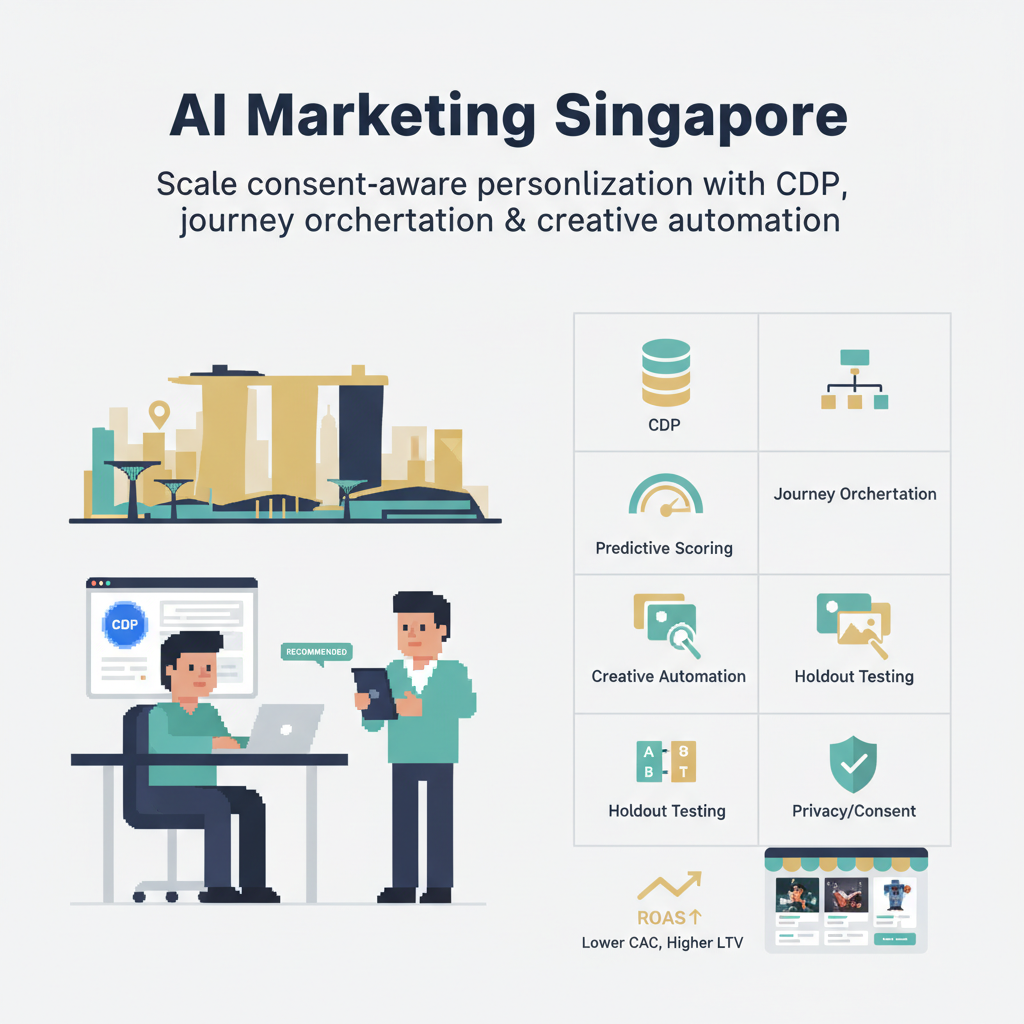
AI marketing Singapore: A practical guide for SMEs and ecommerce
Singapore’s digital economy is compact, fast-moving and intensely competitive — and that makes AI-driven marketing both an immediate opportunity and a practical necessity for many SMEs and ecommerce operators. High internet and smartphone penetration, mature digital payments and logistics, and consumers who expect relevant, fast experiences mean small teams can now deliver personalization and automation at scale without enterprise headcount. At the same time, Singapore’s regulatory environment and customer expectations for privacy require consent-aware design and transparent data use.
In this guide, you’ll learn what AI marketing means for Singaporean SMEs and online merchants, the automation and personalization capabilities that deliver the most value, how to select tools, a phased implementation roadmap, practical measurement guidelines, and realistic case vignettes. For deeper context, see our AI marketing agency Singapore guide or explore our Digital Marketing Services.
Understanding AI marketing in Singapore
AI marketing uses machine learning, predictive models, and automation to improve targeting, tailor content, and optimize delivery across channels (email, ads, web, app, SMS). For a Singapore SME this often means:
- Replacing one-off broadcasts with triggered lifecycle journeys (welcome, cart recovery, re‑engagement).
- Personalizing on-site content and product recommendations in real time.
- Using predictive scores (propensity to buy, churn risk, LTV) to prioritize resources and offers.
- Automating creative variants and media optimization to increase ROAS while reducing manual effort.
Singapore’s digital fundamentals are strong — internet penetration is in the mid‑90% range and mobile/social reach is very high, enabling personalization at scale (Digital 2025 Singapore report). Ecommerce revenue is substantial and growing, with consumers expecting speed and relevance (Statista: e‑commerce in Singapore). For privacy, design consent-aware flows in line with PDPA’s purpose-limitation principles (PDPC PDPA overview).
Automation and personalization: core capabilities
How automation streamlines campaigns
- Email: Triggered sequences (welcome, cart recovery, post-purchase) that scale with segmentation.
- Ads: Automated bidding, audience updates, and dynamic creative that adjust budgets and messaging.
- Social: Scheduled content, automated retargeting audiences, and AI-assisted creative testing.
Example: A fashion D2C deploys cart-abandonment emails with dynamic product recommendations and auto-triggered social retargeting from one CDP audience.
Industry analyses report that advanced AI adopters see stronger revenue growth and ROAS uplifts when programs are measured and governed well. See Think with Google: AI pathways to marketing excellence and Bain on retail personalization. Strategic guidance on scaling personalization is also outlined by McKinsey.
Personalization at scale
- Dynamic content: Pages, emails, and ads adapt to attributes (location, purchases, device).
- Recommendations: Real-time suggestions on PDPs and in emails to increase AOV and conversion.
- Lifecycle messaging: Journeys across acquisition, onboarding, and retention with next-best-offer logic.
AI marketing tools and platforms available in Singapore
Selection criteria
- Data compatibility (web, app, POS, CRM, loyalty, payments) and real-time APIs/streaming.
- Identity & CDP functions (unified profiles, consent flags, activation).
- Localization (EN/CH/MY/TA), currency/tax/regional formatting.
- Integrations (e.g., PayNow/NETS, ecommerce, logistics).
- Local/regional support and implementation partners.
- Governance (consent management, audit logs, certifications).
Capabilities to prioritize
- Customer Data Platform (CDP) for first-party data and consent.
- Journey orchestration for cross-channel sequencing.
- Predictive analytics for propensity, churn, and LTV.
- Campaign/creative automation for dynamic content and testing.
Useful neutral resources: Gartner research, Forrester, and IMDA: SMEs Go Digital.
Implementation roadmap for SMEs and ecommerce in Singapore
Phase 1: Data readiness and governance
- Inventory data flows (web, app, CRM, POS, loyalty, payments).
- Implement consent-first collection and central consent flags (PDPC PDPA overview).
- Start with high-quality core attributes; enforce RBAC, encryption, and audit logs.
Phase 2: Pilot campaigns and quick wins
- Cart-abandonment + recommendations (email + dynamic retargeting).
- Welcome/onboarding flow for new customers.
- On-site personalization for top categories/PDPs.
- Define KPIs (incremental revenue, ROAS, conversion uplift) and use control holdouts.
Phase 3: Scale and cross-channel orchestration
- Expand orchestration across email, push/SMS, ads, onsite.
- Deploy propensity/churn/LTV models with monitoring for drift.
- Use creative automation with brand guardrails and human review.
- Quarterly governance reviews (consent capture, data quality, model performance).
Measuring ROI and benchmarks in Singapore
Core metrics
- ROAS, CAC, and LTV (cohort-based).
- Email engagement, on-site conversion, push/SMS CTR.
- Funnel conversion and AOV/repeat-rate.
Dashboards and governance
- Executive ROI, channel performance, personalization impact, and data governance dashboards.
For market and impact context, see Statista: e‑commerce in Singapore, McKinsey on personalization, Bain: retail personalization, and Think with Google: AI pathways.
Case studies and practical tips
Composite vignettes
Fashion D2C — After CDP + lifecycle automation + on-site recommendations, the brand saw material revenue and ROAS uplifts; similar outcomes are profiled by Think with Google and Bain.
F&B delivery/cloud kitchen — Forecasting + targeted offers + order-status messaging reduced CAC and increased repeat orders; local logistics/payment integration and consent-aware flows mattered.
Beauty ecommerce — Localization plus personalization improved engagement and conversion; cross-language identity resolution was a key challenge.
Tips to avoid pitfalls
- Prioritize clean first-party data and a simple data-quality scorecard.
- Start with core cohorts (new, active, at-risk, high-LTV); avoid over-segmentation.
- Design consent-first personalization and preserve opt-outs.
- Use holdouts to measure incrementality and maintain consistent attribution.
Tool comparison (vendor-neutral)
Customer data platforms (CDPs)
Pros: central identity, real-time audiences, easy activation. Cons: integration complexity; cost scales with data volume.
Journey orchestration engines
Pros: visual flows, cross-channel sequencing. Cons: requires clean event taxonomy; can get complex if data quality is weak.
Predictive analytics and scoring
Pros: next-best-offer and churn prevention. Cons: needs history; models drift without monitoring.
Creative automation
Pros: scales variants and testing. Cons: brand consistency risks if guardrails are weak.
FAQ
What is the minimum data I need to start AI marketing?
Start with first-party purchase history, email, web behavior (pageviews, add-to-cart events), and a consent flag. Those enable basic personalization and lifecycle automation.
How do I remain PDPA-compliant while personalizing?
Design around consent and purpose limitation: collect data for explicit, documented purposes and provide clear opt-outs. Align messaging and retention with PDPC PDPA guidance.
Which channel should I prioritize for quick wins?
Email cart-abandonment flows and on-site recommendations typically deliver fast, measurable uplift for ecommerce.
Do I need a data science team?
Not immediately. Start with out-of-the-box CDP and predictive capabilities; scale to specialist support as models expand.
How should I measure success?
Define KPIs upfront (ROAS, CAC, LTV uplift, conversion, incremental revenue) and use control groups/holdouts.
Conclusion and next steps
- Inventory first-party data and implement consent flags.
- Pilot one lifecycle flow plus on-site recommendations.
- Measure incrementality with a holdout and standardize attribution rules.
- Scale with journey orchestration and predictive scoring under governance.
- Localize content and integrate with SG payments/logistics where it affects CX.
Continue learning with Digital 2025 Singapore, Statista: e‑commerce in Singapore, IMDA: SMEs Go Digital, and our blog.
Contact Hamilton & Sherwind to design your AI marketing roadmap, select tools, and launch pilot campaigns with built-in governance and measurement.
Related internal resources: Digital Marketing Services · Branding Portfolio · AI marketing agency guide