

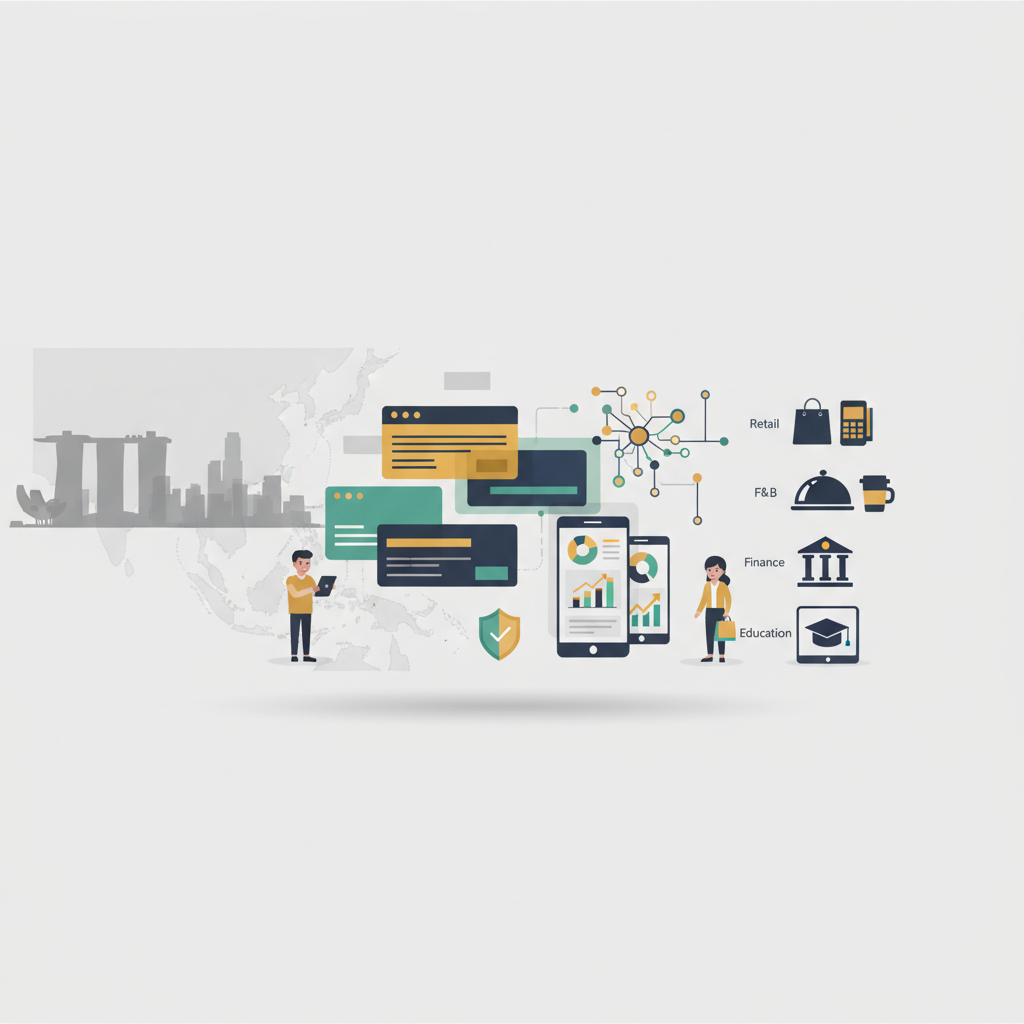
AI Marketing in Singapore: Trends, Tools & Real-World Wins
Introduction -> The New Era of AI Marketing
The marketing landscape in Singapore and Southeast Asia is undergoing a profound transformation. What once seemed like science fictionmachines that write copy, predict customer behaviour, and optimise campaigns in real timeis now operational reality for forward-thinking brands across the region. Artificial intelligence marketing is no longer a future consideration; it’s a competitive necessity.
The numbers tell a compelling story. [source] Singapore’s SME adoption of AI solutions has tripled in just one year, jumping from 4.2% in 2023 to 14.5% in 2024. Large enterprises have moved even faster, reaching 62.5% adoption. Meanwhile, 73.8% of Singapore’s workforce now uses AI tools at work several times a week or daily, with marketing tasksbrainstorming, writing, editing, and administrative automationamong the top use cases. [source]
For marketing leaders in Singapore and across Southeast Asia, this shift presents both an opportunity and an imperative. The brands that master AI marketing tools and techniques will capture market share, reduce costs, and build deeper customer relationships. Those that hesitate risk falling behind competitors who are already deploying predictive analytics, generative content, and hyper-personalisation at scale.
This article explores the current state of AI adoption in the region, practical use cases that drive measurable business results, how to select and integrate the right tools, and the ethical principles that ensure responsible deployment. Whether you’re a CMO at a multinational, a marketing director at a regional SME, or a digital marketing agency evaluating AI capabilities for your clients, this guide will equip you with the knowledge to navigate the AI marketing revolution.
State of AI Adoption in Singapore’s Marketing Landscape
Singapore stands as Southeast Asia’s AI adoption leader, but the region’s growth trajectory is equally noteworthy. Understanding where the market stands today helps contextualise the urgency and opportunity ahead.
The Singapore Advantage
Singapore has emerged as the region’s AI powerhouse. [source] 48% of Singapore companies are already using AI, up from 40% in 2024. More significantly, 17% of Singapore firms have reached the “transformative” stagedeploying multiple customised AI systems to re-engineer operationscompared to 10% or less in other Southeast Asian markets. [source]
Within Singapore, certain sectors lead the charge. Financial services tops the list at 71% AI penetration, followed by technology and software at 70%, and healthcare at 63%. These sectors’ access to large customer datasets and their compliance-driven cultures make them natural early adopters of AI-powered segmentation, predictive scoring, and campaign optimisation. The lessons learned in finance and tech are now cascading into retail, F&B, education, and other verticals.
The government has played a catalytic role. Singapore’s Infocomm Media Development Authority (IMDA) reports that firms deploying AI-enabled solutions under the Productivity Solutions Grant achieve average cost savings of 52%, with cyber-security-related solutions reaching 71% savings. [source] This financial incentive, combined with Singapore’s robust digital infrastructure95% of SMEs have adopted at least one core digital solutioncreates an ecosystem primed for AI adoption.
Southeast Asia’s Uneven but Accelerating Curve
The broader Southeast Asian picture is more fragmented but rapidly evolving. [source] Current AI adoption rates vary significantly:
- Singapore: 48%
- Thailand: 32%
- Indonesia: 28%
- Malaysia: 27% (but fastest growth rate at +35% year-over-year)
- Philippines: 21%
- Vietnam: 18%
Malaysia’s story is particularly instructive. Some 630,000 Malaysian companies adopted AI in 2024 alonemore than one per minute. Yet 73% of these firms remain at the “basic efficiency” stage, using AI primarily for chatbot FAQ handling and automated report generation. Only 10% have reached transformative use. [source] This represents a massive green-field opportunity for B2B marketing vendors and agencies that can provide best-practice roadmaps and implementation support.
The Data Quality Challenge
Across the six major Southeast Asian markets, a consistent barrier emerges: data quality and talent scarcity. [source] IDC research found that 40% of enterprises cite poor or untrusted data as a blocker, 38% cite privacy and compliance constraints, and 41% struggle with scarce specialised talent. For marketers, this insight is actionable. Teams that invest in first-party data pipelines, customer data platforms (CDPs), and data-governance practices position themselves as internal AI champions and unlock the full potential of AI marketing tools.
Core Use Cases & Practical Applications for Local Businesses
AI marketing isn’t abstract. It delivers tangible, measurable results across multiple business functions. Here’s how leading brands in Singapore and Southeast Asia are deploying AI to drive growth.
Hyper-Personalisation & Recommendation Engines
Real-time, AI-driven personalisation is reshaping customer experience. FairPrice Group’s “Smart Cart” pilots in Sengkang and Punggol link shopping trolleys to customers’ app profiles, surfacing aisle-level promotions and recipe ideas based on purchase history. Early trials have cut queue times to near-zero and lifted average basket size. [source]
OCBC Bank’s mobile app uses an AI “daily insights” engine that serves one hyper-personalised financial nudge per customerfor example, “You spent 12% more on dining this month, here’s a 5% cashback card.” The bank makes six million AI decisions daily, contributing to a 20% rise in mobile-sales conversion. [source]
For SMEs, the playbook is straightforward: unify product, promotional, and customer event data into a cloud CDP, then train a lightweight recommender that outputs ranked product IDs directly into your CMS or app banner slot.
AI-Generated Content & Creative Optimisation
Generative AI is revolutionising content production. Singapore-based fashion e-tailer Love, Bonito fed its brand-voice guidelines and historical top-seller copy into a private GPT to produce variant product descriptions in English, Bahasa Indonesia, and Filipino. The result: 60% reduction in time-to-publish and an 11% increase in add-to-cart rate during the 11.11 campaign. [source]
DBS Bank’s in-house “AdGen” tool combines past creative performance, customer-segment affinities, and an AI image model to auto-compose banner variants for credit-card campaigns. Multivariate testing across Meta and Google drove a 17% lower cost-per-acquisition in 2025. [source]
Regional F&B chain Sushi Tei now uses AI avatar technology to localise TikTok menu explainers into Thai and Vietnamese within 24 hours, versus the previous 10-day agency turnaround. [source]
Customer Segmentation & Predictive CLV
Unsupervised clustering and supervised propensity models identify high-value cohorts and predict churn or purchase likelihood. KFC Malaysia plugged POS and delivery-app data into AWS SageMaker to score diners on next-visit propensity. The “Hot & Cheezy” push coupon now targets only segments with >0.65 purchase probability, halving promo cost while maintaining stable redemptions. [source]
Shopee’s “Premium” tab selection uses a Gradient-Boost model that filters users whose gross product value, return rate, and category affinity mirror luxury shoppers. Personalised emails to that segment yield 2.1open-rate relative to the generic newsletter. [source]
For SMEs, start with RFM (recency-frequency-monetary) clustering in BigQuery ML. Graduate to gradient-boosted churn-propensity models once you have six months of labelled data.
Demand Forecasting & Dynamic Pricing
Indonesian coffee chain Kopi Kenangan forecasts cup-level demand per store using an LSTM time-series model that ingests weather and nearby-event feeds. Marketing now time-locks two-for-one vouchers only on low-traffic mornings, trimming waste milk by 8% and boosting voucher ROI. [source]
Airline Scoot uses reinforcement-learning-driven pricing to tweak flash-sale seat buckets every 15 minutes, messaging updated fares via in-app banners. Revenue per available seat kilometre rose 5% year-over-year. [source]
Conversational AI & Chatbots
Intent-recognition plus large language model layers provide 24/7 self-service support, product discovery, and lead capture. NTU’s “Leodar” chatbot, launched in January 2024, answers course and admin questions. It has handled 12,000 queries, cutting tutor emails from several a day to a handful a week. [source] NUS will follow with AI-Know for students in 2025.
Chatfood’s AI ordering assistant, deployed at OverEasy and Potato Head Singapore, lets diners reorder via Instagram DM. Restaurants report 14% higher average order value versus phone orders. [source]
Email & Journey Automation
Luxury e-commerce site Reebonz AutoPilot (Klaviyo + OpenAI) drafts subject lines predicted to maximise open rate per segment. A/B testing shows a 6-point lift. [source] Thailand’s Central Retail Group pipes segment propensity scores into Salesforce Marketing Cloud’s Einstein Send Time Optimisation, netting a 12% gain in click-throughs and 18% uplift in revenue per email. [source]
Voice of Customer & Social Listening
Singapore Airlines deploys an AI model that clusters social posts into 25 intent themes. Insights on “missed connections” grievances fed a remarketing campaign that recouped S$1.4 million in upsell revenue within one quarter. [source]
Indonesian EdTech giant Ruangguru analyses millions of student-session transcripts with BERT-based sentiment tagging. Marketing uses the top frustration motifs to script parental-facing reassurance ads, cutting acquisition CPA by 9%. [source]
Selecting & Integrating AI Marketing Tools
The vendor landscape for AI marketing tools has exploded. For Singapore and Southeast Asian SMEs, the challenge isn’t finding optionsit’s choosing wisely.
Evaluation Checklist & Budgeting for Singapore SMEs
Before committing budget, work through this evaluation framework:
Business Fit
- Define your core use case first (lead capture, e-commerce repeat sales, omni-channel loyalty).
- Attach a measurable outcome (open-rate, conversion-lift, cost-per-lead, staff hours saved).
Feature Depth vs. Ease of Use
- No-code UI, pre-built playbooks, and drag-and-drop journeys matter more than advanced modelling for most SMEs with lean teams.
Data & Compliance
- Ensure the tool supports Singapore PDPA and Malaysia PDPA requirements.
- If storing NRIC, banking, or health data, verify Singapore-hosted data centre options.
- Check for IMDA AI Verify certification or similar transparency standards. [source]
Integration Footprint
- Native connectors for Shopify, WooCommerce, Lazada/Shopee, Netsuite, Xero, GrabPay, Meta Ads, Google Ads, LINE, and WhatsApp Business are essential.
- API, webhooks, and Zapier/Workato/IFTTT support for when native connectors aren’t available.
Pricing Transparency & Total Cost of Ownership
- Subscription fee + metered usage (contacts, emails, API calls, AI-credits) + optional onboarding/consultancy.
- Watch for hidden costs: dedicated IP for email, extra seats, overage charges, and implementation partner fees.
Local Support & Community
- SEA time-zone customer success, WhatsApp/LINE ticketing, and self-service knowledge bases in English, Bahasa, Thai, and Vietnamese.
Vendor Viability
- At least Series A funding or multi-year profitability; public roadmap for AI features.
The 2025 Vendor Landscape
Customer-Data Platforms & Journey Orchestration
Antsomi CDP 365 is Singapore/Malaysia-based, starting at SGD 1,200/month for 100,000 profiles with built-in PDPA modules. [source] Insider, a Turkey-born platform with SEA HQ in Singapore, bundles CDP, AI recommendations, and on-site personalisation at approximately USD 2,000/month (negotiated). [source] MoEngage offers strong mobile push capabilities with an INR-denominated SMB plan around USD 999/month for 25,000 monthly active users. [source] Segment Twilio Starter provides a plug-and-play option at USD 120/month for 10,000 visitors, integrating with GA4, Shopify, and HubSpot. [source]
Marketing Automation & Email/SMS/WhatsApp
HubSpot Marketing Hub Starter offers localised Singapore pricing at SGD 30/month, scaling to SGD 75/month at 1,000 contacts, with AI subject-line and blog-draft tools included. [source] ActiveCampaign ranges from USD 49149/month with integrated WhatsApp in SEA via 360Dialog. Brevo (formerly Sendinblue) starts at EUR 25/month for 20,000 emails with pay-as-you-go SMS and WhatsApp templates. CleverTap offers 50,000 MAU free for 12 months, popular with Indonesian and Vietnamese app-first SMEs. Exabytes LEMON, a Malaysia-based bundle of email, SMS, and chat, starts at MYR 199/month. [source]
Generative Content & Creative Tools
Hypotenuse AI, Singapore-based, offers SGD 24/month for 25,000 words of e-commerce product copy and Instagram captions in multiple languages including Indonesian and Thai. Canva Pro “Magic Write” costs SGD 17+ per seat per month with Bahasa and Thai font support. Jasper + SurferSEO bundle at USD 89/month includes built-in Tone Profiles popular with SEA customers. Adobe Firefly for Teams starts at SGD 25/month per user for unlimited image generations, integrating directly with Express and Photoshop Web. [source]
Chatbots & Conversational Commerce
AiChat, Singapore-based and IMDA PSG-approved, supports Facebook, WhatsApp, LINE, and website at SGD 400/month plus SGD 5,000 one-time setup (up to 50% grant eligible). [source] Yellow.ai’s “Growth” cloud plan costs USD 99/month plus usage, with LLM engine support for 120+ languages including Bahasa Indonesia and Thai. SleekFlow, Hong Kong-origin with a Singapore office, offers omnichannel inbox plus AI reply suggestions with freemium up to 100 chats/day. [source]
Analytics & Decision Intelligence
Google Analytics 4 with Machine-Learning Insights is free and includes e-commerce funnel AI anomaly alerts. Mixpanel Starter is free to 20,000 monthly tracked users with event auto-correlations recommended for app SMEs. Appier AIQUA & AIXON, a Taiwanese vendor with strong SEA presence, offers predictive churn/scoring fed into Line and Email at USD 214,000/month for mid-market packages. Nugit, Singapore-based, provides AI narrative-generation for multi-channel dashboards from SGD 700/month, popular with boutique agencies managing multiple SME clients. [source]
Indicative Starter Stack Costs
Micro business (fewer than 20 staff, e-commerce): Brevo (S$35) + Hypotenuse (S$24) + GA4 (free) + ChatGPT Plus (S$30) S$90100/month.
Growth SME (20100 staff, omni-channel): MoEngage Growth plan (S$1,400) + Canva Team (S$80) + AiChat (after PSG, ~S$300) + Mixpanel Starter (free) S$1.82.0k/month plus S$510k one-time integration.
Rule of thumb: Allocate 710% of annual marketing expenditure to martech, of which 1525% can justifiably be “AI-specific” (generative AI licences, predictive modules, GPT API calls). [source]
Integration & Grant Considerations
Use Zapier (USD 29/month) or Make.com (USD 9/month) for quick wins like Shopify-to-Brevo abandoned-cart emails. Graduating SMEs should consider Workato Business plan (SGD 3,000/year) or Singapore-grown Automate.io for deeper ERP, POS, and accounting sync. [source]
Singapore’s IMDA SMEs Go Digital programme offers 50% PSG subsidy for approved martech, chatbot, and CRM vendors including AiChat, Antsomi CDP 365, and SleekFlow. Malaysia’s MDEC Smart Automation Grant and Thailand’s DEPA Digital Transformation Fund mirror these incentives, up to 1 million THB per project. [source]
To connect AI initiatives with broader digital programmes and expert support, Singapore businesses can also work with integrated partners who provide strategy, implementation and creative execution, such as full-service digital marketing services in Singapore pair data-driven campaigns with creative storytelling, making it easier to operationalise AI-driven insights.
Data, Privacy & Ethical Considerations
Deploying AI marketing responsibly isn’t optional—it’s foundational to sustainable growth and customer trust.
High-Level Principles of Responsible AI Marketing
Consent & Choice
Use granular checkboxes for email, WhatsApp, and push notifications. Surface these options again during re-engagement campaigns. Customers should always have an easy path to opt out of AI-driven personalisation.
Transparency & Explainability
In your privacy notice, add a dedicated “How we use AI” section that explains data sources, decision types, and human review processes. If an AI system makes a material decision affecting a customer—such as a credit-card limit or loan offer—you should be able to explain the key factors in plain language.
Data Minimisation & Purpose Limitation
Store only signals that improve your models. Purge raw clickstream data after aggregation (for example, after 90 days). This reduces privacy risk and simplifies compliance.
Fairness & Bias Mitigation
Test models across gender, age, and language segments. Set KPI alerts for disproportionate offer allocation. If your recommendation engine favours certain customer groups, investigate and correct the bias.
Accountability & Human Oversight
Assign a “model owner” in marketing operations. Schedule quarterly model audits with your data team. Maintain a staffed mailbox for customer appeals and complaints—this is both a best practice and a regulatory expectation in Singapore and Malaysia. [source]
Measuring Impact -> – Metrics, KPIs & Continuous Optimisation
Effective measurement ensures your AI marketing investments deliver ROI and remain trustworthy.
Up-Funnel Metrics (Awareness & Engagement)
- Predicted Reach Lift % (AI model vs. rule-based audiences)
- Cost per Thousand AI-Qualified Impressions (CPM_Q)
- Ad Creative Iteration Cycle Time (hours)a key generative AI efficiency metric
Mid-Funnel Metrics (Consideration & Acquisition)
- AI-Propensity Score Accuracy (AUC-ROC)
- Conversion Rate Uplift vs. Control (absolute and relative %)
- Customer Acquisition Cost (CAC) after AI vs. business-as-usual
Loyalty & Lifetime Value Metrics
- Incremental Revenue per User (iRPU) attributable to AI recommendations
- Churn-Risk Model Precision at top 20%
- Average Basket Lift from AI cross-sell (%)
Operational & Governance Metrics
- Explainability Coverage (% of models with auto-generated readable reports)
- Data-Minimisation Ratio (features used / features collected)
- % of Decisions with Human-Override Path
Continuous Optimisation Framework
Weekly: Retrain or fine-tune models using the most recent labelled data. Update your feature store only after privacy review.
Monthly: Run a creative-exploration sprint. Feed highest-performing generative AI creatives back into your prompt library.
Quarterly: Conduct an ‘offline’ A/B test of a challenger algorithm. Freeze other variables to isolate the model effect. Conduct a fairness audit across demographic segments.
Always-on: Apply automatic decay weighting to older training data to minimise concept drift, especially critical in fast-moving retail and F&B sectors.
For SMEs, start with metrics you already track (open rate, CPA) and bolt on AI-specific deltas. Use GA4’s built-in “predicted revenue” for e-commerce as your first AI baseline before investing in bespoke models. Keep measurement budget to approximately 10% of campaign spend. [source]
Case Studies – Local-Style Scenarios of Brands Leveraging AI for Growth
While we cannot disclose specific client results, these composite scenarios illustrate how AI marketing drives real business outcomes in Singapore and Southeast Asia.
Scenario 1: Regional Retail Chain – Personalisation at Scale
A mid-sized fashion retailer with 15 physical stores and a growing e-commerce presence faced a classic challenge: inventory was spread across channels, and marketing messages were generic. The team implemented a CDP that unified online browsing, in-store purchase, and loyalty-app data. They then deployed a recommendation engine that surfaced the next best product for each customer across email, SMS, and in-store digital signage.
Within three months, email open rates climbed 18%, and average order value increased 12%. The in-store digital signage, powered by the same recommendation engine, lifted basket size by 8%. The retailer also reduced inventory holding costs by 6% because the AI system prioritised promoting slower-moving stock to relevant segments. Total ROI on the CDP and recommendation platform was achieved within 14 months.
To achieve similar outcomes, many retailers partner with integrated branding and creative strategy specialists who can translate model outputs into on-brand experiences across visuals, messaging, and store environments.
Scenario 2: Financial Services – Predictive Offer Personalisation
A regional bank wanted to deepen wallet share among existing customers. They built a propensity model that scored each customer on likelihood to adopt a new product (credit card, investment account, insurance). The model ingested transaction history, demographic data, and engagement signals. Marketing then deployed targeted campaigns with AI-generated copy tailored to each segment’s primary pain point.
The AI-generated subject lines outperformed control by 9% in open rate. Conversion rates on the offer page improved 14% because the copy addressed segment-specific objections. Within six months, the bank had acquired 23,000 new product customers, with a CAC 22% lower than previous campaigns. The model also identified a high-churn segment, enabling a retention campaign that saved the bank an estimated S$2.1 million in annual revenue.
Because of the highly regulated nature of financial services, this bank worked closely with both internal compliance and external partners similar to full-service marketing and advertising agencies to align AI-driven messaging with brand and governance standards.
Scenario 3: F&B Chain – Demand-Driven Promotions
A quick-service restaurant chain with 40 outlets struggled with food waste and inconsistent traffic patterns. They deployed a demand-forecasting model that ingested historical sales, weather, local events, and day-of-week patterns. The model predicted demand for each menu item at each location, enabling marketing to time promotions strategically.
On low-traffic mornings, the system automatically triggered a “breakfast bundle” promotion via the app. On high-traffic evenings, it suppressed discounts and instead promoted premium items. Food waste dropped 11%, and promotional spend efficiency improved 19%. The chain also used the demand forecast to optimise staffing, reducing labour costs by 7%.
To bring these offers to life across channelssocial media, in-store displays, and campaign videosthe chain also leaned on creative partners for social media marketing solutions and video production, ensuring each AI-driven promotion felt compelling and on-brand.
Scenario 4: EdTech Platform – Content Personalisation & Retention
An online education platform with 200,000 active learners faced high churn in the first 30 days. They deployed an AI system that analysed learner behaviour (video completion rate, quiz performance, time-of-day engagement) to predict churn risk. For high-risk learners, the platform triggered personalised email sequences with encouragement, study tips, and peer success stories.
The churn-prevention campaign reduced 30-day churn by 16%. The platform also used AI to personalise course recommendations based on learner performance and career goals, increasing course completion rates by 12% and lifetime value by 18%. The EdTech platform recovered its AI investment within eight months.
Key Takeaways for Future-Ready Marketers
The AI marketing revolution in Singapore and Southeast Asia is not comingit’s here. The brands and agencies that move decisively will capture disproportionate value. Here are the key takeaways:
1. Start with data foundations. Clean, first-party data is the prerequisite for trustworthy AI. Invest in a CDP or data-clean-room before deploying predictive models or generative tools.
2. Pick one measurable friction point. Don’t try to transform everything at once. Identify one customer journey friction (abandoned carts, low email open rates, high churn) and pilot a low-code AI add-on. Measure the incremental lift rigorously.
3. Embed human oversight. AI is a tool, not a replacement for human judgment. Build human-review loops into your workflows, especially for generative content and high-stakes decisions like credit offers.
4. Upskill your team. The region’s biggest adoption barrier is talent. Invest in training your marketing team in prompt engineering, data storytelling, and model monitoring. These skills will define competitive advantage in 2025 and beyond. [source]
5. Measure and optimise continuously. Define clear KPIs before launch. Track incremental ROI vs. business-as-usual. Use local benchmarks (the case studies and statistics in this article) as target ranges. Iterate weekly and monthly.
6. Prioritise ethical AI. Consent, transparency, data minimisation, fairness, and accountability aren’t compliance checkboxes—they’re the foundation of customer trust and long-term brand value. Build them into your AI strategy from day one.
7. Leverage government incentives. Singapore’s IMDA PSG, Malaysia’s SAG, and Thailand’s DEPA fund can subsidise 50170% of AI marketing tool implementation. Use these grants to accelerate adoption and reduce financial risk. [source]
8. Partner with experts when needed. Whether you’re evaluating AI marketing tools, building a CDP, or designing a predictive model, the right partner can compress your learning curve and de-risk implementation. Agencies and consultants with regional expertise and proven track records can be invaluable.
For organisations that want to integrate AI into broader brand-building, creative and media plans, partnering with a full-service digital marketing and creative agency in Singapore ensures AI capabilities are anchored in clear strategy, strong storytelling, and robust execution across channels.
Ready to Transform Your Marketing with AI?
The insights and frameworks in this article provide a roadmap, but implementation requires expertise, strategy, and ongoing optimisation. If you’re ready to move from exploration to executionwhether that’s selecting the right AI marketing tools, building a first-party data strategy, or launching your first AI-driven campaignwe’re here to help.
At Hamilton & Sherwind, we work with marketing leaders across Singapore and Southeast Asia to design and deploy AI marketing solutions that drive measurable business results. From strategy and tool selection to implementation and continuous optimisation, we combine regional market expertise with deep technical knowledge to ensure your AI marketing investments deliver ROI.
Let’s talk about your AI marketing opportunity. Contact us to schedule a consultation with our team. We’ll assess your current state, identify high-impact use cases, and outline a roadmap tailored to your business, budget, and timeline.